
Google “keratin treatment Singapore” and you’ll find conflicting advice everywhere. One site says it’s totally safe; another warns about chemical fumes. Someone claims you can color right after; another says wait a month. People with straight hair wonder if it’s worth it. People with fine hair worry it’ll flatten them. So what’s actually true?
This guide cuts through the noise and answers the real questions people ask before booking a keratin treatment—the ones that actually matter for deciding if it’s right for you.
FAQ #1: Will Keratin Treatment Damage My Hair?
Short answer: No. In fact, it repairs.
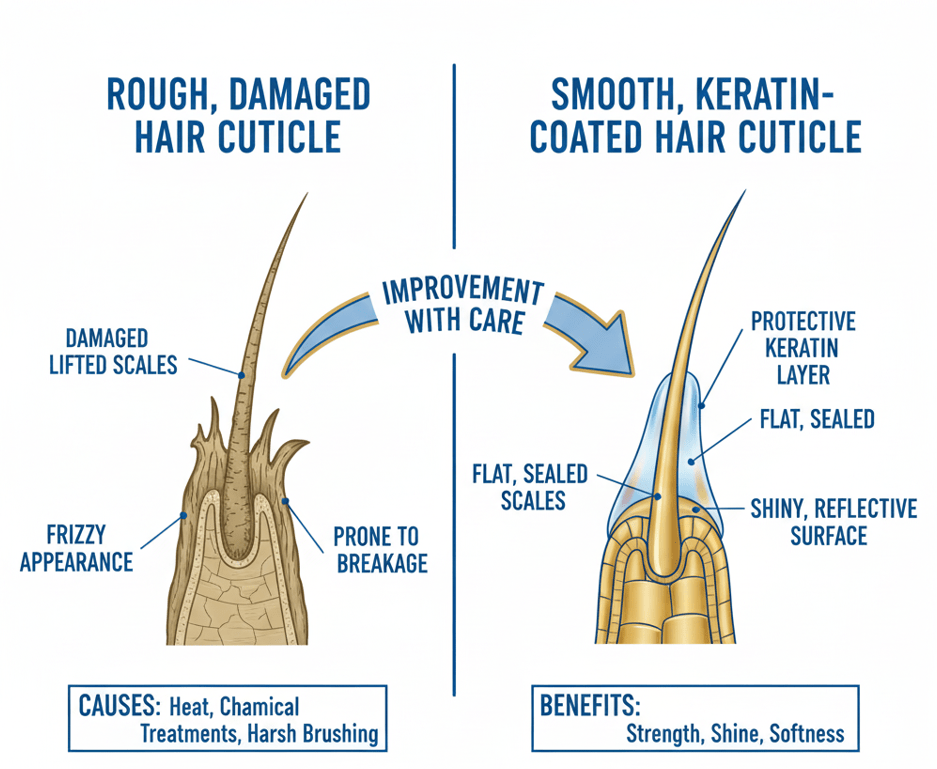
People confuse keratin with rebonding (permanent hair straightening), which does damage your hair by breaking and reforming its chemical bonds. Keratin doesn’t do that. It’s more like wrapping your hair in protective armor rather than chemically restructuring it.
Why damaged hair actually benefits most: If your hair is bleached, color-treated, or heat-damaged, keratin seals up all those compromised areas. It locks in moisture and smooths down the rough, raised cuticles that make damaged hair look dull and feel fragile. Post-keratin, that same hair looks shinier, feels softer, and is actually stronger.
One exception: If your hair is severely damaged (lots of breakage, straw-like texture), you might want to do a restorative treatment first to stabilize it. Some salons will even recommend this before applying keratin. But the keratin itself? It heals, not harms.
FAQ #2: Can I Color My Hair After a Keratin Treatment?
Short answer: Wait at least 2 weeks.
Here’s the issue: The keratin coating you just paid for needs time to fully lock into your hair structure. Hair dye contains chemicals that can weaken this new coating, potentially shortening your results by weeks. Additionally, the fresh keratin layer may create a barrier that prevents color molecules from absorbing evenly, leading to patchy or inconsistent color.
The smarter sequence: Get your color done before booking keratin. The treatment then acts as a sealant, locking in your color and keeping it vibrant longer—basically a free bonus. If you’re already keratin-treated and need color urgently, the minimum safe wait is 2 weeks. Tell your stylist about the recent treatment so they can use techniques (like lower processing times or gentle formulations) to minimize damage to your keratin coating.
FAQ #3: Does Keratin Treatment Work on Curly or Coily Hair?
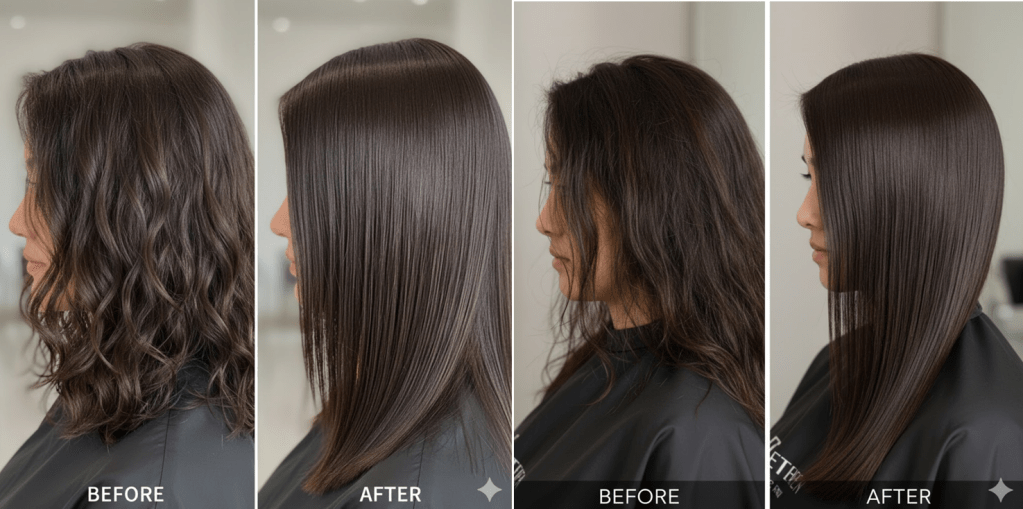
Short answer: Yes, but the results depend on how curly you are.
Keratin works on all hair types. Period. But the visual result depends on your starting point.
What happens to different curl types:
Wavy hair: Goes from wavy to straighter waves, more manageable, way less frizz. You retain some wave pattern but it’s sleeker and easier to style. People love this for beach waves that are smooth instead of frizzy.
Curly hair: Gets noticeably smoother and more elongated, but the curls don’t disappear. Your curl pattern relaxes and falls softer. Think of it as “calmer curls” instead of “straight hair.” Still curly, just more defined and less chaotic.
Tightly coiled/textured hair: Gets smoother and slightly more elongated, but the coil pattern stays. You’re trading “tightly wound and dry” for “smoother and moisturized.” Still textured, just healthier-looking.
Key difference from Japanese straightening: If you have tight curls and want actual straightness, Japanese hair straightening is what you need. Keratin relaxes and tames; it doesn’t permanently straighten tight coils. It’s still amazing for manageability and shine, just not the same result.
FAQ #4: How Often Can I Get Keratin Treatments?
Short answer: Space them 3-4 months apart. Your hair will thank you.
People sometimes think “if one treatment is good, two is better” — wrong. Blasting your hair with keratin too frequently doesn’t accelerate results; it just damages your hair unnecessarily. Think of it like getting a massage—daily massages don’t heal you faster; they just exhaust your muscles.
Here’s what actually happens: The keratin coating naturally sheds as your hair grows and you wash it. New treatments before the old coating fully sheds can create buildup and weaken your hair structure.
For express/smoothing treatments: These lightweight versions can be done every 4-6 weeks to extend your look between full treatments without overdoing it.
How to know you’re ready: Stop counting months. Instead, pay attention to your hair. When you start reaching for the flat iron again and notice frizz returning, that’s your sign—usually month 3-4 for most people in Singapore’s climate.
FAQ #5: Does Keratin Treatment Work in Singapore’s Humidity?
Short answer: Yes, absolutely—but it won’t last as long as it would in Arizona.
Let’s address the elephant in the room: Singapore’s humidity is keratin’s kryptonite. At 80%+ humidity year-round, moisture in the air attacks that protective keratin coating, slowly wearing it away faster than in drier climates.
The realistic timeline: In dry places (California, parts of Australia), people brag about 6-month keratin results. In Singapore? More like 3-4 months of really noticeable smoothness, then a gradual fade. By month 5, you’ll start reaching for the frizz serum again.
Why you should still get it: Even at 3-4 months, you’re getting solid results. That’s still way better than dealing with constant humidity frizz. And if you’re comparing keratin to rebonding (which also fades in humidity), keratin is actually less damaging and easier to redo.
Bonus tip: Formaldehyde-free treatments tend to be slightly less humidity-resistant than traditional Brazilian Blowout, so they might fade marginally faster. If you’re climate-sensitive, factor that in when choosing between treatment types.
The smart timing hack: Get treated during the dry season (Nov-March) when Singapore humidity drops a tiny bit. You might squeeze out month 5 results instead of month 4.
FAQ #6: What’s the Yearly Cost of Maintaining Keratin Treatment?
Short answer: Plan for $900-$1,500 annually if you want strong results year-round.
Let’s break down realistic scenarios for Singapore:
Minimal maintenance: 3 full treatments × $300 = $900/year
- Works if you’re comfortable with noticeable fading by month 4-5
Serious maintenance: 2 full treatments ($300) + 4 express touch-ups ($200) = $1,400/year
- Keeps your hair consistently smooth with minimal frizz
Premium upkeep: 3 full treatments × $450 = $1,350/year
- Using higher-end salons for best results
Add-on expenses: Sulfate-free shampoo/conditioner ($30-50/month) = $360-600/year
- Optional but strongly recommended to protect your investment
Real talk: Yes, $1,200-1,500 seems like a lot. But consider this—if you’re currently spending 25 minutes daily on hair styling and keratin cuts that to 5 minutes, you’re saving ~20 minutes × 365 days = 7,300 minutes (120+ hours) yearly. At minimum wage value, that’s worth it for many people.
FAQ #7: Will Keratin Treatment Affect My Hair Texture or Natural Wave?
Short answer: It temporarily changes your texture, but only while the coating is active. Your natural pattern bounces back completely.
Here’s the worry: “If I get keratin, will my waves disappear forever?” Nope. It’s not a permanent chemical restructuring like rebonding. Think of it as a temporary varnish, not a new coat of paint.
What happens: The keratin coating smooths and relaxes your natural wave/curl while it’s on your hair. So a wavy person might get sleek waves. A curly person might get their curls soften and elongate. But it’s the coating doing the work, not changing your hair itself.
When the coating sheds (3-6 months): Your original texture comes back exactly as it was. Completely. No permanent changes. If you had tight coils before keratin, you’ll have tight coils after the treatment wears off.
Why this matters: You can try keratin without commitment. If you hate looking straighter or whatever, just wait it out. Your hair reverts. It’s reversible, which is why a lot of people love it—low-risk transformation.
FAQ #8: Is Keratin Treatment Worth It for Fine or Thin Hair?
Short answer: Yes, and fine-haired people often see the most dramatic before-and-after.
The myth: “Keratin will flatten my fine hair and make it look like straw.” Wrong.
Here’s what actually happens: Fine hair is basically thin strands with a rough, raised surface. That roughness catches light unevenly and looks dull and limp. Keratin smooths that surface, making the same thin hair suddenly look shiny, healthy, and thicker.
What fine-haired people experience:
- Hair looks noticeably fuller (the smoothness creates visual volume)
- Styling is easier because hair doesn’t fall flat
- You can use body-building products without looking weighed down
- One keratin treatment transforms “limp” to “glossy”
The technical part: Keratin fills microscopic gaps in your hair shaft without adding bulk. For fine hair, this is perfect—you get structural support without the weight that would normally flatten fine strands.
The only real risk: A bad stylist applying too much product. Go to a salon experienced with fine hair and specify you want a light touch. A good stylist will nail it.
FAQ #9: Is Keratin Treatment Right for Me if I Have Naturally Straight Hair?
Short answer: If you care about shine and humidity frizz—yes. If you have perfect straight hair already—maybe not.
People with naturally straight hair sometimes dismiss keratin as “not for them.” But here’s what they’re actually missing:
What keratin actually does for straight hair:
- Locks in incredible shine (your hair becomes a mirror)
- Eliminates the tiny frizz halo that forms in Singapore’s humidity
- Makes hair feel like silk, not just look smooth
- Reduces daily styling time by 20-30% (less frizz management)
- Protects color-treated straight hair and makes it last longer
What you won’t experience: That dramatic straightening transformation. Your already-straight hair stays straight. That’s not a downside; it just means the benefits are subtle but real.
Honest answer: Is it worth $300-400 for someone with already-straight hair? It depends. If humidity frizz bothers you, yes. If you’re already happy and have zero frizz issues, maybe invest in a good shampoo instead. If you spend 15+ minutes daily on styling and blow-drying, keratin saves time and damage. That’s the real value for you.
FAQ #10: Who Should NOT Get a Keratin Treatment?
Short answer: People unwilling to do aftercare, those with severe existing damage, and anyone expecting permanent results.
Let’s be real: keratin isn’t a magic bullet. Here’s when you should probably pass:
Skip it if:
Your hair is already falling apart – If strands snap when you brush, your hair looks straw-like, or you can see individual damaged sections, you need restoration first, not coating. Get 2-3 months of deep conditioning before trying keratin.
You’re experiencing hair loss – Keratin smooths what you have but won’t regrow hair or stop shedding. If hair loss is your main issue, see a dermatologist, not a salon.
You need permanent straightening – Keratin is temporary (lasts 3-6 months max). If you want permanent results that never fade, you need Japanese straightening or rebonding instead. Keratin will frustrate you.
You won’t commit to aftercare – Real talk: if you refuse to use sulfate-free shampoo or you wash your hair daily regardless, your $300 investment will fade to nearly nothing in 4 weeks. You’ll be angry at the salon. Skip it.
Money is tight – $300-400+ is real money. If it would stress your budget, wait. It’s a luxury, not a necessity. There’s no judgment in that.
You have scalp issues – Active dermatitis, severe sensitivity, or open sores on your scalp? Check with a dermatologist first. Keratin involves heat near your scalp and chemicals.
You’re just testing it casually – If you’re mildly curious but not committed, try an express treatment ($150-250) first instead of dropping $400 on a full keratin.
Signs it’s a good fit: Frizzy/curly/wavy hair, humid climate frustration, daily heat styling, willingness to use sulfate-free products, budget available without stress.
Ready for Your Keratin Treatment?
You’ve got the answers now. If you’re still on the fence about whether keratin is right for you, think about these questions:
- Do you spend 15+ minutes daily styling your hair?
- Is humidity your biggest hair enemy?
- Are you willing to use sulfate-free shampoo for 3-4 months?
- Does your budget allow for $300-$400 upfront investment?
If yes to most of these, keratin is probably worth it. Pick a salon from our main keratin guide, ask them about formaldehyde-free options, and book your consultation.
This guide is brought to you by Glamingo—Singapore’s AI-powered beauty and wellness marketplace. Soon, you’ll be able to discover, compare, and book featured salons directly through Glamingo. Stay tuned.
 Glamingo Blog
Drop in your comments..