
You’ve stood in the drugstore aisle, box dye in hand, wondering whether the gap between an $8 box and a $200 salon visit is just markup — or whether something genuinely different is happening to your hair. One observation that circulates among people who’ve gone deep on this topic cuts straight to it: “It’s not about box dye versus salon dye. It’s about whether your hair is filled properly.” That distinction isn’t marketing. It’s structural chemistry — and once you understand what hair dye is actually doing inside your strand, you’ll never look at a box the same way again.
Most of us approach hair colour as an aesthetic decision. Pick a shade, apply it, done. But hair colour is a chemical process first and a beauty outcome second. The shade you see in the mirror is the downstream result of a series of reactions happening inside a structure you can’t see — and those reactions are shaped as much by how colour is applied as by what’s in the bottle. That’s the gap this article is here to close.
What gives hair its colour to begin with
Melanin, the pigment that runs from black to red
Human hair gets its colour from melanin pigments, which produce a range of shades from black to brown to red depending on their chemical structures and how concentrated they are within the hair shaft. There are two main types: eumelanin, which produces dark brown and black tones, and pheomelanin, which produces reds and yellows. Most of us have a mix of both. The ratio between them — combined with the overall density of pigment in your hair — determines your natural starting shade.
This matters because hair colour is not a blank canvas. It’s a pigmented structure. When you apply any dye, you’re not colouring an empty tube — you’re working around, over, or through existing pigment that has its own chemistry and its own resistance to change.
Why your natural hair tone is the starting point for every colour decision
Your natural melanin profile doesn’t just affect what shade you start with. It determines how predictably your hair will lift, how warm or cool an applied colour will read on your particular strands, and how much chemical work is needed to get from where you are to where you want to be. Someone with very dark, dense eumelanin is starting from a fundamentally different place than someone with lighter, more pheomelanin-dominant hair — even if they’re both trying to reach the same target shade. This is the first variable that box dye simply cannot account for.
The four types of hair dye — and what each one actually does inside the strand
Permanent dye: how it opens the shaft, deposits colour, and bonds inside
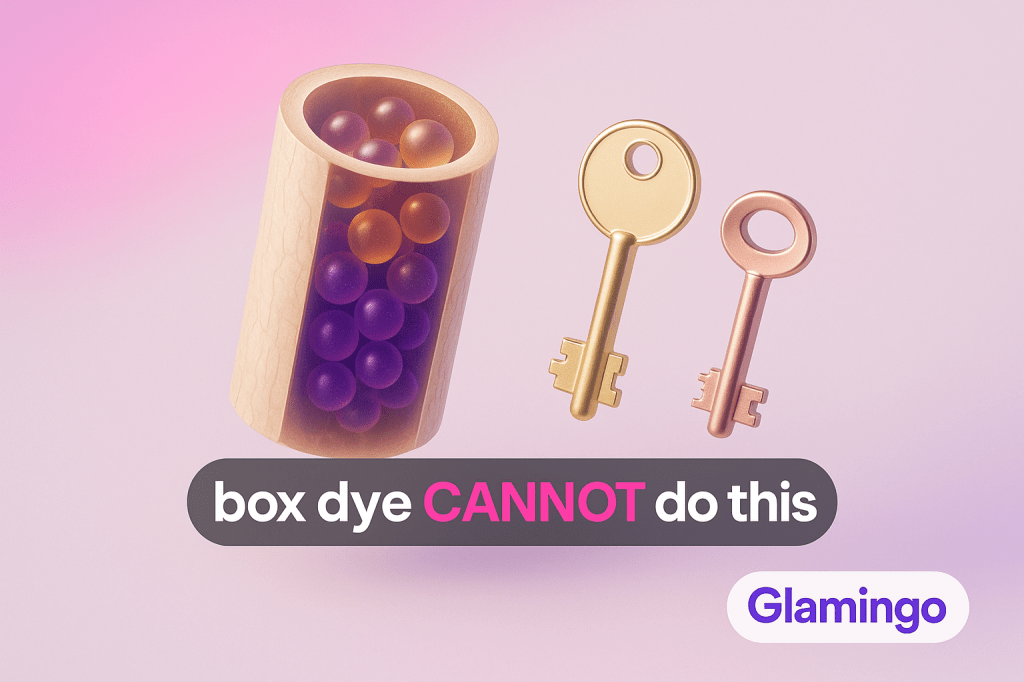
Think of your hair strand as a tightly woven bamboo tube. Permanent dye works by using a chemical key — the developer — to force the tube open, flush out some of the existing colour inside, and push new colour molecules in deep enough to bond. Then the tube closes around them. The result is a colour change that’s locked inside the structure of your hair, not sitting on top of it. This is why permanent colour doesn’t wash out: it’s chemically bonded to your hair’s internal architecture.
The process involves two components — an alkaline agent (usually ammonia or an ammonia substitute) that swells and opens the outer layer of the hair shaft (your cuticle), and an oxidising developer that triggers the colour-forming reaction inside. The dye molecules that enter the shaft are small enough to penetrate, then oxidise into larger molecules that become trapped inside — this chemical bonding is what distinguishes permanent dye from every other type.
Demi-permanent: lighter chemistry, less lift, more conditioning
Demi-permanent dye uses a lower-strength developer and a slightly different alkaline chemistry, which means it opens the cuticle less aggressively. It can deposit colour and add tone, but it can’t lighten — it works by adding to what’s there, not displacing it. The colour molecules still penetrate the shaft, but the bond is less deep and fades over time, typically after twenty to twenty-eight washes. For refreshing colour, blending early greys, or correcting tone without committing to a full lift, this is a gentler option with a meaningfully lower damage profile.
Semi-permanent and temporary: surface deposit only, no chemical bonding
Temporary and semi-permanent dyes deposit colour on or near the surface of the hair shaft without the chemical bonding that happens with permanent formulations. No developer, no cuticle-opening, no penetration into the cortex. The colour sits on the outside of the strand and washes away — sometimes in a single wash, sometimes over several weeks depending on the formulation. For adding vibrancy or trying a shade before committing, these work. For covering grey or making a lasting tone change, they don’t.
What bleaching does that dyeing alone does not
How bleach dismantles melanin before new colour can take hold
Bleach doesn’t add anything to your hair. It removes. Specifically, it uses an oxidising agent (usually hydrogen peroxide combined with a powder lightener) to break apart the melanin molecules inside your hair shaft — effectively dismantling the natural colour from the inside out. Bleaching agents fade natural melanin pigment and then react with colour molecules, creating new colour that becomes fixed inside the shaft — making bleaching a structural alteration to the strand, not merely a surface change. This is why bleached hair doesn’t simply grow back to colour. The melanin that was destroyed is gone. New pigment grows in from the root, which is a different strand entirely.
Why this step creates a structurally different strand that needs different care
Bleaching is the most structurally disruptive thing you can do to hair, and it changes how every subsequent chemical process behaves. A bleached strand has a more open cuticle, a more porous cortex, and significantly less protein integrity than an unbleached one. It absorbs colour faster and releases it faster. It’s more vulnerable to heat, friction, and chemical overlap. If you’ve bleached your hair — even once, even months ago — your hair is now a fundamentally different substrate. Any colour decision made without accounting for that is guesswork.
The developer question: why this is the real difference between box dye and salon colour
What a developer actually does and why concentration changes everything
The developer is the hydrogen peroxide component mixed with dye — and its concentration, measured in volumes (10, 20, 30, 40), determines how far the cuticle opens and how much lift occurs. A 10 volume developer barely opens the cuticle and deposits colour with minimal lift. A 40 volume developer opens it aggressively and lifts several shades — but also causes significantly more structural stress. The relationship between lift and damage is not incidental. It’s mechanical. Higher volume means more cuticle disruption, more cortex exposure, more potential for protein degradation. This is the lever that separates a precise colour result from a damaging one.
Why box dye uses a fixed-volume developer — and what that costs you in control
Box dye uses a standardised developer, typically 20 volume, because it has to work across the widest possible range of hair types and conditions. The manufacturer cannot know whether your hair is fine and virgin, thick and previously bleached, or somewhere in between — so it uses a middle-ground formulation that will produce a result on most heads. That’s a reasonable engineering decision. But it means the tube has been cut to fit every lock, regardless of how tightly yours is wound or how many times it’s been opened before. The result is a controlled process only in the loosest sense of the word.
How a colourist selects developer based on your hair’s current state
A professional colourist cuts a key specifically for your strand — accounting for its porosity, its previous treatment history, the target shade, and how much lift is actually needed to get there. Someone touching up a half-inch of natural root growth on dark hair doesn’t need the same developer as someone lifting mid-lengths that have had three rounds of permanent colour. Using 40 volume on fine, over-processed hair to save time is the kind of decision that causes breakage. A colourist who knows what they’re doing doesn’t make it. Box dye gives you no such judgment call — because it can’t.
Where salon application creates a structural advantage beyond just the shade
Root precision and why cumulative overlap damage matters over time
Professional colourists apply colour more precisely at the roots during touch-up appointments, which reduces cumulative colour overlap on previously treated lengths — though it’s worth noting this reflects professional practice rather than a controlled clinical outcome. The structural logic, however, is sound. Every time permanent dye is applied over hair that’s already been coloured, the developer is opening a cuticle that’s been opened before. Repeatedly overlapping colour on the same sections of hair stresses the shaft cumulatively. If you colour at home every six weeks and soak the full length each time, you’re applying chemical stress to strands that may be twelve or eighteen months old by the time they’re eventually cut off. The damage is invisible at first. It compounds quietly.
Pre-colour assessment: porosity, previous treatments, and strand condition
Porosity — how readily your hair shaft absorbs and releases moisture and colour — is the variable that determines almost everything about a colour result. High-porosity hair (usually from previous chemical treatment, heat damage, or naturally coarser texture) absorbs colour quickly and unevenly, often pulling out faster too. Low-porosity hair resists penetration. A professional assessment before colour begins accounts for this: it changes which developer is selected, whether a pre-treatment or filler is needed, and how long the colour sits. Professional colourists are better equipped to diagnose strand condition before application and adjust accordingly, though this claim reflects industry consensus rather than controlled study.
What box dye can and cannot do — an honest map
When home colour genuinely works (and for whom)
Box dye is not inherently bad. For someone with virgin hair (never chemically treated), a single-process all-over colour in a shade close to their natural tone, box dye can produce a perfectly good result. The chemistry is the same category of chemistry. The formulation, while standardised, is not low quality. If your hair is healthy, your target shade is relatively close to your natural level, and you’re not trying to lift more than a shade or two, the case for spending $200 at a salon versus $15 at the pharmacy is genuinely not overwhelming.
Where it consistently falls short, especially on Asian hair
The challenges multiply quickly under specific conditions. Box dyes are mass-produced formulations — the likelihood of achieving a specific desired colour result is lower with home colour compared to professional dyeing, in part because the formulation cannot account for individual starting hair condition, though this is professional industry assessment rather than controlled evidence. For those of us with naturally dark, dense Asian hair — typically high in eumelanin, often with resistant cuticles — the standardised developer may not lift enough to clear the underlying warm tones, producing results that read orange or uneven rather than the cooler result on the box. That’s not a flaw in the box dye exactly. It’s a mismatch between a fixed formula and a hair structure the formula wasn’t calibrated for.
The health and safety picture: what the research actually shows
Chemical risk profile of oxidative dyes
A review of hair dye safety covers the toxicity profile of both oxidative and non-oxidative formulations, including carcinogenic risk considerations that are relevant to decisions about frequency of use. The research sits at a moderate evidence level — the associations are noted and reviewed, not conclusively established for general consumers — but it’s worth knowing that the primary concerns centre on oxidative dyes used at high frequency over many years. The chemical class of ingredients most associated with risk is aromatic amines, which are present in many permanent dye formulations. This doesn’t mean occasional colour is dangerous. It means frequency and formulation type are worth factoring into a long-term decision, not just the short-term result.
What to factor into decisions about frequency and formulation type
For most people colouring their hair every six to ten weeks, the structural risks to the hair itself — damage, porosity, breakage — are more immediately relevant than the toxicological considerations, which apply primarily to very high long-term cumulative exposure. That said, if you’re someone who colours frequently, exploring demi-permanent or deposit-only formulations for maintenance between full-colour sessions is worth considering both for your hair’s structural health and for reducing overall chemical load. Emerging research has explored bioinspired, nanomaterial-based dye systems designed to mimic natural melanin pigmentation as potentially more biocompatible alternatives to current oxidative formulations, but this is early-stage science — not something yet available in any meaningful consumer product. Worth knowing where the field is heading. Not worth acting on yet.
So which should you choose? Applying the mechanism to your decision
The box-versus-salon question isn’t really about quality of ingredients. It’s about how much diagnostic skill and chemical control your specific hair situation requires. Virgin hair, single-process, close-to-natural shade? Box dye is a reasonable call. Anything involving previous bleach, colour correction, significant lift, or hair that’s been through repeated chemical treatments? That’s a situation where the fixed-developer, no-assessment model of home colour is genuinely working against you — not because the product is bad, but because your hair isn’t the average strand the formula was designed for.
Singapore’s year-round heat and humidity also factor in. Hair in a tropical climate experiences ongoing UV exposure and sweat-related cuticle stress that compounds the structural load of chemical colour. This isn’t a reason to avoid colour — it’s a reason to be accurate about where your hair currently sits before adding more chemistry to it.
The gap between an $8 box and a $200 salon appointment isn’t mostly markup. It’s the cost of a trained eye on your specific strand, a developer concentration matched to what your hair can handle, and an application precise enough to avoid stacking damage on damage. Whether that’s worth the price depends entirely on the complexity of what your hair is starting from — which is exactly what the mechanism above helps you assess.
Before your next colour appointment or box purchase, look at your hair’s recent history: has it had previous permanent colour, bleach, or chemical treatments? If yes, that history changes how your hair will respond to dye — specifically its porosity and how deeply new colour molecules will penetrate. Use that single question to decide whether a professional assessment of your strand condition is worth the cost before committing to a colour change, or whether your current hair state is straightforward enough for a predictable home result.
If you’ve worked through that question and decided a professional colour session is the right call, Glamingo has verified hair colouring salons across Singapore — searchable by treatment type, location, and real customer reviews. Find a colourist near you →
 Glamingo Blog
Drop in your comments..