
You spent nine months with the best hair of your life. Then, somewhere between month three and five postpartum, handfuls started coming out in the shower drain and your hairline began retreating in a way that felt less like shedding and more like a slow emergency. One woman with PCOS described it plainly: since having her baby, the hair loss had been sooo much worse than anything she had been warned about — and the usual advice about biotin supplements and scalp massages wasn’t touching it. The frustrating part is that postpartum hair loss is real, hormonally driven, and largely inevitable — but the way it plays out, how long it lasts, and what actually makes it worse varies far more than anyone tells you.
What makes it harder is that nobody prepares you for the math of it. The glorious hair you had at 32 weeks was not a gift — it was a loan. And like most loans, it comes due at a time that feels spectacularly inconvenient. Understanding the biology will not stop the drain from filling up, but it will help you distinguish between what is supposed to happen, what is being made worse by factors nobody mentioned, and when it is actually time to stop waiting and see someone.
The hair you had during pregnancy was borrowed — here is what you were borrowing against
What oestrogen does to your hair cycle in pregnancy
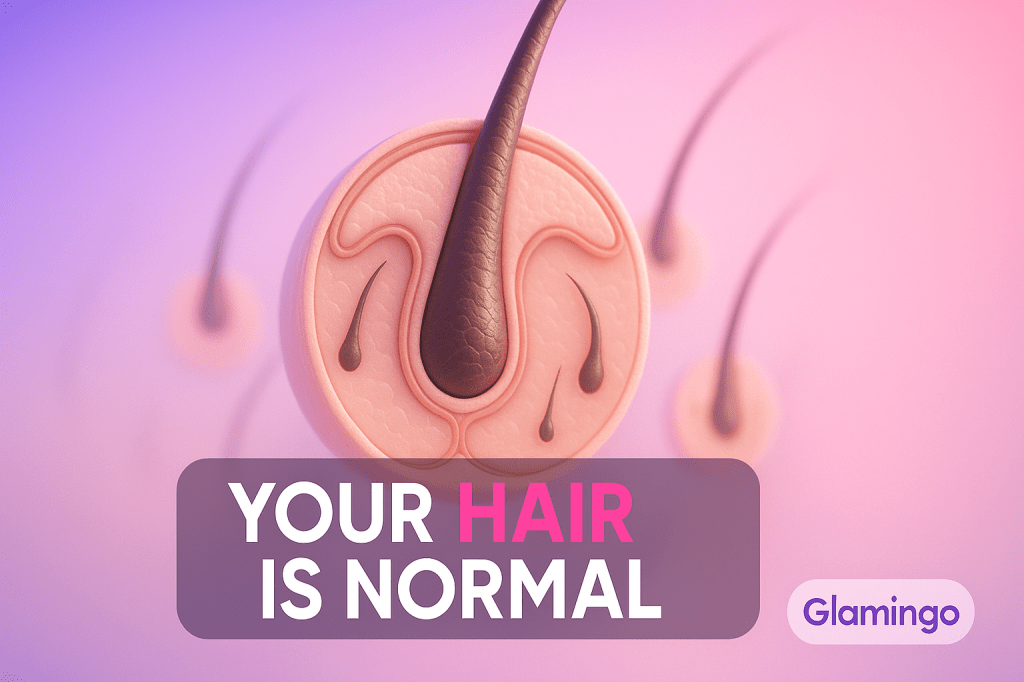
Your hair does not grow continuously. Each follicle cycles through an active growth phase (what dermatologists call the anagen phase), a brief transitional phase, and then a resting-and-shedding phase (the telogen phase), where the old hair sits quietly before falling out and making room for a new one. Under normal circumstances, roughly 85–90% of your follicles are in active growth at any given time, with the remainder resting. This staggered rotation is why you shed 50–100 hairs a day without noticing it — it is orderly, distributed, and invisible.
During the second half of pregnancy, high oestrogen levels inhibit the normal hair cycle, keeping significantly more follicles locked in the active growth phase beyond their usual tenure. Think of your hair follicles during pregnancy like concert-goers who have been told the show is still going — oestrogen is the security guard keeping everyone in their seats past curfew. Nobody leaves. The result is hair that looks exceptionally full, thick, and alive. It is. But it is also accumulating a backlog.
The mass shedding trigger: what happens when oestrogen drops after birth
The moment you deliver, oestrogen drops sharply. The security guard leaves the building. And the entire audience tries to exit at once. The venue looks empty. After delivery, the follicles that were held in the active phase during pregnancy exit simultaneously into the resting-and-shedding phase — a phenomenon known as telogen effluvium, or stress-triggered mass shedding. This is not hair loss in the clinical sense of follicle damage. The follicles are intact, cycling correctly, and the exits are working exactly as they should. The problem is the timing: it all happens in a rush instead of the normal staggered rotation, so the visual impact is dramatic even though the biology is working exactly as intended.
Knowing the mechanism intellectually, as one woman noted, does absolutely nothing to make the drain full of hair feel less alarming. Both things are true simultaneously.
Prolactin: the hormone nobody mentions when they talk about postpartum hair loss
How breastfeeding duration connects to the severity and length of shedding
Most postpartum hair loss conversations start and end with oestrogen. Which means they are missing something important. Prolactin — the hormone that rises significantly during breastfeeding to support milk production — has its own relationship with the hair cycle, and it is not a friendly one. If you are breastfeeding and your shedding feels like it has gone on longer or harder than what you were led to expect, prolactin is a plausible reason why.
This matters practically because prolonged breastfeeding means sustained prolactin elevation. Over 90% of women in one study experienced postpartum hair loss, with long-term breastfeeding identified as a specific exacerbating factor. That is not a reason to stop breastfeeding — the benefits are not in question here. But it is a reason to stop wondering why your hair is still shedding at month seven when your friend who formula-fed from birth seemed to bounce back faster. You are not doing something wrong. You are experiencing a different hormonal environment.
What the research actually shows about prolactin and the hair cycle
Prolactin promotes hair loss by actively controlling the hair cycle — specifically by pushing follicles toward the resting phase. The evidence here is moderate rather than definitive, meaning the mechanism is well understood but large-scale trials specifically isolating prolactin’s contribution to postpartum shedding are limited. What it does suggest is that the postpartum hair loss story is not a single hormonal event (oestrogen drops, shedding happens, it stops) but an ongoing hormonal environment shaped by whether and how long you are breastfeeding. The two-hormone picture — oestrogen withdrawal plus prolactin elevation — is closer to what is actually happening in your body.
The timeline question — when does postpartum hair loss peak, and when should you stop waiting for it to resolve on its own
Population-level data versus individual variation
The standard reassurance is “it peaks around three to four months and resolves by six.” This is a reasonable average and a genuinely unhelpful one in practice. Incidence of postpartum hair loss increases gradually from 2% at one month postpartum to 20% at six months, then declines — which means peak shedding for many women arrives closer to six months than three, and the resolution timeline is similarly distributed. Population data tells you where the centre of the curve is. It does not tell you where you are on it.
Individual variation is shaped by a genuine set of biological variables: your baseline hair cycle, the hormonal specifics of your pregnancy, whether you delivered preterm, whether you are breastfeeding and for how long, your nutritional status, and your stress load. None of these are small factors. The three-to-six-month framing was never meant to be a promise.
The signals that suggest something beyond normal postpartum shedding
Here is where the reassurance has to stop and specificity has to start. Postpartum telogen effluvium sits on the same differential diagnosis list as female pattern hair loss (androgenetic alopecia), alopecia areata in its diffuse form, and other conditions that require different management entirely. Prolonged or atypical hair loss after birth warrants clinical assessment rather than continued watchful waiting — and this is not a disclaimer, it is a clinically grounded position.
The signals worth taking seriously are: shedding that is patchy or asymmetric rather than diffuse across the whole scalp, loss that continues beyond 12 months postpartum without meaningful improvement, a shedding pattern that is progressing rather than plateauing, or any scalp changes like redness, scaling, or irritation. Diffuse shedding that began around months three to six and is slowly improving is almost certainly telogen effluvium doing its thing. A pattern that does not match that description deserves a different conversation.
Factors that make it worse: what the evidence identifies beyond the basics
Preterm labour and hormonal disruption
This one receives almost no coverage in mainstream postpartum content. Research shows preterm labour correlates with more pronounced postpartum hair loss, which makes biological sense: the hormonal recalibration after birth is already a significant system-wide event, and an earlier-than-expected delivery means that recalibration happens against a different hormonal backdrop. If you delivered preterm and your postpartum shedding felt disproportionately severe, there is a plausible physiological reason for that — not just bad luck or a weak baseline.
Nutritional depletion, crash dieting, and psychoemotional stress as compounding triggers
Telogen effluvium as a biological mechanism is not exclusive to postpartum hormones. Psychoemotional stress, weight loss, crash dieting, and nutritional insufficiency are all recognised triggers of the same shedding mechanism — which is significant because new mothers in Singapore are navigating all of these simultaneously. The pressure to “bounce back,” disrupted sleep, the physical demands of feeding, the nutritional cost of pregnancy itself — these are not separate issues. They layer on top of the hormonal shedding and extend or amplify it. This is not a wellness platitude. The biology of hair cycling is genuinely sensitive to energy availability and cortisol load.
PCOS and pre-existing hormonal vulnerabilities
For women who already had androgen-driven hair thinning or disrupted hair cycling before pregnancy — particularly those with polycystic ovary syndrome (PCOS) — the postpartum period is not simply a hormonal reset. It is a hormonal reset on top of a system that was already managing excess androgens or irregular cycling. The experience described by women with PCOS is categorically different: louder, longer, and harder to attribute cleanly to “postpartum” versus pre-existing androgenetic vulnerability. This is a population that genuinely benefits from dermatological assessment earlier rather than later, rather than waiting for the standard timeline to resolve something it may not fully resolve on its own.
What the shedding pattern tells you — and what it does not
Why the front hairline loses hair first and most visibly
Postpartum hair loss is diffuse across the scalp, but is most pronounced along the anterior hairline — the front fringe and temples. This is partly because hairline follicles tend to have slightly shorter anagen cycles to begin with, making them more sensitive to the mass exit signal. It is also the area most exposed to friction from styling, ponytails, and the general chaos of managing long hair with a newborn. The diffuse nature of the loss is actually important diagnostic information: it tells you this is telogen effluvium, not patterned hair loss driven by androgens, which tends to concentrate at the crown and mid-parting rather than the front.
The regrowth phase: what ‘baby hairs’ actually signal
The wispy, short new hairs that appear along your hairline at around six to twelve months postpartum are not a cosmetic nuisance — they are a biological readout. Virtually the whole scalp’s hair is being replaced after the shedding phase; the hairline is just where regrowth is most visually apparent because it was the most visible area of loss. Those baby hairs mean the follicles are active and cycling normally. They are the evidence that the biology did what it was supposed to do.
What actually helps — and what the evidence grades on popular interventions
What the research supports (and at what level of evidence)
The honest answer is that the evidence base for postpartum hair loss interventions is thinner than the supplement industry would have you believe. For nutritional support, correcting genuine deficiencies — particularly iron, ferritin, vitamin D, and zinc — has a reasonable evidence basis for improving telogen effluvium where deficiency is confirmed. This means getting bloodwork done and supplementing based on results, not taking a generic “hair, skin, nails” formula as insurance. Biotin supplementation is one of the most heavily marketed interventions for postpartum hair loss; it has evidence for improving hair growth in cases of confirmed biotin deficiency, which is actually uncommon in women who are eating adequately. The mechanism is sound where deficiency exists. The independent evidence for supplementing at high doses in well-nourished women is considerably thinner.
Topical minoxidil — a treatment that works by extending the active growth phase of follicles — has strong evidence for female pattern hair loss, and some dermatologists do use it in the postpartum context. However, it is not compatible with breastfeeding, and postpartum telogen effluvium is self-resolving in most cases, which changes the risk-benefit calculation. This is a conversation to have with a dermatologist, not a decision to make based on a product description.
What is trending but not yet evidenced for postpartum hair loss specifically
Scalp treatments, rosemary oil, and various salon protocols for postpartum shedding are circulating widely — and some, like rosemary oil, have early comparative data against minoxidil for androgenetic alopecia specifically. Whether that translates meaningfully to postpartum telogen effluvium is a different question that the research has not cleanly answered. The mechanism is plausible. The independent evidence for this specific application is not there yet. Worth watching, not worth spending significantly on right now when the underlying biology is time-limited in most cases.
The emotional dimension — why ‘it’s just temporary’ is not a satisfying answer
Hair carries a lot. It is tied to identity, to how you recognise yourself in a mirror, to how you felt before pregnancy, before the sleep deprivation, before the version of yourself that is currently managing everything at once. The fact that postpartum hair loss is temporary and hormonally explained does not make the experience of watching your hairline change at an already destabilising time feel minor or manageable. Early research suggests that the emotional impact of postpartum hair loss intersects meaningfully with themes of anxiety, identity disruption, and depressive experience — though large-scale studies on this specific intersection are still limited. What the online communities make clear without any research needed is that the dismissal of this as a cosmetic concern, rather than a legitimate physical and emotional experience, compounds the distress rather than relieving it.
“It’s just temporary” is medically accurate and emotionally insufficient. Both things can be true. You are allowed to find this hard while also knowing it resolves. These are not contradictory positions.
If you are currently in a postpartum shedding phase, map your own timeline this week: note when you gave birth, whether you are still breastfeeding, and whether the shedding is diffuse across the scalp or concentrated in a specific pattern. The research shows that peak shedding often hits around six months postpartum and that long-term breastfeeding is a specific exacerbating factor — not a reason to stop feeding, but a reason to stop blaming yourself for it going on too long. If your loss is patchy rather than diffuse, or if it has continued past 12 months postpartum without improvement, that is the specific signal to seek a dermatology referral rather than continuing to try supplements.
If you are thinking about speaking to a professional rather than navigating this alone, Glamingo can help you find trichology consultations and scalp treatment providers near you with verified reviews. Search postpartum hair care providers on Glamingo →
 Glamingo Blog
Drop in your comments..