
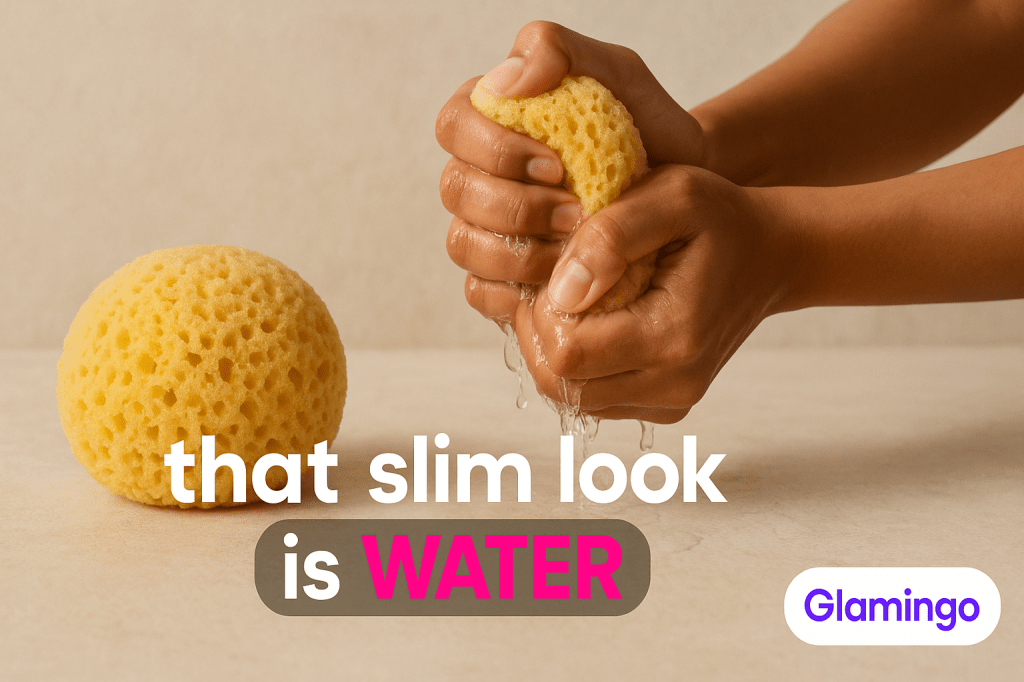
You step off the treatment bed, the therapist hands you a mirror, and something genuinely looks different. The waist looks smaller. The thighs look less puffy. You feel lighter. But by day three, it’s all back — and you’re left wondering whether the treatment did anything at all, or whether you just paid to temporarily sweat. The confusion between water loss and actual fat loss is the most exploited gap in the body contouring industry, and it’s costing people real money on results that were never going to last.
This is not a niche problem. If you’ve ever walked out of a slimming session feeling genuinely different, only to watch the effect quietly disappear by the end of the week, you’re not imagining things — and you’re not alone. The treatment did something. The question is what, exactly, it did. And whether the clinic told you the truth about it.
The Myth: If You Look Slimmer After a Treatment, It Must Be Working
Why the body contouring industry thrives on this confusion
The slimming industry has a structural incentive to keep the line between water loss and fat loss as blurry as possible. When a treatment produces a visible, measurable result — centimetres off the waist, a looser waistband, a noticeably flatter stomach in the mirror — it’s genuinely difficult not to interpret that as progress. Widespread myths about rapid weight loss are documented even among health professionals, which creates exactly the kind of fertile ground that allows treatment marketing to plant its flag. A before-and-after photo taken on the same day tells a real story. It just might not be the story you think it is.
The language used in salons and clinics reinforces this. “Inch loss.” “Visible results from the first session.” “Sculpt and define.” None of these claims are technically false — and that’s precisely the problem. You can lose inches from temporary fluid reduction. You can see visible results from a single session of compression or heat. The words are chosen to imply something lasting while describing something temporary, and misconceptions about rapid weight loss are well-documented across both general populations and healthcare providers globally.
What ‘instant results’ actually look like — and why they feel so convincing
The results are convincing because they’re real. Your clothes fit differently. The tape measure says something different. You feel less bloated. None of that is placebo. What’s actually happened is that your tissue fluid has shifted — temporarily. Rapid slimming effects from treatments that cause dehydration are temporary and not intended to be permanent fat reduction — the visible change reflects fluid movement, not structural change to fat cells. The result is real. The interpretation is where things go wrong.
The Verdict: What Your Body Can and Cannot Do in a Single Session
The biology of fat loss — why it cannot happen in an hour
Fat loss has one proven mechanism, and it is not a quick one. A sustained negative energy balance — consuming less energy than you burn over time — is the only mechanism by which the body reduces fat stores. This is not a controversial position. It’s foundational physiology. Fat cells don’t get squeezed out, sweated out, or drained away in a session. They shrink gradually as the body draws on stored energy over days and weeks. No topical treatment, wrap, or non-invasive therapy bypasses this. Not one.
This matters because the timeline alone should set off alarm bells. Meaningful fat reduction requires a sustained caloric deficit maintained over weeks. A single 60-minute treatment cannot compress that process, regardless of what technology is used or what the brochure says. If you see a dramatic change within 24 hours, fat is not what changed.
The biology of water retention — why it absolutely can shift in an hour
Tissue fluid is a different story entirely. The body holds water throughout its tissues — in the spaces between cells, in the lymphatic system, in the layers just beneath the skin. This fluid fluctuates constantly in response to heat, pressure, hormonal changes, sodium intake, posture, and how long you’ve been sitting at a desk. Unlike fat, it can shift meaningfully within a single session. Apply enough heat, compression, or drainage and you will move fluid. The change will be visible. It will also be temporary.
Think of your body’s tissue fluid like water in a sponge. A slimming treatment that uses heat, pressure, or drainage is essentially squeezing the sponge — it looks smaller immediately, and that result is real in the moment. But the sponge hasn’t changed in size or structure. Once you drink water and go about your day, it reabsorbs fluid and returns to its normal volume. Fat loss, by contrast, is like actually trimming the sponge itself — you can’t do that by squeezing it, and it doesn’t happen in a session. That analogy is not an oversimplification. It is the mechanism.
The 1–2% dehydration effect: how small fluid shifts produce visible change
Even mild dehydration — a body water loss of just 1–2% — produces measurable physical changes, including shifts in how the body looks and feels. That’s a small percentage with a surprisingly large visible effect. For someone who weighs 60kg, 1–2% body water is just 600ml to 1.2 litres of fluid. Losing that through a heat treatment or compression session is entirely plausible in a single appointment — and the resulting change in how clothes fit, how the stomach looks, and what the scale reads is genuine. It’s just not fat.
The Treatments Most Likely to Sell You Water Loss as Fat Loss
Heat-based treatments: hot wraps, saunas, infrared sessions
Hot body wraps, infrared sauna sessions, and sweat-inducing thermal treatments are the most straightforward offenders here. Saunas, sweat suits, and heat-based treatments primarily produce water loss — when you rehydrate, much of the weight lost during the session returns. In Singapore’s humidity, you’re likely already dealing with baseline fluid retention just from the climate — so these treatments can produce a particularly noticeable temporary result. That doesn’t make the result meaningful.
The issue isn’t that these treatments are useless. Relaxation, improved circulation, and the sensory experience of a good heat treatment are legitimate benefits. The issue is when they’re marketed — or understood — as slimming treatments that reduce body fat. They don’t. They reduce body water, temporarily.
Compression and drainage: lymphatic massage and manual drainage
Compression garments, pressotherapy machines, and manual lymphatic drainage techniques are a step more nuanced. These treatments work with the lymphatic system — the body’s network for clearing excess fluid and waste from tissues. When the lymphatic system is sluggish (which is common, especially after prolonged sitting, post-surgery, or in high-humidity climates), fluid can pool in the tissue and cause that characteristic puffiness. A good lymphatic treatment can genuinely shift this fluid. The tape measure result afterwards is real. So is the return of that fluid once normal physiological balance reasserts itself.
The legitimate use case for lymphatic treatments — and where the claim ends
Here’s where it’s worth being precise, because lymphatic massage has a genuinely useful role — it just isn’t the role it’s most often sold for. For post-surgical recovery, for managing chronic fluid retention, or for the kind of functional puffiness that builds up during a long work week, lymphatic drainage can meaningfully improve how you feel and look in the short term. That’s a real benefit worth paying for, if you understand what you’re buying.
What it cannot do — and this is where the marketing oversteps — is produce lasting fat reduction. Manual lymphatic drainage has a legitimate but limited role: it can reduce temporary fluid retention and improve lymph flow, but it is not a standalone mechanism for fat reduction. The evidence base for lymphatic drainage as a slimming treatment in otherwise-healthy individuals is weak. The mechanism for fluid reduction is well understood. The leap to “fat loss treatment” is not supported by independent research. Those are two very different things, and no reputable clinic should conflate them.
How to Tell Which One You’re Actually Getting
The 72-hour test: what happens when you rehydrate
The single most useful thing you can do after any body treatment is nothing elaborate. Take a measurement or note your weight immediately after the session. Then live your normal life for 72 hours — eat normally, drink normally, don’t restrict sodium or do anything special. Measure again. Water loss results reverse within 24–72 hours as the body rehydrates and tissue fluid normalises. If your measurement has returned to baseline, you experienced fluid reduction, not fat loss. That’s your data point. It doesn’t require a fancy app or a nutritionist — just a tape measure and honesty about what you see.
What a genuine fat loss trend looks like on the scale over weeks
Genuine fat loss doesn’t show up dramatically the morning after anything. It shows up as a slow, inconsistent, but directionally downward trend on the scale over two to four weeks, with day-to-day fluctuations that can temporarily mask the progress entirely. A framework that captures this well: if your weight trends upwards over time, you’re gaining fat. If it trends down or stays roughly the same over a sustained period, a real change may be occurring. That requires weeks of data points, not one weigh-in after a treatment. Anyone telling you otherwise is either confused or counting on you being confused.
Questions to ask your therapist or clinic before booking
Before you hand over your money for a course of body contouring sessions, a few direct questions will tell you a lot. Ask whether the results from a single session are expected to be permanent or temporary, and watch how they answer. Ask whether the treatment affects fat tissue directly or primarily reduces fluid retention. Ask what independent studies — not brand-funded trials — support the specific technology being used. A clinic that can answer these questions clearly and honestly is one worth trusting. A clinic that responds with before-and-after photos and testimonials is showing you its marketing, not its evidence.
The Honest Verdict on Body Contouring Treatments
What non-invasive treatments can realistically do
Non-invasive body treatments are not a con. Some technologies — particularly those using targeted cold (cryolipolysis) or high-intensity focused ultrasound — do have evidence for modest, gradual fat cell reduction over multiple sessions, with results that accumulate over weeks rather than appearing instantly. The key word is modest. The key phrase is over weeks. Even genuine fat loss is physiologically constrained — no external treatment replaces a sustained negative energy balance as the mechanism for reducing fat stores. What non-invasive treatments can credibly offer is a complement to, not a replacement for, that process — with some localised structural effect where the evidence supports it.
They can also deliver legitimate non-fat benefits: improved circulation, reduced post-surgical swelling, temporary de-puffing before an event, relaxation, and the kind of physical attention that simply makes you feel more in tune with your body. These are worth paying for if that’s what you’re paying for. The problem is when those benefits are dressed up as something they’re not.
What they cannot replace
High rates of weight regain following interventions indicate that even genuine fat loss is difficult to sustain — which makes the distinction between a temporary fluid result and a real structural change even more critical when you’re evaluating whether a treatment course is worth the investment. A $300 session that produces a convincing same-day result that reverses by Thursday is not the same as a treatment that contributes to a measurable change over six weeks. Your budget and your expectations deserve to be aligned with what the evidence actually says.
One Thing to Do Before Your Next Booking
Before you book your next body contouring session — or assess whether the last one worked — do the 72-hour rehydration test: weigh yourself or take a tape measurement immediately after a treatment, then again three days later after normal eating and drinking. If the change has fully reversed, you experienced water loss, not fat reduction. Use that data point to decide whether this treatment category is actually delivering what you’re paying for.
If you’re ready to find body contouring or lymphatic treatments from salons that are upfront about what their results actually involve, Glamingo lets you browse verified providers with real reviews — so you can compare what’s on offer before you commit. Search body contouring treatments near you →
 Glamingo Blog
Drop in your comments..