
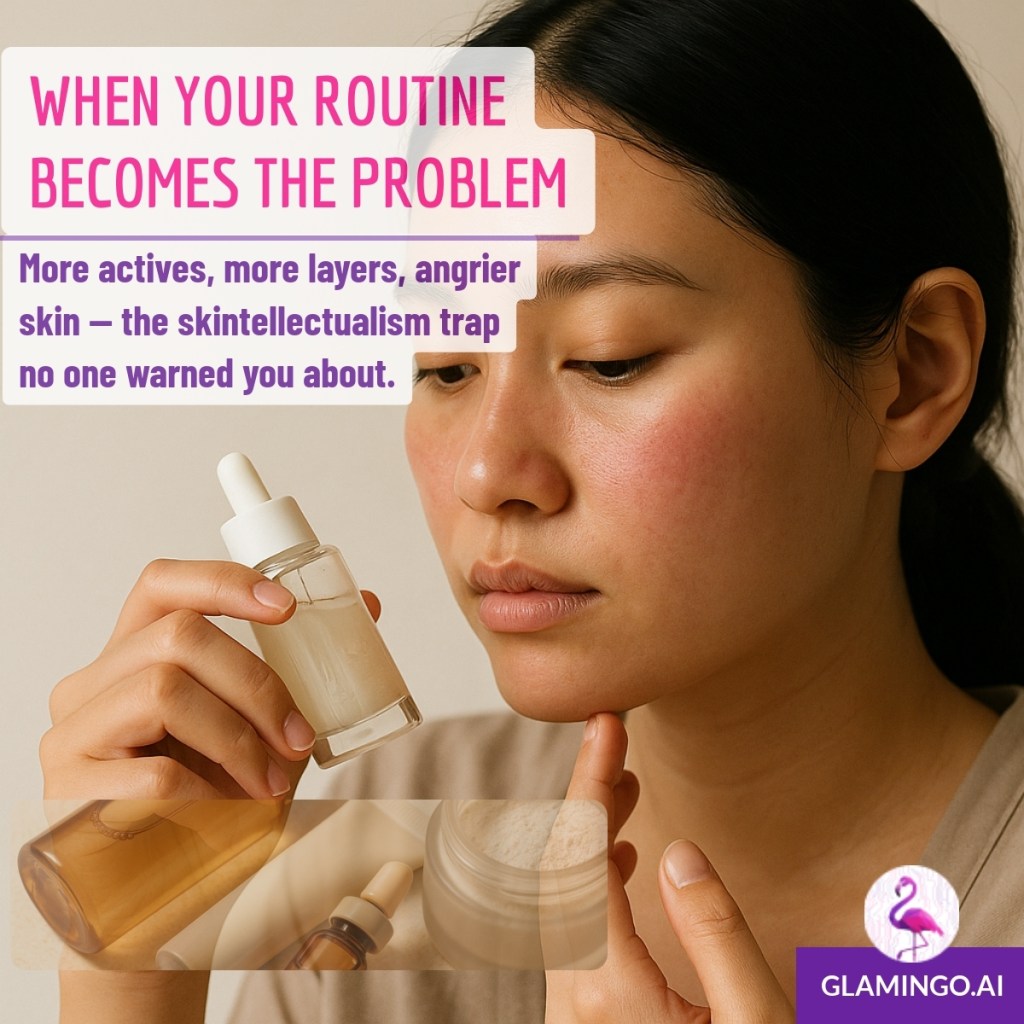
You have read the studies, you know your actives, and your shelfie could stock a small pharmacy — and yet your skin is angrier, more sensitised, and less stable than it was three years ago. The uncomfortable possibility: the routine itself might be the problem.
This is not a beginner’s mistake. If anything, it is the opposite. The women most likely to end up with chronically reactive, tight, flushed skin are not the ones who slap on whatever is on the drugstore shelf. They are the ones who spent three years genuinely learning about skincare — reading ingredient lists, following cosmetic chemists on social media, cross-referencing before they buy. The knowledge is real. The problem is what happens when that knowledge collides with an industry that rewards complexity, and a content ecosystem that treats adding a new step as progress. You end up with a routine that is, technically speaking, extremely well-researched — and actively working against you.
The skintellectual paradox — knowing more and getting worse results
How ingredient literacy became routine complexity
The term skintellectualism describes the shift from passive product use to research-driven, ingredient-led skincare decision-making. Ten years ago, most women picked a moisturiser because it smelled nice or a friend recommended it. Today, the same woman reads clinical abstracts, understands the difference between AHAs and BHAs, and can explain why niacinamide and vitamin C are theoretically incompatible at certain pH ranges. That shift is genuinely valuable. Understanding what you are putting on your skin is not the problem.
The failure mode is specific: you optimise for individual ingredients rather than for whole-skin function. You find an acid exfoliant that demonstrably increases cell turnover. You add a vitamin A derivative because the anti-ageing evidence is strong. You include a vitamin C serum because antioxidant protection matters under Singapore’s UV. You layer a niacinamide product because of the pigmentation benefit. Each decision is defensible. Each ingredient is, in isolation, well-supported. The stack, however, is not a skin routine. It is a chemistry experiment run on living tissue.
Why understanding individual actives does not automatically mean understanding how they interact as a stack
Here is the thing that ingredient literacy does not naturally teach you: the clinical studies that validated each of these actives almost never tested them together. The retinol study used retinol. The AHA study used AHA. They were run in controlled conditions, often with a simple supporting moisturiser and nothing else. When you assemble a ten-product routine based on individual ingredient evidence, you are essentially doing an n-of-one combination trial that no researcher has run — on your face, in real time, without a control group.
This is not alarmist. It is just an honest description of what is happening. The knowledge base is built from isolated studies. The routine you assembled from that knowledge base is not a thing the evidence actually supports.
What your skin barrier is actually doing — and what disrupts it
The mortar-and-brick model: ceramides, natural moisturising factors, and the acid mantle as one integrated system
Think of your skin barrier like a well-maintained road surface. Each active ingredient is a roadworks team — individually competent, with a legitimate job to do. But if you schedule acid exfoliation, retinoid resurfacing, vitamin C oxidation management, and enzyme treatments on the same stretch of road at the same time, the road does not get better faster. It just never gets the window it needs to repair. Skintellectualism gives you excellent roadworks crews. Over-routinising means none of them ever leaves long enough for the surface to set.
The barrier’s structural integrity depends on a combination of fatty molecules that act as mortar between skin cells (ceramides), compounds that keep the surface hydrated (natural moisturising factors), and the slightly acidic protective film known as the acid mantle — these function as an integrated system, not as independent components that can be optimised in isolation. When the acid mantle is functioning, it maintains a pH environment that keeps the right microorganisms in place and the wrong ones suppressed. When the ceramide layer is intact, moisture stays in and irritants stay out. The system works together. Disrupting one part does not stay contained.
How individually evidence-based ingredients can collectively destabilise the barrier
Repeated disruption of the skin’s outer layer — through frequent use of acid exfoliants that dissolve the bonds between dead skin cells (the process dermatologists call desquamation), or vitamin A derivatives that accelerate skin cell turnover — measurably increases the rate at which moisture escapes through the skin surface, a metric known as transepidermal water loss (TEWL), which is a recognised marker of barrier compromise. This is not theoretical. Elevated TEWL is measurable in a lab. It tells you the skin is working harder to maintain basic function and losing the battle incrementally.
Individually, a well-formulated retinoid used correctly, or an AHA used at an appropriate frequency, does not necessarily produce this outcome. The frequency and the combination are where it goes wrong. Your skin has a repair capacity. When you are running multiple exfoliating or resurfacing actives simultaneously, you are regularly outpacing that capacity — and the result is a barrier that never quite closes.
The downstream chain: barrier damage → microbiome shift → chronic low-grade inflammation → reactive, sensitised skin
The skin microbiome — the community of bacteria, fungi, and other microorganisms living on the skin surface — is sensitive to changes in pH and barrier integrity. Disruption of the acid mantle can shift microbial balance toward pro-inflammatory species. Once that shift happens, the resulting chronic low-grade inflammation is mechanistically linked to sensitisation — a state in which the skin reacts to products and environmental triggers it previously tolerated without issue.
If you have ever described your skin as “suddenly sensitive” after a period of dedicated routine-building, this chain is the most plausible explanation. Your skin did not become sensitised despite your routine. It became sensitised because of it. The sensitisation feels like a skin problem requiring more targeted treatment. So you add more actives. Which worsens the barrier. Which deepens the sensitisation. The loop is frustrating precisely because the instinct to treat it is correct in principle — just misdirected.
Singapore context: why the research may not apply to your climate
What year-round UV Index 10–12 and 80% humidity do to baseline barrier stress
Singapore’s year-round UV Index regularly reaches 10–12 — the extreme category — placing the skin under sustained UV-induced oxidative stress even before you apply a single active ingredient. That is a baseline condition your skin is managing every single day, not just on beach trips. Meanwhile, ambient humidity hovering around 80% creates a skin environment that looks and feels different from the Northern European or North American conditions in which most skin research is conducted. Your skin may feel adequately moisturised on the surface while the barrier function underneath is under thermal and UV stress that a study run in Copenhagen or Toronto simply did not account for.
Why most active ingredient studies were not conducted in tropical conditions
Most of the clinical evidence for topical actives was generated in temperate climates with seasonal UV variation, lower baseline humidity, and a different distribution of skin types. The Southeast Asian context — darker skin tones across Fitzpatrick types III to V, higher baseline UV load, and year-round heat — changes how some ingredients behave and how the barrier responds to disruption. This is an area where direct clinical studies in Singapore-specific conditions are sparse, so it would be overclaiming to say the research definitively does not apply. What is reasonable to say is this: you cannot assume it does. Applying a routine designed for someone managing dry winter skin in Seoul or Manchester to skin that is already managing extreme UV daily is not a like-for-like translation.
The content ecosystem is structurally biased toward complexity
How algorithms reward novelty, not stability
A video titled “I used the same three products for four weeks and nothing much changed but my skin is fine” will never perform. The algorithm rewards novelty, before-and-afters, transformation, and the introduction of the next thing. Stability is boring content. But stability is, as it turns out, what most skin actually needs. The incentive structure of beauty content is fundamentally misaligned with what the evidence supports — and that misalignment is built into how the content is distributed, not just how it is created.
Why influencer routines are not designed for sensitised skin
Influencer routines — including many genuinely well-intentioned ones from people who do know their ingredients — are not tested under conditions of pre-existing sensitisation. They are filmed on skin that has been managing the routine for a while, often with professional support, sometimes with periodic skin breaks that are not mentioned on camera. When you adopt a ten-step routine from someone whose skin appears to be thriving under it, you are not seeing the full picture: their skin history, their usage frequency, whether they are actually running all those actives at once, or what happened in the months it took to get there.
The K-beauty ten-step context: what the original framework was actually for versus how it has been adopted
The K-beauty ten-step routine — which a significant portion of this audience will have encountered, tested, or partially adopted — is worth revisiting in its original context. The framework was built around layering lightweight hydration, not layering high-concentration actives. Essence, toner, and ampoule steps in traditional K-beauty are largely about water-binding and skin-softening, not exfoliation and resurfacing. The Western and Westernised adoption of the ten-step framework often replaced those hydration-focused steps with active-heavy alternatives. The scaffold stayed. The philosophy did not make the journey. What remains is the step count without the original logic — which is roughly the worst outcome you could design.
What the evidence actually supports — and how boring it is
The evidence-graded case for SPF, one retinoid, and a barrier-focused moisturiser
The ingredients with the strongest independent evidence base for improving skin appearance and function — a broad-spectrum SPF, a well-formulated vitamin A derivative (retinoid or retinol), and a ceramide-containing moisturiser — represent three products, not ten to fifteen. And the clinical studies supporting these outcomes were conducted using these ingredients largely in isolation, not as part of multi-active stacks. This evidence is moderate in grade because while the individual ingredient data is well-established, comparative studies directly testing minimal versus multi-step routines are limited. But the gap between what the evidence actually demonstrates and what a skintellectual routine looks like is large enough to be meaningful.
What clinical studies actually test versus what a skintellectual routine looks like
A clinical retinoid study typically involves: the retinoid, a basic moisturiser, a basic SPF, no other actives, a fixed frequency, a controlled participant pool, and twelve to twenty-four weeks of consistent use. The results that get cited in your favourite skincare deep-dive — reduced fine lines, improved skin texture, measurable increase in collagen density — come from that controlled, stripped-back protocol. They do not come from a routine that also includes a 10% AHA, a mandelic acid pad, a brightening serum, a niacinamide booster, and a peptide overnight mask. The evidence that made you confident in your retinoid was generated in conditions that look nothing like your current shelf.
How to know if your routine is the problem
Five signals that your skin is over-routinised, not under-treated
There are recognisable patterns that suggest your skin is being overworked rather than under-addressed. A tight, uncomfortable sensation after cleansing — with a cleanser you have used for months — is one early sign that the barrier is compromised enough to react to what should be neutral contact. Stinging or tingling from products that previously sat on your skin without issue is another: your baseline irritation threshold has dropped. Persistent low-grade flushing or redness that does not resolve between routines suggests the skin is not getting a window to recover. A feeling that your skin is never quite settled — not broken out, not calm, just perpetually reactive — is a strong clinical signal that the system is under sustained stress. And if moisture seems to escape quickly after moisturising (that tight feeling returns within an hour), elevated transepidermal water loss is the likely culprit. These signals are clinically recognised, though formal diagnostic criteria for routine-induced sensitisation are not yet standardised — which means you have to use them as a pattern, not a checklist.
The skin rest protocol: what stripping back actually involves
Stripping back a routine is not the same as doing nothing. A skin rest protocol typically means reducing to a gentle, fragrance-free cleanser, a barrier-supporting moisturiser with ceramides, and SPF in the morning — and removing all actives for a defined period, typically four to six weeks. The point is not that actives are bad. The point is that you need a baseline to work from. If your skin settles significantly within that window, you have your answer about what the routine was doing. You can then reintroduce one active at a time, slowly, with enough spacing to actually observe the response.
The honest verdict on skintellectualism — the knowledge is not the problem
Skintellectualism is not a mistake. Knowing your ingredients, understanding how actives work, reading beyond marketing claims — this is exactly what you should be doing, and it is genuinely better than the alternative. The problem is a specific gap between individual ingredient literacy and systems thinking about the skin as a whole. Understanding that retinol drives cell turnover does not automatically give you insight into what happens when it runs alongside two exfoliating acids and a high-concentration vitamin C on a face that has already been under UV Index 12 all day. That requires a different kind of thinking — less about what each ingredient does, more about what the skin is managing as a total load.
The content ecosystem will keep rewarding complexity. New actives will keep being launched. Someone will always have a before-and-after that makes you feel like you are missing a step. The intellectual move here is not to stop learning. It is to redirect the learning — from ingredient optimisation toward barrier function, from routine expansion toward routine assessment. The most sophisticated skin decision you can make right now might be to take something out.
This week, map out every product in your current routine and mark any that contain an active — acid exfoliants that dissolve bonds between dead skin cells, vitamin A derivatives that speed up cell turnover, vitamin C, niacinamide at high concentration, enzyme exfoliants. If you have more than two actives running simultaneously on any given day, that is your diagnostic. Do not add anything new. Instead, identify which single active has the strongest evidence for your primary skin concern and run it alone — without the stack — for four weeks. If your skin settles, you have your answer about what the routine was doing.
If this article has you thinking about a professional skin assessment rather than diagnosing it yourself, Glamingo has facial and skin consultation options near you where you can get an honest read on your barrier health from someone who can actually see your skin. Find a provider near you →
 Glamingo Blog
Drop in your comments..