
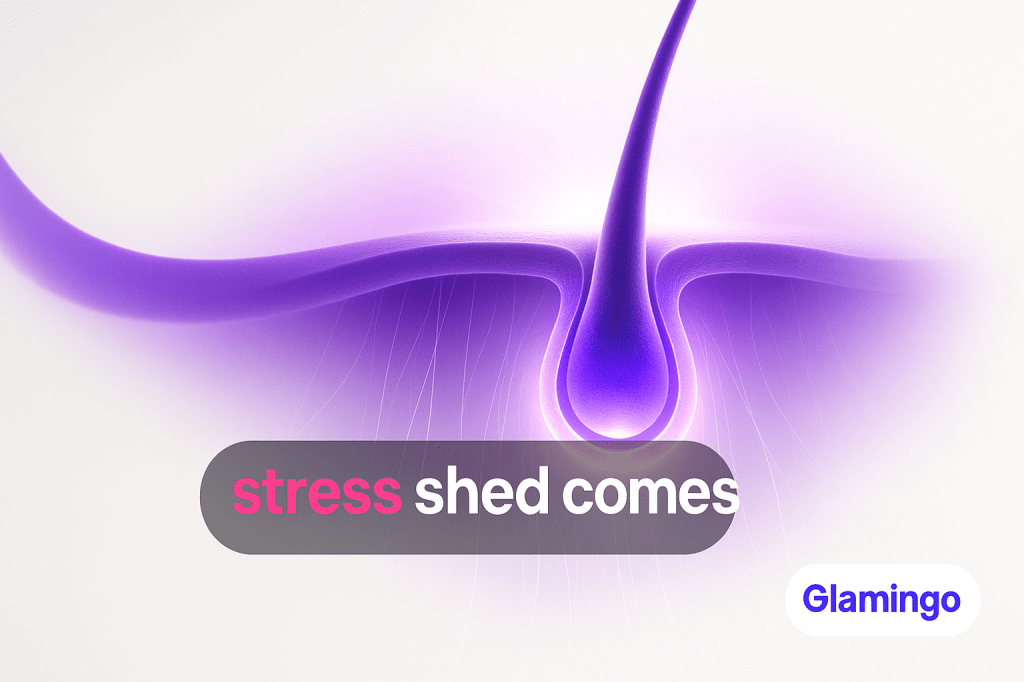
You finally got through the worst of it — the brutal project deadline, the family crisis, the months of running on empty — and your hair looked fine. Then three months later, clumps in the shower. It feels random, unfair, and completely disconnected from anything you can point to. It isn’t random. Stress-related hair loss is a delayed biological response with a specific mechanism, and understanding that delay changes how you respond to it.
This is the part that trips most people up. By the time the shedding starts, the stress feels like old news. You’ve moved on. Your sleep is better. You’re eating actual meals again. And yet your hairbrush is telling a completely different story. The frustration isn’t just the shedding itself — it’s the disorienting sense that by the time you notice it, whatever caused it is already long gone and the moment to act has somehow passed. It hasn’t. But you do need to understand what’s actually happening inside your follicles before you can respond intelligently.
What is actually happening inside the follicle when you’re under stress
The active growth phase, the resting phase, and the shedding phase — a quick orientation
Each hair follicle on your scalp runs its own independent cycle. There’s the phase when it’s actively producing a hair shaft (the growth phase, or anagen), a transitional phase where production winds down (catagen), and then a resting phase where the follicle sits dormant before the hair detaches and sheds (telogen). Under normal circumstances, roughly 85–90% of your follicles are in anagen at any given time, with only a small percentage resting and shedding. You lose some hairs every day — that’s normal biology, not a crisis.
The problem begins when something forces a large number of follicles out of anagen prematurely and into telogen all at once. When that happens en masse, the result — weeks to months down the line — is a wave of shedding that’s anything but normal. That clinical entity has a name: telogen effluvium — excessive shedding of resting-phase hairs following metabolic stress, hormonal disruption, or other systemic shocks. It’s a well-characterised condition, not a vague catch-all.
How stress signals force follicles to exit early and what ‘premature transition into involution’ actually means
Think of your hair follicles as a workforce responding to a company-wide emergency. During a crisis, management pulls staff off long-term projects — growing new hair — and redirects them to handle the immediate problem. The long-term projects get quietly shelved. Months later, when the crisis is technically over, all those shelved projects get cleared out at once. That’s the shed. The emergency is already finished. The clearing-out is just the paperwork catching up.
What makes this more than just a metaphor is that there’s actual biology behind it. When your body registers significant stress — physical, psychological, or both — it releases stress hormones including cortisol, adrenaline, and related signalling molecules. These circulating signals interact with receptors on and around hair follicles, effectively telling them that conditions are not suitable for sustained growth. Research has shown that stress can induce significant changes in actively growing follicles and promote their premature transition into the involution phase — the technical term for the regression process (catagen) where the follicle actively shrinks before entering its resting state. The follicle doesn’t just pause. It shuts the project down and starts clearing out.
The delay problem — why your hair didn’t fall out during the hard months, but is falling out now
The biology of the 3-to-6-month lag
Here’s where the biology becomes almost counterintuitive. The stressful event forces your follicles into telogen. But telogen isn’t instantaneous shedding — it’s a resting phase that itself lasts approximately two to four months before the hair naturally detaches. So the follicle that got prematurely pushed into rest during your worst stretch in February doesn’t shed until May or June at the earliest. The 3-to-6-month delay between a triggering event and visible shedding is clinically recognised — it’s built into the biology of the phase itself.
This is why the gap between cause and effect is one of the best-documented features of follicle biology related to stress. The hair that’s falling out now went into resting phase months ago. You’re not experiencing the stress in real time. You’re experiencing its paperwork.
Why this gap makes stress-related shedding one of the most misdiagnosed hair conditions
When the shed finally arrives, most people — understandably — try to connect it to something current. The new shampoo. The weather change. The recent diet tweak. Or they catastrophise: maybe this is genetic loss beginning. Maybe something is seriously wrong. Both of these instincts are wrong, but they’re wrong in ways that lead to real-world consequences — either wasted money on products targeting the wrong mechanism, or genuine anxiety about something that would resolve on its own.
The shedding-to-cause gap also means that women who are already dealing with hormonal fluctuations (perimenopause, post-pregnancy, thyroid changes) often can’t isolate stress as a contributing factor, because multiple triggers may be colliding. Hair loss in practice rarely operates in isolation from other overlapping variables — genetic predisposition, nutritional deficiencies, skin conditions, and hormonal shifts can all interact. Stress doesn’t always act alone. But it’s often the unnamed contributor nobody thought to trace backwards.
The stress-hormone-cytokine chain — what the research actually measured
What a prolonged naturalistic stress study found about cytokine balance and hair parameters
It’s one thing to understand the mechanism conceptually. It’s another to see it measured in actual humans under real-world conditions. A pilot study examining healthy people under prolonged naturalistic life stress found measurable shifts in both cytokine balance and hair parameters — meaning the psychological stress of ordinary life, not a laboratory shock, produced quantifiable changes in the biology of hair growth. The sample was small and the design was observational rather than controlled, so it would be overstating it to call this definitive. But it matters because it’s human data, not animal models, in conditions that resemble what your body actually experiences during a difficult year.
Cytokines are signalling proteins that regulate inflammation and immune responses throughout the body. When they shift under stress, the downstream effects aren’t limited to your immune system — they reach hair follicles, which are themselves sensitive to the inflammatory environment they sit within. An inflammatory signal that’s appropriate for a short-term immune response becomes disruptive when it’s chronically elevated. The follicle, sitting in that environment day after day, responds accordingly.
How stress hormones interact with neurotrophic factors in people who already have a genetic predisposition to hair thinning
This is where the story gets more personal for some readers. If there’s a family history of hair thinning — the kind that’s gradual, concentrated at the crown, and often described as genetic or hormonal hair loss (the clinical name is androgenetic alopecia) — stress may not just cause a temporary shed that resolves when life calms down. Research has found that mental stress affects the levels of neurotrophic factors — proteins that support nerve and follicle survival — specifically in people with androgenetic alopecia, suggesting stress may actively worsen an underlying predisposition rather than simply causing a standalone episode. The sample in this study was limited, so the finding warrants attention rather than alarm. But it does mean that for some women, stress isn’t just a temporary visitor. It may be accelerating something already in motion.
Telogen effluvium versus alopecia areata — same trigger, different mechanism
What distinguishes diffuse shedding from patchy loss
Not all stress-related hair loss looks the same. Telogen effluvium tends to present as diffuse shedding — more hair across the whole scalp, most noticeably at the temples, part line, and in the shower or on your pillow. It’s distressing but the distribution is relatively even. Alopecia areata looks different: smooth, coin-sized (or larger) patches of complete hair loss, often appearing suddenly. The immune system is attacking the follicles directly rather than simply interrupting the growth cycle. The root cause and the mechanism are distinct, even if the emotional experience of losing hair feels similarly destabilising.
The evidence linking psychological stress to alopecia areata — where it’s strong and where it’s still uncertain
Emotional stress is consistently implicated in the onset and flaring of alopecia areata, and the association across studies is meaningful. But the honest framing here is that the association is well-established while full causality is not. Stress may trigger an episode in someone who is immunologically predisposed. It may intensify an existing flare. Whether it can cause alopecia areata from scratch in someone with no predisposition is less clear. Cross-country research has also found that the correlation between disease extent, anxiety, and depression varies across populations, sexes, and age groups — so the stress-hair link in alopecia areata isn’t a simple, universal equation. If you’re seeing distinct patches rather than diffuse thinning, the diagnostic path and the treatment pathway are different, and that’s a conversation for a dermatologist rather than a serum purchase.
How your scalp condition amplifies (or dampens) the stress response
The scalp-inflammation-follicle connection
The condition of your scalp directly affects hair growth and retention — and this isn’t a cosmetic claim, it’s a physiological one. A scalp that’s chronically inflamed, has a disrupted skin barrier, or is struggling with microbiome imbalance is a more hostile environment for follicles that are already under stress-related pressure. The follicle doesn’t sit in isolation. It sits in living tissue that has its own inflammatory state, its own barrier function, and its own microbial ecosystem. When that environment is compromised, the signals reaching the follicle are noisier and more hostile.
Why Singapore’s year-round heat, humidity, and UV load are relevant here
This is worth saying directly for anyone reading in Singapore or the broader Southeast Asian region. The combination of year-round UV index 10–12, ambient humidity around 80%, and the kind of sweating that comes with commuting outdoors means the scalp is under constant low-grade environmental stress that many people in cooler climates don’t experience. Chronic UV exposure degrades scalp barrier function over time. Persistent humidity and sweat create conditions where microbial imbalance — including the kind associated with dandruff and seborrheic dermatitis — is harder to keep in check. Neither of these directly causes telogen effluvium. But a chronically irritated scalp that’s already managing environmental load has less resilience when psychological stress arrives on top. The system was already working hard.
What the evidence actually supports for recovery — and what’s being oversold
The role of removing the stressor versus treating the hair
The most important thing the evidence supports is also the least marketable: telogen effluvium is largely self-limiting once the triggering stressor resolves. If the cause was a discrete event — an illness, a high-pressure sprint at work, a major life disruption — the follicles that were pushed into rest will cycle back into growth without intervention. The shed looks dramatic but the prognosis, in the absence of complicating factors, is genuinely good. No product accelerates that regrowth meaningfully. What you can do is stop adding new stressors — which in practice means not panicking about the shed itself, because anxiety about hair loss compounds the problem in a fairly literal sense.
Nutritional factors with actual evidence versus the supplement marketing wave
There’s a real and legitimate role for nutrition here — but it’s narrower than the supplement industry would have you believe. Deficiencies in iron, ferritin, zinc, vitamin D, and protein have genuine mechanistic relationships with hair shedding and regrowth. If your shedding is happening in the context of restrictive eating, significant weight loss, or a period of poor nutrition — common during high-stress periods, not coincidentally — addressing those deficiencies is relevant and evidence-grounded. What has considerably weaker support is the wave of branded hair supplements promising to reverse shedding with proprietary blends in women who are already nutritionally replete. The mechanism support for targeted supplementation in well-nourished women is thin, and the independent trial data on most marketed hair supplements is either absent or industry-funded. If you’re eating well and your bloodwork is normal, another biotin gummy is not the answer.
Topical interventions: what has mechanism support and what is trend
Minoxidil — applied topically to the scalp — has the strongest evidence base among topical interventions for extending the anagen phase and is now available over the counter in lower concentrations. It won’t reverse the cause of telogen effluvium, but it can support regrowth in the recovery phase. Scalp care that reduces inflammation and maintains barrier function has mechanistic support for creating a better environment for returning follicles. Beyond that, the serums, peptide sprays, and botanical oils flooding this space should be approached with the same scepticism you’d apply to any beauty category where the marketing is running well ahead of the clinical data. The mechanism story is often compelling. Whether it translates to measurable regrowth in real-world conditions is a different question, and the independent evidence mostly isn’t there yet.
How to know if your shedding is stress-related — and when to see a trichologist or dermatologist
Diffuse shedding that appeared roughly three to six months after an identifiable high-stress period, in the absence of patchy bald spots, is the classic presentation of telogen effluvium. If your part line looks wider, your ponytail feels thinner, and more hair is coming out in the shower than usual — but you can’t see actual patches of scalp — this fits the profile. The shed typically peaks around three to four months in and starts to ease as the follicles cycle back into growth.
See a dermatologist or trichologist if your shedding has been going on for more than six months without improvement, if you’re seeing distinct patchy areas of complete hair loss, if there’s associated scalp pain, burning, or significant change in scalp appearance, or if you have a family history of patterned hair loss and the shedding feels different from a temporary episode. A trichoscopy (a magnified examination of the scalp) or bloodwork checking ferritin, thyroid function, and vitamin D can rule out or identify the complicating factors that stress-related shedding sometimes obscures. There’s no shame in getting a professional read — and honestly, the peace of mind alone is worth it.
Work backwards from your current shedding by three to six months and write down what was happening in your life at that point — a demanding project, an illness, a major life event, a period of chronic poor sleep. If you can identify a plausible trigger in that window, you have a meaningful data point: this is likely telogen effluvium, which is temporary and self-limiting once the stressor resolves, not the beginning of permanent loss. That distinction changes what you do next — and whether you need a trichologist or just time.
If working it out alone isn’t cutting it and you’d rather get a professional scalp assessment than spend more time second-guessing, Glamingo has trichology and scalp treatment providers near you with verified reviews from real clients. Find a scalp specialist near you →
 Glamingo Blog
Drop in your comments..