
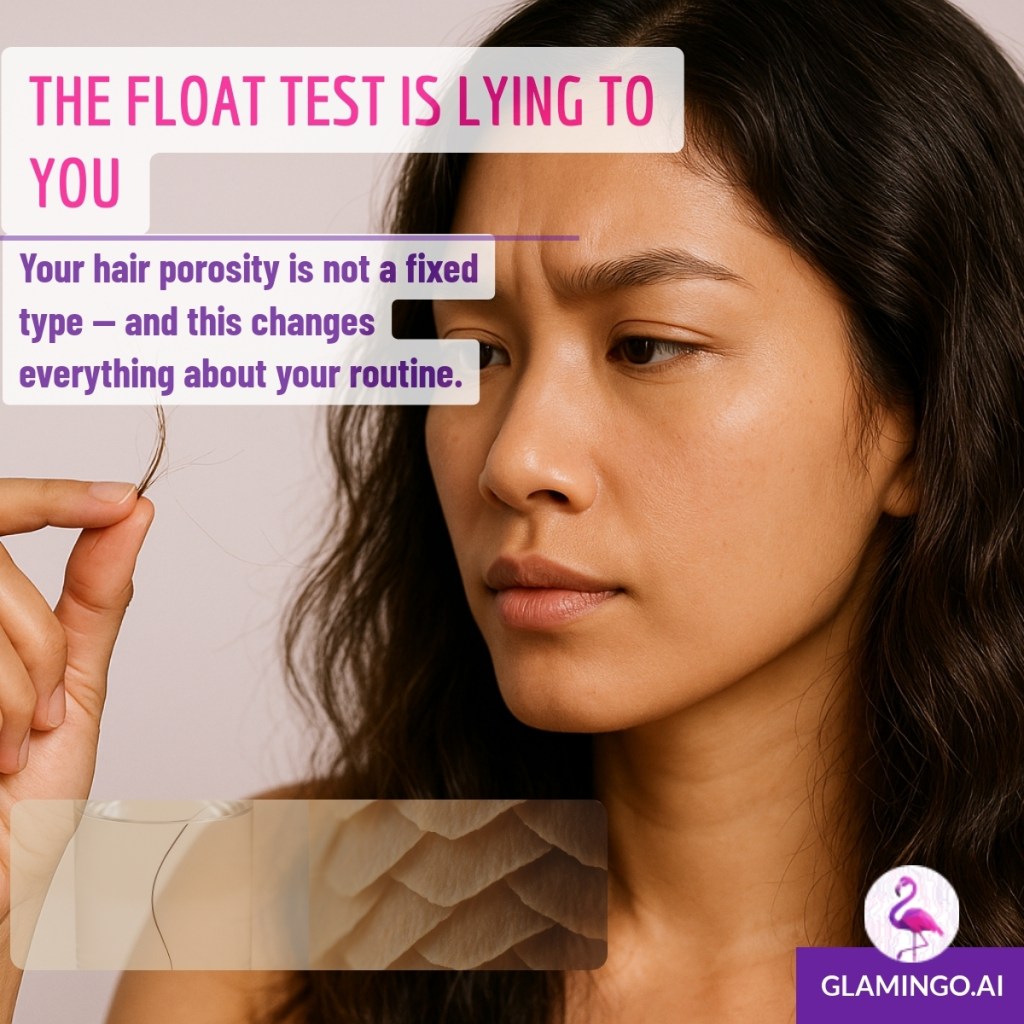
You’ve dropped a strand of hair into a glass of water, watched it float, and decided your hair is low porosity. Half the internet told you to avoid heavy oils. You swapped your products. Nothing changed. Sound familiar? The confusion the float test generates is strikingly consistent — one woman described having “signs of both” porosity types and being completely unable to match any product recommendation to her actual hair. Another got contradictory results from the same test depending on whether she broke the surface tension first. That’s not user error. That’s the test failing you.
Hair porosity content has exploded across every beauty platform in the last few years, and with it, a whole framework of product rules, oil recommendations, and routine overhauls — all built on a diagnostic that doesn’t reliably work. If you’ve spent time trying to figure out whether you’re low, medium, or high porosity, and your hair still doesn’t feel like it’s responding to what you’re doing, you’re not imagining it. The premise itself has problems.
The myth: your hair has a fixed porosity type you can test at home
Where the low/medium/high porosity framework came from — and why it spread
The low/medium/high porosity framework didn’t originate in a laboratory. It emerged largely from the natural hair community, where textured and curly hair types were — and often still are — underserved by mainstream haircare advice. The intent was genuinely useful: to help people understand why some products worked and others didn’t, and why hair absorbs moisture differently. That’s a real and meaningful question. The problem is that the framework hardened into a fixed typing system, complete with diagnostic tests, and then the beauty industry found it extremely sellable.
Once brands could attach a porosity category to a product, they had a targeting mechanism. Low porosity ranges, high porosity ranges, entire routines built around your “type.” It spread quickly because it felt scientific, it felt personalised, and it gave people a vocabulary to describe why their hair was behaving the way it was. The fact that the underlying test didn’t actually measure what it claimed to measure got quietly buried under the marketing.
What the float test actually measures (hint: it’s not your cuticle)
Whether a strand sinks or floats in a glass of water depends on surface tension, the presence of product residue, and air trapped around the strand — not the actual structure of your cuticle. If you’ve used a silicone-based conditioner recently, that strand may float regardless of your hair’s actual condition. If you broke the surface tension before dropping the strand in, you may get a completely different result. What you’re testing is water physics, not hair biology. These are not the same thing.
This has been called out directly by science-focused haircare communities and beauty scientists. Labmuffin, a PhD-qualified chemistry communicator whose work on beauty science is among the most credible available, has stated directly that hair porosity tests are unreliable. That’s a significant flag when the test underpins an entire product selection system.
What hair porosity actually is — and how it is properly measured
The cuticle layer: what opens it, what closes it, what damages it
Think of your hair cuticle like a pine cone. In dry conditions, the scales open up — that’s what people call “high porosity.” In humid or acidic conditions, the scales close tight — “low porosity.” But a pine cone doesn’t have a fixed open or closed identity. It responds to its environment. Dropping it in a glass of water tells you whether it floats — not whether its scales are open. Your hair works the same way: porosity is a state, not a type, and it shifts based on damage, pH, heat, and what products you’ve been using.
What opens the cuticle scales? Alkaline products, heat styling, chemical treatments, UV exposure, and mechanical damage all cause the outer layer (the cuticle) to lift or degrade. What closes them? Acidic rinses, cooler water temperatures, and conditioning agents that smooth the surface back down. The cuticle opening and closing in response to pH is established hair science — which means the same strand of hair can behave like “high porosity” on one wash day and “low porosity” the next, depending entirely on what it was exposed to in between.
Gas sorption — the real scientific method, and why it’s not a glass of water
The scientifically recognised method for measuring hair porosity is gas sorption — a laboratory process that quantifies how porous the hair structure actually is at a structural level. It involves measuring how gas molecules are absorbed into and released from the hair fibre under controlled conditions. It is precise. It is repeatable. And it has absolutely nothing in common with a glass of water on your bathroom counter.
This isn’t about making consumers feel bad for using accessible methods. It’s about being honest that the home test was never a valid proxy for the lab method — and the gap between the two is large enough to matter for the decisions being made on the basis of the test results.
The verdict: high porosity is mostly damage, not destiny
How proteins, lipids, and pH all shift your hair’s porosity in real time
High porosity is not a fixed hair “type” you are born with in most cases — it is primarily a state of damage. When hair loses structural components like proteins and lipids through repeated heat styling, chemical colouring, bleaching, or aggressive brushing, gaps and holes form in the hair shaft. The outer protective layer thins. The hair becomes more porous as a result. This means porosity can change — it can worsen with more damage, and it can improve (at least temporarily) with the right care.
This is an important reframe. If you’ve been told you’re “high porosity hair type” and internalised that as a permanent characteristic, the more accurate picture is that your hair is currently in a more damaged state — and that state is responsive to what you do next. Proteins (like the keratin that makes up the hair shaft) and lipids (fats that coat and protect the cuticle, particularly the one known as 18-methyl eicosanoic acid or 18-MEA) are partly depleted through damage, and conditioning treatments that replenish these can shift how your hair behaves.
Why the same strand can behave differently depending on what you did to it last week
If you used a clarifying shampoo last week, your cuticle may still be slightly raised. If you followed it with an acidic conditioner, it may have closed back down. If you then heat-styled without a protectant, you’ve opened it up again in a different way — not through pH, but through physical and thermal stress. The strand you’d drop in a glass of water today is not the same strand you’d drop in next Tuesday. Testing it once and assigning it a permanent label ignores the entire dynamic reality of how hair actually works.
The marketing problem: an entire product category built on a flawed test
What brands gain from the porosity framework
Entire product ranges, oil recommendations, and routines are now sold on the basis of a test that doesn’t reliably work. This is a marketing structure built on an unvalidated diagnostic, not a clinically grounded system. Brands gain a targeting mechanism — once you’ve identified as “low porosity,” you’re steered toward their low porosity range. Once you’ve identified as “high porosity,” you’re a different customer segment with different products to sell. The framework creates loyalty loops and product necessity out of a categorisation that the science doesn’t support.
It’s worth being direct: the independent evidence that porosity-matched product selection produces better outcomes than simply paying attention to your hair’s actual condition is thin. The mechanism makes sense on paper. Whether the test reliably identifies that mechanism in the first place is the problem the entire system skips over.
Why the confusion is so common — and why it’s not your fault
The confusion is structurally predictable. Hair changes constantly. It changes with the weather — and in Singapore, where humidity sits at around 80% year-round, your cuticle behaviour on a Tuesday morning is genuinely different from a dry air-conditioned office environment two hours later. It changes with every wash, every treatment, every product layered on top. A framework that assigns you a fixed type cannot account for this variability. When your results don’t match the rules you were given, the natural conclusion is that you did the test wrong, or that you have some unusual combination of characteristics. The actual conclusion is that the framework was never designed to handle the reality of how hair behaves.
What to do instead: read your hair’s behaviour, not its category
Five observable signals that tell you more than any float test
Your hair tells you what it needs through behaviour, and behaviour is something you can observe reliably without a glass of water. Watch whether water beads on the surface of your hair or absorbs into it quickly — that tells you about the current state of your cuticle more honestly than a float test. Notice whether your hair feels rough and dry within hours of washing, or whether it holds moisture through the day — that speaks to damage and protein-lipid depletion. Pay attention to whether it tangles more at the ends than at the roots, which is a common sign of more damage at the ends (as you’d expect from older hair that’s been through more heat and friction). Notice whether protein-rich treatments leave your hair feeling stiffer and brittle, or whether they improve texture — hair that reacts badly to protein may have a different balance of needs than hair that responds well to it. And track which products actually produce observable changes over days and weeks. Tracking which products and oils produce genuine improvements in hair behaviour over time is a more reliable guide to haircare decisions than a single porosity category test — not a peer-reviewed finding, but practically honest in a way the float test simply isn’t.
How Singapore’s humidity and hard water affect how your hair behaves — and what to adjust
Living in Singapore adds two layers that the generic porosity content you’ll find online doesn’t account for. The first is humidity. When moisture in the air is consistently high, your cuticle scales are already being asked to respond to a more humid environment than, say, a reader in London or New York. This can mean products that work in lower-humidity climates feel heavy or build up faster here. It also means the pine cone is already getting signals to close — which affects how your hair absorbs applied products. Lighter application, more frequent clarifying, and paying attention to how your hair behaves specifically in this climate rather than following advice calibrated for somewhere drier is genuinely useful.
The second is hard water. Singapore’s tap water contains minerals (primarily calcium and magnesium) that deposit on the hair shaft over time, creating a film that affects how hair absorbs moisture and responds to products. This can mimic “low porosity” behaviour — water beading on the surface, products not absorbing — when the actual issue is mineral build-up rather than tightly closed cuticles. A chelating shampoo (one designed to bind and remove mineral deposits) used once or twice a month will tell you more about what your hair actually needs than recategorising your porosity type.
This week, instead of repeating the float test or trying to assign yourself a porosity category, spend five minutes observing how your hair actually behaves after your next wash: does water bead on the surface or absorb quickly? Does it feel rough and dry within hours, or stay soft? Does it tangle more at the ends than the roots? These are the signals that will tell you whether your hair is damaged, how it responds to moisture, and what it actually needs — without a category label that the science can’t validate.
If you’d like a professional assessment of your hair’s condition rather than a category — someone who can look at your actual hair, not a float test — Glamingo has verified hair treatment salons and trichology-informed hair care providers across Singapore. Find one near you and book directly. Search hair treatments on Glamingo →
 Glamingo Blog
Drop in your comments..