
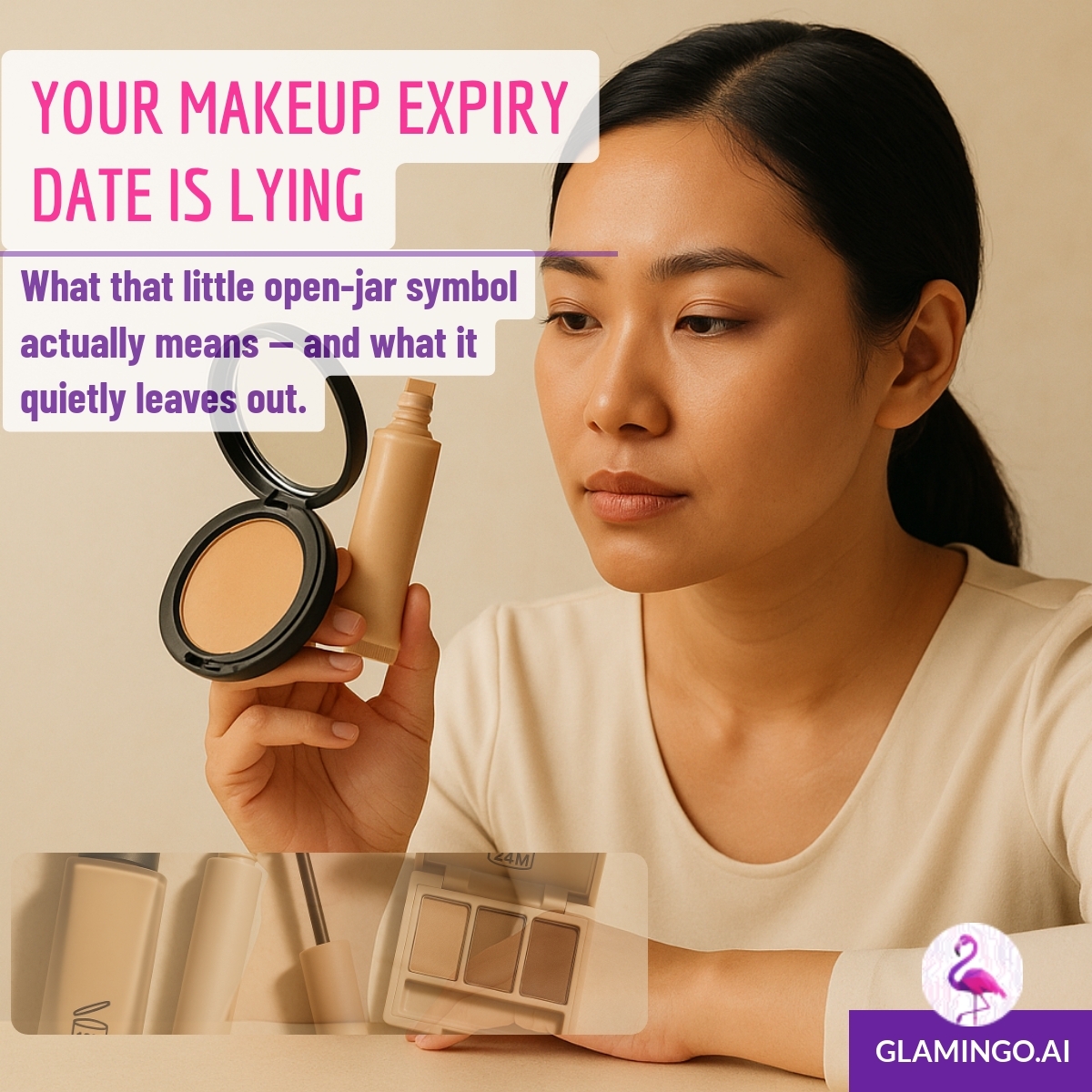
You open a foundation you bought two years ago, sniff it, decide it smells fine, and use it anyway — then later wonder if you did something reckless. Or you’ve read that eyeshadow palettes expire after 12 months and quietly ignored that because you spent $80 on one. Here’s what’s actually happening when makeup ‘expires,’ and why the date stamped on your product is telling you something more specific — and less alarming — than you’ve been led to believe.
The guilt around this is real. Most of us have a drawer or makeup bag that contains things we know we’ve held onto too long, sitting alongside things we’re quietly convinced are still perfectly fine. The problem is that the beauty industry has handed us one blunt tool — a little open-jar icon with a number — and told us to use it to make a nuanced safety decision. That’s not really how it works. And understanding why changes what you actually need to worry about.
The myth: makeup has an expiry date that tells you when it goes bad
What the PAO symbol actually means — and what it doesn’t
That small open-jar symbol printed on your makeup packaging — usually followed by a number like 12M or 24M — is called the Period After Opening symbol, or PAO. What it’s telling you is how long the formulation’s preservative system is expected to remain effective after you first open the product. It is not a hard safety cutoff. It is not the date the product turns toxic. And crucially, it has nothing to say about the product if you haven’t opened it yet — an unopened product follows an entirely different shelf-life timeline, often significantly longer.
The number is a formulation estimate, based on stability testing done under controlled conditions. It tells you when the preservative system was designed to start losing reliability — not when something definitively goes wrong. Think of the preservative system in your makeup like a bouncer at a door. The PAO date is roughly when the bouncer is expected to clock off. But whether bacteria actually get in depends on how often you’ve opened the door, whether you’ve been double-dipping your fingers, and whether the heat outside has already tired the bouncer out early. The date on the jar tells you when the shift was scheduled to end — not whether the door has already been breached.
The difference between a ‘use by’ date on food and a PAO on makeup
Food expiry dates work on a different logic entirely. They’re telling you that chemical and microbial changes in a perishable product have reached a point where consumption becomes genuinely dangerous on a predictable timeline. Your sandwich goes off on Thursday regardless of whether you opened it or touched it or left it near a window.
A PAO on makeup is conditional. It assumes average use, average storage conditions, and a product that isn’t being contaminated through repeated finger contact or exposure to moisture. Change any of those variables — and you’ve changed the actual risk, independent of what the calendar says. The date is a useful starting point. It was never meant to be the whole answer.
The real risk: preservatives, bacteria, and how you use the product
Why bacteria in makeup is the actual concern, not a chemical clock
Here’s the reframe that matters: the safety concern with makeup that’s past its PAO isn’t that ingredients suddenly turn harmful on a fixed date — it’s that the preservative system degrades over time, leaving any bacteria you’ve introduced during normal use with increasingly less to fight against. The makeup doesn’t become dangerous by itself. It becomes less able to protect you from what you’ve been putting into it.
This is a use-dependent risk, not a calendar-dependent one. A foundation that’s been opened twice in two years, stored in a cool dark place, and applied with a clean brush is in a fundamentally different condition from one that’s been opened daily, touched with fingers, and kept in a steamy bathroom. Same PAO on the label. Completely different actual risk profile.
How cosmetic products can harbour bacteria with antibiotic resistance
This is where the risk stops being theoretical. Research has found that cosmetic products can be a source of bacteria with acquired antibiotic resistance — introduced through the kind of ordinary, daily contamination that happens during normal product use. Touching a product and then reintroducing it back into the same container, repeatedly, over months, creates conditions where resistant bacteria can establish themselves. It’s not a fringe concern. It’s the mechanism that makes old, frequently used liquid products genuinely worth scrutinising.
The eye area is particularly vulnerable here, and we’ll come back to that. But the broader point is that the risk in your makeup bag is bacterial, not alchemical. It’s not that your foundation is brewing something sinister on its own — it’s that you’re an active participant in what happens inside that bottle every time you open it.
What ‘degraded preservatives’ actually means in practice
Most makeup and skincare items have a shelf life because the preservatives in the formulas degrade over time — that’s the actual mechanism driving the entire conversation. Preservatives are not infinitely stable. Heat, light, air exposure, and time all work against them. When they’ve degraded beyond a functional threshold, the product is no longer able to suppress microbial growth the way it was designed to. You may not see any difference. You may not smell any difference. But the defence has quietly stepped down.
This is worth understanding because it explains why storage conditions matter as much as the date on the label — sometimes more.
Not all makeup ages the same way
Dry formats vs liquid formats — why your mascara and your eyeshadow palette are not the same conversation
Product format is probably the single most useful lens for thinking about actual risk. Dry products — pressed powders, eyeshadow palettes, baked blushes — are low-water environments where bacteria struggle to grow. Bacteria need moisture to thrive. A pressed powder palette doesn’t give them much to work with. This is why the widely circulated advice that eyeshadow palettes must be replaced after 12 months is, frankly, an overcall for most people under most conditions.
Liquid and water-containing products are a different matter entirely. Foundation, concealer, liquid eyeliner, mascara — these create conditions where microbial growth is far more likely once preservatives weaken. The water content that makes them blendable and skin-like also makes them hospitable to bacteria in a way that a dry pressed powder simply isn’t. The format determines the risk level. Treating all makeup as equally perishable flattens a genuinely important distinction.
Eye-area products carry higher stakes than face products
Even within liquid products, application zone changes the calculation. Contaminated product applied near the eye — where the mucous membrane is immediately adjacent and where bacteria can access the eye directly — carries meaningfully higher stakes than the same product applied to the cheek or forehead. Eye infections from contaminated cosmetics are a real outcome. They’re not common, but they’re not hypothetical either.
Mascara is the highest-risk product in most people’s makeup bags for this reason: it’s a liquid, it’s used near the eye, the wand is reintroduced into the tube after every single use, and the tube creates a warm, contained environment where any contamination has nowhere to go. The 3-month PAO guidance on mascara is one of the few where the timeline has genuine biological logic behind it, not just marketing incentive.
The Singapore factor: heat, humidity, and bathroom storage
Why PAO estimates assume conditions your bathroom doesn’t have
PAO estimates are based on stability testing conducted under controlled laboratory conditions — typically temperate climates, stable temperatures, and low humidity. Singapore’s year-round heat and roughly 80% ambient humidity mean your makeup is aging in conditions the PAO was not really designed for. Heat and humidity accelerate preservative breakdown, which means products stored in a Singapore bathroom or near a window may be reaching their functional limits before the label date suggests — regardless of what the number says.
This doesn’t mean everything needs to be thrown out earlier. It means that bathroom storage for liquid products specifically is worth reconsidering. A cool, dry drawer in your bedroom — away from the shower’s steam — is a genuinely better environment for preservative longevity than a humid bathroom cabinet that fluctuates in temperature every time the shower runs.
Counterfeit products and why their expiry timelines are unreliable from day one
There’s an additional layer of uncertainty worth naming, particularly for anyone who shops across e-commerce platforms in Singapore. Thousands of skincare and beauty products available on local e-commerce platforms may be counterfeit — and this matters for the expiry conversation because counterfeit cosmetics may have compromised or entirely absent preservative systems from the moment you open them. Their PAO symbol, if they even have one, is meaningless. You’re starting with a product whose protective system was never functional, which makes any timeline printed on the packaging unreliable from day one. It’s worth flagging because the instinct to buy a ‘cheaper version’ of a luxury product online doesn’t always account for this particular risk.
The verdict — what you can actually throw away and what you can keep
The sensory checklist: smell, texture, colour separation, and performance change
The most honest toolkit for assessing a product that’s past its PAO isn’t a calendar — it’s your senses. A change in smell (particularly a rancid, sour, or just different odour than when you first opened it) is a meaningful signal that something in the formulation has shifted. A change in texture — a liquid that’s separated, become thicker, gone lumpy, or developed a film — tells you the emulsion or formulation structure has broken down. Colour changes that aren’t explained by oxidation on the surface of a product, and a product that suddenly performs differently than it used to, are all worth paying attention to.
None of these signals require a chemistry degree to read. They’re the same instincts you’d apply to food — not because makeup expires like food, but because your senses are actually a reasonable proxy for product condition when you know what to look for. The sniff test you applied to that two-year-old foundation? It’s not a bad instinct. It just needs to be one tool among several, not the only one.
The one category where the date genuinely matters
There’s a point of honesty worth ending on: for most dry products, the anxiety around PAO dates is genuinely disproportionate. Your pressed eyeshadow palette from 2022, stored well and used with clean brushes, is almost certainly not a safety risk. The widespread messaging that all makeup must be replaced on the PAO date is — as more than one experienced beauty user has observed — difficult to separate from the commercial interest in selling more product. That scepticism is warranted.
But mascara, liquid eyeliner, and other liquid eye-area products genuinely are the category where the format and application zone combine to make the risk real. Here, the date matters less than how the product looks, smells, and applies — and the willingness to let go when those signals change.
This week, go through your liquid eye products specifically — liquid eyeliner and mascara — and apply the sensory test: any change in smell, texture, or how it applies means it goes. These are the highest-risk format and application-zone combination in your makeup bag. Your pressed eyeshadow palette from 2022 is almost certainly fine. Your three-year-old tube of liquid liner is the one worth questioning.
If this has you thinking about which products in your current routine are actually worth replacing versus keeping, Glamingo can help you find beauty counters and professional makeup services near you where you can get honest, hands-on advice without the hard sell. Browse beauty services near you →
Leave a Reply