
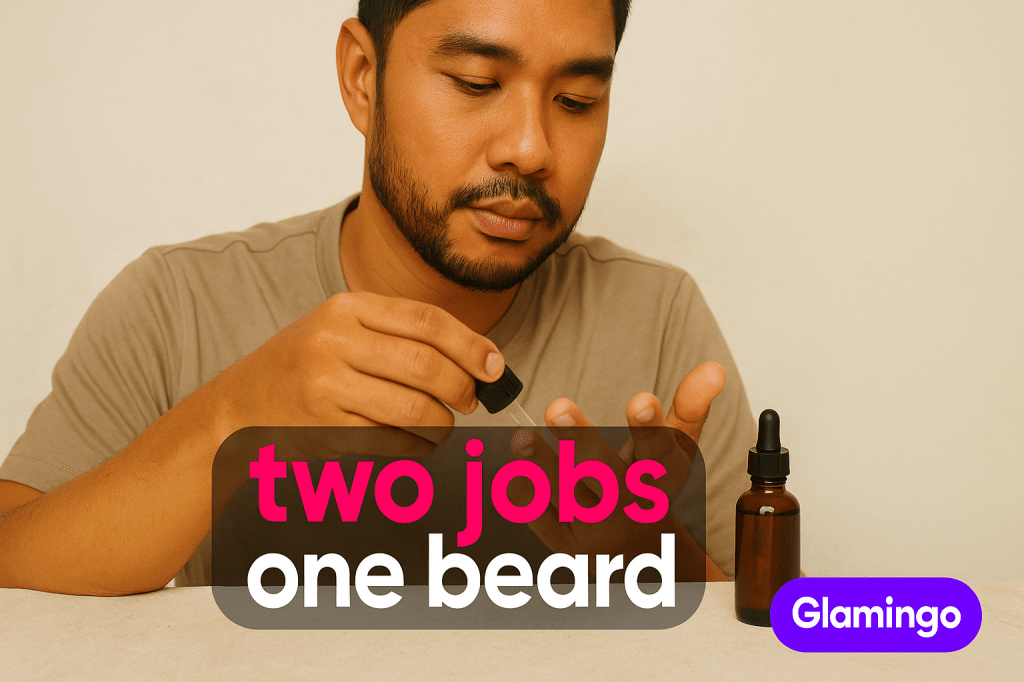
Your beard is dry and frizzy, but your face underneath feels tight or flaky — and no amount of regular face wash seems to fix either problem. That’s not a product failure. It’s a biology problem. Beard hair and facial skin have fundamentally different structural needs, and most men are treating them with the wrong tools. The fix is not more product. It’s understanding what you’re actually dealing with.
This situation is more common than the grooming industry lets on. The default mental model most men have — beard as a hair problem, skin underneath invisible — is exactly why routines fail. You might be buying oil after oil trying to tame frizz, completely unaware that the tight, flaky skin beneath the beard is a separate issue running in parallel, quietly worsening. And if a well-meaning partner has ever bought you a beard care set without really knowing what’s in it or why, that’s not their fault — the category is poorly explained and aggressively marketed. Here’s what’s actually going on.
The mechanism question: why does beard hair need different care from the rest of your face?
How beard hair is structured differently from scalp hair — and why that changes everything
Think of your beard hair like a length of rough rope left out in the sun — it dries out, frays, and stiffens without conditioning. The skin underneath is like the ground beneath a tarpaulin: sheltered from rain but also trapped in its own moisture and heat, collecting debris the tarpaulin above brings in. This isn’t just a visual metaphor. It describes the actual functional problem you’re trying to solve.
Beard hair is structurally coarser than scalp hair. The outer protective layer of each strand — the cuticle — is more raised and irregular, which means moisture escapes from the hair shaft faster and friction between strands causes more visible frizz. Because the hair itself is thicker and grows at a different angle than scalp hair, it also doesn’t distribute sebum (the skin’s natural oil) efficiently down the length of the strand the way scalp hair does. The result: even if your skin is producing adequate oil at the follicle, the ends of longer beard hair are chronically under-moisturised. This structural difference is why beard hair is more prone to brittleness and frizz than head hair under the same conditions.
What happens to the skin under the beard that regular face wash misses
The skin beneath your beard is dealing with a completely different set of problems. It’s partially occluded — covered and poorly ventilated — which means sweat, sebum, dead skin cells, and product residue accumulate faster than on exposed facial skin. In Singapore’s year-round humidity, that process accelerates. You’re essentially creating a warm, slightly damp microenvironment under your beard every single day. That’s not inherently bad, but it does mean the skin under your beard needs more deliberate cleansing than your forehead does.
Standard face wash is typically formulated to cleanse the skin surface. It’s not designed to penetrate a layer of coarse hair, reach the follicles beneath, and remove the specific combination of product residue and beard-trapping debris that accumulates there. The skin under the beard is simultaneously more prone to dryness and product buildup — a dual-problem that a single off-the-shelf face wash rarely addresses effectively. So the rope stays dry and the ground stays congested. Both problems look like one problem. They’re not.
What actually controls beard growth — and what doesn’t
Testosterone, DHT, and the androgen-follicle relationship
If you’ve ever wondered why some men grow thick, full beards at 22 and others are still waiting at 35, the answer lives in your hormones and your genetics — not in your product shelf. Beard growth is primarily driven by testosterone and its more potent derivative, dihydrotestosterone (DHT) — the two main androgens that signal hair follicles on the face to grow coarse, terminal hair. DHT, which is converted from testosterone by an enzyme in the skin, is particularly influential in facial hair development. The follicles on your face have androgen receptors, and how sensitive those receptors are to DHT largely determines how dense and fast-growing your beard will be.
This hormonal signalling is why beard growth changes during puberty, why it can shift slightly with significant hormonal fluctuations in adulthood, and why conditions that affect androgen levels have visible effects on facial hair. Understanding this also explains something that a lot of beard care marketing carefully avoids saying out loud.
Why genetics sets the ceiling — and topical products can’t override it
No beard oil, no serum with exotic botanicals, and no “growth-stimulating” face roller will change the fundamental density of your beard. Your genetic blueprint determines how many follicles you have on your face, how sensitive they are to androgens, and where they’re distributed. Topical products applied to the skin surface cannot reprogramme follicle receptor sensitivity. The beard care market — projected to reach $38 billion by 2030 — has a commercial incentive to imply otherwise. That figure reflects commercial momentum, not scientific validation of growth claims.
What topical care can do is optimise the conditions around the hair and skin you already have. That’s genuinely useful. It’s just a different and more modest promise than what a lot of products imply on the label.
What beard oil actually does (and what it can’t do)
The real function: moisture-sealing and conditioning the hair shaft and skin
Beard oil is not a growth stimulant. It is a conditioning and moisture-sealing agent — functioning as both an emollient (softening the hair shaft and skin) and an occlusive (slowing moisture loss from the skin surface beneath). Going back to the rope analogy: beard oil is the conditioning coat that keeps the fibres from cracking. It won’t make the rope longer. It keeps the rope you have from becoming a brittle, fraying mess.
Its real function is reducing brittleness, taming frizz, and preventing moisture loss from the skin beneath the beard — and when applied correctly to slightly damp hair after washing, it genuinely does all three. That’s worth something. It’s just not worth the growth claims.
What to look for in a formulation — and what to avoid in Singapore’s humidity
In a temperate or dry climate, heavier oils like castor or argan can deliver excellent conditioning without consequence. In Singapore’s heat and humidity, the calculus shifts. Heavy, comedogenic oils — those with a higher tendency to block pores — will sit on already-warm, already-sweaty facial skin and contribute to congestion and breakouts under the beard. Lighter, non-comedogenic carrier oils like jojoba (which closely mimics the skin’s own sebum), sweet almond, or grapeseed are better suited to a Southeast Asian climate.
Fragrance is a separate consideration. Many beard oils use high fragrance loads for scent appeal. On the scalp this is relatively low-risk. On facial skin — a higher-absorption area that you’re treating daily — fragrance components are worth scrutinising. More on that shortly.
The growth-treatment question: minoxidil in beard serums
How minoxidil works — and what the evidence actually shows for beard use vs. scalp use
Minoxidil deserves its own section because it’s increasingly appearing in beard care products and because its backstory is genuinely unusual. Minoxidil was originally developed and approved as a treatment for high blood pressure (hypertension) — its hair-related effects were discovered as a side effect. It works by prolonging the active growth phase of hair follicles (the anagen phase) and by widening blood vessels near follicles, theoretically improving nutrient and oxygen delivery to the follicle bed.
The evidence for minoxidil on scalp hair loss is reasonably well-established and it has regulatory approval for that use. For beard growth specifically, the evidence is more limited. Small studies have shown some increase in beard hair density with topical minoxidil application, but these trials are generally small and lack the scale of scalp hair loss research. The mechanism makes sense on paper. Whether it reliably delivers meaningful beard growth in practice — and which men will respond — is still an open question.
What to know before trying it
Minoxidil is a pharmacologically active compound, not a cosmetic ingredient. Side effects documented in scalp use include scalp irritation, unwanted facial hair growth in women who contact treated surfaces, and in rare cases with systemic absorption, cardiovascular effects. Applying it to the face — a higher-absorption area than the scalp — means those considerations are not trivial. If you’re considering a minoxidil-containing beard serum, it warrants the same informed decision-making you’d apply to any active ingredient, not a casual addition to your morning routine. Consulting a doctor before starting is not overcautious here — it’s appropriate.
Ingredient safety in beard care — the concern the market doesn’t advertise
Why facial skin absorption matters more than you think
Here is something the beard care category does not advertise prominently: peer-reviewed health literature has flagged potential toxicity concerns with certain components in beard care products, noting that ingredient safety in this category warrants closer consumer scrutiny. The specific concern is not that beard oil will poison you. It’s that daily application of any product to the face — a skin surface with higher absorption rates than the body — means that ingredient loads matter more than with, say, a hand lotion you use occasionally.
The word “natural” on a label does not resolve this. Essential oils, which appear widely in beard care formulations for scent and claimed skin benefits, can be potent contact allergens and sensitisers. Preservatives like certain parabens have been subjects of ongoing safety debate. Fragrance compounds are among the most common causes of contact dermatitis in cosmetic products. None of this means you need to panic about your current beard oil. It means you should read labels with the same mild scepticism you’d apply to any product going on your face every day.
How to read a beard product label with scepticism
The ingredients list on a cosmetic product runs in descending order of concentration — what’s listed first is present in the largest amount. Look at where fragrance (or “parfum”) sits. If it’s high on the list, fragrance is a significant component of the formula. Look for known irritants like alcohol denat (denatured alcohol) near the top — in Singapore’s climate, a drying alcohol-heavy beard oil will accelerate the exact problem you’re trying to solve. Unfamiliar botanical extracts listed with no indication of concentration or clinical purpose are usually there for marketing, not function. The active work in a beard oil is done by the carrier oils. Everything else is context.
A practical beard care framework for the Singapore climate
Cleansing frequency and product weight — getting the basics right in heat and humidity
In Singapore, sweat, sebum, and product residue accumulate faster under facial hair than in cooler climates. A beard that felt adequately clean in Melbourne or Seoul in winter will need more frequent cleansing here. For most men with a medium to long beard in Singapore, washing the beard two to three times a week with a dedicated beard wash or a gentle, low-sulphate cleanser is more appropriate than daily shampooing (which strips moisture) or infrequent washing (which allows buildup). On non-wash days, rinsing thoroughly with water and working it through to the skin beneath is underrated and free.
Product weight matters as much as ingredient quality here. A thick, heavy beard balm formulated for a cold-weather climate is going to behave very differently on your skin in 32-degree heat. Start with a lightweight oil, applied sparingly to slightly damp hair — never bone-dry, which makes application uneven and absorption poor.
The minimum effective routine: what you actually need vs. what the market is selling you
The beard care market is enthusiastically diverse. Beard washes, beard conditioners, beard oils, beard balms, beard serums, beard combs, beard rollers, growth vitamins. Some of this is genuinely useful. Much of it is the category expanding to fill commercial space, not skin need. The honest minimum effective routine is simpler than most product marketing suggests.
You need something to cleanse the hair and the skin beneath it properly — a beard wash or low-sulphate cleanser does this. You need something to condition the hair shaft and seal moisture into the skin — a lightweight, non-comedogenic beard oil does this. Applied correctly and consistently, those two things will address the vast majority of dryness, frizz, and under-beard skin issues most men in Singapore experience. A beard balm adds hold and slightly heavier conditioning for longer beards and is worth adding if you need it. Everything beyond that is optional, and some of it — particularly growth serums making significant density claims — deserves healthy scepticism until you understand what’s in them and what the evidence actually says.
This week, wash your beard with a dedicated beard wash or a gentle, low-sulphate cleanser instead of your regular face wash — then apply a lightweight, non-comedogenic beard oil only to slightly damp hair. This tests whether your current dryness or frizz issue is a cleansing and moisture-sealing problem (the most common cause) rather than a growth or product problem.
If you’d rather get a professional take on your beard and skin condition before building a routine from scratch, Glamingo has men’s grooming and facial treatment options near you with verified reviews from real customers. Find a provider →
 Glamingo Blog
Drop in your comments..