
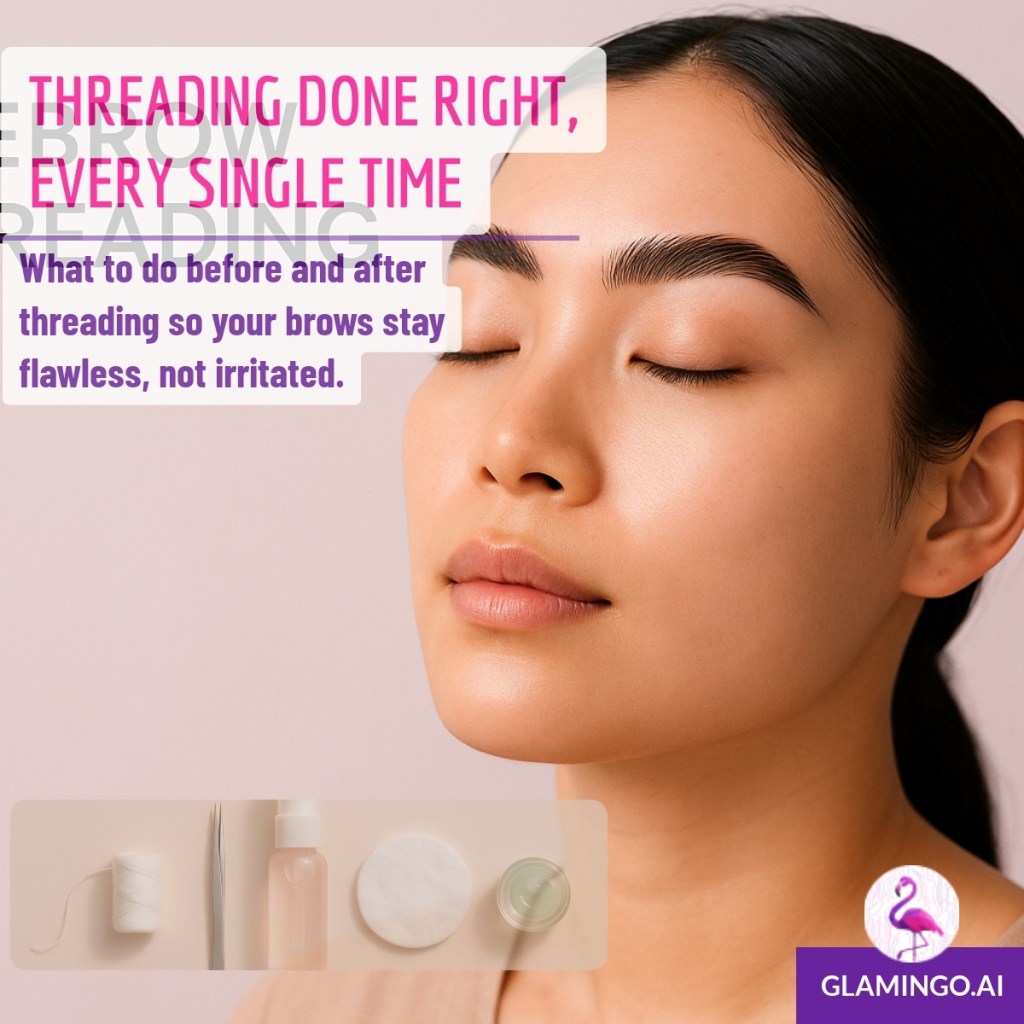
You walked out of your last threading appointment with perfectly shaped brows — and by day three, one side had swollen, your skin was still red, and a few hairs you didn’t want gone were missing. Threading is one of the most precise hair removal methods available, but what you do before and after the appointment determines whether you get two weeks of clean results or two weeks of damage control.
The frustrating part is that none of this is particularly complicated. Threading itself is quick — often under ten minutes for brows — and the technique hasn’t changed much in centuries. What has changed is that most of us are now using active skincare ingredients, booking laser treatments, and expecting our skin to perform through it all without a briefing. The gap between a great threading result and a problematic one usually comes down to timing and aftercare that nobody at the salon actually explains to you. This protocol fills that gap.
What threading actually does to your skin (and why that matters for prep and aftercare)
The mechanics — how a twisted thread removes hair at follicle level
Think of threading like a very precise pair of scissors made from a twisted loop of cotton. Instead of cutting the hair at the surface, the loop catches individual hairs at the root and pulls them cleanly from the follicle — the same way you would pull a splinter out at an angle rather than breaking it off at the skin. That root-level removal is why the results last longer than shaving, and why the skin is temporarily more vulnerable: the follicle opening is exposed until it closes back down over the next 24 hours.
Threading typically keeps brows clean for two to three weeks before regrowth becomes noticeable, though this varies depending on your individual hair growth cycle. With consistent appointments over time, repeated root-level removal can gradually weaken the follicle, which many people find reduces regrowth density — though this effect isn’t robustly studied and results differ person to person.
Why threading is different from waxing for sensitive and darker skin tones
Here is what a lot of salons won’t spell out: threading involves no chemical contact with the skin — unlike waxing — making it a lower-irritant option, particularly for those managing skin sensitivity or prone to post-inflammatory hyperpigmentation. No adhesive, no heat, no stripping of the skin surface. Usually just a small amount of witch hazel or rose water before and after, which is precisely why people with sensitive skin tend to do better with threading than waxing.
This matters significantly in a Southeast Asian context. Post-inflammatory hyperpigmentation (PIH) — the darkening that happens when skin is irritated or traumatised — is a known concern for Fitzpatrick skin types III through V, which describes most Singaporean and Southeast Asian skin. The mechanism behind threading’s lower PIH risk makes sense: less heat and adhesive contact means less trauma to the skin surface. That said, this reasoning is based on how each method works rather than head-to-head clinical trials, so think of it as a strong rationale rather than a guaranteed outcome.
Before your appointment — the preparation protocol
Step 1: Let regrowth reach the right length
Threading needs something to grab. If your hairs are too short — think freshly tweezed or shaved stubble — the thread can’t catch them cleanly and the therapist will either miss hairs entirely or catch skin instead. Aim for at least two to three millimetres of growth. If you’ve been filling your brows with pencil or powder every day, this might feel uncomfortable, but that brief awkward week is what makes the threading session actually work.
Step 2: Arrive with clean, product-free skin
Show up to your appointment with clean, bare skin around the brow area. No SPF, no foundation, no brow gel. Products on the skin change the surface tension slightly, which can affect how cleanly the thread moves, and residue near the follicle opening after threading increases the risk of irritation or breakouts in the area. A gentle cleanser before you leave home is all you need.
Step 3: What to avoid in the 24–48 hours before threading (actives, exfoliants, retinoids)
If you are using chemical exfoliants (AHAs and BHAs — acids that dissolve dead skin cells), retinoids (vitamin A derivatives that accelerate skin cell turnover), or any prescription actives around the brow area, pause them for at least 48 hours before your appointment. These ingredients thin and sensitise the outermost layer of the skin (the stratum corneum). Threading over freshly actived skin dramatically increases the risk of redness that lasts days rather than hours, surface grazing, and in some cases, temporary raw patches where the thread catches compromised skin rather than just hair.
This is the most commonly skipped prep step and the most likely culprit when people blame threading for skin damage that was actually a timing issue.
Step 4: If you are doing laser hair removal, stop threading at least one month before
This one is non-negotiable. For laser hair removal procedures, threading and waxing should be avoided for at least one month prior to the procedure, because the hair shaft must remain intact for the laser to effectively target the follicle. Laser energy travels down the hair shaft to the root. If you’ve threaded and there is no shaft present, the laser has nothing to target — and you’ve paid for a session that can’t work properly. If you have laser booked in the next four weeks, trim stray brow hairs instead of threading.
During the appointment — what to expect and what to communicate
Pain, redness, and what is normal vs. what is not
Threading is not painless. The sensation is a sharp, quick sting as each row of hairs is removed — most people describe it as somewhere between tweezing and a light flick. Immediately after, the threaded area will look pink to red and feel slightly raised or warm. This is completely normal. The redness is the skin’s short-term inflammatory response to follicle-level hair removal and should begin fading within 30 to 60 minutes for most skin types. Some sensitivity may persist for a few hours.
What is not normal: swelling that worsens rather than improves in the hours after the appointment, blistering, broken skin, or persistent redness that has not resolved by the following morning. If the therapist’s thread is catching skin rather than just hair — which can happen with technique errors or an overly tight grip — you may notice small surface abrasions. These are a sign of technique, not threading as a method, and worth factoring into whether you return to that specific salon.
How to give clear shape instructions without over-directing
The best threading results come from a conversation at the start of the appointment, not constant correction mid-session. Before the therapist starts, be specific about two things: the arch shape you want (high arch, soft arch, or natural follow of your existing brow shape) and the thickness you want to keep. Showing a reference photo on your phone is genuinely useful — it removes the ambiguity of terms like “natural” or “clean up”, which mean very different things to different therapists.
Once threading begins, the session moves quickly. If something feels wrong — if you sense the shape is going in a direction you didn’t intend — say so immediately. Mid-session is always easier to correct than post-session.
Immediately after threading — the 24-hour aftercare window
Step 5: Soothing lotion or antibiotic cream on the threaded area
After a threading session, applying a soothing lotion or antibiotic cream to the threaded area is standard post-procedure practice. A good salon will do this for you before you leave. If yours doesn’t, this is worth flagging — or doing yourself when you get home. A fragrance-free, alcohol-free soothing lotion (aloe vera-based works well), or a thin layer of over-the-counter antibiotic cream if your skin is prone to post-threading breakouts, helps calm the inflammatory response and reduces the window during which exposed follicle openings can become infected.
The lack of any aftercare guidance from a salon is one of the most common complaints from people who’ve had threading go wrong. A quick application takes thirty seconds. Don’t skip it just because they didn’t offer it.
Step 6: No makeup on threaded skin for at least 24 hours
Makeup should be kept off the threaded area for at least 24 hours after the procedure to reduce the risk of infection and irritation in temporarily open follicles. Foundation, brow products, concealer — all of it. The follicle openings are physically open for roughly 24 hours post-threading, and pigments, preservatives, and application brushes are all potential irritants in that window. If you need to be somewhere important the day of your appointment, that’s another reason to plan your threading at least a week out from a big event.
Step 7: Apply sunscreen before going outside — non-negotiable in Singapore’s UV Index 10–12 climate
Sunscreen is essential after threading if you will be outdoors, as the freshly exposed follicle openings increase UV sensitivity in the treated area. In Singapore, where the UV Index sits between 10 and 12 for most of the year, this isn’t a minor consideration — it’s the difference between clean healing and hyperpigmentation. Use a mineral sunscreen (zinc oxide or titanium dioxide) rather than a chemical filter on freshly threaded skin, as it sits on the surface rather than absorbing into the skin and is less likely to irritate exposed follicles. SPF 50, reapplied if you’re outside for more than a couple of hours.
The 2-week maintenance window — keeping results clean
How to handle regrowth between appointments without tweezers
Put the tweezers down. Tweezing between threading appointments disrupts the follicle weakening that consistent threading builds over time — and it can pull hairs at an angle that makes them more likely to become ingrown. If a stray hair is bothering you in the first week, a small pair of brow scissors to trim the length is a far better option. It addresses the visual issue without pulling the root.
Ingredients and actives to reintroduce and when
Give your skin a full 48 hours before reintroducing retinoids, AHAs, BHAs, or any prescription actives around the brow area. The skin surface needs to fully close and stabilise before it can handle anything that accelerates cell turnover or lowers the skin’s pH. Reintroducing too early is a reliable way to end up with prolonged redness or small whiteheads along the threading line. After 48 hours, your normal routine can resume.
Spacing appointments correctly to support follicle weakening over time
For most people, every two to three weeks is the sweet spot for threading appointments — long enough for regrowth to reach a workable length, frequent enough to maintain the shape. Booking too infrequently and letting significant regrowth accumulate means each appointment essentially starts from scratch, which limits the gradual follicle weakening that consistent threading can achieve. Think of regular appointments less as a chore and more as a long-term investment in sparser, finer regrowth over time.
If you have a wedding or significant event coming up, industry guidance generally suggests threading at least one week before — not the day before, and definitely not the day of. This is general practice rather than clinical evidence, but the logic is sound: any residual redness or sensitivity has fully resolved, and you have time to address anything that needs a small correction.
When threading is not the right choice
Active skin conditions, open wounds, or recent chemical peels
Threading moves a thread across the skin surface at speed. If that surface has active eczema, psoriasis, open spots, or has recently undergone a chemical peel, you are asking the thread to move across compromised skin — and the result will not be a clean hair removal session. It will be irritation, potential removal of skin that wasn’t ready to be disturbed, and a longer healing window for everything. Reschedule for when the skin is fully settled. A therapist worth their salt should be checking for this before they start.
If you are on isotretinoin or topical retinoids — what the skin state means for threading tolerance
Isotretinoin (the oral acne medication sometimes known by the brand name Roaccutane) thins and sensitises skin significantly — not just at the surface but deeper into the tissue. Threading on isotretinoin is widely advised against because the skin’s structural integrity is reduced, which means the mechanical pull of threading can cause grazing, tearing, or prolonged inflammation that wouldn’t occur in skin with normal barrier function. Topical retinoids cause a milder version of the same effect, which is why the 48-hour pause rule applies. If you are currently on oral isotretinoin, speak to your dermatologist before booking any threading appointment.
What a good threading result actually looks like — and how to spot a bad one early
A well-executed threading result looks clean and symmetrical — a defined arch that follows the natural bone structure of your brow, with a smooth skin surface that calms to its normal tone within an hour. You should not see broken skin, uneven patches where hair has been removed inconsistently, or significant asymmetry between the two brows at the end of the session.
The early warning signs of a problematic result are worth knowing. Threading carries a risk of ingrown hairs and hyperpigmentation when performed incorrectly or without proper aftercare. Ingrown hairs typically show up as small raised bumps along the threading line in the days after — usually a sign that hairs were broken rather than cleanly pulled at the root, or that the follicle closed over a hair that didn’t fully exit. Hyperpigmentation in the threading area that develops over one to two weeks post-appointment points to either a technique issue, sun exposure on unprotected freshly threaded skin, or a skin type that needed more careful aftercare management.
Neither outcome is inevitable. Both are significantly less likely when the prep and aftercare in this protocol are followed correctly. The threading itself takes minutes. The before and after is where the actual result is made.
Before your next threading appointment, check the timing against any active treatments in your current routine. If you are using a retinoid, AHA, or BHA, stop applying it to the area being threaded for at least 48 hours before and 48 hours after. If you are booked for laser hair removal in the next four weeks, move the threading appointment — or skip it entirely and trim instead. That single timing adjustment is the most common mistake that turns a clean threading result into an irritated one.
If you’d rather leave the shape work to a professional you can trust, Glamingo lists threading specialists across Singapore with verified reviews and real pricing — so you can compare before you book. Find a threading salon near you →
 Glamingo Blog
Drop in your comments..