
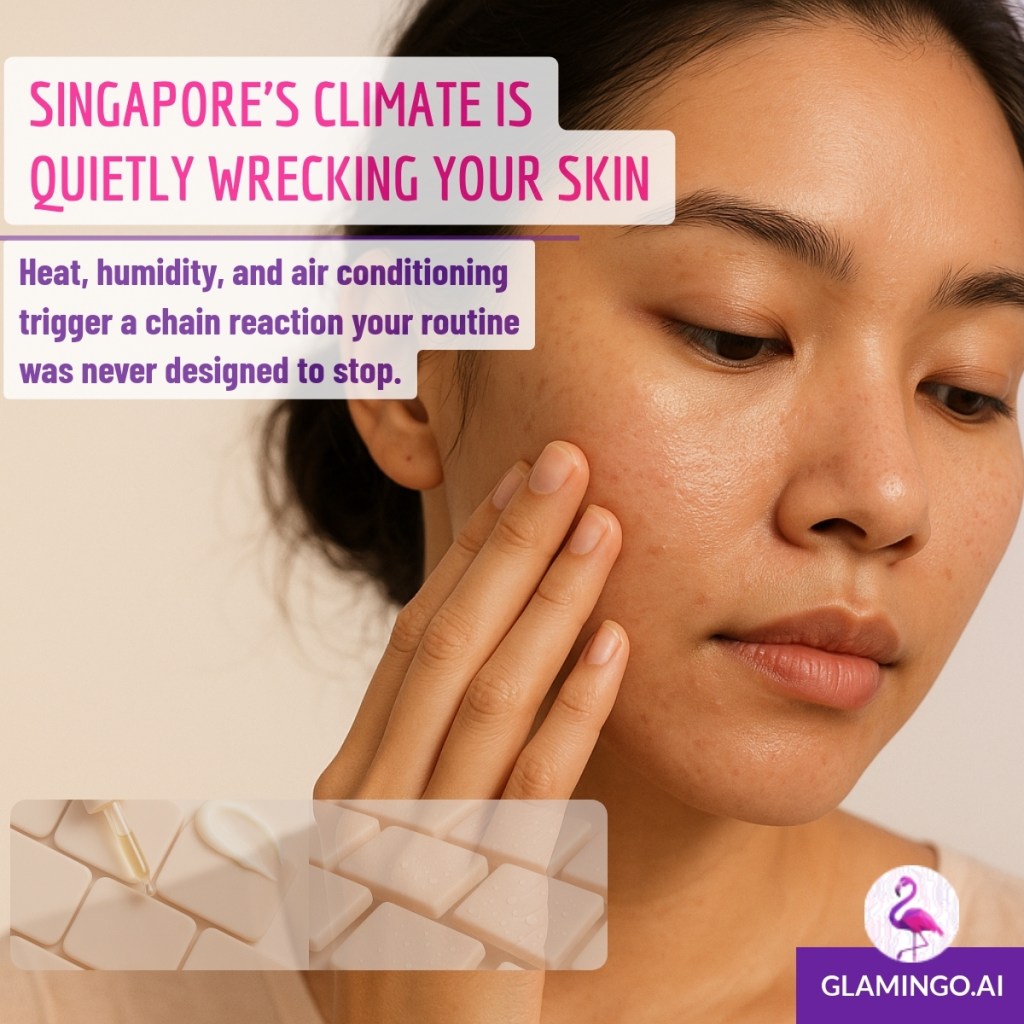
You cleanse, tone, and layer your actives in the right order — and yet your skin is persistently oily, breaking out, or randomly reactive despite doing everything right. If you’ve recently moved to Singapore, or just noticed that your skin behaved better everywhere else you’ve ever lived, you’re not imagining it. One person who relocated here described it with uncomfortable precision: the mild acne and dehydrated skin started practically the day they arrived — simultaneously oily and tight, which makes no sense until you understand what’s actually happening at your skin surface. The problem may not be your products. It may be that Singapore’s climate is running a continuous disruption loop your routine was never designed to interrupt.
This isn’t about having the wrong skin type or needing a more expensive serum. It’s about a specific cascade — a chain reaction that starts at your skin’s surface chemistry, works its way through your barrier structure, triggers low-grade inflammation, and quietly accelerates ageing in the background. Every day. Year-round. Most routines are managing the symptoms at steps three and four without ever touching step one. Understanding the chain is how you finally interrupt it.
The Starting Point — What Singapore’s Climate Is Actually Doing to Your Skin Surface Every Day
Why Outdoor Humidity Is Not Hydration (The Acid Mantle Disruption Mechanism)
Here’s the counterintuitive part: Singapore’s ~80% outdoor humidity doesn’t mean your skin is hydrated. It means your skin surface is persistently wet — and those are not the same thing. The skin’s protective chemistry depends on a slightly acidic environment at its surface called the acid mantle — the thin, invisible film of sweat and sebum that maintains the pH conditions the barrier needs to function. When your skin is constantly damp from ambient humidity and perspiration, this acid mantle is progressively disrupted, shifting the surface pH away from its optimal range. You read that as “oily but fine.” Your skin barrier reads it as a slow structural emergency.
The illusion is convincing. Your skin looks dewy. It feels moist to the touch. So you assume hydration is handled and load up on actives. But underneath, the conditions the barrier needs to maintain itself are being eroded continuously. The sweat isn’t nourishing anything — it’s chemically disrupting the environment that keeps everything intact.
The Indoor-Outdoor Air-Conditioning Whipsaw: A Daily pH Stress Test Your Barrier Is Failing
Then there’s what happens when you step inside. Singapore’s offices, malls, and MRT stations are aggressively air-conditioned — often down to temperatures that would feel cold in winter climates. The shift from 32°C humid outdoor air to 19°C dehumidified indoor air isn’t just uncomfortable. Moving repeatedly between these two environments creates a cycle where your skin surface is alternately saturated and dehydrated, placing chronic stress on the barrier’s ability to regulate moisture loss. You do this transition multiple times every single day.
The result is what looks like an oil problem but is partly a stress response. The barrier, under moisture-regulation pressure, overproduces sebum as a compensatory mechanism. Your skin appears oilier. You reach for stronger cleansers or mattifying products. Those strip the barrier further. The cycle tightens. This is the whipsaw — and it’s running on repeat before you’ve even started your commute home.
Step One in the Chain — A Compromised Skin Barrier
What a Disrupted Barrier Looks Like Structurally (Ceramides, Filaggrin, Lipid Layer)
Think of your skin barrier like a tiled roof. Each tile — a fatty molecule called a ceramide — sits flush against the next, shedding water and blocking debris. Singapore’s climate is like living through a permanent monsoon with intermittent blowtorch blasts from air conditioning. The tiles lift slightly, gaps open, water gets in where it shouldn’t, the roof’s protective chemistry shifts, and the structure underneath starts to slowly degrade. From outside, the roof still looks wet and “fine.” But the damage is happening in the gaps.
Structurally, skin barrier dysfunction involves impairment of structural proteins — including filaggrin, which acts as the scaffolding that keeps skin cells compacted and organised — alongside depletion of epidermal lipids including ceramides, and a breakdown in the skin’s immunological barrier function. These aren’t independent problems. They fail together. Filaggrin loss means ceramides have less structural support. Ceramide depletion means the lipid layer between cells thins. A thinner lipid layer means the barrier becomes permeable — to water loss and to everything else it was supposed to keep out.
Why a Barrier-Compromised Skin Surface Is Not Just “Sensitive” — It Is Immunologically Activated
“Sensitive skin” is how most people describe this. But sensitivity is a description of experience, not a mechanism. What’s actually happening when your barrier is compromised is that the skin’s immunological barrier is also disrupted — and the immune cells sitting in your epidermis begin responding to what they’re now exposed to. Environmental irritants, microbes, and even your own skincare products can trigger an immune response that wouldn’t have registered on intact skin. Your skin isn’t becoming more sensitive over time. It’s becoming more permeable and more immunologically reactive — which looks the same from the outside but requires a completely different response.
Step Two — Chronic Low-Grade Inflammation Becomes the Default Skin State
How Sustained Inflammatory Signalling Drives Sebum Overproduction, Breakouts, and Rosacea-Like Flushing
Once the immunological alarm is triggered, the inflammatory signals don’t simply switch off when you go back inside and cool down. They sustain. And sustained, low-grade inflammation has downstream consequences that most skincare routines treat as separate, unrelated skin concerns. Hot and humid weather directly increases sebum production and raises both the risk and severity of adult female acne through elevated oil gland activity and increased follicular occlusion — the mechanism that turns an oily skin surface into clogged pores and then into breakouts. This isn’t a hygiene or diet problem. It’s a climate-triggered cascade beginning at the barrier and ending in your chin breakouts.
The vasodilation piece matters too. Singapore’s heat triggers the widening of blood vessels near the skin surface — a known driver of rosacea flares and persistent facial redness that is frequently misread as acne or general sensitivity. If your skin flushes, stays red after exercise or after commuting, or reacts disproportionately to temperature change, this mechanism is likely active. It’s not a skin type. It’s an inflammatory response to a climate doing something specific to your barrier.
Post-Inflammatory Hyperpigmentation: Why the Inflammation-to-Pigmentation Link Is Amplified in Deeper Skin Tones Common in Singapore
For many women in Singapore — and this is especially relevant across Chinese, Malay, and Indian skin tones sitting in Fitzpatrick types III through V — the end point of every inflammatory event is not just a blemish. It’s a dark mark that lasts for months. Post-inflammatory hyperpigmentation (PIH) — the darkening of skin at the site of inflammation or injury — occurs because melanin-producing cells (melanocytes) respond to inflammatory signals by producing more pigment. In skin with a higher baseline melanin level, this response is amplified. The breakout resolves. The inflammation technically ends. The dark patch remains.
This means that every small inflammatory event triggered by barrier disruption — every clogged pore, every heat flush, every reactive episode — leaves a visible mark that takes far longer to fade than the event itself. Managing PIH without addressing the upstream inflammatory chain is, at best, a monthly catch-up game. The chain itself is the problem.
Step Three — Accelerated Structural Skin Ageing Running in the Background
UV-Generated Free Radicals and Enzyme-Driven Collagen Breakdown: What Photoaging Actually Is at the Cellular Level
While the inflammation cascade is playing out at the skin surface, UV radiation is running a simultaneous, quieter process underneath. Singapore’s UV Index sits at 10 to 12 year-round — extreme by global standards, and present even on overcast days. UV radiation and environmental pollutants generate reactive oxygen species — unstable molecules commonly called free radicals — in the skin, triggering a cascade of reactions that damage skin structures at the cellular level. These free radicals activate enzymes called matrix metalloproteinases (MMPs) that break down collagen and elastin — the structural scaffolding that keeps skin firm and bouncy. This is what photoaging actually is: not just sun exposure, but enzyme-driven structural degradation running silently in the dermis below what your morning mirror shows you.
It’s worth noting that higher melanin levels do offer some UV protection — but not enough to bypass this mechanism entirely. Photoaging in deeper skin tones tends to manifest differently (more as uneven tone and texture than fine lines) but the underlying collagen degradation is still occurring. It’s not a concern you can opt out of.
Cellular Senescence: When Skin Cells Stop Functioning but Keep Sending Inflammatory Signals
UV exposure causes DNA damage that drives skin cells into a state of cellular senescence — where damaged cells stop functioning normally but don’t die and clear out. Instead, they remain in place and continue emitting inflammatory signals that degrade the surrounding collagen and elastin scaffold. These are sometimes called “zombie cells” in research shorthand, which is an uncomfortable image but an accurate one. They’re not doing their job. They are, however, still very much doing damage. And in a country where UV exposure is relentless and year-round, the accumulation of senescent skin cells is a continuous process — not something that happens gradually after 50.
The Pollution Multiplier — Haze Season and Daily Particulate Matter Stack the Cascade
How Fine Particles Breach a Compromised Barrier and Add an Oxidative Stress Layer
At least once a year, usually between June and October, Singapore’s air quality deteriorates during haze season — when particulate matter from regional fires drifts across the region and PSI levels climb. But daily pollution from traffic and urban density is present regardless of PSI readings. Particulate matter activates inflammatory cascades and generates oxidative stress in the skin — and critically, it does this most effectively when the barrier is already compromised. A healthy, intact barrier has some capacity to resist particle penetration. A humidity-stressed, ceramide-depleted barrier does not. The pollution lands on skin that is already inflamed and structurally weakened, adding an oxidative stress layer on top of the humidity-UV loop that is already running.
There is also a microbiome dimension here that’s worth understanding. The community of microorganisms living on your skin surface — your skin microbiome — is directly linked to barrier function; when the barrier is disrupted, the microbial balance shifts (a state called dysbiosis), and that dysbiosis then sustains and amplifies the inflammatory signal. The downstream effect becomes an upstream driver. The cascade feeds itself.
Why Your Current Routine May Be Managing Symptoms, Not Interrupting the Chain
What Barrier-First Sequencing Looks Like in a Singapore Climate Context
Most skincare routines — including well-researched, well-intentioned ones — are structured around treatment. An exfoliant for texture, a vitamin C for brightening, a retinol for ageing, a niacinamide for pores. These are all working at steps two, three, and four of a cascade that is being continuously restarted at step one. If the barrier is perpetually compromised by the climate you live in, the actives are doing their best work on a surface that is simultaneously being destabilised. You get partial results. You add more products. The results stay partial.
Barrier-first sequencing doesn’t mean abandoning your actives. It means that the first question to ask each day isn’t “what does my skin need to fix?” but “is my barrier currently intact enough to handle what I’m about to put on it?” In Singapore’s climate, the honest answer — especially during and after commuting, after sweating, after hours in air conditioning — is frequently no.
The One Upstream Intervention That Changes the Downstream Outcomes
The upstream intervention is barrier repair, applied at the right moment in the climate cycle — not just as a final moisturiser at night, but as a deliberate interruption of the whipsaw. A ceramide-containing barrier repair product applied before transitioning from air-conditioned spaces into outdoor humidity acts as a pre-emptive structural reinforcement. You’re filling the gaps in the tiles before the monsoon starts again. The inflammation doesn’t start. The sebum overproduction doesn’t get triggered. The PIH doesn’t have a new inflammatory event to respond to. Everything downstream quiets down because you’ve addressed the origin point.
This is a meaningfully different logic from managing symptoms. It’s not more complicated. It’s just applied at the right point in the cycle.
What to Do This Week
This week, track whether your skin’s reactivity, oiliness, or breakouts follow the indoor-outdoor pattern — worse after commuting or time outside, then different again after hours in air conditioning. If yes, your barrier is the upstream target, not your actives. Swap your next product purchase away from a new treatment serum and toward a ceramide-containing barrier repair product applied before you leave air-conditioned spaces for humid outdoor air — that is the one point in the cycle where you can interrupt the chain before it starts.
If this article has you thinking about getting a professional barrier assessment or a targeted facial designed for Singapore’s climate rather than troubleshooting alone, Glamingo has verified facial and skin treatment providers near you who specialise in barrier repair and reactive skin. Find a provider near you →
 Glamingo Blog
Drop in your comments..