
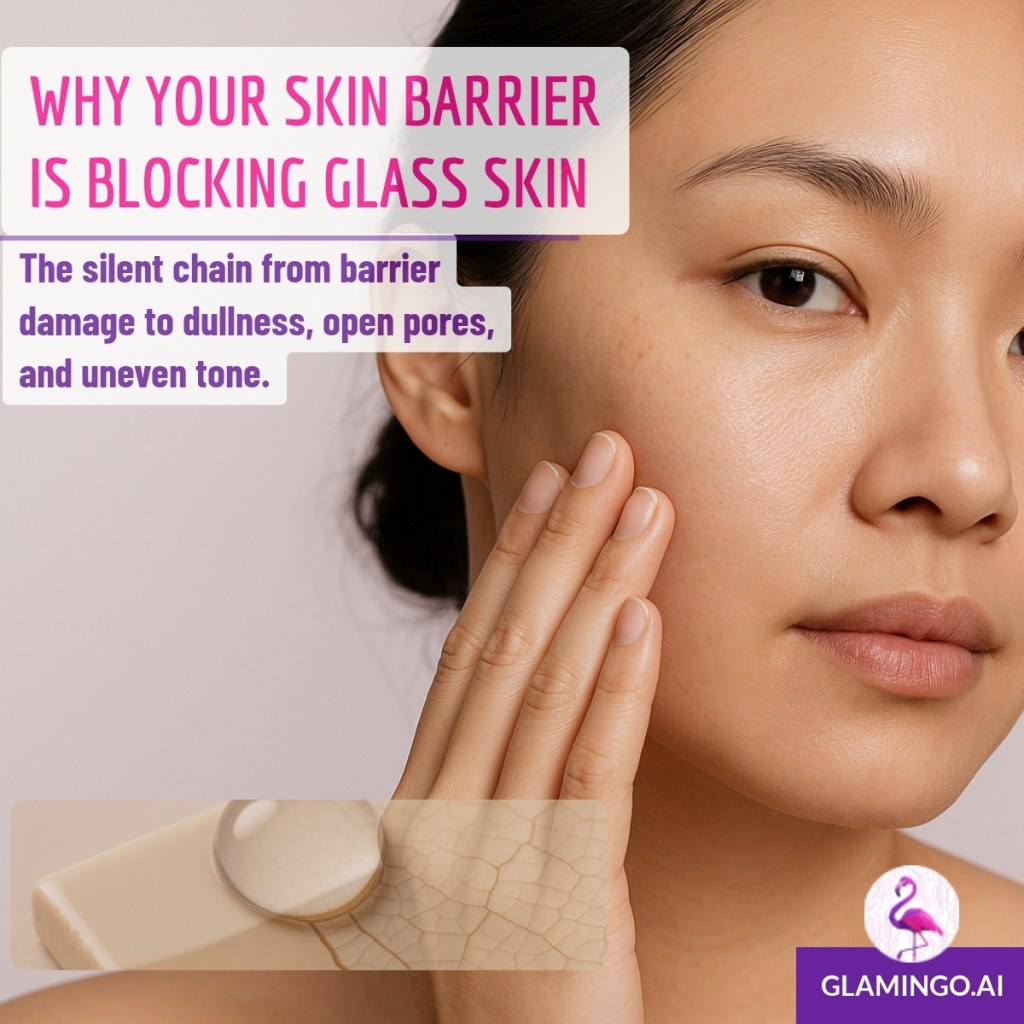
You have tried layering essences, slugging, and every hydrating serum with a Korean name — and your skin still looks more frosted glass than the luminous, poreless finish you keep seeing. Lighting and filters are doing a lot of work in those photos, and if you have spent enough time on skincare forums you already know this. But there is also a biological reason your skin keeps falling short, and it starts somewhere most glass skin routines never actually address.
Here is what is frustrating about that gap: you are probably doing a lot of things right. The essences, the toners, the ten-step commitment — none of it is wrong, exactly. It is just that hydration layered on a compromised surface cannot deliver what an intact surface can. Think of your skin like a freshly glazed ceramic tile. When the glaze is intact, light bounces off evenly and the surface looks luminous and smooth. The moment tiny cracks appear — even invisible ones — the surface starts scattering light instead of reflecting it, and suddenly the tile looks dull and textured. Your skin barrier is the glaze. Every product you layer on top is polish applied to a cracked surface. Until the glaze itself is repaired, the polish just settles into the cracks. Understanding this cascade — from barrier damage to dullness to visible pores to uneven tone — is what most glass skin content conveniently skips over.
What glass skin actually requires from your skin biology (not your product shelf)
The three structural conditions that create light-reflective, poreless-looking skin
Glass skin is not a makeup finish. It is a description of a skin condition — one where the surface is smooth enough, uniformly hydrated enough, and structurally intact enough to reflect light in a way that creates the appearance of translucency. Industry formulation research targeting the glass skin aesthetic identifies three primary obstacles: visible pore size, surface texture irregularities, and uneven hydration distribution. These are not independent problems. They are downstream effects of the same upstream cause, which is why no single essence or serum — however beautifully formulated — can address all three at once.
Smooth, even skin reflects light the way that glazed tile does. Skin with even micro-level texture — clumped dead cells, slightly enlarged pores, dehydration-induced fine lines — scatters that light in multiple directions instead. The result is the flat, slightly dull finish that no amount of layering seems to shift. You are not imagining it. Your product shelf is not the problem. The surface the products are landing on is.
Why hydration alone is not the same as barrier integrity
This distinction matters more than most routines acknowledge. Hydration refers to water content in the skin. Barrier integrity refers to the skin’s ability to hold that water in — to maintain what dermatologists call the stratum corneum (the outermost layer of the skin) as a functional seal between your body and the environment. A dehydrated skin and a barrier-damaged skin can look similar from the outside, but they respond very differently to the same products.
When the barrier is intact, hydrating ingredients have something to work with — they sit within a sealed system that keeps moisture where it belongs. When the barrier is compromised, even the most beautifully dosed hyaluronic acid serum can actually accelerate moisture loss by drawing water toward a surface that cannot retain it. You feel the immediate plumping effect. Two hours later, your skin feels tight again. That is not a formulation problem. That is a barrier problem.
The upstream cause — where the chain starts
How barrier damage triggers moisture loss through the skin surface
When the skin barrier is disrupted — whether by over-exfoliation, harsh cleansers, UV damage, or even the wrong combination of active ingredients — the fatty molecules that act like mortar between skin cells (ceramides and free fatty acids) become depleted. The gaps this creates allow moisture to escape through the skin surface in a process called transepidermal water loss — the technical term for what is essentially your skin leaking. The barrier-hydration-texture pathway that follows is well-established in dermatology, even if its direct connection to the glass skin aesthetic has not been formally studied under that label.
This moisture loss is chronic and cumulative. It does not happen dramatically overnight. It happens gradually, which is part of why it is so easy to miss — especially in Singapore.
Singapore’s UV and humidity paradox: why your skin feels fine while the damage accumulates
Singapore’s year-round humidity sits at around 80%, and the UV Index regularly hits 10 to 12. This creates a specific trap. The ambient humidity in the air reduces how obviously dry or tight your skin feels — which means you may not notice the signs of a compromised barrier the same way someone in a dry climate would. Your skin feels adequately moisturised. It does not feel stripped. So the feedback signal that would usually prompt you to repair your barrier never arrives clearly.
Meanwhile, UV-driven oxidative stress at Singapore’s intensity is quietly degrading the collagen and elastin scaffold beneath the skin’s surface — the structural framework that gives skin its firmness and that characteristic lit-from-within quality. The mechanism is supported by established UV and humidity biology, even though the specific interaction in Singapore’s climate has not been independently studied. You are not imagining that your skin looks somehow less vital than it did a few years ago, even with a consistent routine. The sun here is doing work that the humidity is masking.
The first downstream effect — dehydration that dulls and flattens
How chronic dehydration changes the way your skin reflects light
Once transepidermal water loss becomes chronic, the plumpness that underpins light-reflective skin begins to flatten. Well-hydrated skin cells are like full, smooth grapes — they sit evenly, create an uninterrupted surface, and bounce light back cleanly. Dehydrated cells are more like slightly deflated grapes — the surface becomes microscopically uneven, and instead of reflecting light, it starts diffusing it. The result is what most people describe as dullness: skin that looks flat, slightly grey, and lacks any sense of depth or glow, regardless of how many brightening serums are in the routine.
This is not a dramatic visible change that happens overnight. It is the kind of gradual shift where you look at photos from two years ago and think your skin looked better then, without being able to identify exactly what changed.
The cell-shedding disruption that creates rough texture
Healthy skin goes through a natural shedding cycle — dead cells at the surface loosen, separate, and fall away to reveal fresher cells beneath. The technical term for this is desquamation, and when the barrier is intact and skin is properly hydrated, it happens evenly and continuously without any visible sign. When the barrier is compromised and dehydration sets in, this process gets disrupted. Dead cells do not shed cleanly — they clump together and remain on the surface longer than they should, creating that rough, slightly textured feel that no amount of gentle exfoliation seems to permanently resolve. You exfoliate, it feels smooth for two days, then the texture returns. That cycle is often a sign that the shedding disruption is barrier-driven, not exfoliation-frequency driven.
The second downstream effect — pores that appear larger
The barrier-sebum feedback loop that makes pores more visible
Pore size is largely genetic. This is the part of glass skin marketing that is worth being honest about. You cannot shrink a pore anatomically with a serum. What you can influence is how visible that pore appears — and this is where barrier health enters the picture in a less obvious way.
When skin loses water and the surrounding tissue contracts slightly, the sebaceous glands (oil-producing glands) can overcompensate, increasing sebum production in the pore lining. The pore appears more visible not because it changed size, but because the surrounding skin surface is less plump and smooth, and because increased sebum makes the pore opening more prominent — a mechanism that is supported in dermatological research, even if not all related claims have been independently replicated. The dehydrated, slightly contracted skin around the pore essentially frames it more obviously. Restore barrier integrity and hydration levels, and the same pore becomes less of a feature.
Why layering more hydration on top does not reverse this
If the barrier is what allows hydration to stay in the skin, adding more hydrating products to a leaking barrier is genuinely ineffective at solving the underlying problem. It is the skincare equivalent of mopping the floor while the tap is still running. The water goes in, the sensation of hydration is real and immediate — and then the skin loses it again before the sebaceous feedback loop has any reason to slow down. This is why some people with very thorough hydration routines still struggle with congested, larger-looking pores. The issue is not the amount of hydration. It is the retention.
The third downstream effect — uneven tone that blocks translucency
Post-inflammatory hyperpigmentation and melanin distribution in Fitzpatrick III–V skin
Glass skin requires evenness — even hydration, even texture, even tone. For most women in Singapore, this last element is the most complicated to address, and the one most routinely underestimated by glass skin content that draws primarily from East Asian K-beauty contexts. For skin in the Fitzpatrick III–V range — which covers much of Singapore’s Chinese, Malay, and Indian population — post-inflammatory hyperpigmentation (PIH) is a significant structural obstacle to translucency. PIH is the darkening of skin that follows inflammation: a breakout, a minor abrasion, friction, even a reaction to an active ingredient. It is not a sign of damaged skin in the acute sense, but it creates uneven melanin distribution across the surface that genuinely blocks the light-reflective evenness that glass skin requires.
A barrier-compromised skin is also a skin that inflames more easily — which means the cascade feeds directly into PIH risk. Every episode of barrier disruption is a potential trigger for the kind of surface unevenness that hydration alone cannot correct.
How UV damage degrades the collagen scaffold that gives skin its lit-from-within quality
Translucency — the quality that makes glass skin look luminous rather than just smooth — depends on more than surface hydration. It depends on the structural scaffold beneath: collagen and elastin fibres that keep the skin firm, bouncy, and capable of reflecting light from within rather than just off the surface. UV radiation at Singapore’s intensity accelerates the breakdown of this scaffold through oxidative stress (free radical damage triggered by UV exposure). The result is skin that may be reasonably hydrated at the surface level but lacks the depth and firmness that creates the glass skin effect in photographs. SPF is not optional in this context. It is the most direct intervention for protecting the structural quality that the cascade, if left unaddressed, will slowly erode.
Where the cascade can actually be interrupted
Barrier repair first — what the evidence shows for ceramides and fatty acids
The place to interrupt the cascade is at the top: the barrier itself. The evidence for ceramide-based moisturisers and fatty acid-rich formulations in barrier repair is among the better-supported areas in topical skincare research. Ceramides are a fatty molecule that acts like mortar between skin cells, and their depletion is central to how barrier damage begins. Replenishing them — through moisturisers that combine ceramides, cholesterol, and free fatty acids in a physiologically relevant ratio — is the foundational step that everything else depends on. This is not the exciting part of a glass skin routine. It is less compelling than a new essence. But it is the intervention that makes every other step more effective.
Rosehip oil and PDRN as examples of ingredients working further down the chain
Once the barrier is being addressed, ingredients that target texture and cellular repair further down the cascade become genuinely useful rather than cosmetically superficial. A peer-reviewed study on topical rosehip oil observed meaningful improvements in skin texture, with outcomes the researchers described as resembling the glass skin effect — making it one of the few ingredient studies to reference that aesthetic as a measurable outcome, though it was a single study with limitations around sample size and funding transparency. Rosehip oil’s fatty acid profile supports barrier function while simultaneously delivering antioxidant protection — addressing two links in the chain at once.
Further down the regenerative end of the spectrum sits PDRN — polydeoxyribonucleotide, derived from salmon DNA — which has gained significant traction in Korean clinic treatments. PDRN is proposed to work through intense cellular regeneration, stimulating collagen and healing pathways at a deeper level than topical humectants reach. This distinguishes it from surface-level hydration strategies — the mechanism sits at cellular repair rather than moisture retention alone. The glass skin framing around PDRN is partly a marketing overlay, and the specific outcome has not been independently validated under clinical trial conditions. But the underlying regenerative mechanism is real science. If you are considering a professional treatment rather than a topical product, PDRN represents the kind of intervention that works on the structural quality of skin rather than just its surface state.
What the glass skin ceiling looks like for real skin — and how to set honest expectations
This matters, and it is worth saying plainly: glass skin has a biological upper limit that is different for every person. Genetic pore size does not change. Melanin levels and PIH tendency are structural realities for much of Singapore’s population. The luminous, apparently poreless finish in K-beauty content is photographed on skin types with specific characteristics, under specific lighting, and the gap between that and what a well-maintained Fitzpatrick IV skin in Singapore can achieve is real — not a failure of effort or routine. Improving barrier integrity, addressing PIH systematically, protecting the collagen scaffold with SPF, and using ingredients that genuinely support cellular repair will get your skin closer to its own best version. Whether that version matches the aesthetic ideal is a different question, and one worth making peace with honestly.
The one thing to do this week
This week, before you add anything new to your routine, check whether your current regimen actually contains a barrier-repair ingredient — a ceramide, fatty acid, or cholesterol-based moisturiser — applied as a final step at night. If your routine is all serums and no sealant, that is the first link in the chain to fix. The glass skin cascade starts with moisture escaping through the skin surface; interrupting it at the barrier level is the only intervention that addresses the root cause rather than layering more water on top of a leaking skin.
If this article has you thinking about professional treatments that work at the structural level rather than the surface — PDRN facials, barrier-focused clinical treatments, or professional skin analysis — Glamingo lists verified providers across Singapore with real reviews from women who have been there. Search glass skin treatments near you →
 Glamingo Blog
Drop in your comments..