
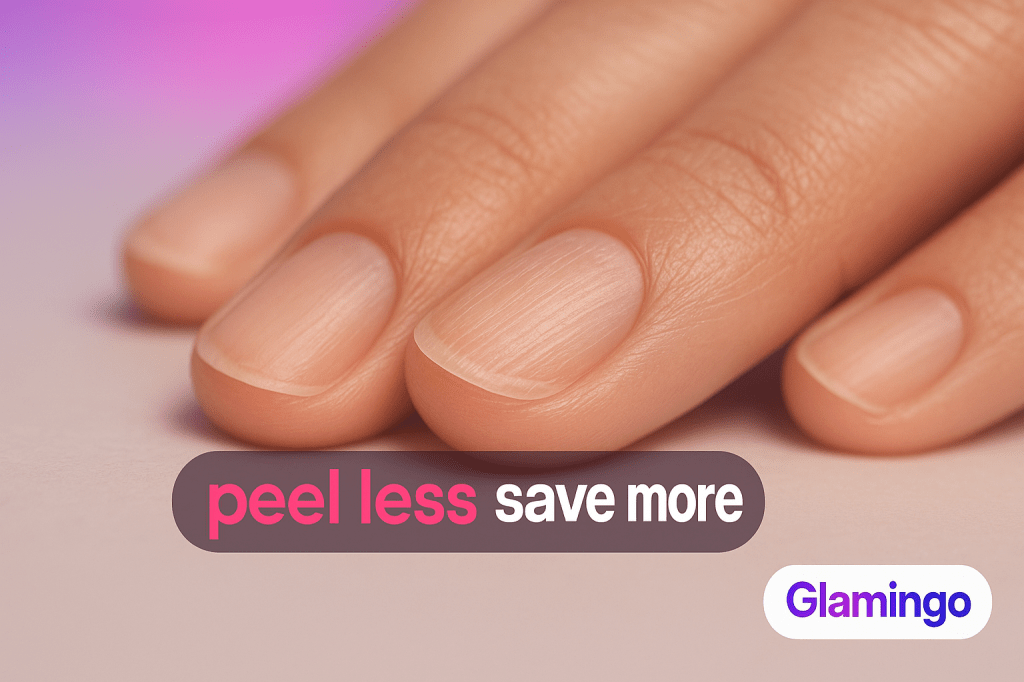
You’ve done it — or you’ve been tempted. The gel is lifting at the edges, a salon appointment feels like an unnecessary errand, and the acetone and foils are right there in your drawer. But anyone who has peeled, filed, or soaked incorrectly knows exactly what comes next: nails that look like they’ve been through something. The damage isn’t random, and it isn’t inevitable. Understanding what’s actually happening to your nail plate during removal is what separates a clean result from a setback that takes months to grow out.
That “months to grow out” part is the thing that doesn’t fully register until it happens to you. You peel off one nail in an impatient moment, and three weeks later you’re still looking at a chalky, bendy nail that snags on everything. The frustration isn’t just cosmetic — it’s the slow realisation that a thirty-second shortcut created a problem that your biology needs four to six months to solve. So before you reach for the foil, it’s worth spending five minutes understanding what you’re actually dealing with.
Why gel is genuinely hard to remove — and why that’s by design
The polymer cross-linking that makes gel durable also makes it resistant to solvents
Gel nail polish isn’t just thicker nail polish. When it cures under a UV or LED lamp, it undergoes a chemical transformation — the liquid monomers link together into long, intertwined polymer chains in a process called cross-linking. The result is a solid, three-dimensional network that is fundamentally different from the film that air-dry nail polish leaves behind. Think of it like the difference between a pile of uncooked spaghetti and a baked pasta dish — one you can pull apart strand by strand, the other holds together as a solid mass.
Research on polymer cross-linking chemistry shows that cross-linked polymer networks achieve their hardness and adhesion through both ionic and covalent bonding — which is precisely what makes gel nail polish so resistant to simple removal. It’s not just sitting on top of your nail. It has bonded to the nail surface at a molecular level and formed a network that ordinary solvents can’t easily unravel. This mechanism is reasonably well understood from polymer chemistry, though nail-specific peer-reviewed data remains limited, so treat this as mechanistic context rather than clinically proven certainty.
Soft gel vs. hard gel — two completely different removal requirements
Here’s the distinction that most at-home removal disasters trace back to: not all gel on your nails behaves the same way. Soft gel — which includes standard gel polish and soak-off gel — contains a polymer network that acetone can penetrate and disrupt. Hard gel — builder gel, gel extensions, and many nail strengtheners — uses a denser cross-linked structure that acetone simply cannot dissolve fully. It softens slightly at the surface, but it will not come off with soaking alone.
This is not a matter of soaking longer or using more acetone. Hard gel requires mechanical filing to remove the bulk of the product, with acetone used only at the final stage for residue. The problem is that the two types look nearly identical on the nail, which is why so many people spend forty-five minutes soaking something that was never going to dissolve, and then resort to scraping in frustration. That scraping is where the real damage begins. The community knowledge around this distinction is detailed and hard-won — and almost universally learned the wrong way first.
What acetone actually does (to the gel, and to your nail)
How acetone dissolves soft gel — the mechanism
Think of a gel manicure like a laminated document — the laminate is bonded across every millimetre of the surface underneath. Acetone is the solvent that softens that laminate from the edges inward, so it can be slid off cleanly. If you try to peel the laminate before the solvent has done its job, you don’t just remove the laminate — you pull off the top layer of the paper with it. That paper is your nail plate, and unlike a document, it can’t be reprinted.
What acetone does chemically is penetrate the cross-linked polymer network of soft gel and disrupt the bonds holding it together, causing the gel to swell, soften, and eventually detach from the nail surface. This takes time — typically ten to twenty minutes of proper contact. The keyword is contact, which is why technique matters so much.
What happens to your nail plate during prolonged acetone exposure
Acetone doesn’t only affect the gel. Topical delivery research shows that solvents disrupt the barrier function of keratinised structures, temporarily increasing their permeability and stripping away natural moisture and lipid content. Your nail plate is built from layered keratin — structurally similar to the outer layer of your skin — and it maintains its flexibility and strength partly through its moisture balance. Acetone draws that moisture out.
The immediate result is nails that feel dry, slightly chalky, and more brittle than usual. This is normal and temporary — but the window right after removal is when the nail plate is most vulnerable to further mechanical damage. Filing aggressively, peeling residue, or applying anything harsh in the hour after removal compounds the initial solvent stress significantly. The nail-specific data here is limited, but the barrier disruption mechanism is well established in skin research and the structural analogy is sound.
Why the foil-wrap method works better than a bowl soak
The acetone bowl soak is intuitive but inefficient. Submerging your fingers in a bowl keeps the acetone in contact with your skin and cuticles far more than necessary, and the solvent evaporates quickly from an open surface, meaning concentration drops before the gel has fully softened. Foil wraps — cotton pads soaked in acetone secured against the nail with foil — create a sealed, concentrated microenvironment that keeps the solvent working on the gel rather than evaporating into the air or spreading across your skin. The foil also traps a small amount of warmth, which accelerates the softening process. It takes slightly more setup but meaningfully less total acetone exposure for your surrounding skin.
The real damage map — what causes what
Peeling: the fastest way to thin your nails permanently
Peeling gel polish off is the single most damaging thing you can do to your nails, and the damage is structural, not just surface-level. Because the gel has bonded to the top layers of the nail plate, peeling it away doesn’t remove just the gel — it physically separates those top keratin layers along with it. The nail plate’s layered keratin architecture can be mechanically compromised in exactly this way, and unlike skin, there’s no accelerated healing response that rebuilds nail plate thickness quickly. What you lose, you wait out. That thinning, that peeling, that bendiness you feel for months after — that’s what you actually paid for in that one impatient moment.
The temptation is highest when the gel is lifting at the edges — it looks like it wants to come off. And in a sense it does. But “lifting at the edges” means the edges have separated; the centre is still bonded. Pulling from a lifted edge leverages the gel against the still-attached nail plate underneath. That’s where the damage concentrates.
Over-filing: how close is too close to the nail plate
Filing is legitimate and sometimes necessary — particularly with hard gel. The problem is depth perception. A 180-grit file removes gel reasonably quickly, and it also removes nail plate with the same efficiency once you’ve gone through the gel layer. Most people don’t know where the gel ends and the nail begins, especially under colour, which is why the standard advice is to file until you see a matte, uniform surface and then stop — even if the gel doesn’t look fully gone. Residual gel that’s been filed thin will yield to a short acetone soak. Nail plate that’s been filed thin takes months to recover.
The tell-tale sign you’ve gone too far is a white, chalky patch on the nail surface, combined with the nail feeling noticeably thinner or flexible in that spot. At that point, filing is done — full stop.
Skipping the base coat: the silent setup for future damage
This one doesn’t relate to removal directly — but it shapes how much damage removal causes. A proper base coat creates a buffer layer between the gel and your natural nail, which means the gel’s adhesion is primarily to the base coat, not directly to the nail plate itself. When the gel is removed, it takes the base coat with it cleanly, leaving the nail surface intact. Without a base coat, the gel bonds more directly to the nail, and removal — even done correctly — creates more surface disruption. If you’ve noticed that your nails are consistently damaged after gel removal despite doing everything right, ask your technician whether a base coat was applied, or check whether you’re using one correctly at home.
A step-by-step breakdown of the safest at-home removal process
What you need before you start
Gather pure acetone (not acetone-based nail polish remover, which is diluted), cotton pads, foil cut into squares large enough to wrap each fingertip, a coarse nail file (100–180 grit) for hard gel, a fine buffer (180–220 grit) for soft gel surface prep, cuticle oil or a thick balm like petroleum jelly, and a nail oil or treatment for after. Do not start without the cuticle protection — that step comes first, not as an afterthought.
Soft gel removal — the soak-off method done correctly
Start by very lightly buffing the top coat with a fine file — just enough to break the shine and allow acetone to penetrate. You are not trying to file off the gel; you are opening the surface. Then coat the skin around each nail and your cuticles generously with petroleum jelly or thick balm. This creates a physical barrier that limits how much acetone contacts your skin during the soak. Soak a cotton pad in pure acetone, place it directly over the nail, wrap firmly with foil, and leave it for ten to fifteen minutes. When you remove the foil, the gel should look wrinkled or be visibly lifting. Use a wooden cuticle pusher or the foil itself to gently slide the softened gel toward the tip — no scraping, no force. If it resists, rewrap for another five minutes. Patience here is the entire technique.
Hard gel removal — when filing is unavoidable and how to do it without going too deep
Hard gel will not dissolve fully in acetone, so the process starts with filing. Use a 100-grit file to remove the bulk of the product, working in one direction and checking frequently. File until the surface is uniformly matte and the gel layer appears thin — roughly half the original thickness — then switch to a finer file and continue more carefully. Stop before you think you’re done. At this point, wrap with acetone-soaked cotton and foil for ten minutes. The thin residue left after filing will soften enough to push off gently. What does not yield to gentle pushing at this stage should be left for a second short soak, not forced off mechanically. Hard gel removal done well takes thirty to forty-five minutes. If it’s taking longer, that is information: either the filing didn’t go far enough, or you’re dealing with a very dense product that may be better handled professionally.
The one thing most people skip that matters most (cuticle and skin protection before acetone contact)
The cuticle oil or balm barrier is genuinely important, not ceremonial. Acetone removes the natural oils from skin as effectively as it removes them from your nail plate, and your cuticles and the thin skin at the nail margins are particularly susceptible. Dry, cracked cuticles post-removal aren’t just uncomfortable — micro-cracks create entry points for bacteria and fungal organisms, especially in Singapore’s warm, humid environment where you’re going from outdoor humidity to aggressive air conditioning constantly. Apply the barrier before the first drop of acetone touches your hands, not after you notice your skin feeling dry.
After removal — what your nails actually need
Why your nails feel weak immediately after removal and how long that lasts
The softness and flexibility you feel in your nails immediately after removal is real structural vulnerability, not imagination. Solvent exposure temporarily disrupts the nail plate’s barrier properties, and the nail will take time to re-establish its normal hydration and lipid balance. For most people, this vulnerable window lasts twenty-four to forty-eight hours, after which the nail begins to feel more normal. The nail plate’s full recovery, including any thinning from mechanical damage, takes as long as it takes to grow out — roughly three to six months for a full nail depending on your growth rate. There is no product that meaningfully accelerates this. What products can do is limit further damage during the recovery period.
What to apply, and in what order, to restore nail integrity
Immediately after removal, wash your hands gently, dry thoroughly, and apply cuticle oil generously — not just to the cuticle but across the entire nail surface. Work it in for a minute. Follow with a nail strengthener or treatment, ideally one that creates a light occlusive film over the nail surface. Research on occlusive barriers in wound healing shows that sealing a compromised surface reduces moisture loss and supports recovery — while this evidence comes from skin, the mechanistic principle of reducing post-solvent dehydration by sealing the nail surface is plausible and worth applying. The occlusive layer doesn’t need to be expensive; a layer of ridge-filling base coat over a cuticle oil application does the job. What you’re trying to avoid is leaving the nail plate exposed and dry, particularly in air-conditioned environments where the humidity swing from outside to inside is considerable.
When to take a break from gel entirely
If your nails are visibly thinning, bending at the tips with normal activity, developing white patches, or if you’re experiencing discomfort under the nail plate, these are signals that the nail needs a break from gel entirely — not just better removal technique. A three-month break, with consistent cuticle oil use and a breathable base coat if you want any coverage, is typically enough for the nail plate to grow out and recover. If you’re in Singapore and wearing gel continuously for the convenience of low-maintenance nails through the humidity, that’s a completely reasonable lifestyle choice — just build in a recovery period every six to nine months rather than waiting until the damage forces your hand.
What the evidence actually supports — and where the gaps are
Mechanic reasoning vs. real nail research: what we know with confidence
The honest picture here is that nail-specific peer-reviewed research is genuinely thin. Most of what the beauty industry presents as nail science is either extrapolated from skin barrier research or drawn from polymer chemistry that wasn’t designed with nails in mind. What we can say with reasonable confidence, based on established mechanisms: acetone disrupts keratinised barriers and strips lipids, as topical delivery research confirms. Cross-linked polymer networks resist simple solvent removal, as polymer chemistry demonstrates. Occlusive barriers reduce moisture loss from disrupted surfaces, as wound healing research shows. These aren’t guesses — but their direct application to nail plate biology involves a degree of extrapolation that’s worth acknowledging.
Claims that are marketing or community wisdom, not clinical evidence
Several claims you’ll encounter in the at-home gel removal space don’t hold up well under scrutiny. The idea that specific nail “repair” serums can rebuild thinned nail plate quickly is not supported by peer-reviewed evidence — nail plate grows from the matrix, and no topical can accelerate that. Tea tree oil has documented antimicrobial properties, but its specific benefit for post-gel-removal nail application is not clinically established, despite being a common recommendation. The soft gel versus hard gel distinction — critical as it is practically — comes primarily from professional and community knowledge rather than published nail science. That doesn’t make it wrong; it means the evidence grade is weak, and you should treat it as informed practitioner consensus rather than clinical fact.
The honest bottom line on at-home gel removal
At-home gel removal is genuinely manageable — but it requires the right technique for the right type of gel, patience that most tutorials underestimate, and a clear understanding that the damage everyone warns you about is real and slow to reverse. The process doesn’t have to be complicated. It does have to be done in the right order, at the right pace, with the right product for what’s actually on your nails.
The gap between “gel removal looks easy on video” and “gel removal on my actual nails” is mostly explained by one variable: knowing whether you’re dealing with soft gel or hard gel before you start. Everything else — technique, timing, aftercare — follows from that single piece of information. Most of the cautionary tales, the months-long recovery periods, the nails that look like they’ve been through something — they trace back to that one skipped step.
Before your next at-home gel removal, take 30 seconds to identify whether what’s on your nails is soft gel (soak-off gel polish) or hard gel (builder gel or extensions). If you’re not certain, test a corner with an acetone-soaked cotton pad for five minutes — soft gel will begin to lift or wrinkle; hard gel will not. That single distinction changes everything about how you proceed, and skipping it is the most common reason at-home removal goes wrong.
If you’d rather leave the hard gel removal to someone who does this daily — especially if your nails are already showing signs of damage — Glamingo has verified nail salons across Singapore offering gel removal and nail recovery treatments, with real reviews from customers who’ve been in exactly your position. Find a nail salon near you →
 Glamingo Blog
Drop in your comments..