
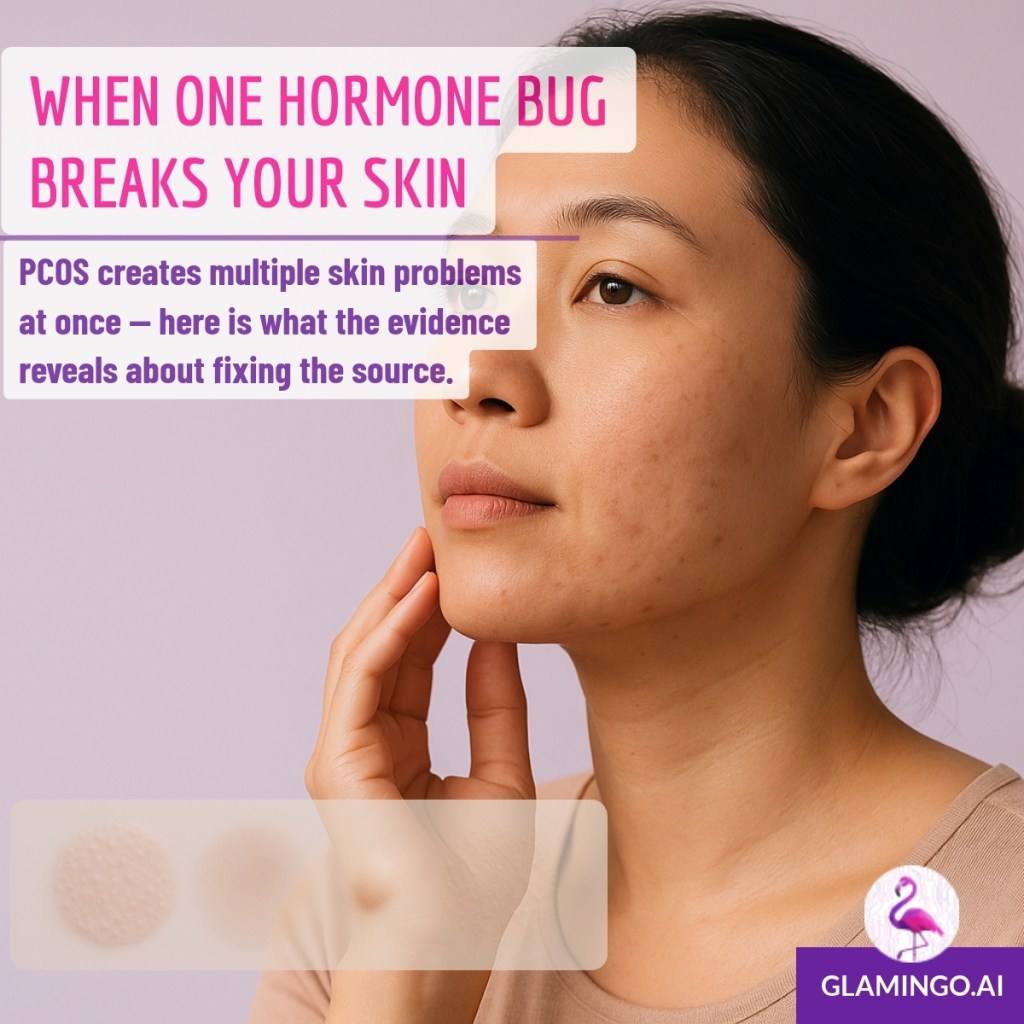
Your skin is showing you a system problem, not a collection of random conditions
You have adult acne on your jawline, patches of darker skin in your neck folds, small skin tags appearing where you never had them before, and a flaky scalp that no anti-dandruff shampoo seems to fix — and your dermatologist has been treating each one separately. If you have PCOS, these are not four unrelated problems. They are four outputs of the same hormonal disruption running underneath your skin. Understanding that connection changes how you approach every single one of them.
It is a genuinely frustrating experience to be handed four separate treatment plans — a retinoid for acne, a topical for the dark patches, a referral to get skin tags removed, a medicated shampoo for the scalp — when the same hormonal system is driving all of it. Not because the individual treatments are wrong, necessarily, but because treating each symptom in isolation means you are always managing, never resolving. Your skin keeps producing new outputs because the underlying programme keeps running the same faulty code.
What PCOS actually is — and why the skin is one of its most visible outputs
Polycystic ovary syndrome (PCOS) is one of the most common hormonal conditions affecting women of reproductive age — and one of the most frequently misunderstood. The name is slightly misleading: not everyone with PCOS has cysts, and the ovaries are not the only organ involved. What PCOS actually describes is a complex hormonal pattern characterised by elevated androgen levels, disrupted ovarian function, and — in the majority of cases — some degree of insulin resistance. These three features do not always present together in equal measure, which is partly why PCOS looks different from woman to woman.
The skin sits squarely at the intersection of all three. It is directly sensitive to androgens, which regulate oil production and hair follicle behaviour. It also responds to insulin signalling in ways that produce entirely different, but equally visible, symptoms. This is why PCOS is associated with a cluster of skin manifestations — acne, hirsutism, acanthosis nigricans, and skin tags — driven collectively by the hormonal imbalances central to the condition. The skin is not the problem. It is the messenger.
The hormonal cast of characters: androgens, insulin, and their relationship to your skin
Think of your skin as a display screen showing the output of what is happening in the operating system underneath. PCOS is a bug in the operating system — specifically in how your body handles androgen hormones and insulin signalling. Most topical skincare is like adjusting the screen brightness: it changes what you see without touching the software. The skin symptoms improve when the underlying code is addressed, not just when the display is managed.
The two main drivers running that faulty code are androgens and insulin. They are linked — elevated insulin drives more androgen production — but they also each have their own downstream effects on the skin. Knowing which pathway is louder in your particular case is the difference between a treatment strategy that actually works and one that keeps you buying products indefinitely.
The androgen pathway: how excess male hormones drive oily skin, acne, and unwanted hair
Androgens — the group of hormones that includes testosterone, present in all women but elevated in PCOS — directly affect skin health by overstimulating the oil-producing glands (sebaceous glands) and hair follicles. The result is excess oil production, enlarged pores, and a skin environment that is chronically hospitable to the kind of inflammation that produces acne. This is not a skincare problem. It is an endocrine problem that shows up on your skin.
Why PCOS acne is structurally different from ordinary adult acne
PCOS-driven acne tends to present differently from the stress breakouts or product-reaction acne that most adult women are more familiar with. It clusters around the lower face — the jawline, chin, and neck — because the hair follicles in these areas are particularly sensitive to androgenic stimulation. It also tends to be deeper, more cystic, and more persistent than surface-level congestion. The usual over-the-counter salicylic acid or niacinamide routine may calm things down temporarily, but without addressing androgen levels, the pipeline stays open.
This distinction matters for treatment decisions. A standard acne protocol — topical retinoids, benzoyl peroxide, antibiotics — may produce partial improvement, but it is working against the grain of an ongoing hormonal signal. The skin clears slightly, the androgens keep signalling, and the acne returns. This is the ceiling that topical treatment alone cannot break through.
Hirsutism — where on the body, and why the pattern matters
Hirsutism — the growth of coarser, darker hair in areas typically associated with male hair patterns — is another direct output of the androgen pathway. In PCOS, this typically presents on the chin, upper lip, chest, abdomen, and inner thighs. The pattern roughly follows where androgen-sensitive hair follicles are concentrated. Waxing, threading, and laser hair removal address what appears above the skin, but the follicle is receiving a continuous androgenic signal that keeps re-stimulating growth. Reducing androgen load — rather than just managing the hair — is the more efficient long-term approach, even if removal methods remain a practical short-term tool.
The insulin resistance pathway: the skin symptoms your doctor may not connect to PCOS
This is where the clinical picture often gets fragmented. The acne and hair growth are visible enough that most doctors will consider the androgen angle. The darker skin patches and skin tags — both driven by a separate but related mechanism — are more frequently treated as standalone cosmetic findings, disconnected from the PCOS diagnosis. They should not be.
The insulin resistance common in PCOS triggers excess circulating insulin (what clinicians call hyperinsulinaemia), which stimulates further androgen production and also produces its own direct skin effects. This creates a compounding loop: more insulin, more androgens, more skin symptoms, from two different but interlocking pathways.
Acanthosis nigricans — what those darker patches at your neck and underarms are telling you
Acanthosis nigricans — the velvety, hyperpigmented thickening that appears at the neck, underarms, and other skin folds — is a direct cutaneous marker of insulin resistance. It happens because excess insulin stimulates the rapid proliferation of skin cells in these areas, producing that characteristic darkened, almost velvety texture. It is not a pigmentation problem in the conventional sense — no amount of brightening serum or chemical exfoliant will resolve it, because it is not a melanin issue. It is a metabolic signal.
In Singapore and across Southeast Asia, where post-inflammatory hyperpigmentation is already a more common concern due to higher melanin levels across Fitzpatrick skin types III–V, acanthosis nigricans can be easily misread as sun-related darkening or general pigmentation, and treated accordingly. If the patches are specifically in skin folds, have that velvety texture, and resist brightening treatments, this is a reason to look at metabolic markers rather than reaching for another vitamin C serum.
Skin tags and PCOS: not a cosmetic coincidence
Small skin tags — the soft, flesh-coloured growths that appear on the neck, underarms, or under the breasts — are another insulin resistance marker that often goes unremarked in PCOS conversations. Their association with insulin resistance and hormonal imbalance makes them a potential visible marker of underlying metabolic dysfunction, not a purely cosmetic finding. They can be removed, and removal is entirely reasonable for comfort or aesthetic reasons. But if new ones keep appearing, removal alone is not answering the question your skin is asking.
The full cluster: seborrheic dermatitis, scalp health, and other skin disruptions in PCOS
Beyond the acne, the dark patches, and the skin tags, many women with PCOS deal with a scalp and facial skin situation that is harder to categorise. Persistent flaking, redness along the hairline, eyebrows, or sides of the nose — sometimes a greasy scalp that also somehow feels irritated — that cycles through shampoos and treatments without ever fully resolving. This is frequently seborrheic dermatitis, a yeast-driven inflammatory skin condition, and its connection to PCOS is underappreciated.
Why yeast-driven scalp flaking is more common in PCOS — and why anti-dandruff shampoo is only a partial answer
Seborrheic dermatitis is driven by an overgrowth of a naturally occurring yeast called Malassezia, which thrives in sebum-rich environments. Elevated androgens in PCOS increase sebum production on the scalp and face, creating exactly the environment this yeast prefers. The standard anti-dandruff shampoos — zinc pyrithione, ketoconazole — do address the yeast load when used consistently, and that part is useful. But if elevated androgens keep producing excess sebum, the yeast keeps finding ideal conditions. The medicated shampoo is managing the display, not the code.
Some women with PCOS report only connecting their scalp symptoms to the broader hormonal picture years after their diagnosis — having spent considerable time and money cycling through scalp treatments that produced temporary improvement at best. That experience is common enough to be worth naming.
The ageing question: does PCOS actually slow down skin ageing?
What the Reddit observation is and where it comes from
There is a recurring observation among women with PCOS — particularly those in their forties — that they appear significantly younger than their age. A woman in her mid-forties noting she is regularly assumed to be a decade younger, and a broader conversation about whether elevated androgens might be providing some structural benefit to skin over time. It is a genuinely interesting question, and one worth addressing honestly rather than dismissing or overclaiming.
What the evidence actually shows — and why this is not a simple trade-off
The short answer is: the mechanism is plausible, but the evidence is not there yet. Androgens do have structural effects on skin — they can stimulate collagen production and increase skin thickness, which in theory could slow the thinning and fine-line formation associated with oestrogen decline. This is a mechanistic hypothesis that has some logic to it. Whether it translates to meaningfully slower facial ageing in PCOS populations, in a way that survives rigorous study, is a different question entirely. The observation is largely anecdotal, and no peer-reviewed human trial data currently supports the claim that PCOS is protective against facial ageing.
There is also a different angle worth considering. Elevated androgens in PCOS are also associated with increased sebum production, chronic low-grade inflammation, and insulin resistance — all of which are not neutral for skin ageing. Chronic inflammation accelerates collagen degradation over time. The picture is not “androgens make you age slower.” It is considerably more complicated than that, and framing PCOS as an anti-ageing benefit glosses over the real costs of living with the condition’s skin symptoms long-term.
Why topical treatments are a ceiling, not a solution
The case for treating the hormonal root rather than the skin symptom
This is not an argument against topical treatments — many are genuinely useful for managing symptoms while a more upstream approach takes effect. A good retinoid, a non-comedogenic sunscreen, a ketoconazole shampoo: none of these are wasted effort. The problem is when they become the entire strategy, and when each symptom is managed in isolation without asking what is driving all of them simultaneously.
Hormonal imbalance is the root cause of many skin issues in PCOS, which means understanding the hormonal mechanism is necessary for selecting appropriate treatment rather than managing surface symptoms alone. That is not a wellness platitude. It is the mechanistic basis for why women with PCOS often find their skin conditions recurring or evolving even when they are doing everything right topically.
What lifestyle interventions actually do to androgen levels and insulin resistance — and what the evidence grade is
Regular exercise and dietary changes targeting insulin sensitivity are identified as interventions that can help balance hormones and reduce insulin resistance in PCOS — with downstream effects on skin health, rather than acting on skin symptoms directly. The evidence for lifestyle intervention improving insulin resistance and androgen levels in PCOS is moderate — it is supported by multiple studies, though the direct skin outcome data from these interventions is less robust than the metabolic data.
In practical terms: reducing insulin resistance through regular strength and cardiovascular exercise, and dietary patterns that avoid large blood sugar spikes, may reduce the hormonal load driving sebum overproduction, acanthosis nigricans, and skin tags. It is an upstream intervention. The timeline is longer than applying a product, and the effects are less immediately visible. But it is working on the actual problem, not the symptom.
Medical treatment options: what works, for whom, and with what caveats
Isotretinoin in PCOS-driven acne — specific considerations
Isotretinoin (the drug most know as Accutane) is used for PCOS-driven acne, but requires specific dosage and safety considerations in the PCOS context — it is not a straightforward application of standard acne treatment protocols. Because PCOS acne is driven by ongoing hormonal stimulation rather than a finite sebaceous gland activity, relapse after isotretinoin courses is more common than in non-hormonal cystic acne. This does not mean isotretinoin is not appropriate — for severe, scarring acne it remains a highly effective tool — but it does mean that using it without also addressing the hormonal driver is likely to produce a shorter-lasting result than expected.
Hormonal therapies and what they address
Combined oral contraceptives — particularly formulations with anti-androgenic progestins — are one of the most commonly prescribed approaches for PCOS-driven acne and hirsutism, and the evidence for their effect on androgen-mediated skin symptoms is well-established. Anti-androgens such as spironolactone work by blocking androgen receptors at the skin level, reducing the signal that drives oil production and follicular stimulation. Metformin, typically associated with blood sugar management, is also used in PCOS to address the insulin resistance pathway — which has knock-on effects for the skin symptoms driven by hyperinsulinaemia. None of these are solely cosmetic drugs. They are working on the operating system.
When to push for a referral beyond your dermatologist
If your skin symptoms — particularly acne, acanthosis nigricans, or skin tags — are being managed exclusively by a dermatologist without any investigation of your hormonal or metabolic status, it is worth asking for more. The visible symptoms carry a documented psychological impact beyond the physical, and cycling through dermatological treatments that keep hitting the same ceiling is exhausting in a way that the clinical conversation often underweights. A gynaecologist or endocrinologist with experience in PCOS can assess androgen levels and insulin resistance markers, which informs whether hormonal therapy or metabolic intervention is warranted alongside any topical approach.
Building a skin strategy around a PCOS diagnosis — not around individual symptoms
The most useful reframe for anyone with PCOS managing multiple skin concerns is this: stop building a routine for acne, a routine for dark patches, and a routine for your scalp. Start building a strategy for PCOS skin — which means knowing which of the two main pathways, androgen or insulin, is more active in your case, and calibrating accordingly.
If your skin presentation is dominated by acne, hirsutism, and oily scalp, the androgen pathway is likely your primary target. If acanthosis nigricans, skin tags, and metabolic symptoms are more prominent, insulin resistance deserves more attention. In many cases it is both, and the interventions overlap — but the diagnostic clarity matters.
Topical treatments remain part of the picture. Sunscreen every single morning, particularly in Singapore’s UV index of 10 to 12 year-round, is non-negotiable for anyone dealing with post-inflammatory pigmentation from PCOS acne. A keratolytic or antifungal shampoo for seborrheic dermatitis is genuinely useful. But these sit on top of a metabolic and hormonal strategy, not instead of one. Dermatological manifestations are a recognised area of clinical study in PCOS research, and the conversation between dermatology and endocrinology is slowly improving. You can push for it to improve in your own care, too.
If you have a PCOS diagnosis and are currently managing acne, skin tags, or darkened patches at skin folds with topical treatments only, book one appointment — not with your dermatologist, but with your GP or gynaecologist — specifically to ask for insulin resistance and androgen level testing. The results will tell you whether your skin symptoms have a metabolic driver that topical products cannot reach, and that knowledge changes your treatment options entirely.
If you want to explore professional treatments designed around hormonal skin concerns rather than generic facials, Glamingo lists clinics and aesthetic providers in Singapore who specialise in PCOS-related skin conditions — with verified reviews from women dealing with the same cluster of concerns. Find a specialist near you →
 Glamingo Blog
Drop in your comments..