
You’ve booked your next colour appointment before the last one has fully settled, and somewhere in the back of your mind, you’re wondering whether you’re pushing it. The question isn’t really about vanity — it’s about whether there’s a biological limit to how often hair can absorb another round of chemistry before it stops cooperating. The mechanism behind colour frequency is less about a calendar rule and more about what your hair structure can actually withstand.
If you’ve been colouring for a few years, you’ve probably noticed that your hair doesn’t always behave the same way it did during your first few sessions. Colour that used to last six weeks now looks washed out by week three. Or maybe the texture has changed — not dramatically, but enough that you reach for products you never used to need. These aren’t signs that your stylist has suddenly gotten worse or that your shampoo betrayed you. They’re the cumulative record of every chemical process your hair has been through. Understanding what’s actually happening inside the hair shaft is what lets you make smarter decisions about when to go back — and when to wait.
What Actually Happens to Your Hair When You Colour It
The cuticle lift: why permanent colour has to break in before it can work
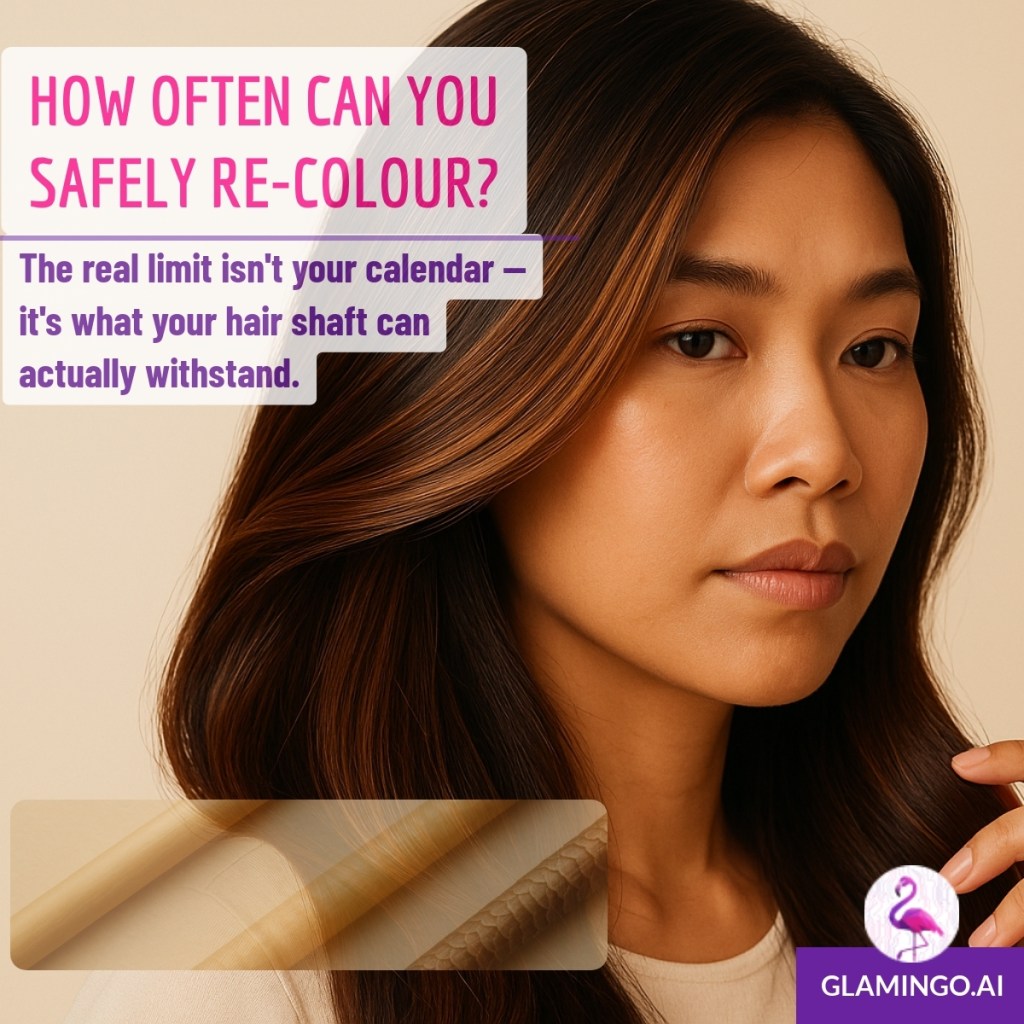
Think of your hair shaft like a tightly woven bamboo mat. Permanent colour works by soaking the mat in a solution that loosens the weave enough to push pigment into the core — then the weave tightens back around the new colour. Each time you repeat that process, the weave becomes a little less tight, a little more porous. The mat still looks fine after a few rounds, but eventually it stops holding its shape as well, and new colour poured in just runs straight back out. The frequency question is really: how many times can you loosen and re-tighten that weave before it can no longer recover?
The loosening happens through the outermost layer of the hair strand — the protective surface made up of overlapping scales (what cosmetic chemists call the cuticle). Permanent hair dye uses an alkaline agent, typically ammonia or an ammonia substitute, to raise these scales and allow the colour molecules to enter. At the same time, a developer containing hydrogen peroxide oxidises the hair’s existing pigment and activates the new dye. This is a chemical process that the hair doesn’t emerge from unchanged. The cuticle scales close again afterwards, but slightly less neatly than before. One session is manageable. Six sessions over eighteen months is a different story.
Melanin and the cortex — what gets displaced or deposited, and why it matters for Asian hair
Once the cuticle is lifted, the chemistry reaches the inner layer of the hair strand (the cortex), where natural pigment is stored. Hair colour is determined by two types of pigment: eumelanin, which produces dark brown and black tones, and phaeomelanin, which produces warm red and yellow tones. The balance between these two pigment types — and whether they’re present at all — determines baseline hair colour and how it responds to chemical processing. This is particularly relevant if your natural hair is dark Asian black, which typically carries a high concentration of eumelanin. That density of dark pigment doesn’t lift easily or evenly, which is why achieving lighter colours often requires multiple bleach sessions, each one adding to the cumulative structural load. It also means the cortex is doing more work during each colour session than it would for naturally lighter hair — a consideration that’s worth factoring into how often you’re going back.
Why the Three-Month Rule Exists (And What It’s Actually Based On)
Cumulative structural damage versus single-session damage
One professional guideline advises not dyeing hair more than once every three months, or no more than four times a year, to reduce cumulative structural damage. It’s worth being honest about what that guideline is based on: it’s professional consensus, drawn from years of stylist experience and cosmetic chemistry knowledge, not a peer-reviewed clinical trial. There’s no large-scale independent study that has tracked exactly how many colour sessions cause a measurable tipping point. But the mechanism — repeated cuticle disruption leading to progressive porosity — is well understood, even if the precise frequency threshold isn’t pinned down to the week.
The practical logic holds. Each colouring session adds to a structural account that your hair can only draw down on for so long. A single session might leave your cuticle slightly more open than before; that’s expected and manageable. But the damage from session three compounds on sessions one and two. Eventually the porosity becomes the problem — not just aesthetically, but functionally. Highly porous hair absorbs colour unevenly, holds moisture poorly, and is more prone to breakage. The three-month guideline exists as a buffer to let the hair shaft stabilise between sessions. Whether your hair specifically needs exactly twelve weeks depends on its condition, the type of colour service, and what you’re doing at home in between.
Root touch-up versus full re-colour — they’re not the same ask on your hair
One important distinction that often gets flattened in the “how often should I colour?” conversation: a root touch-up and a full re-colour are not equivalent chemical events. A root touch-up applies colour only to the new growth — the section of hair that has never been chemically processed — which means the cuticle disruption is limited to virgin hair. A full re-colour overlaps with previously coloured lengths, applying chemistry to hair that has already been through the process at least once. Doing full re-colours every six weeks is categorically more damaging than root touch-ups at the same frequency. If what you’re managing is regrowth, not overall tone, a targeted touch-up on roots only is a significantly lower-stress option for your hair’s long-term structural integrity.
What Normal Fade Looks Like Versus Damage-Driven Fade
How dye molecules exit the hair shaft over wash cycles
Colour fading between appointments is normal. That’s not a product failure, and it’s not necessarily a sign that your hair is damaged. Small dye molecules — particularly the vivid, fashion-shade types — don’t bond permanently inside the cortex the way larger oxidative dye molecules attempt to. They sit inside the hair shaft but exit gradually with each wash cycle, especially with hot water, which causes the cuticle to swell and release molecules faster. What many people interpret as something going wrong is often just the straightforward physics of dye molecules in a porous structure. Cooler rinse water and less frequent washing genuinely slow this process — not because of any complex chemistry, but because you’re simply giving the molecules fewer opportunities to leave.
When colour stops holding — the structural signal you shouldn’t ignore
Damage-driven fade is a different issue. If your colour looks uneven two weeks after a salon visit — patchy, brassy in unexpected areas, or noticeably lighter at the ends than the roots — the problem may not be how you’re washing. It’s how the hair is receiving colour in the first place. Highly porous hair (the bamboo mat that’s lost its tightness) absorbs colour quickly but can’t retain it, so the result looks vivid immediately after the appointment and fades dramatically within weeks. This is the structural signal worth paying attention to. Adding more colour on top won’t fix the underlying porosity — it just repeats the same cycle and deepens the damage. What that hair actually needs is a period of protein and moisture-focused care before the next chemical service, not an earlier return to the salon chair.
The short-term cosmetic improvement some people notice in their hair’s texture in the day or two immediately after colouring — that temporary smoothness and fullness — is a small hint at this dynamic. The chemistry of the colouring process can temporarily fill gaps in the hair shaft, creating a brief window of better-looking texture even as the longer-term structural stress accumulates underneath.
How to Extend Time Between Appointments Without Compromising Your Colour
What colour-depositing products actually do (and the limits of what they can fix)
Colour-depositing conditioners and hair glosses have become a standard recommendation for stretching time between salon visits, and they do something real — just not quite what the marketing implies. These products coat the outside of the hair shaft with temporary pigment molecules, refreshing the tone without any chemical lift or cortex penetration. Results typically last around three washes and are milder in effect than even an at-home semi-permanent dye. The independent clinical evidence on their efficacy is thin — most of what you’ll find is editorial product testing. But the mechanism is sound: surface tonal refresh without structural cost. What they can’t do is replicate the depth or longevity of a salon colour, and they won’t fix colour that’s fading because the hair can no longer hold it structurally. A colour-depositing conditioner works when the problem is fade. It won’t disguise damage.
Wash routine factors that matter more than sulfate content
The “colour-safe” label on shampoo packaging is not a single-ingredient guarantee. The relationship between sulfates specifically and colour fade is actually less clear-cut than the marketing suggests — the evidence base is anecdotal and requires more independent verification than currently exists. What does seem to matter, based on the underlying chemistry, is a combination of factors: wash frequency (less washing means less cuticle swelling and fewer dye molecules escaping per week), water temperature (cooler rinses reduce cuticle opening), and whether you’re using a conditioner that helps close the cuticle after washing. In Singapore’s heat, the temptation to wash daily is real — but if you’re washing every day with hot water, you’re giving your colour very few chances to stick around regardless of what’s in the bottle.
Tonal strategy: choosing a colour that works with your grow-out, not against it
Colour experts advise that one of the most effective strategies for stretching time between appointments is to gradually shift toward a shade closer to your natural base — reducing the contrast between root growth and coloured ends so that grow-out becomes less visible. This is stylist-sourced editorial advice rather than clinical evidence, but the logic is simple and hard to argue with. A high-contrast colour — platinum blonde on dark Asian hair, for example — announces its root growth within two to three weeks. A tone that’s two or three shades from your natural colour can go eight to ten weeks without looking obviously grown out. If you’re working within a budget and trying to reduce appointment frequency, this is the most structurally sound strategy available: choose a colour that cooperates with your biology rather than fighting it every six weeks.
The Bottom Line on Re-Colouring Frequency
There’s no single number that applies to every head of hair, and anyone who gives you a definitive answer without knowing your hair’s current condition, colour history, and maintenance habits is working from a rule of thumb rather than evidence. What is well-established is the mechanism: permanent colour creates cumulative structural change, and the hair has a finite capacity to absorb repeated chemical processes before it starts showing signs of real compromise. The three-month professional guideline exists for good reason, even if it’s consensus rather than controlled-trial evidence. The honest answer to how often you can re-colour without damage is: less often than most of us do, and significantly less often when full re-colours are involved rather than targeted root work.
Singapore’s appetite for hair colour services is clearly not slowing down — the local hair colour market is projected to grow at 5.5% annually through to 2033 — which means salons will keep offering appointments and you’ll keep having reasons to book them. That’s fine. The goal isn’t to stop colouring. It’s to colour in a way that your hair can sustain without structural cost that compounds over the years into something much harder to reverse than a slightly brassy tone.
Before booking your next colour appointment, check the date of your last full re-colour — not root touch-up, but full application. If it’s been less than ten to twelve weeks and your concern is fade rather than regrowth, try a colour-depositing conditioner in your shade for two to three wash cycles first. It won’t replicate a salon result, but it will tell you whether the issue is fade (fixable without chemical stress) or structural damage (the hair isn’t holding colour anymore), which changes what your next appointment should actually be.
If you’ve worked through the at-home options and want a professional to assess your hair’s current condition before your next colour service, Glamingo can help you find colour specialists near you who offer hair health consultations alongside their colour services. Browse colour salons on Glamingo →
 Glamingo Blog
Drop in your comments..