
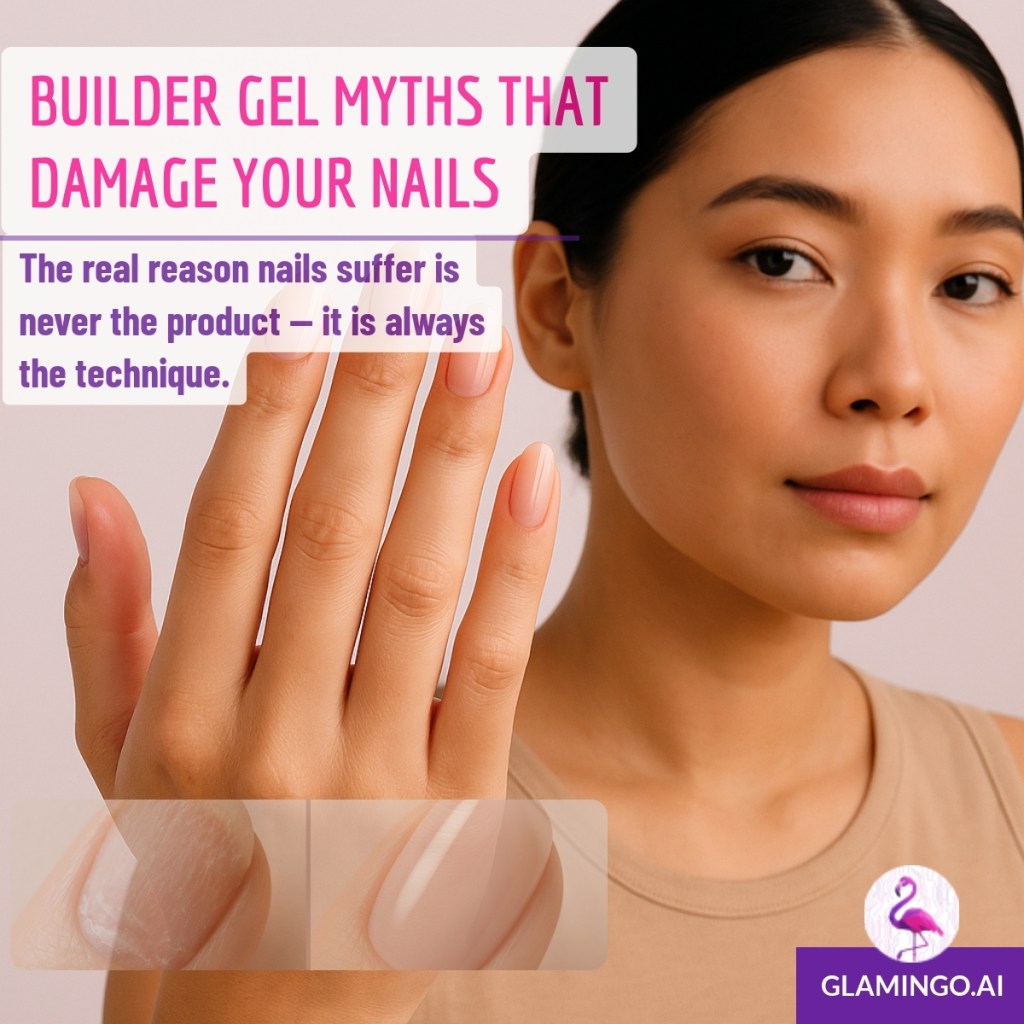
If you’ve heard that builder gel is just a faster route to thin, peeling, ruined nails, you’re not alone — it’s one of the most repeated warnings in nail communities. But there’s a difference between builder gel being inherently damaging and builder gel being applied or removed badly. One of those is a product problem. The other is a technique problem. They are not the same thing.
And if you’ve ever walked out of a salon with nails that looked incredible for three weeks and then felt paper-thin once the product came off, that experience is real. The frustration is valid. But before you write off an entire product category, it’s worth asking what actually happened in that salon — because the answer matters more than the ingredient list.
The Myth — Builder Gel Ruins Your Nails
Where This Belief Comes From (And Why It Feels True)
The “gel ruins nails” narrative has been circulating long enough that it feels like settled fact. You’ve probably heard it from a friend who swore off gels after a bad removal, seen it repeated in beauty forums, or had a well-meaning relative tell you to stick to regular polish. The belief has staying power because it’s rooted in real experiences — experiences that are genuinely common, even if the cause is being misidentified.
Here’s what typically happens: gel is applied over several weeks, removed hastily or aggressively, and the nails underneath are visibly thinner and more fragile than before. The logical conclusion is that the gel did this. It wore the nails down, suffocated them, weakened them. But that sequence — product goes on, nails come out worse — doesn’t automatically mean the product is the problem. It means something in the process was the problem. There’s a meaningful difference, and collapsing the two is where the myth gets its grip.
It’s also worth noting that people who have great experiences with builder gel aren’t writing cautionary posts about it. Negative outcomes are disproportionately visible, and that shapes perception — especially in beauty communities where strong opinions travel fast.
What Builder Gel Actually Is and What It Does
Before you can evaluate whether something damages your nails, you need to understand what it actually is. Builder gel is not simply a stronger version of the gel polish you’d get in a standard shellac manicure. It’s a distinct product category — formulated to be thicker and more structural, designed specifically to add reinforcement, length, or both to natural nails or extensions. Think of it as architectural rather than decorative. Its job is to build and support, not just to colour and seal.
How It Differs From Regular Gel Polish
Regular gel polish is relatively thin in viscosity — it’s designed to sit in a thin, even film over the nail plate, cure under UV or LED light, and give you colour that outlasts regular lacquer. It offers minimal structural benefit. Builder gel, by contrast, has a much thicker consistency, which means it can be shaped, sculpted, and used to correct nail shape or add real reinforcement to weak or damaged nails. The self-levelling viscosity that makes it heavier is also, interestingly, what makes it less likely to flood your cuticle during application — the opposite of what most people assume about a denser product.
How It Differs From Acrylic
Acrylic nails involve a two-part system — a liquid monomer and a powder polymer — that hardens through a chemical reaction in open air. Builder gel cures under UV or LED light and typically contains different chemical compounds. The removal processes are also different: acrylics typically require soaking in acetone for an extended period, while builder gel can often be filed off, depending on the formulation. Builder gel also tends to be more flexible once cured, which means it moves more naturally with the nail rather than sitting as a rigid overlay. These are not cosmetic differences — they have real implications for how each product interacts with your nail plate over time.
The Verdict — The Gel Isn’t the Problem
Think of builder gel like a fibreglass cast on a fractured bone. The cast itself does not weaken the bone — in fact, it protects it while it heals. But if someone removes the cast by hacking at it with the wrong tool, or applies it so thick the material never fully sets, the damage that follows gets blamed on the cast. The cast was not the problem. The technique was.
This is, in essence, what the professional nail community consistently points to when discussing builder gel outcomes. Prep quality and removal method — not the gel formula itself — are the primary determinants of whether your nails come out of a gel period thinner, weaker, or in worse shape than when you started. It’s worth flagging that this is professional consensus rather than peer-reviewed clinical data, but it’s a consistent pattern across experienced practitioners, and the underlying logic is mechanistically sound.
The Real Culprit: Prep, Application, and Removal
Nail prep involves dehydrating the nail plate, pushing back the cuticle cleanly, and sometimes lightly buffing the surface to create adhesion. Done well, it gives the product something to bond to without removing meaningful layers of the nail itself. Done badly — or rushed, as it often is in high-volume salons — it either fails to create proper adhesion (leading to lifting, moisture trapping, and eventually bacterial or fungal risk) or over-buffs the nail, which removes actual nail plate before the product even goes on. The gel then gets blamed for thinness that was created before it touched the nail.
Removal is where the most visible damage tends to happen. Peeling, picking, or filing off gel product without properly softening the bond first drags layers of the nail plate off with it. This is not a subtle effect — it’s physically removing part of your nail. The nail is thinner after that not because the gel weakened it from above, but because the removal took material from it. The difference matters enormously, both for understanding what happened and for preventing it next time.
The Thickness Rule: Why One Thick Pass Can Cause Real Issues
Builder gel’s structural benefit comes from its thickness, but that same thickness introduces a specific technical requirement. If builder gel is applied too thickly in a single layer, the UV or LED curing light may not penetrate through to the full depth of the product — leaving an under-cured layer at the base. A well-formulated builder gel will self-level and cure correctly with a generous application, but pile on too much in one pass and you’ve potentially created an incompletely set layer sitting against your nail plate. This can compromise adhesion, contribute to lifting, and in some cases cause sensitivity reactions — not because the formula is toxic, but because an under-cured gel is chemically different from a fully cured one. The fix is applying in thinner, multiple passes. This is basic technique. It’s also apparently not universal practice.
The One Legitimate Risk You Should Know About
UV Lamp Exposure — Separating the Gel Formula Risk From the Curing Lamp Risk
Here’s where the conversation deserves more nuance than it usually gets. The most evidence-supported concern associated with gel manicures isn’t about the gel formula at all — it’s about the UV and LED lamps used to cure them. Clinical and regulatory frameworks that cover nail products in formal risk contexts specifically address UV exposure as a documented concern — one with dermatological support, particularly around repeated exposure over time. The skin on the backs of your hands and around your nail folds is thin and accumulates UV damage. In Singapore, where you’re already dealing with a UV Index sitting between 10 and 12 for most of the year, adding regular lamp exposure to existing environmental UV load is worth factoring in.
The practical response is simple: apply a broad-spectrum SPF to your hands before sitting under the lamp, or use thin UV-protective gloves with the fingertips cut off. This is not a reason to avoid builder gel. It’s a reason to manage a specific, real risk that has nothing to do with whether the product itself is safe for your nails.
Who Builder Gel Actually Makes Sense For — And Who It Doesn’t
If Your Nails Are Already Compromised
If your nails are currently thin, splitting, or recovering from a previous set that was removed poorly, builder gel can legitimately act as a protective layer during the recovery period — exactly like that fibreglass cast analogy suggests. The key is that the nail tech working on you understands this and adjusts their prep accordingly. Over-buffing already-compromised nails to create adhesion is counterproductive. A light dehydration and a thin, well-cured layer of builder gel can give fragile nails the mechanical protection they need to grow out without breaking. This is a real use case that often gets buried under the “all enhancements damage nails” generalisation.
If You Want Strength Without Committing to Gel Colour
One of the least-marketed uses of builder gel is as a structural base under regular nail polish. A thin layer of builder gel, properly cured, gives you the reinforcement benefit without locking you into a full gel colour system — which means you can change your polish colour whenever you like, the way you would with regular lacquer, while still getting meaningfully stronger nails underneath. This is a genuinely useful option for anyone who wants the structural benefits without the commitment, and it’s a setup that most builder gel marketing never mentions because it’s harder to sell.
The Evidence Honest Summary
It’s important to be direct about what the evidence here looks like. Most of what’s cited in support of builder gel’s safety — including the claim that correct application and removal prevents damage — comes from industry sources, manufacturer education content, and practitioner observation. None of it is peer-reviewed clinical research. The mechanism is sound, and the professional consensus is consistent, but this is not a category with a deep independent research base behind it. What that means practically: the “builder gel is safe when done correctly” claim is mechanistically plausible and professionally supported, but you cannot point to clinical trials proving it. You’re working from informed reasoning, not established science.
The one area with stronger evidence is the UV lamp concern, which sits within a broader, well-documented body of dermatological work on UV exposure and skin risk. That part of the conversation deserves to be taken seriously — and it often isn’t, because it complicates the “gel is fine” reassurance that salons prefer to give.
One Thing to Do Differently This Week
Before your next gel appointment, ask your nail technician directly: what removal method will you use, and how do you handle the cuticle and skin boundary during application? If they cannot give a specific answer, or if the salon’s default removal involves anything other than careful soaking or filing off the top layer first, that is your actual risk to manage — not the builder gel formula itself.
If you’d rather take this out of your own hands and book a nail technician who can give you those answers confidently, Glamingo lets you browse builder gel specialists near you with verified reviews — so you can find someone who actually knows their removal technique before you’re in the chair. Search nail salons on Glamingo →
 Glamingo Blog
Drop in your comments..