
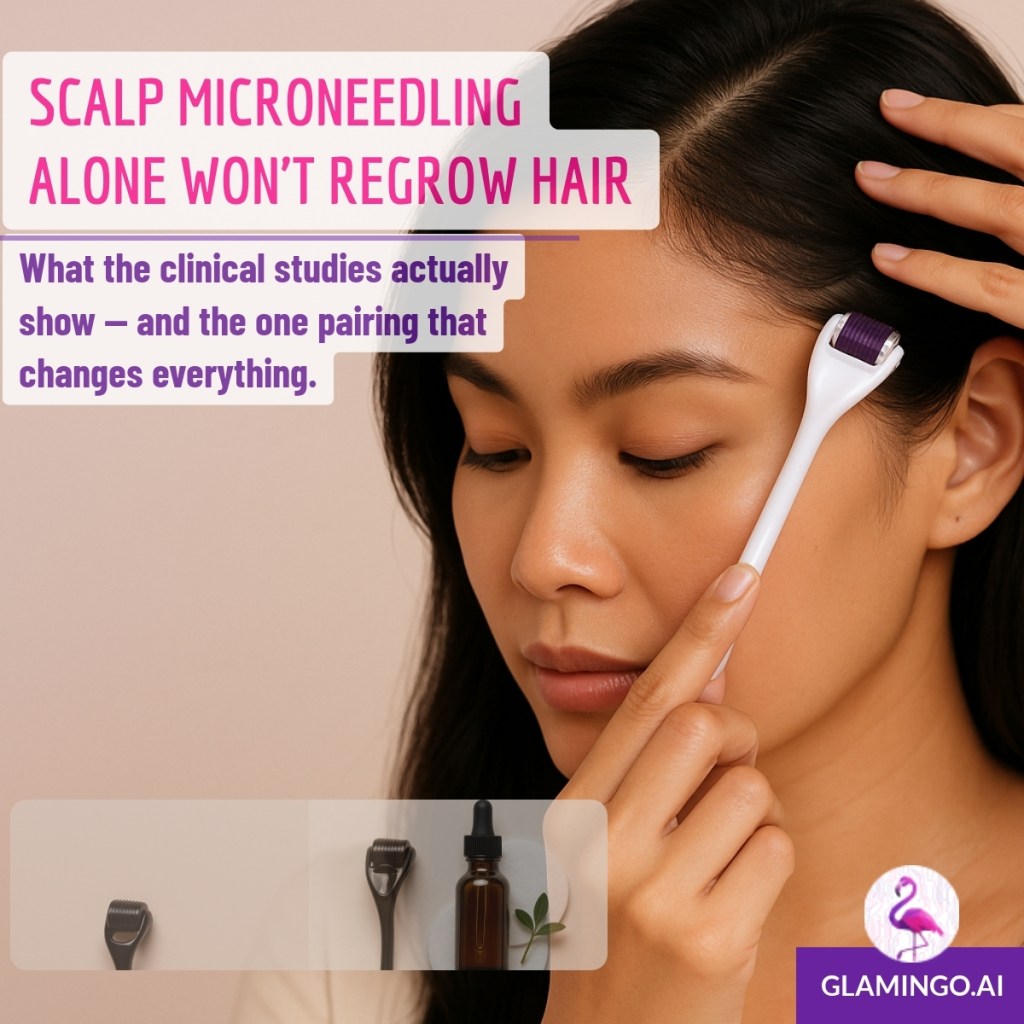
If you’ve been rolling a dermaroller over your scalp every week hoping to reverse thinning hair, you’ve likely come across the claim that scalp microneedling alone is enough to trigger regrowth. Some people swear by it. The reality — once you look at what the studies actually tested — is more complicated, and more useful to know before you spend money on sessions or DIY tools.
Hair thinning is one of those concerns that arrives quietly, then becomes impossible to ignore. A wider parting. More strands on the shower floor. The particular frustration of it is that there’s no shortage of treatments being sold at you — devices, serums, clinic protocols — and almost all of them are framed as the thing that will finally fix it. Scalp microneedling has landed firmly in this category. It’s showing up on Singapore salon menus, in aesthetic chain promotions, and across every corner of beauty social media. Before you commit to a course of sessions or pick up a roller from the pharmacy, it’s worth understanding exactly what this treatment does — and what the evidence was actually measuring when it showed results.
The myth: scalp microneedling alone can regrow thinning hair
Where this claim comes from — and why it is half-true
The claim didn’t come from nowhere. The mechanism behind scalp microneedling is genuinely interesting — and the part about stimulating blood flow and collagen production at the follicle level is real. Scalp microneedling is described by Singapore trichology providers as promoting follicle stimulation through enhanced blood flow and collagen production to support healthier hair growth — and that mechanistic description is plausible. The problem is the leap from “this creates conditions that could support follicle health” to “this will regrow your thinning hair.” Those are two very different claims, and the evidence that’s often cited to support the second one was actually testing something else entirely.
The half-truth is this: microneedling does create real physiological activity at the scalp level. Whether that activity is sufficient, on its own, to reverse hair loss in a meaningful way is where the story gets less tidy.
What scalp microneedling actually does to your follicles
The micro-injury mechanism: blood flow, collagen, and follicle stimulation explained
When a needle — whether on a roller or a professional device — punctures the scalp at a controlled depth, it triggers the skin’s wound-healing response. Blood flow increases to the area. The body sends growth factors and initiates collagen production around the follicle. Think of your scalp follicles like a garden with compacted, under-watered soil. Scalp microneedling is the aerating fork — it breaks up the surface and helps water and nutrients reach the roots more effectively. But if you’re not also watering (using an active treatment like minoxidil), aerating the soil alone will not make the plants grow back. The fork is a delivery tool, not a fertiliser.
That distinction matters enormously — because the regrowth story that gets told around microneedling often stops at the aerating fork and forgets to mention that the water is the point.
The product absorption angle — why this mechanism matters more than the regrowth claim
Here’s where microneedling’s actual, well-supported use case lives. The three most consistently cited benefits of scalp microneedling are collagen production, scalp stimulation, and enhanced penetration of topical treatments — and it’s that third one that arguably carries the most weight. When microneedling creates thousands of tiny channels in the scalp, it dramatically improves the absorption of whatever active treatment you apply immediately after. If that active is minoxidil — the most evidence-backed topical treatment for androgenetic hair loss — the question changes from “does microneedling regrow hair?” to “does microneedling make minoxidil work better?” That’s a more useful question. And the answer appears to be: probably yes, which is why the combination exists in the first place.
What the clinical evidence was actually testing
The PRP and microneedling studies — combination protocols, not standalone treatments
If you’ve read about microneedling and hair regrowth, you’ve likely come across studies showing positive outcomes in patients with pattern hair loss. What those summaries often don’t emphasise is the protocol context. A peer-reviewed study on androgenetic alopecia indexed on PubMed tested scalp microneedling as part of a combination protocol with PRP treatment — the design included a group receiving microneedling, but the primary treatment being validated was the combination, not microneedling standing alone as a regrowth intervention. This is how a lot of the positive data came to exist: microneedling was an adjunct, the supporting act that enhanced the delivery and effect of something else.
That’s not a criticism of microneedling. It’s actually a useful clarification. It means the treatment has a legitimate evidence-supported role — just not the one the marketing tends to lead with.
Evidence grade summary: what is proven, what is plausible, what is marketing
To be direct about where the evidence sits: the micro-injury mechanism is plausible and mechanistically well understood, but the standalone regrowth claim requires stronger controlled trial data than currently exists. The product absorption enhancement angle is the most clinically supported outcome — moderate evidence, consistent with how the treatment is actually used in well-designed protocols. The idea that microneedling alone will reverse thinning hair is largely a marketing extrapolation from combination study results. And the emerging trend of pairing scalp microneedling with exosome injections — which is starting to appear on Singapore clinic menus — is currently aspirational rather than established, with no peer-reviewed human trial data to anchor the claims being made for it.
The at-home vs professional gap — why a dermaroller is not a clinical device
Needle depth, hygiene, and technique: what changes between your bathroom and a clinic
A concern that many women considering this treatment share is whether a dermaroller from a beauty shop or online marketplace can deliver what’s being described. That hesitation is not irrational — it reflects a genuine gap. In a clinical setting, needle depth is calibrated to scalp anatomy, the device is either single-use or properly sterilised, and the practitioner controls pressure and coverage systematically. At home, needle depth is often too shallow to reach the dermal layer where the follicle matters, or — if you’re pressing harder to compensate — potentially too aggressive without the technique to manage it safely. An untrained hand with a blunt or contaminated roller is not approximating a clinical outcome. It’s a different procedure with a different risk profile.
The hygiene point deserves particular attention. Microneedling on an unclean scalp — with product residue, sebum, or any scalp condition present — introduces real infection risk. The clean scalp requirement before a session isn’t an upsell or an afterthought. It’s a basic safety condition that an at-home user is much more likely to overlook. The discomfort many women feel about attempting this at home reflects a real safety and efficacy gap — the device you’re buying is not equivalent to what a trained technician is using, and the conditions you’re applying it in are not the same either. Worth noting: there is currently no peer-reviewed comparison of at-home versus professional scalp microneedling outcomes, so the gap is inferred from what we know about device standards and protocol rigour rather than a head-to-head trial.
The verdict: when scalp microneedling is worth it — and when it is not
Who it works best for and what you need to use alongside it
Scalp microneedling makes the most sense as part of a structured hair loss protocol — not as the centrepiece of one. If you’re already using a clinically supported active treatment like minoxidil and want to enhance its penetration and efficacy, adding professional microneedling sessions into your routine is a reasonable, evidence-informed decision. Singapore aesthetic providers list scalp microneedling alongside minoxidil scalp boosters and low-level laser therapy as part of multi-modal hair loss treatment menus — that combination framing is consistent with how the evidence actually works. If you’re in the early stages of hair thinning and want to take a proactive approach to scalp health, periodic professional sessions combined with a good topical active are a more defensible use of your money than either microneedling alone or an untested stack of supplements.
If you are experiencing significant, rapid, or patchy hair loss, a dermatologist assessment should come before any device treatment. Microneedling does not address the hormonal, autoimmune, or nutritional drivers of hair loss — and if those are the underlying cause, the aeration fork won’t help no matter how well you use it.
What to ask before booking a session in Singapore
When you’re looking at scalp microneedling options, the most useful question to ask any provider is what the protocol pairs with the needling itself. A clinic that positions microneedling as a standalone regrowth solution without any adjunct active treatment is making a claim that the evidence doesn’t support — and that’s worth pushing back on directly. Ask about needle depth used on the scalp versus the face (they should differ), ask whether the device is single-use, and ask what you’re expected to apply immediately after the session. The aftercare application window is where a significant part of the treatment’s value actually lives. If there’s no answer to that last question, the clinic may not be designing its protocol around the mechanism that actually works.
One thing to do differently this week
Before booking a scalp microneedling session or buying a dermaroller, check whether the provider or protocol pairs the treatment with a clinically supported active — minoxidil is the most evidence-backed option. If a clinic is selling microneedling as a standalone regrowth treatment without any adjunct therapy, that is the question to push back on.
If you’re ready to explore professional scalp microneedling protocols in Singapore — the kind that pair needling with a proven active rather than selling it solo — Glamingo has verified hair and scalp treatment providers across the island with real reviews from women who’ve actually tried the sessions. Search scalp treatments near you →
 Glamingo Blog
Drop in your comments..