
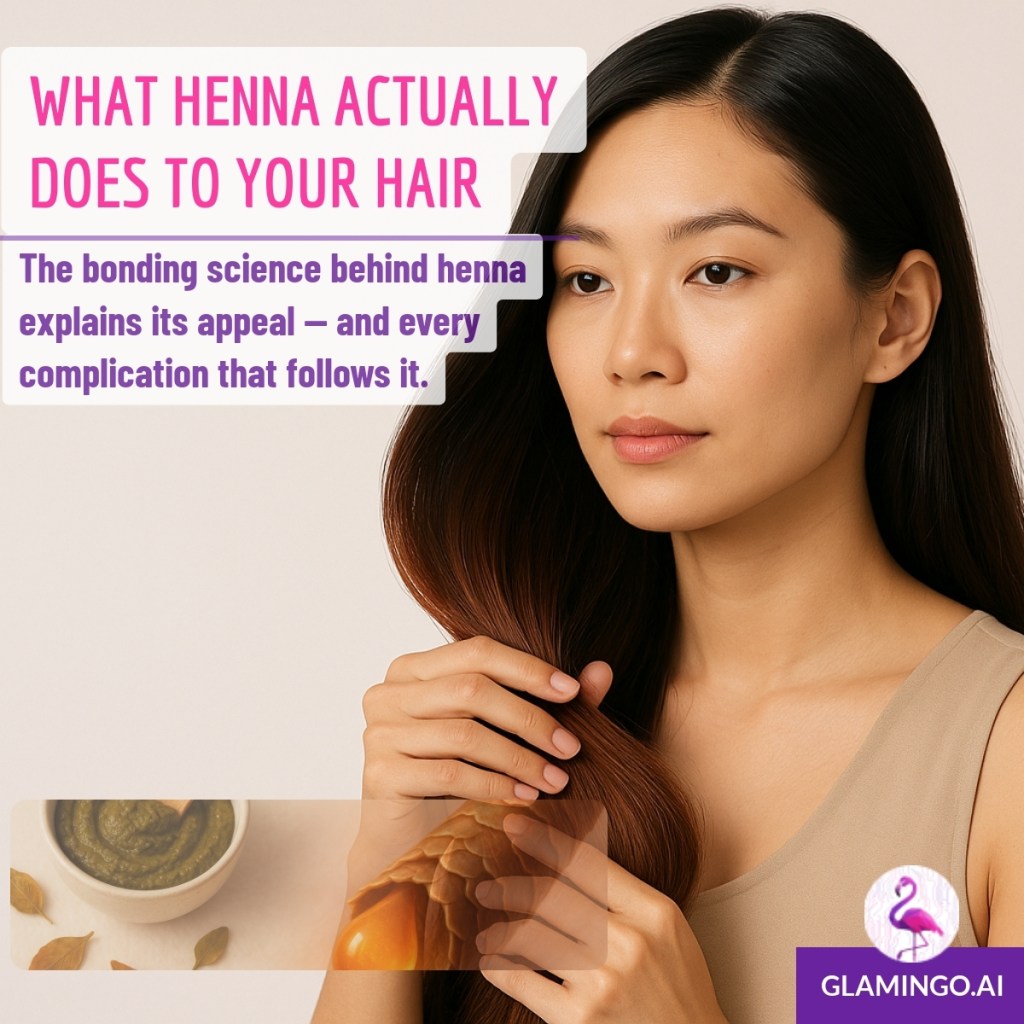
You’ve seen henna positioned as the ‘safe’ alternative to permanent dye — no ammonia, no peroxide, ancient tradition, all of that. But if you’ve ever tried to go lighter after a henna application, or watched your colour turn unexpectedly brassy, you’ll know henna is not as simple as just mixing a powder with water. The mechanism matters, and understanding it changes every decision you make around it.
Here’s the thing that most henna conversations skip over: the reason it works is also the reason it’s complicated. Unlike a semi-permanent rinse that slowly fades with each wash, henna forms an actual chemical bond with your hair. That bond is doing something real and lasting inside the strand — and once you understand it, a lot of confusing henna experiences suddenly make sense. The brassy colour that appeared after a few weeks. The disaster that happened when someone tried to bleach over it. The wildly different results two people got from the same product. All of it traces back to the same mechanism.
The molecule doing the work: what lawsone is and why it behaves differently from every other hair dye
How lawsone bonds to keratin — and why that makes henna genuinely permanent
True henna comes from one plant: Lawsonia inermis. The leaves are dried, ground into powder, and the active ingredient responsible for all the colour is a molecule called lawsone. This is not a synthetic dye. It is a naturally occurring chemical compound, and it behaves unlike anything else you’ll find in a hair colour product.
The reason matters. Lawsone binds chemically to the keratin protein that makes up the structure of your hair shaft — it doesn’t just sit on the outside of the strand waiting to be washed off. This is a fundamentally different mechanism from the surface-coating dyes used in most semi-permanent colours, and it’s why henna colour behaves with such stubbornness.
Think of conventional semi-permanent colour like painting a wall with a water-based coat — it sits on top and fades with washing. Henna is more like wood stain: the lawsone molecule soaks into the structure of the hair shaft and chemically bonds to the protein inside. You cannot simply wipe it off or paint over it with a different colour without the layers reacting unpredictably. That bond is the source of both henna’s appeal and its complications.
What the dye release process actually requires (acidity, time, temperature)
Lawsone doesn’t leap out of the powder and onto your hair the moment you add water. Dye release — the process by which lawsone becomes available to bond to hair — requires an acidic environment and adequate resting time after mixing. This is why experienced henna users mix with lemon juice or apple cider vinegar rather than plain water, and then leave the paste to rest for anywhere from two to twelve hours before applying it.
Temperature plays a supporting role too. A warmer environment speeds up dye release; Singapore’s year-round heat is actually useful here, provided you’re not leaving paste out so long that it oxidises past its peak. The orange-to-deep-red window you’re working within is narrow, and a commercial premixed paste sitting on a shelf for months has likely already passed it. This is one of the reasons inconsistent results are so common — and it’s almost always a preparation problem, not a hair problem.
What henna does to the hair strand beyond colour
The coating and conditioning effect — what it helps and who it doesn’t suit
Henna is frequently described as conditioning, and there is something real behind that claim — though it’s worth understanding what “conditioning” actually means here before you assume it will work the same way for everyone. The mechanism is sometimes described as a ‘double-coating’ effect: the lawsone molecule bonds chemically to the keratin protein, while the paste itself deposits a physical film over the strand. Together, these two actions can reduce moisture escaping through the hair surface (what professionals call transepidermal water loss from the strand), add weight, and improve the appearance of shine.
For fine hair that lacks body, this can feel genuinely transformative. For coarser or highly textured hair — particularly tightly coiled strands — the same effect can feel heavy, stiff, or suffocating over time. It’s worth flagging because the “henna makes hair amazing” testimonials online skew heavily towards certain hair types, and if your texture doesn’t match that profile, your experience may be very different. The evidence behind these conditioning claims is based on the understood mechanism rather than large-scale clinical trials, so treat this as informed expectation-setting rather than guaranteed outcome.
Porosity, texture, and the cuticle-smoothing mechanism
High-porosity hair — strands with a raised or damaged outer layer (the cuticle) — tends to absorb henna colour deeply and quickly, sometimes resulting in a more intense shade than expected. Lower-porosity hair may take longer to absorb colour and can produce subtler results. The physical film that henna deposits can temporarily smooth the cuticle surface, which is why some people report their hair looking shinier and feeling less frizzy after application.
What this also means: if your hair is already highly porous from bleaching or heat damage, you may be working with an unpredictable canvas. The lawsone will bond, but the distribution of colour across the strand may be uneven. Going in with realistic expectations about this — rather than hoping henna will “repair” damage — is the more useful mindset.
Pure henna versus ‘henna for hair’ products — a critical distinction
What body art quality (BAQ) henna is and why purity grade matters
There is a distinction that experienced henna users draw firmly and most first-time buyers don’t know to ask about: the difference between body art quality (BAQ) henna and commercial ‘henna for hair’ products. BAQ henna is pure Lawsonia inermis powder — nothing else. It’s finely milled, sourced for high lawsone content, and behaves predictably because the only active ingredient is the one you know about.
If you’ve ever applied henna carefully, followed all the preparation steps, and still got muddy, uneven, or inconsistent colour — this distinction is likely your answer. Pure BAQ henna in good condition, properly prepared, should give you a reasonably predictable orange-to-auburn result depending on your starting colour. That’s the baseline. Everything that deviates from it is usually a product purity issue.
What commercial henna blends often contain — and why that changes everything
Commercial ‘henna for hair’ products are frequently lower quality and may contain additives including metallic salts and synthetic dyes beyond pure henna powder — and these additives alter dye behaviour and can react dangerously with subsequent chemical hair treatments. Metallic salts, in particular, are a serious issue. They can make hair brittle, cause unpredictable colour shifts, and — critically — react with the hydrogen peroxide in permanent hair colour or bleach in ways that can cause significant damage to the strand.
The darker the shade promised on the box, the more suspicious you should be. True henna produces a range of reddish-orange to deep auburn tones. Products promising brown, black, or burgundy from “henna” are almost certainly blended with other ingredients. That’s not automatically disqualifying — but you need to know what those ingredients are before you commit to using them on your hair. A label that lists only Lawsonia inermis is a green flag. A label that lists “herbal blend” or “natural extracts” without specifics is not.
The real risk categories you need to understand before you start
Allergic contact dermatitis — natural does not mean hypoallergenic
“It’s natural” is one of the most misleading things you can say about a cosmetic ingredient’s safety profile, and henna is a good example of why. Henna is a recognised cause of allergic contact dermatitis — a delayed allergic skin reaction — and the risk increases significantly when henna formulations contain additives beyond pure lawsone. The reaction typically affects the scalp, hairline, neck, and ears — areas in direct contact with the paste.
Even pure henna can trigger sensitisation in some people, though the risk is meaningfully lower with uncontaminated product. If you have a history of skin sensitivity, or if you’re using a commercial blend for the first time, a patch test 48 hours before full application is not optional. It’s the minimum.
Black henna and PPD — a completely different (and dangerous) product
This section deserves its own clear heading because “black henna” is not a type of henna. It is a different product entirely, and its risks are in a different category. Paraphenylenediamine (PPD) — the chemical that creates dark shades in black henna — is a known contact allergen and systemic toxin. PPD is metabolised in the body and is associated with serious toxic and allergic reactions.
PPD is used in conventional permanent hair dyes too, at regulated concentrations. In “black henna” products — particularly those marketed as temporary tattoo pastes in some parts of South Asia and North Africa, and occasionally appearing in unregulated cosmetic products — concentrations are often far higher and uncontrolled. Severe reactions include blistering, scarring, and in some cases systemic effects. If a “henna” product promises to turn your hair black or very dark brown without any other explanation, PPD is almost certainly involved. Walk away.
Heavy metal contamination in unregulated henna products
Sourcing matters more with henna than with most cosmetic products because the supply chain is opaque and quality controls vary enormously. Some traditional and commercial henna preparations have been associated with heavy metal contamination, including lead — a concern particularly relevant for products sourced outside of regulated cosmetic safety frameworks. Singapore’s Health Sciences Authority (HSA) does regulate cosmetic products, which means products sold through official retail channels here have a degree of oversight. Products sourced from unregulated online marketplaces or brought in from abroad do not carry the same assurance.
The permanence problem and what it means for your hair future
Why you cannot chemically lighten or relax over henna without serious risk
This is the part that doesn’t make it onto the packaging. Because lawsone bonds to keratin — the actual protein structure of the strand — henna does not fade the way other colour does. It grows out. And that has direct consequences for what you can do to your hair afterwards.
Applying bleach or a chemical lightener over hennaed hair can cause the strand to break, because the bleach is working on a hair shaft that has already been altered by the henna bond. The results range from uneven patchiness to severe breakage. Chemical relaxers interact similarly. Even applying conventional permanent colour over henna — especially over henna blended with metallic salts — can produce unpredictable, damaging results. Any stylist worth their training will ask about your henna history before touching your hair with chemicals, and if they don’t, that’s a red flag.
The only realistic exit strategy: growing it out
There is no reliable solvent, treatment, or “henna remover” product that will undo lawsone’s bond to keratin. Oils can soften the deposit and fade the colour marginally over many applications, but the fundamental bond remains. The honest answer is that if you decide henna isn’t working for you, your exit strategy is a haircut and time. That’s not a scare tactic — it’s just what the chemistry means in practice. Going in with this understanding changes how you approach the decision in the first place.
Who henna genuinely works for — and who should think twice
Henna is a genuinely interesting option if you have naturally dark hair (it works best on a medium brown to black base, where the reddish tones read as warmth rather than orange), you’re committed to the colour for the long term, you are comfortable with the auburn-to-red range it produces, and you have no plans to chemically colour, lighten, or relax your hair for the foreseeable future. Fine hair that needs weight and texture can respond beautifully. Scalps that react to conventional colour’s chemical load sometimes tolerate pure henna far better.
You should think carefully — and perhaps pause — if you have textured or coily hair that already tends towards dryness, if you’re likely to want chemical colour flexibility in the next couple of years, if you’re sourcing henna from an unverified supply chain, or if you have any history of skin sensitivity or contact allergy. None of these are automatic disqualifiers, but they are genuinely relevant variables, not marketing caveats.
Henna rewards the informed user. It punishes the impulsive one.
Before you buy any henna product, check whether the ingredient list contains only Lawsonia inermis (pure henna powder) or whether it includes metallic salts, PPD, synthetic dyes, or unnamed ‘herbal blends.’ That single label check determines whether you are working with a predictable, bondable dye or an unknown mixture that could react badly with any future colour or chemical treatment you want to do.
If you’d rather have a professional assess your hair before committing to henna — especially if you have colour-treated or chemically processed hair — Glamingo can connect you with experienced hair colourists in Singapore who can advise on whether henna is the right fit for your hair history. Find a hair colour specialist near you →
 Glamingo Blog
Drop in your comments..