
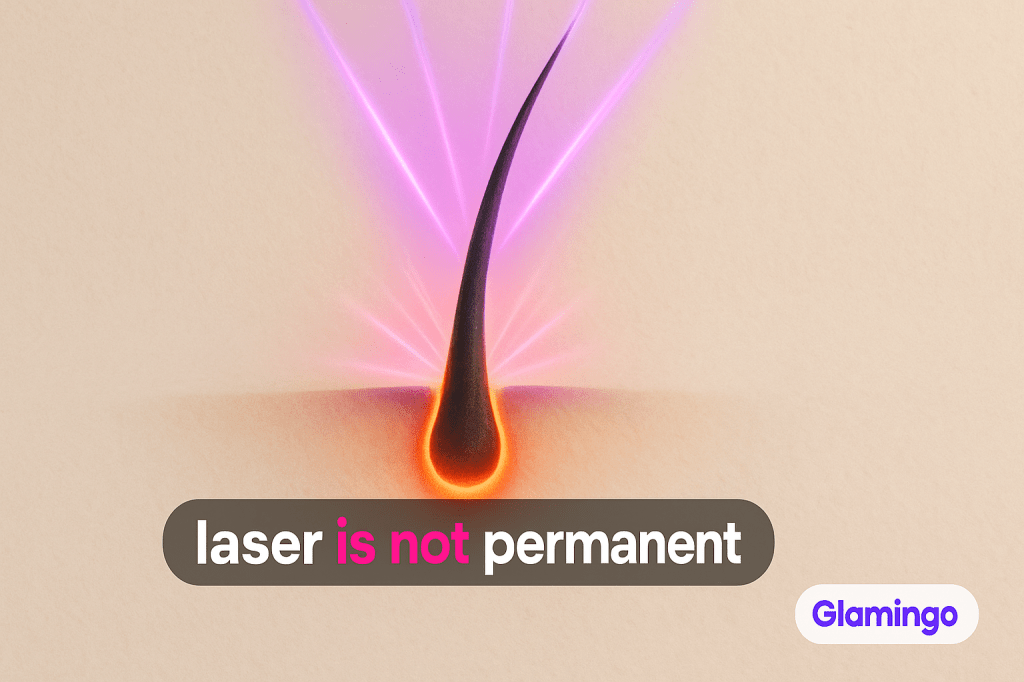
You have paid for six sessions, waited the full cycle, and the clinic swore it was permanent. Then three months later, hair. If you have been sold “permanent hair removal” by a laser clinic, you were sold something the science does not support — and the FDA-cleared label has never used those words.
This is not a niche complaint from one unlucky person. It is one of the most consistent frustrations among women who have gone through a full laser course and found themselves standing in the shower, razor in hand, wondering what exactly they paid for. The gap between what clinics promise and what the treatment actually delivers is not a matter of bad luck or unusual physiology. It is a language problem — one that costs you money and sets up expectations the technology was never designed to meet.
The myth: laser hair removal is permanent
What “permanent” actually means in the FDA’s own language
Here is the thing clinics rarely put in their brochures: the FDA-cleared claim for laser hair removal is “permanent hair reduction“, not “permanent hair removal“. That distinction is not semantic wordplay. It is a clinical and legal boundary that defines exactly what the treatment is approved to deliver — a long-term, stable reduction in the number of hairs that regrow, not the complete and irreversible elimination of a hair follicle.
Permanent reduction means that after a completed course of treatment, many of your follicles will be significantly disrupted and will produce finer, slower-growing, or no hair for an extended period. Some may stop producing hair altogether. But the regulatory language deliberately does not promise that all follicles are gone for good — because the mechanism does not support that outcome in every case.
Why clinics say “permanent” anyway — and what to look for when they do
Peer-reviewed literature has specifically flagged the gap between how laser hair removal is marketed and what the clinical evidence actually supports — this is not just consumer frustration, it is a documented attitudinal problem within the industry itself. “Permanent hair removal” is a more compelling marketing line than “significant, long-term reduction in hair density.” One sells six-session packages. The other requires a more honest conversation about realistic outcomes.
When a clinic uses the word “permanent” without qualification, it is worth pausing. It does not necessarily mean they are bad at what they do. It may mean their marketing team is doing what marketing teams do. But if a clinician — not the receptionist, the actual clinician — cannot explain the distinction between reduction and removal when you ask directly, that tells you something about the standard of informed consent happening in that clinic.
The mechanism — why permanent reduction, not removal, is the honest outcome
What selective photothermolysis actually does to a hair follicle
The established clinical basis for laser hair removal is a mechanism called selective photothermolysis — the laser targets heat-absorbing melanin (the pigment that gives hair and skin their colour) specifically within the hair follicle, causing thermal injury to the structure responsible for hair growth. In plain terms: the laser finds the dark pigment in the follicle and heats it up enough to damage the growth cells.
Think of each hair follicle as a furnace powered by dark pigment. The laser is designed to heat that furnace hot enough to break it. But if the heat is not calibrated correctly — too low, wrong wavelength, wrong skin-to-hair contrast — you are warming the furnace, not destroying it. Warm enough, and it may actually come back stronger. That is why the outcome is reduction, not removal: you are disrupting the follicle’s ability to function, not surgically excising it.
Why thermal damage does not always mean destruction
A damaged follicle is not the same as a destroyed one. The thermal injury caused by a correctly calibrated laser session can permanently impair a follicle’s ability to produce a normal, pigmented, thick hair — which is why many women find that regrowth after laser is finer and sparser than before. But biological variability means some follicles sustain only partial damage. They recover. They produce hair again. This is not a treatment failure in the dramatic sense — it is the expected biological range of outcomes that the “permanent reduction” language actually accounts for, and that “permanent removal” glosses over entirely.
The skin tone variable most clinics underexplain
Why contrast between hair and skin colour drives results
Laser hair removal works best when there is a high contrast between hair colour and skin tone, because the laser needs to target the melanin in the hair while the surrounding skin absorbs as little energy as possible. The classic “ideal candidate” profile — dark hair, lighter skin — comes directly from this physics. The laser is not smarter than physics. It cannot distinguish between the melanin in a dark hair follicle and the melanin in a dark skin tone if there is insufficient contrast between the two.
Someone with very dark hair and light skin will typically see faster, more complete results and require fewer sessions. That is not a coincidence or good fortune — it is the mechanism working under optimal conditions. Someone with light blonde or grey hair may find that laser does very little, because there is not enough melanin in the follicle for the laser to target effectively at all.
What this means for darker skin tones — and which laser type matters
For women in Singapore and Southeast Asia — many of whom fall into Fitzpatrick skin types III to V (the clinical scale used to classify skin colour and its response to UV and laser energy) — this matters enormously. Using the wrong laser type on darker skin does not just reduce efficacy. It increases the risk of post-inflammatory darkening (what dermatologists call post-inflammatory hyperpigmentation), where the treated skin responds to the heat injury by producing excess melanin. Hyperpigmentation post laser hair removal has been documented in clinical literature as a real and relevant risk for this skin type range — not a hypothetical.
The Nd:YAG laser is identified in clinical literature as the documented option for darker skin tones, because its longer wavelength penetrates more deeply into the follicle while bypassing more of the melanin at the skin’s surface. Alexandrite lasers, which work beautifully on lighter skin with dark hair, carry a higher risk of surface damage on Fitzpatrick IV–V skin. Diode lasers sit somewhere in between. The point is not that one laser is universally superior — it is that the match between laser type and your specific skin tone is a clinical decision, not a marketing one.
The rare but real risk no one mentions in the brochure
Paradoxical hypertrichosis — when laser makes hair worse
There is a side effect of laser hair removal that almost no clinic volunteers unprompted, and it is jialat enough to deserve its own section. Paradoxical hypertrichosis — where laser treatment at suboptimal energy levels actually stimulates hair growth rather than destroying the follicle — is a documented side effect in published research. Instead of heat destroying the follicle, insufficient energy essentially acts like a low-level stimulus, potentially activating dormant follicles in the treated area.
This is rare. But it is real, and it is almost never in the consultation paperwork. The women most likely to experience it are those being treated with energy settings that have been dialled too low — often done with the best intentions to reduce discomfort, particularly on more sensitive areas or darker skin tones where the operator is (reasonably) cautious about burning.
How energy level (fluence) is the key variable
Fluence — the amount of energy delivered per unit area — is the variable that separates a session that disrupts a follicle from one that barely inconveniences it. Too high and you risk burns, blistering, and pigmentation changes. Too low and you are not achieving the thermal damage threshold needed for reduction. Getting fluence right for your specific combination of skin tone, hair colour, and hair density is a clinical calibration — it requires training, experience, and an honest assessment of your Fitzpatrick type before the device comes anywhere near your skin.
The operator gap — why the machine matters less than who is using it
What regulated training looks like versus what most clinics offer
Here is the uncomfortable truth about the laser hair removal industry: a peer-reviewed paper on training standards has specifically flagged laser hair removal as an energy-based device procedure requiring regulated certification — and simultaneously identified that training and certification for such procedures is currently unregulated or inconsistently applied across practitioners. The person holding the laser device at one clinic may have undergone rigorous, medically supervised training. The person at the salon two doors down may have completed a weekend course.
The laser machine in both clinics might be identical. The outcomes will not be. Equipment brand, device model, and marketing language tell you very little about the competence of the person calibrating the settings for your specific skin. This is not a reason to avoid laser hair removal — it is a reason to be selective about where you have it done.
Questions to ask before your first session
A qualified operator should be able to tell you exactly which laser they use and why it suits your skin tone without hesitation. They should be able to discuss your Fitzpatrick type, explain the fluence settings they are considering, and describe what realistic results look like for your specific combination of hair colour and skin tone — including the realistic number of sessions and the likelihood of some maintenance being needed over time. If a pre-treatment consultation feels more like a sales conversation than a clinical assessment, trust that instinct.
Verdict — what laser hair removal actually delivers
Who gets the best results
The best candidates for laser hair removal are those with a strong contrast between hair and skin colour — dark, coarse hair on lighter skin tones. For these women, a properly completed course with a calibrated, appropriate laser can deliver dramatic and long-lasting reduction, with regrowth that is finer and sparser than before. Some follicles in the treated area may not produce hair again for years, or at all.
Who should adjust expectations
If you have a darker skin tone — which describes a significant proportion of women in Singapore and Southeast Asia — results are absolutely achievable, but they depend critically on the right laser type (Nd:YAG being the established option), appropriate fluence calibration, and an operator experienced with your Fitzpatrick range. Fewer sessions at the wrong wavelength will not catch up to more sessions done correctly. Light or fine hair — blonde, red, grey — responds poorly regardless of skin tone, because there is simply not enough melanin for the mechanism to work against.
The one thing to change about how you evaluate clinics
Stop evaluating laser clinics primarily on price per session, package deals, or whether the before-and-after photos look impressive. Start evaluating them on whether they can have a specific, technically grounded conversation about your skin before they pick up the device. The clinic that gives you a real consultation — one that involves your skin tone, your hair type, a named laser, and an honest conversation about what “permanent reduction” actually means — is almost always the better investment, even if the per-session rate is higher.
Before your next session or before booking one, ask the clinic directly: “Which specific laser type do you use, and why is it appropriate for my skin tone?” If they cannot name the laser — Nd:YAG, Alexandrite, Diode — and explain why it suits your Fitzpatrick type, that is your signal to look elsewhere. Because the device type and the operator’s ability to calibrate fluence correctly is where results and safety are actually determined, not in the marketing promise of permanence.
If you want to compare laser hair removal providers in Singapore without starting from scratch, Glamingo lists clinics with verified treatment details so you can ask the right questions before you even walk in. Search laser hair removal providers near you →
 Glamingo Blog
Drop in your comments..