
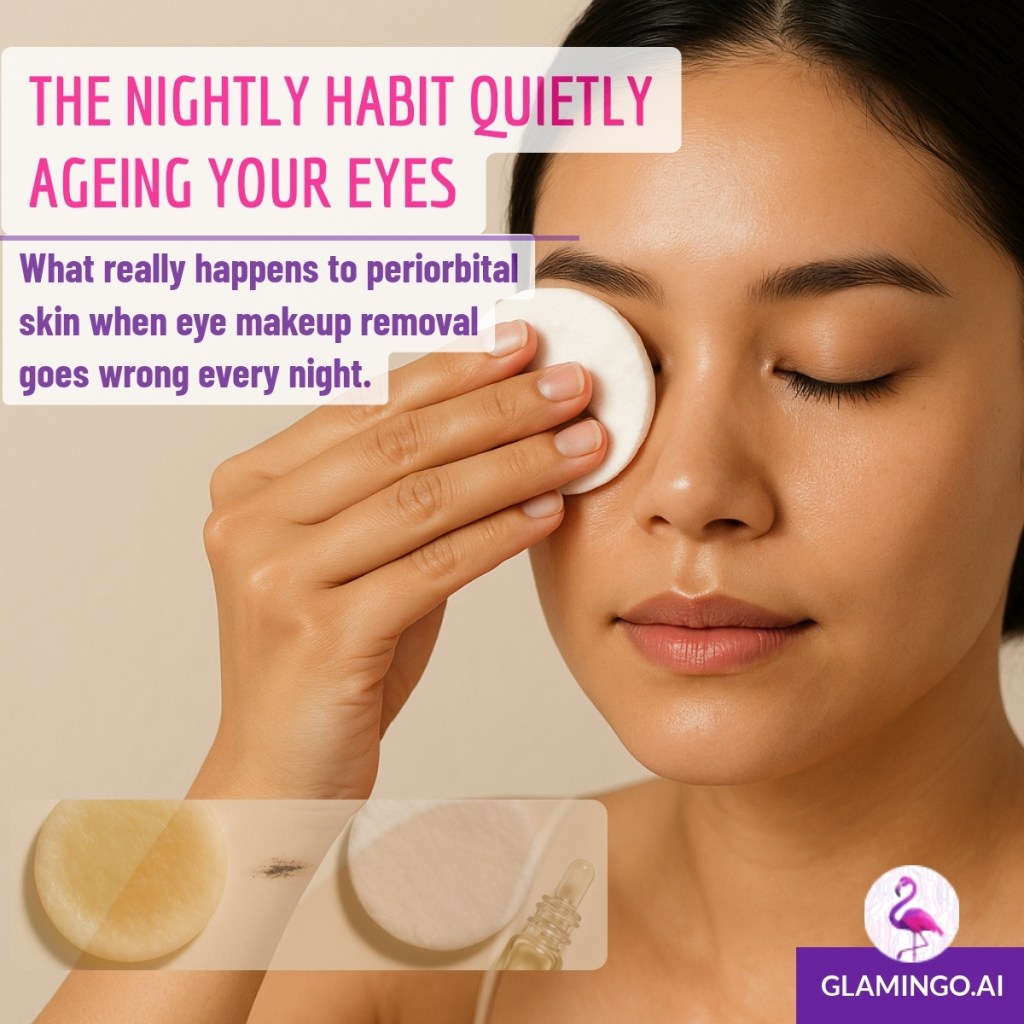
You cleanse, you tone, you layer your actives — and then you scrub off your mascara with a cotton pad and some micellar water and call it done. That scrubbing motion, repeated every single night, is doing more damage to the most structurally fragile skin on your face than almost anything else in your routine. If you have ever cycled through remover after remover — each one either stinging, drying you out, or leaving the skin around your eyes permanently looking a little irritated — the problem probably was not the formula. Nobody explained what is actually happening to your skin during removal. That changes here.
The frustration is real and it is common: you are doing everything right in your skincare routine and still waking up with redness at the outer corners, or noticing that your under-eye area looks somehow more creased than it should at your age. The culprit is hiding in the last step of your evening routine, disguised as something simple and quick. Eye makeup removal, done incorrectly, is a nightly accumulation of micro-damage — and the anatomy of that area means it cannot absorb it the way the rest of your face can.
The eye area is not just ‘sensitive skin’ — it is structurally different skin
How thin is the skin around your eyes, really?
When people say the eye area is delicate, they usually mean it reacts easily. But the difference runs deeper than reactivity — it is structural. The skin around your eyes, known as periorbital skin, has a significantly thinner dermis than skin elsewhere on your face. Where your cheek might have a dermis of around 2mm, the eyelid skin can be as thin as 0.5mm. That is not a minor variation. It means less collagen scaffolding, less structural depth to absorb repeated stress, and far less room for error.
Published research describes the eye area as especially challenging precisely because of this — the delicate surrounding skin, multiple layers of product applied close to the lash line, and the proximity of the eye itself all compound the difficulty of safe removal. What this means practically is that friction that your cheek can tolerate is friction that the periorbital area cannot shrug off without consequence.
Why fewer oil-producing glands make this area slower to recover from barrier disruption
Your skin’s ability to recover from daily wear and mild irritation depends partly on its natural oil production. The sebaceous glands — the small glands embedded in your dermis that produce sebum — act as a continuous moisture replenishment system. The periorbital area has significantly fewer of these glands than the rest of your face. That means when your skin barrier around the eye is disrupted (which removal can and does cause), the area has less natural infrastructure to repair itself overnight.
In Singapore’s climate, this is worth pausing on. The year-round humidity can give a false sense of skin being well-moisturised — but atmospheric moisture is not the same as a functioning skin barrier. If your barrier is being disrupted nightly by removal friction, the humidity around you is not going to compensate. Your periorbital skin is working with less, recovering more slowly, and accumulating that deficit one evening at a time.
What eye makeup is actually made of — and why it does not come off easily
How oil-based and film-forming formulas bond to the skin and lash line
Think of waterproof eye makeup as a thin layer of heat-set wax on a piece of tissue paper. If you try to scrape the wax off with a dry cloth, you tear the paper. But if you press warm oil onto the wax first, it liquefies and lifts — the paper stays intact. The oil is the solvent. The mechanical rubbing with an under-saturated cotton pad is the scraping. The periorbital skin is the tissue paper — and unlike the rest of your face, it does not have much structural depth to absorb that damage before it shows.
Most eye makeup — particularly anything marketed as long-wear, budge-proof, or waterproof — relies on film-forming polymers and wax-based ingredients to stay put through sweat, humidity, and twelve hours of wear. These ingredients create a physical bond with the skin surface and the lash line. Research into makeup removal design confirms that multiple oil-based product layers applied close to the eyelashes bond to each other and to the skin, significantly increasing the force required for removal with standard techniques. That force is what your cotton pad is generating every night.
Why waterproof mascara and long-wear liner require a chemical match to dissolve, not just a wipe
The core chemistry principle here is straightforward: like dissolves like. Oil-based formulas dissolve in oil. They do not dissolve easily in water or in the mild surfactant solutions that most micellar waters use. Micellar water works by surrounding individual particles of makeup in tiny clusters of surfactant molecules — it is effective for light, water-soluble products. But against a properly waterproof mascara or a long-wear gel liner, it is bringing the wrong chemistry to the job. The makeup does not dissolve. So you compensate with pressure and movement — and that is where the damage accumulates.
What happens during removal — the mechanism of damage
Mechanical stress: what repeated friction does to periorbital skin over months and years
A single removal session does not ruin your skin. The problem is the nightly compounding. Repeated friction against thin, structurally limited periorbital skin gradually degrades the outermost skin barrier layer — the layer responsible for keeping moisture in and irritants out. Over months and years, this contributes to a cycle of low-grade chronic inflammation in that area: the persistent redness at the outer corners, the dry patches that no eye cream seems to touch, the fine lines that appear earlier than they should.
The direction and speed of wiping matters here too. Horizontal back-and-forth wiping across the eye area creates lateral traction on skin that has very little elastic depth to accommodate it. Downward strokes — single, deliberate — create significantly less mechanical stress than the instinctive scrubbing motion most people default to when mascara is not lifting.
Chemical stress: how the wrong remover formula disrupts the skin barrier and tear film
Beyond the mechanical issue, the formulation of your remover matters — and not always in the ways product labels imply. A clinical in vivo study documented that eye makeup removal products negatively affect the tear film — specifically the lipid layer of the tear film that protects the surface of the eye and contributes to ocular comfort. This is moderate-strength evidence: it is peer-reviewed and conducted in living subjects, though the scope is specific to tear film characteristics rather than broader skin outcomes.
What this means in practice is that when remover migrates even slightly into the eye margin — which is difficult to avoid entirely — it can interfere with the thin oily layer that coats the surface of your tears. The result is eyes that feel dry, gritty, or irritated even after removal is complete. If you routinely finish your evening routine with eyes that sting or feel uncomfortable, this is a plausible mechanism — not just individual sensitivity.
The overlooked casualty — brow hair follicles and lash roots
There is a third casualty that almost nobody talks about. If you have noticed your brows thinning over the years — and you wear brow product regularly — removal technique is worth examining before you blame age or hormones alone. Aggressive eye makeup removal is identified as one of the most common practices that unknowingly weakens eyebrow hairs by damaging follicles through repeated mechanical stress at the brow.
The same logic applies to lash roots. The lash line sits at the exact epicentre of where most people apply the most pressure during removal. Repeated traction at the follicle level — night after night, year after year — does not immediately cause lash loss, but it gradually compromises the structural integrity of the follicle environment. If your lashes seem sparser than they were five years ago, your removal technique is a legitimate variable to review.
The oil-first principle — why it reduces friction at the source
Like dissolves like: how oil breaks down oil-based makeup without rubbing
For stubborn waterproof eye makeup, oil-based eye cleansers are specifically recommended as a first step before any further cleansing, because oil-based formulas dissolve oil-based makeup more effectively than water-based alternatives. This is not a new concept — double cleansing has been a cornerstone of K-beauty routines for years, and most readers will have used a cleansing oil at some point. But applying it specifically and intentionally as the first move on the eye area before doing anything else is a different proposition from using it as a general face step.
The chemistry works in your favour: oil solvents penetrate the wax-based film of waterproof mascara and begin breaking the bond between product and skin before any mechanical force is involved. By the time you introduce a cotton pad, you are wiping away dissolved product rather than abrading bonded product off the skin surface. The friction required drops dramatically.
What the press-and-hold technique actually achieves
Contact time is the variable most people skip. When you press a saturated cotton pad against your closed eye and hold it still for fifteen to twenty seconds without moving, you are giving the solvent — whether that is oil, micellar water, or a dedicated remover — time to work on the chemical bond before any mechanical force is introduced. Most people hold for two seconds and then start wiping. That is not enough time for dissolution to occur, so the wiping compensates. The press-and-hold step is not a luxury. It is the part that makes the rest of the removal genuinely less damaging.
How to read an eye makeup remover label honestly
Formulation flags that increase irritation risk
Fragrance is the most reliable red flag for eye area products. It serves no functional purpose in a remover and is a well-documented irritant for periorbital skin and the ocular surface. Alcohol — particularly denatured alcohol — is the second: it disrupts the skin barrier and is drying in an area that is already slow to self-moisturise. High-concentration surfactants are the third. Surfactants are what make products foam and emulsify, but in high concentrations around the eye margin, they increase the risk of disrupting the tear film.
None of these ingredients are necessarily present in products that claim to be “gentle” or “suitable for sensitive eyes.” Which brings us to the second problem.
What ‘ophthalmologist-tested’ and ‘gentle’ actually mean — and do not mean
“Ophthalmologist-tested” means the product was reviewed or tested by an ophthalmologist — it does not mean it passed, it does not mean it was tested in a clinical trial, and it does not establish a standard level of safety. It is a process claim, not an outcome claim. Clinical research on the ocular side effects of eye makeup removal products confirms that even products used in routine cosmetic practice can disrupt tear film characteristics — a finding that the average product label gives you no indication of whatsoever.
“Gentle” is even less regulated. It means whatever the brand decides it means. What you can actually evaluate on a label is the ingredient list: absence of fragrance, alcohol, and high-concentration surfactants is a meaningful formulation signal. The word “gentle” printed on the front is not.
Applying the mechanism: the removal sequence that works with your skin biology, not against it
When you understand what is actually happening during removal — oil-based bonds that require oil-based solvents, skin with minimal structural depth to absorb friction, a tear film that is disrupted by product migration, and follicles that are stressed by repeated traction — the correct sequence becomes intuitive rather than prescriptive.
Start dry. Apply a small amount of cleansing oil or balm directly to your fingertips and press it gently onto the closed eyelid and lash line before any cotton pad is involved. This initial contact begins dissolving the makeup bond while your hands are exerting almost no traction on the skin. Then saturate a soft cotton pad — fully saturated, not damp — with your chosen remover, press it against the eye, and wait. Not two seconds. Fifteen to twenty seconds. When you move the pad, move it once, downward, without back-and-forth friction. If product remains, a second press-and-hold achieves far less damage than re-wiping the same area repeatedly.
Brow product deserves its own separate attention. Many people swipe the same cotton pad used for the eye across the brow in a single horizontal motion — which is applying maximum friction directly to the follicle zone. A dedicated downward press on the brow, with a properly saturated pad and a second or two of contact time, removes the product without the traction.
The entire sequence takes perhaps forty-five seconds longer than what most people currently do. That difference, sustained over months, is the difference between periorbital skin that holds up well and periorbital skin that is quietly accumulating damage nightly while you invest in eye creams to undo it.
This week, change the sequence before you change the product: apply your current eye makeup remover to a dry cotton pad, press it against your closed eye for 15–20 full seconds before moving it at all, then slide gently downward once rather than wiping back and forth. If you are wearing waterproof mascara or long-wear liner, add a drop of cleansing oil or balm to the pad first. The mechanism insight here is contact time and chemistry before friction — not a new remover.
If this has you thinking about what a professional eye area treatment could do for skin that has taken years of removal stress, Glamingo has verified facial and eye treatment options near you — from soothing eye masks to targeted periorbital treatments — with real reviews from women who have actually tried them. Find a treatment near you →
 Glamingo Blog
Drop in your comments..