
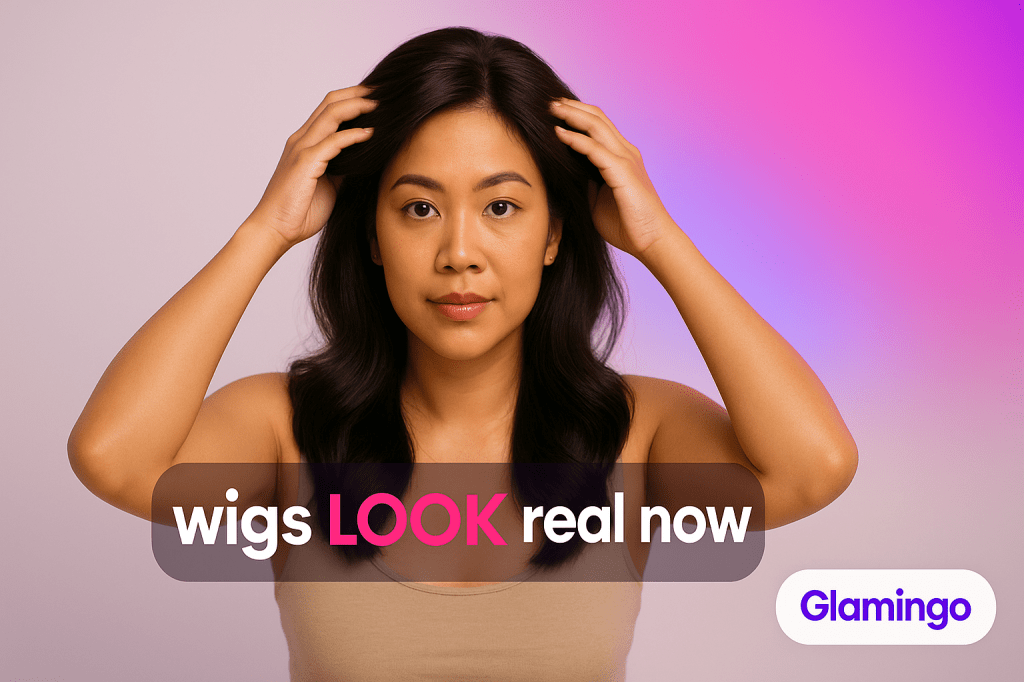
If you have ever quietly Googled hair toppers at midnight because your parting is getting wider and you are not ready to talk about it, you already know the problem: almost everything you think you know about wigs and toppers came from a bad soap opera or a well-meaning but misinformed friend. The myths keeping women away from these solutions are not just wrong — they are costing people genuinely good hair days. And in some cases, they are keeping women stuck in a loop of dry shampoo, strategic parting, and quiet frustration when there is a real option sitting right in front of them.
This is not a niche problem. Hair thinning in women in their twenties, thirties, and forties is more common than most people discuss out loud — postpartum shedding, hormonal shifts, years of tight ponytails, or just diffuse thinning that crept up slowly. The tools exist. The stigma and the misinformation are what get in the way. So let us go through the myths properly, one by one.
The Myth Stack — Why Everything You Think You Know About Wigs and Toppers Is Probably Wrong
Where These Myths Came From (Hint: Outdated Pop Culture and Medical Gatekeeping)
The cultural image of a wig in most people’s heads is a specific one: stiff, shiny, sitting slightly too high on the forehead, slipping during a dramatic scene. Decades of television and film used obvious wigs as visual shorthand for disguise, illness, or comedy. That image lodged itself into collective memory and has been remarkably resistant to updating, even as the actual product category has changed almost beyond recognition.
The second source of mythology is medical gatekeeping — the implicit idea that hairpieces are a clinical tool, prescribed for serious conditions, and not something a person reaches for out of choice. This framing served a purpose once, when the products genuinely were basic and primarily functional. It no longer reflects reality, but the attitude has stuck. Together, outdated pop culture and medicalised framing have created a myth stack that stops women from even beginning to look seriously at a category that might genuinely help them.
Myth 1 — They Always Look Fake
What Actually Makes a Hair Piece Look Unnatural
The wiggy look has a cause, and it is not the product category itself. It is a failure of fit, construction, and matching. Think of a hair topper like a well-fitted bra: the cheap, wrong-sized version looks obviously wrong and feels uncomfortable, while the correctly fitted one disappears under your clothes and you stop thinking about it entirely. The product itself is not the problem — the fit, the match, and the construction are everything. A poorly matched piece in the wrong density, the wrong undertone, or mounted on a stiff wefted base will look like a hairpiece on anyone. A correctly matched piece on the right base construction will not.
How Modern Construction Has Changed the Game — Lace Fronts, Monofilament, and Hand-Tied Bases Explained in Plain English
The three terms you will encounter most often are lace front, monofilament, and hand-tied — and they refer to how the hair is attached to the base of the piece, which directly determines how natural it looks and moves. A lace front base uses a sheer mesh along the hairline so that individual hairs appear to grow directly from the scalp rather than from a visible edge. A monofilament base uses a thin, skin-like mesh across the top of the piece so that each hair moves independently — mimicking the way real hair falls in multiple directions rather than all moving as a fixed unit. Hand-tied construction means each hair strand is individually knotted onto the base, which creates the most natural movement and the most realistic appearance of density variation. These are not minor upgrades — they represent a fundamentally different category of product compared to the machine-wefted pieces that shaped most people’s mental image of what a wig looks like. Early research and widespread user experience support that these construction methods significantly improve realism, though large-scale comparative studies are limited, so the strongest evidence here is observational and experiential rather than clinical.
The Asian Hair Matching Problem That Most Wig Guides Ignore
Most wig advice available online is written for a Western market, which creates a specific problem for women in Singapore. Asian hair — Chinese, Malay, and Indian hair types — typically has a rounder strand cross-section, sits at higher natural density, and has a darker melanin baseline with distinct cool or warm undertones depending on your heritage. A piece matched for volume and colour against European hair norms will look wrong even on a well-constructed base, because the density and the light-reflection properties will not align with your natural hair. Finding a specialist who understands how to match colour undertone and strand density for Asian hair is not a minor detail — it is the difference between a piece that blends and one that obviously does not. Generic Western wig guides consistently skip this, which is one of the reasons women in Singapore have historically had to source pieces internationally to find the right match.
Myth 2 — They Are Only for Cancer Patients or Severe Alopecia
The Real Spectrum of Users: Postpartum Shedding, Hormonal Thinning, Traction Damage, and Convenience
The medical associations are real and important — for someone going through chemotherapy or managing significant alopecia, a well-fitted piece is genuinely life-changing. But restricting the category to those use cases ignores the far larger group of women who are using toppers and wigs for entirely different reasons. Postpartum shedding, which typically peaks around three to four months after delivery, can leave women with dramatically reduced density at the hairline and crown. Diffuse thinning from hormonal fluctuations — including thyroid shifts, perimenopause, and the aftermath of coming off the pill — often progresses so gradually that women do not notice how much ground they have lost until they see a photograph. Traction alopecia (hair loss caused by repeated tension on the follicle from tight hairstyles over years) is particularly relevant in communities where braids, extensions, and tight styles have been part of regular hair practice since childhood. And then there are women who simply want more volume, more length, or more versatility without putting their hair through another round of bleach and heat. All of these are legitimate use cases. None of them require a medical diagnosis to justify.
Why Medical Gatekeeping of a Styling Tool Hurts the People Who Need It Most
There is a specific kind of harm in medicalising a styling tool. When the cultural message is that hairpieces are only for people who are ill, women experiencing early or moderate thinning are left without a framework for considering them — because they do not feel their situation is “serious enough.” They wait. The thinning continues. And the window in which a topper might have made the most difference narrows. Meanwhile, the framing also creates pressure on women who are genuinely ill, suggesting they must visibly signal their condition rather than manage it on their own terms. Neither group is served by treating a tool like a prescription.
Myth 3 — Wearing One Will Damage Your Real Hair
When This Is Actually True (Clip Tension and Poor Scalp Hygiene)
This myth has a grain of truth in it, which is exactly what makes it sticky. Clip-in toppers attached to fragile or already-thinning hair can cause traction stress — the same mechanism behind traction alopecia — if the clips are placed repeatedly on the same sections, clipped too tightly, or left on hair that has not been adequately supported. Scalp hygiene is the other real risk: wearing a piece for extended periods without proper cleaning of both the piece and the scalp underneath can create the conditions for follicle-blocking buildup and, in some cases, fungal issues. These are real concerns, and dismissing them entirely would be dishonest. But they are concerns about misuse, not about the product category itself.
When It Is Not True — How Correct Fit and Maintenance Protect Your Existing Hair
A correctly fitted topper on a healthy base, with clips distributed across sections of hair with adequate density to support them, does not cause the kind of repeated directional tension that leads to follicle damage. In fact, for women who are accustomed to daily heat styling or tight updos to manage the appearance of thinning, switching to a topper can meaningfully reduce the total stress load on their real hair. The piece handles the visual work; your natural hair underneath gets a rest from the tools and tension it would otherwise be subjected to. The maintenance rule of thumb that holds up consistently is simple: clean the piece regularly, clean your scalp regularly, and do not clip into hair that cannot comfortably support the weight.
Myth 4 — You Need a ‘Good Enough’ Reason to Wear One
Why Wanting Fuller Hair Is Already a Good Enough Reason
At some point, the conversation about hair toppers developed an implicit qualification requirement. You had to be losing hair. It had to be significant. There had to be a medical explanation. Anything short of that, and the implication was that a woman using a topper was somehow overreacting, or vain, or hiding something. This is a strange standard to apply to a styling tool. Nobody asks a woman to justify her decision to get a blowout, wear a hair extension, or use a volumising powder. A topper is a styling solution that happens to be particularly effective. Wanting fuller, more confident hair is already a good enough reason. Full stop.
The Self-Stigma Loop — How Internalised Shame Keeps Women From a Tool That Works
The more insidious barrier is not what other people think — it is what women think other people will think. Research on stigma experiences has documented that self-stigma — internalised shame about a condition or characteristic — frequently operates as a more limiting barrier to daily functioning than enacted stigma from others, meaning the judgment people fear often exceeds the judgment they actually receive. This framework applies directly to the hair topper hesitation loop: women delay, research privately at midnight, worry about being “found out,” and forgo something that would genuinely help them — not because anyone around them has actually said anything, but because they have already decided how the conversation would go. The woman who described toppers as “the best decision I’ve ever made” — and who went to the effort of sourcing hers from overseas because she could not find the right quality locally — did not arrive at that conviction without working through that loop first. The conviction on the other side of it is telling.
Myth 5 — Human Hair Is Always the Better Choice
What Singapore’s Climate Actually Does to Human Hair Wigs
Human hair has a prestige framing that is not entirely unearned — it responds to heat tools the way your own hair does, and high-quality human hair pieces can look extraordinarily natural. But the “human hair is always superior” claim breaks down quickly when you factor in Singapore’s climate. With year-round humidity sitting around 80% and a UV index regularly hitting 10 to 12, human hair wigs are exposed to exactly the conditions that cause frizzing, colour fading, and structural degradation in natural hair — and a human hair piece does not benefit from your scalp’s sebum production to maintain moisture balance. What this means in practice is that a human hair piece in Singapore’s climate requires significant maintenance: conditioning, careful washing, heat-free drying, UV-protective products, and regular professional care. Skip any of those steps consistently, and a premium piece deteriorates faster than expected.
Where High-Quality Synthetic Wins on Practicality
High-quality synthetic fibres engineered specifically for humidity and heat resistance can actually outperform human hair in longevity and frizz control in tropical conditions — the fibres hold their style through humidity in a way that human hair simply does not, and they require significantly less maintenance. This is not an argument that synthetic is always better. It is an argument that “human hair is always better” is a marketing claim, not a climatically informed recommendation. For women in Singapore wearing a piece regularly, the honest answer is that the best choice depends on your lifestyle, your maintenance commitment, and how you are using the piece — not on a hierarchy that ignores where you actually live.
The Verdict — What the Evidence Actually Says
To be transparent about what this article is built on: the evidence base for this topic is largely experiential and observational rather than clinical. The stigma research is peer-reviewed and applicable as a framework, though the original study context is cancer patients, not cosmetic wig users. The construction and climate claims are supported by real user experience and industry knowledge rather than large-scale comparative studies. Where the evidence is thin, it has been framed as such throughout. What that means practically is that the myth-crushing here is grounded in logic, user experience, and contextual reasoning — not randomised controlled trials. In this particular category, that is the honest level of evidence available, and it is enough to dismantle myths that were never evidence-based to begin with.
The actual verdict: modern hair toppers and wigs, correctly fitted and matched, do not inherently look fake, are not restricted to medical use cases, do not inherently damage your natural hair, do not require a qualifying level of hair loss to justify, and are not automatically better when made from human hair in a tropical climate. Every one of those claims holds up under scrutiny. The myths do not.
One Thing to Do This Week
This week, drop the framing that you need a medical reason to try a hair topper. If your parting is wider than it was two years ago and it is affecting how you feel when you leave the house, book a consultation at a specialist wig or topper studio in Singapore — not a general hair salon — and ask specifically to see lace or monofilament base options matched to your hair’s density and undertone. The product category has changed; your assumptions about it may not have.
If you want to find a specialist who actually understands Asian hair matching and the right base construction for your hair type, Glamingo lists verified wig and topper studios in Singapore with real reviews from women who have been through exactly this process. Browse hair topper specialists near you →
 Glamingo Blog
Drop in your comments..