
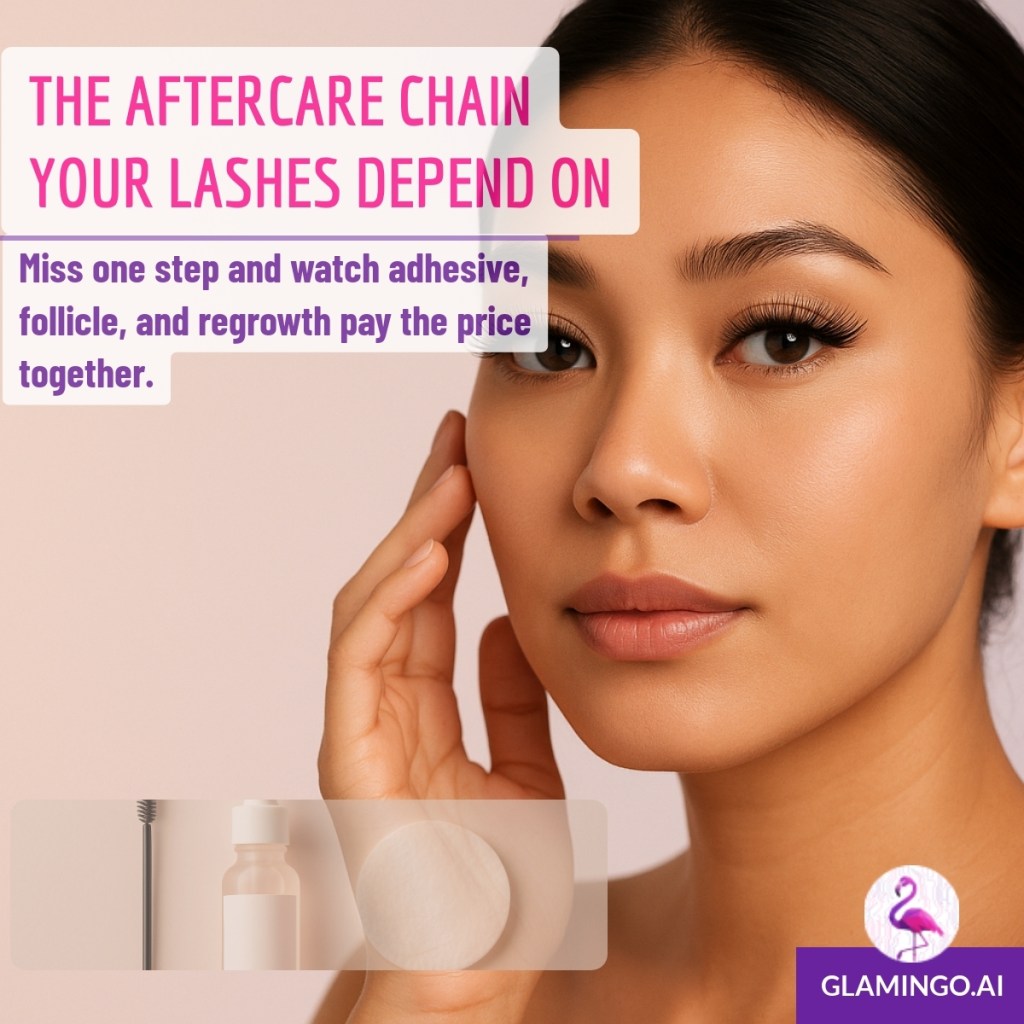
You leave the salon with perfect lashes and a vague instruction sheet you half-remember by morning. Three weeks later, your extensions are patchy, your natural lashes look thinner than before, and you’re not sure if that’s normal or if something went wrong. It isn’t random — there’s a specific chain of events that starts the moment aftercare slips, and once you understand it, the rules stop feeling arbitrary.
Most lash extension wearers treat aftercare as optional fine print. Keep them dry for a bit, avoid oil, brush them gently — sure, sure. But the reason those instructions exist isn’t to protect the extensions themselves. It’s to protect what’s underneath them: the natural lash and, more importantly, the follicle it grows from. Get that wrong repeatedly, and the consequences compound. By the time you notice your lashes looking genuinely sparse, the chain has already been running for months.
The chain starts the moment you leave the salon — here’s what’s actually happening
Think of a lash extension as a tent peg driven into soil. The adhesive bond is the peg, your natural lash is the stake holding it, and the follicle is the ground beneath. If you soak the ground before the peg sets, it never anchors properly. If you pour oil on it repeatedly, it loosens over time. And if the peg pulls out badly — taking chunks of soil with it — the ground becomes less stable for the next peg. Aftercare isn’t about protecting the extension. It’s about protecting the ground.
Why the first 24 hours are structurally different from every hour after
The adhesive used in lash extensions is cyanoacrylate — the same chemistry family as superglue, formulated for cosmetic use. It doesn’t dry in the traditional sense. It cures by reacting with moisture in the air, cross-linking into a rigid polymer chain. That process takes time. Exposing the adhesive to water before it has fully cross-linked weakens the bond at the base of the extension, which means the extension sits less securely on the natural lash from that point forward. Every subsequent blink, every rub, every windy commute applies mechanical load to a bond that was never given the chance to set properly. The 24-hour water-avoidance rule isn’t cosmetic caution. It’s structural.
What ‘fully cured adhesive’ actually means for your natural lash underneath
Once cured, the bond transfers mechanical force — the weight of the extension, friction from pillowcases, the drag of a lash brush — directly to the natural lash it’s bonded to, and by extension to the follicle anchoring that lash. A well-set bond distributes this load predictably. A poorly cured or degraded bond shifts it unpredictably. The difference matters because eyelash follicles have a distinct biology from scalp hair follicles, with a shorter active growth phase and independent cycling between individual follicles — meaning any given follicle is at a different stage from its neighbours at any moment. Mechanical disruption doesn’t affect your lashes as a uniform group. It affects individual follicles, one at a time, each at whatever stage they happen to be in.
Link 1 — Adhesive breakdown: how oil, water, and friction degrade the bond
After the first 24 hours, water is less of an issue than oil. Cyanoacrylate adhesive is oil-sensitive in a way that makes everyday beauty routines quietly destructive. The problem isn’t dramatic — you won’t watch an extension fall off after applying your moisturiser. It’s cumulative. Oil from cleansers, makeup removers, eye creams, and SPF products migrates toward the lash line during normal use, and each exposure softens the adhesive bond incrementally.
Oil-based products don’t just loosen extensions — they change how they detach
Here’s the part that most aftercare advice skips over. Oil doesn’t just shorten how long your extensions last — it changes the mechanics of how they leave. A clean, natural detachment happens at the end of the lash’s resting phase (the telogen phase), when the old lash sheds and a new one pushes through. At that point, the extension goes with it. That’s the ideal outcome. But when an adhesive bond is progressively weakened by oil, the extension becomes unstable before the natural lash is ready to shed. It begins to slide, catch, and pull — dragging at the natural lash rather than releasing cleanly at the end of its natural cycle. People who switch to oil-free makeup removers consistently report their extensions lasting meaningfully longer — not because the extensions are better, but because the bond is being allowed to degrade on its own timeline rather than being chemically accelerated. The mechanism is straightforward, even if it’s not something most wearers connect to their cleanser choice.
Uneven shedding vs. natural telogen release: why the difference matters for the follicle
The shedding pattern you see at the three-week mark — a few extensions gone, some hanging by a thread, some still intact — is often read as normal variation. Sometimes it is. But when extensions are detaching prematurely due to adhesive breakdown, the shedding is mechanical rather than biological. Instead of the natural lash releasing cleanly at the follicle opening, there’s traction. Repeated traction on a follicle that isn’t ready to release its lash is how you get to link two in the chain.
Link 2 — Follicle stress: what happens at the root when the extension leaves wrong
The follicle is small, but it isn’t passive. When a lash is pulled rather than shed, the follicle receives a mechanical signal it isn’t prepared for. Mechanical force applied at the cell surface can disrupt signalling within the follicle — including pathways governing cell structure and adhesion — triggering downstream cellular stress responses. The follicle registers this. How it responds depends on how often it happens, what stage of its cycle it’s in, and what else is going on in its local environment.
The lash growth cycle is shorter than you think — and more interruptible
Scalp hair cycles over years. Lash follicles cycle in months — sometimes as few as five to eleven weeks for the active growth phase (anagen), followed by a brief transition, then the resting and shedding phase. Because each follicle operates independently and cycles faster than scalp hair, mechanical stress during the wrong phase can interrupt the cycle and delay regrowth. Interrupt enough individual follicles often enough, and what you experience is an overall thinning — not because lashes aren’t growing, but because they’re growing back slower and shorter than before.
Debris, sebum, and low-grade inflammation at the follicle opening
There’s a second source of follicle stress that has nothing to do with how the extension detaches: the environment you’ve created around it. Extensions make the lash line harder to clean. Sebum, dead skin cells, and environmental debris — think humidity, pollution, and the general reality of wearing makeup in Singapore — accumulate at the follicle opening when cleansing is inadequate. This accumulation creates conditions for microbial overgrowth and low-grade inflammation around the follicle, which is a documented disruptor of healthy hair cycling. The irony is that many extension wearers under-cleanse specifically because they’re afraid of disturbing the extensions. The result is a compromised follicle environment that does more long-term damage than careful cleansing would have.
The systemic wildcard: stress, hormones, and premature telogen
Not everything affecting your lashes is happening at the lash line. Chronic physiological stress activates neurological, immune, and hormonal pathways — including cortisol-driven signalling — that can push hair follicles prematurely from the active growth phase into the resting and shedding phase. Eyelash follicles are not exempt from this. If you’ve been through a stressful season — a difficult work period, illness, disrupted sleep — and your extensions seem to be dropping faster than usual, it may not be entirely about your cleansing routine. The systemic and the local interact. Both matter.
Link 3 — Weaker regrowth: what repeated stress does to the follicle over time
A follicle that is occasionally disrupted recovers. A follicle that is disrupted cycle after cycle, across months or years of continuous extension wear, is dealing with a different situation entirely. The cumulative effect of repeated traction, low-grade inflammation, and interrupted cycling is not just delayed regrowth — it’s structural change to the follicle itself.
Follicle miniaturisation — the slow outcome that sneaks up on long-term extension wearers
The end-state of this repeated stress is something called follicle miniaturisation — a progressive reduction in the diameter and depth of the follicle, producing finer, shorter, and sparser lashes with each regrowth cycle. Eyelash follicle anomalies — including disrupted cycling and structural changes — are documented outcomes of sustained physical insult or inflammation at the follicle level. This is the outcome that long-term extension wearers most commonly report and least expect. The timeline is slow enough that many people attribute it to age or genetics before connecting it to years of extension wear. That’s exactly why it sneaks up.
How to tell if your sparse lashes are temporary shedding or a longer-term shift
Temporary shedding after removing extensions is normal. Your natural lashes were growing beneath extensions the entire time, cycling independently, and when the extensions come off you may see more of your natural lash base than you expected — and it can look sparse compared to what you’d become accustomed to. Give it six to eight weeks of clean recovery before drawing conclusions. What you’re watching for is whether lashes regrow to their previous density and length within that window. If they don’t — if regrowth is visibly finer, shorter, or patchy in the same spots across multiple extension cycles — that’s a different conversation, and it warrants one with a professional rather than another set of extensions.
Breaking the chain: the aftercare logic that actually protects your natural lashes
None of this is an argument against lash extensions. It’s an argument for understanding the mechanism so that your aftercare is deliberate rather than decorative.
The non-negotiables in the first 24 hours
Keep them dry. Not “try to avoid splashing your face” dry — genuinely dry. No steam rooms, no sweaty workouts, no crying through a particularly dramatic K-drama. The adhesive is still cross-linking, and water exposure during this window compromises the structural integrity of the bond in a way that cannot be corrected later. Skip the eye makeup entirely on day one. And sleep on your back, or invest in a silk pillowcase — friction during this window matters more than at any other point in the cycle.
The ongoing routine that keeps the follicle environment clean
Cleanse the lash line daily. This feels counterintuitive when you’re trying to preserve extensions, but the alternative — letting sebum, debris, and dead skin accumulate at the follicle opening — creates exactly the inflammatory environment that disrupts lash cycling. Use a dedicated oil-free lash cleanser and a clean spoolie to work it gently through the lash line, then rinse with cool water. Brush your extensions after cleansing when they’re dry, not wet — wet extensions under tension are more susceptible to mechanical stress. This is the routine that makes the difference between extensions that look good at three weeks and extensions that look rough.
What to avoid near the lash line if you’re using skincare actives
If you use retinoids, AHAs, or other active ingredients in your skincare routine, be precise about where they’re going. Various topical compounds applied to the periocular area — the skin and tissue around the eye — can cause adverse effects on the ocular surface and periocular skin, and some are known to alter lash growth and structure. This doesn’t mean abandoning your actives. It means applying them with intention and keeping them at least five millimetres from the lash line during an active extension cycle. Eye cream applied with a ring finger tapping motion at the orbital bone — not dragged toward the lashes — is the right technique here.
When to take a break from extensions entirely
A planned break isn’t failure. Four to six weeks without extensions — with consistent cleansing and no lash tinting or perming layered on top — gives follicles a genuine recovery window. If you’ve been wearing extensions continuously for more than a year, or if you’re noticing regrowth that seems finer than it used to be, a break is worth building into your calendar. Think of it as maintenance for the ground, not just the peg.
What to expect — and when sparse lashes should prompt a professional conversation
Some shedding after extensions is normal biology, not damage. Expect a transitional phase. What isn’t normal is persistent patchiness across multiple cycles, lashes that regrow noticeably shorter or finer than before, or any irritation, redness, or crusting at the lash line — the last of which may indicate the low-grade inflammation discussed earlier and warrants a dermatologist or ophthalmologist visit, not just a different salon. If a lash technician is consistently applying extensions that feel heavy, pulling, or uncomfortable within a day or two of application, that’s a fit and weight issue worth raising before the next appointment, not after. The best outcome from extension wear is one where your natural lashes are genuinely protected — not just maintained well enough to keep booking refills.
This week, check what you’re actually applying within 5mm of your lash line — cleanser, makeup remover, eye cream, or SPF. If any of them contain oils (look for ingredients ending in ‘-ate’, ‘-oil’, or listed as mineral oil, squalane, or plant extracts high in the ingredient list), swap to an oil-free alternative for the active period of your extension wear. This single change addresses the first link in the chain before follicle stress has a chance to begin.
If you’re thinking about finding a lash technician who actually talks you through aftercare — not just hands you a sheet — Glamingo lets you browse verified lash extension providers near you with real reviews from women who’ve been in exactly your position. Find a lash salon near you →
 Glamingo Blog
Drop in your comments..