
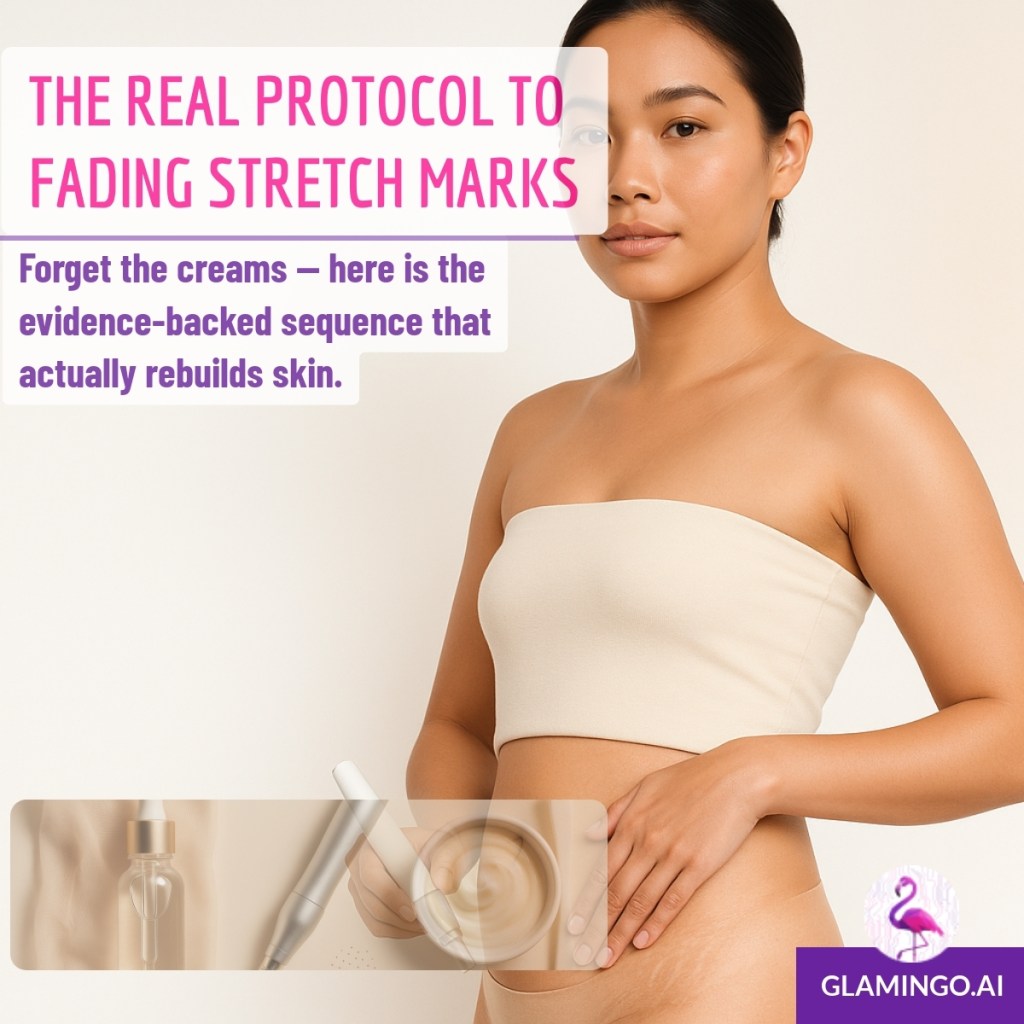
You have probably already tried the creams. Maybe a bio-oil phase, a vitamin E phase, something from the pharmacy that promised clinical results. If you are reading this, they did not work — and that is not a personal failing, it is just the biology of what a stretch mark actually is. The research trail on this is long, and the results from over-the-counter approaches are incremental at best — the scepticism surrounding these products is completely understandable, given the historical lack of results from topical solutions. This protocol tells you what the evidence actually supports, in what sequence, and what to realistically expect.
If you have spent any real time in beauty communities, you will recognise the pattern: people come looking for advice only after the creams have already failed them. That is not a coincidence. It reflects something true about what stretch marks actually are — and why the products most commonly sold to treat them are working on the wrong layer of skin entirely. What follows is a practical, stage-by-stage protocol for anyone who wants to move past the pharmacy shelf and into approaches that have real clinical rationale behind them.
First, understand what you are actually treating
Stretch marks are tears in the dermal scaffold — not surface dryness
Think of a stretch mark like a tear in a piece of fabric that has been repaired with a different, thinner thread. Moisturising the surface of the fabric does nothing to the weave underneath. To actually improve the repair, you need to unpick part of it and restitch — which is essentially what microneedling and energy-based treatments do: they deliberately create tiny controlled injuries that prompt the skin to re-lay collagen into the gap, gradually replacing the thin, disorganised scar tissue with something closer to the original structure.
Stretch marks form when the skin stretches rapidly, causing collagen and elastin fibres in the dermis to break. That damage happens in the deep structural layer of the skin — not at the surface. This is why no amount of topical hydration reaches the problem. Effective treatment must actively boost collagen and elastin production — surface moisturisation alone cannot deliver structural improvement. The stretch marks themselves will naturally fade over time in terms of colour, but the structural gap does not close on its own. That distinction matters enormously for choosing the right treatment.
Red vs white stretch marks: why the stage you are at changes everything about your protocol
Not all stretch marks are at the same point in their lifecycle, and the stage you are currently in determines both which treatments make sense and how much improvement you can realistically expect. Red or purple stretch marks — known as striae rubrae — are actively inflamed, meaning the skin is still in a repair phase and the blood supply is intact. This is the window where your skin is most receptive to intervention. White or silver marks (striae albae) are mature scar tissue. The inflammation has resolved, the blood supply has retreated, and what remains is a structurally stable — but significantly harder to treat — scar. The biology is different. Your protocol needs to be different too.
Step 1 — Before you book anything, assess your marks honestly
How to tell if your marks are in the active (red/purple) or mature (white/silver) phase
Stand in natural light — not bathroom lighting, which flatters everything — and look at the actual colour of your marks. Active marks will appear pink, red, or purple, and may feel slightly raised or even mildly itchy if they are very recent. Mature marks will appear white, silver, or pale against your skin tone, often slightly indented or with a different texture to the surrounding skin. On deeper skin tones (Fitzpatrick IV–V, which is common across Southeast Asia), this colour distinction can be subtler — mature marks may appear lighter than the surrounding skin or have a pearlescent quality rather than a stark white. If you are unsure, a consultation with a clinical provider is genuinely worth it before spending money on a treatment course.
What this means for which treatment tier to start with
If your marks are still active, you are in the best possible position to start treatment — the skin is still in a repair mode that clinical treatments can amplify. The priority is booking a consultation sooner rather than later, because this window does close. If your marks are already mature, that does not mean treatment is pointless — it means your expectations and your protocol need to be calibrated honestly. Significant fading and texture improvement is achievable for mature marks, but the degree of change will be more modest, and you will likely need more sessions to see it. Get that answer from your provider upfront.
Step 2 — Build your home protocol first (and set expectations correctly)
What actives actually do at home — and what they cannot do
Home actives are not going to re-lay collagen. That needs to be said plainly. What they can do is improve the surface texture around the marks, support skin cell turnover, and keep the skin in the best possible condition between clinical sessions. Think of this layer of your protocol as maintenance and preparation — not treatment. The mistake most people make is treating the home protocol as the primary intervention and the clinical work as optional. It is the other way around.
AHA exfoliants: glycolic and lactic acid for surface texture between sessions
Alpha-hydroxy acids — the family of water-soluble exfoliants that dissolve the bonds between dead skin cells at the surface — are a reasonable addition to your home routine, particularly glycolic acid and lactic acid. Early evidence suggests these can improve surface texture and support cell renewal at stretch mark sites, though this is limited evidence and they are working on a surface level. Glycolic acid, being the smallest molecule in the AHA family, penetrates slightly deeper than lactic acid and is generally the stronger option for texture work. Lactic acid is gentler and also adds some hydration, which makes it more suitable if your skin is sensitive. Either used two to three evenings a week gives your skin enough stimulus without compromising the barrier.
Retinol: how vitamin A derivatives support cell turnover at the mark site
Retinol — a vitamin A derivative that speeds up the rate at which your skin cells turn over — is worth including in your between-session routine. It will not structurally repair the scar, but it supports the surface renewal process and may help with the texture difference between marked and unmarked skin over time. Start low (0.025% to 0.1%) and build slowly. In Singapore’s humidity, retinol tolerability is generally better than in drier climates, but the golden rule still applies: don’t layer it with your AHAs on the same evening. Alternate nights is a simple and effective system.
Hydration and barrier support: why this is maintenance, not treatment
A well-functioning skin barrier helps your skin respond better to clinical treatment and recover from it faster. That is the genuine role of a good moisturiser and ingredients like ceramides (fatty molecules that act like mortar between skin cells, keeping the barrier intact) and niacinamide (a vitamin B3 derivative that supports barrier repair and can help with the discolouration aspect of stretch marks). These are not stretch mark treatments. They are skincare fundamentals that support the skin you are treating. Do not expect more from them than that — but do not skip them either.
Step 3 — Choose the right clinical treatment for your stage
Microneedling (collagen induction therapy): how it works, what the evidence shows, what to expect per session
Microneedling — clinically referred to as collagen induction therapy — is currently the most evidence-supported frontline clinical treatment for stretch marks. Fine needles create controlled micro-injuries across the surface of the marks, triggering the skin’s wound-healing response and forcing it to lay down new collagen and elastin into the scar gap. Over repeated sessions, this gradually replaces the thin, disorganised scar tissue with something closer to healthy skin architecture. Personalised treatment plans are essential — depth, frequency, and the addition of serums or other technologies all vary depending on the severity of your marks and your skin tone. Expect the skin to appear red and feel tight for 24 to 48 hours post-session. Results build cumulatively — do not judge a course of treatment on one session.
Radiofrequency microneedling: when the addition of heat energy makes sense for deeper, mature marks
Radiofrequency microneedling combines the needle-based collagen stimulus with radiofrequency energy — essentially controlled heat delivered at the precise depth where the needles reach. The heat adds a second layer of collagen-remodelling stimulus and can help with the deeper structural changes that mature or more severe marks require. If your marks are white, silver, or significantly indented, this is worth asking about specifically at consultation. The downtime is generally slightly longer than standard microneedling, and the cost is higher, but for mature marks it may deliver more meaningful change than standard microneedling alone.
Laser treatments: which types are used for stretch marks and what they target
Laser is not one thing — and which type of laser is relevant depends entirely on what you are treating. For red or purple marks, vascular lasers (such as pulsed dye laser) target the blood vessels contributing to the pink-red colour, which is why timing matters so much. For mature marks, fractional lasers — which create a grid of micro-injuries in the skin, leaving surrounding tissue intact — work on a similar collagen-induction principle to microneedling but with more precise depth control. On Asian skin tones (Fitzpatrick III–V), laser selection requires care, because the wrong laser settings can trigger post-inflammatory hyperpigmentation — a darkening response that is more common in deeper skin tones. Always verify that your provider has specific experience treating your skin tone before proceeding.
Emerging option — needle-free jet injection: what the early research shows and what questions to ask at consultation
You may see clinics in Singapore listing needle-free injection technology — such as devices using jet injection, where active ingredients are delivered into the skin under high pressure without a needle — as an option for stretch marks. The appeal is logical: if the problem is at the dermal level, delivering treatment directly there makes sense. A sonographic study examining the injection depth consistency of one such device (CureJet) in 25 individuals with abdominal stretch marks showed it could deliver treatment to the dermal depth where stretch marks form — but this is early-stage research. The delivery mechanism appears promising; whether this translates to meaningful clinical outcomes in large human trials is still an open question. If a clinic is offering this, ask specifically what active ingredient they are delivering, what evidence base they are drawing on, and what outcomes their own patients have seen. Treat this category as exploratory for now.
Step 4 — What to do immediately after each clinical session
The 48–72 hour window: what to avoid and why
The 48 to 72 hours after a microneedling or energy-based session are when your skin is most vulnerable and, simultaneously, most receptive. What you do — and do not do — in this window directly affects how well you heal and how much collagen response you trigger. Avoid anything that disrupts the healing process: no AHAs, no retinol, no active exfoliants of any kind. No swimming pools (the chlorine is jialat for a compromised barrier), no heavy exercise that drives significant sweating directly onto treated skin, and strict sun avoidance. Singapore’s UV Index sitting at 10 to 12 most of the year means this is not a casual advisory — it is a genuine risk for hyperpigmentation in recovering skin, particularly on Asian skin tones.
What to apply and in what order during the healing phase
Keep it simple and focus on recovery. A gentle, fragrance-free cleanser, a straightforward hydrating serum (hyaluronic acid is ideal — it draws moisture in without any active stimulus to the skin), a barrier-supporting moisturiser with ceramides, and then SPF50+ on any area that will see daylight. That is your entire routine for the first 72 hours. Your provider may give you a specific recovery product — use it. If they do not, the above is a sound default. Resist the urge to add anything else. The skin is doing its repair work and your job is to support that process, not to layer actives on top of it.
Step 5 — Long-term maintenance between sessions and after your course ends
How to sequence home actives back in after treatment
Once your skin has fully settled — usually seven to ten days after a session — you can reintroduce your home actives. Start with hydration-focused products first, then bring retinol back in at a conservative frequency (two nights a week before building back up), followed by your AHAs on alternate evenings. Do not rush this. The skin that has been treated is in a more receptive state for actives too, which means it is also more reactive. Give it the time it needs before resuming a full active rotation.
How many sessions is realistic and how far apart
For active stretch marks, a typical microneedling course is three to six sessions spaced four to six weeks apart. For mature marks, the same session range applies but you may need to extend the course for meaningful results. This is not a one-and-done treatment. The collagen remodelling process happens gradually over weeks and months, and the visible improvement continues to develop between sessions — which is why patience with this protocol matters as much as the treatment itself. Most providers recommend a reassessment consultation after the first three sessions to evaluate progress before committing to more.
Why consistency matters more than the single best treatment
The research trail on stretch mark treatments is long and the results, even with clinical intervention, are incremental rather than transformative. That framing is honest and important. What consistently drives the best outcomes is not finding one magic treatment but maintaining a coherent, staged protocol over time — clinical sessions done on schedule, home actives used consistently between them, sun protection worn without exception, and realistic expectations held throughout. The people who see the most improvement are usually not the ones who found the most aggressive treatment. They are the ones who stayed consistent.
What will not work — and why you can stop spending money on it
The evidence grade on popular over-the-counter claims
Bio-oil. Vitamin E oil. Dedicated stretch mark creams with the word “clinical” on the packaging. The American Academy of Dermatology advises seeking a dermatologist’s expertise when over-the-counter options fail to deliver results — and frames store-bought treatments as expensive relative to the results they actually achieve. The mechanism is straightforward: these products work at the surface. Stretch marks are a dermal-layer structural problem. The two things are not in contact with each other in any meaningful clinical sense. Some products claim quick fixes for stretch marks but lack scientific backing — and at this point in your research, you already knew that. The only genuinely useful role for a rich body oil or moisturiser in a stretch mark protocol is barrier support between clinical sessions. That is it. Useful, but supporting — not treating.
Booking a treatment in Singapore: what to ask before you pay
Key questions for your consultation
Before committing to a course of treatment, a good consultation should give you answers to the following. Ask the provider which specific device or laser they use and why it is appropriate for your skin tone — particularly important if you are Fitzpatrick III or above, which covers most Southeast Asian skin. Ask how many sessions they recommend and what interval they suggest, and why. Ask whether they will be adjusting needle depth or energy settings based on your mark stage and location on the body (stretch marks on the abdomen behave differently to those on thighs or breasts). Ask what the realistic outcome looks like — not best case, but typical case for someone at your stage. If the provider cannot give you a nuanced answer to that last question, that is useful information too.
What a realistic price-to-result conversation should look like
Microneedling in Singapore starts from approximately $700 per session at clinical providers — this is weak pricing data and clinic-to-clinic variation is significant, so treat it as an orientation point rather than a benchmark. A meaningful course of treatment across four to six sessions represents a real financial commitment. The honest framing is this: no treatment eliminates stretch marks completely, and you should be immediately suspicious of any clinic that implies otherwise. What is genuinely achievable — particularly for active marks — is significant fading, improved texture, and a reduction in the visual contrast between marked and unmarked skin. For mature marks, more modest improvement is the realistic expectation. Get specific numbers and photographic examples from the clinic before you agree to a package.
Before you book a clinical session or buy another topical product, spend five minutes in natural light assessing the actual colour of your stretch marks. If they are still pink, red, or purple, you are in the active phase where treatment response is meaningfully better — book a consultation for microneedling or energy-based treatment now rather than waiting. If they are already white or silver, adjust your expectations accordingly when you speak to a provider: ask specifically what improvement is realistic for mature marks at your skin tone, and get that answer before you pay.
If you are ready to find a clinical provider for microneedling or energy-based stretch mark treatment in Singapore, Glamingo lists verified providers with real reviews so you can compare options before you commit. Search stretch mark treatments near you →
 Glamingo Blog
Drop in your comments..