
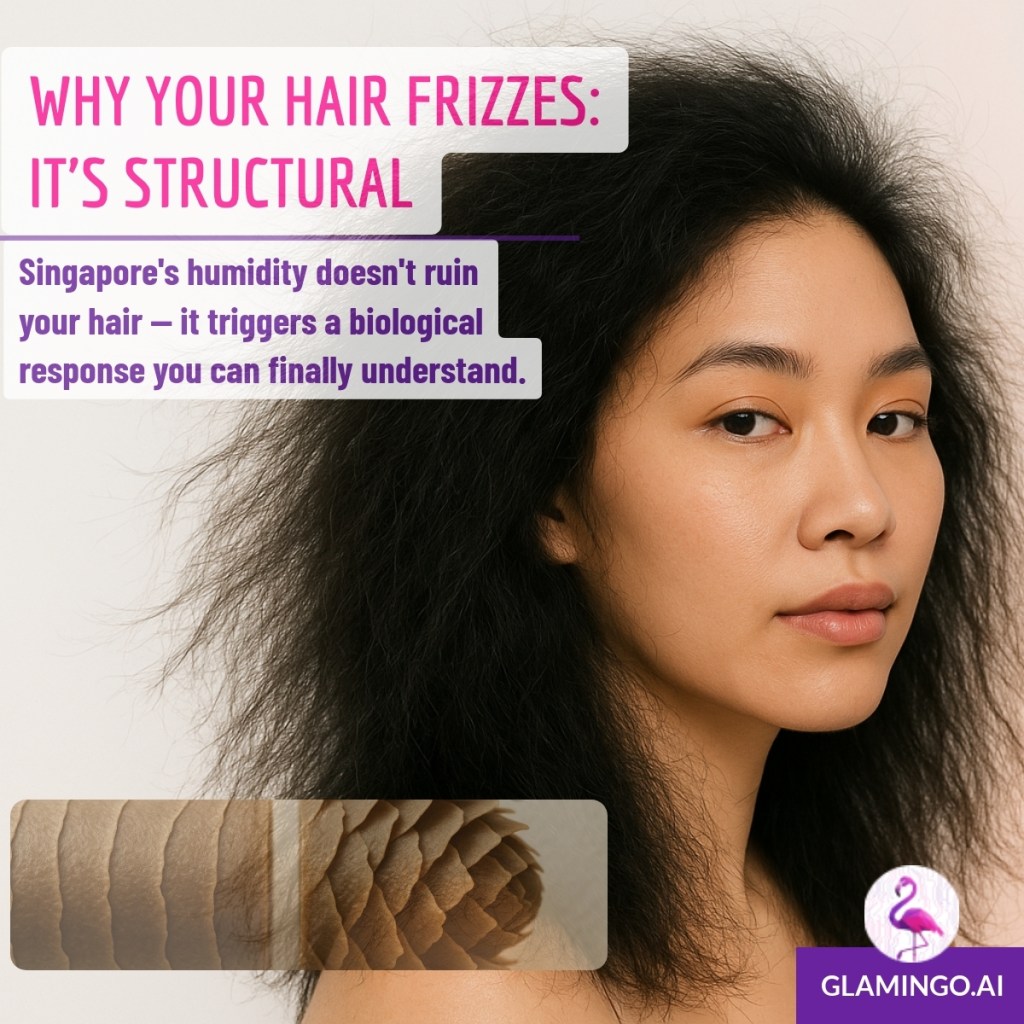
You’ve deep-conditioned, you’ve sealed with oil, you’ve applied the anti-humidity spray — and the second you step outside into 85% humidity, your hair does exactly what it always does. The frustration isn’t a product failure. It’s a structural one. Frizz in humidity isn’t random — it’s your hair responding to moisture exactly the way its biology is designed to, and understanding that chain of events is the only way to work with it rather than against it endlessly.
If you’ve ever stood at the void deck, freshly blown-out hair already starting to puff at the temples, wondering what exactly the point of your entire morning routine was — you’re not alone, and you’re not doing anything wrong. Singapore’s year-round humidity hovers around 80–85%, with UV levels that would qualify as extreme in most other countries. That combination doesn’t just affect your skin. It is structurally incompatible with most of the frizz management advice written for temperate climates, and most of the products formulated with those climates in mind. The reason the advice keeps failing you isn’t your hair. It’s that nobody explained what’s actually happening inside the strand.
What is actually happening inside your hair when humidity hits
The keratin scaffold and why it is inherently moisture-reactive
Each strand of your hair is built around a protein scaffold — keratin, the same structural protein that makes up your nails and the outer layer of your skin. Inside the hair shaft, keratin proteins are twisted together in a coiled structure, held in place by chemical bonds. Some of those bonds are strong and permanent. Others are temporary and sensitive to water. It’s those temporary ones — hydrogen bonds — that sit at the heart of every frizz problem you’ve ever had.
The physical structure of the hair shaft makes it inherently reactive to atmospheric moisture — this isn’t a flaw in the design, it’s a feature of how keratin behaves as a biological material. When humidity rises, water molecules from the air attach to the keratin proteins inside the strand, disrupting the hydrogen bonds that were holding the fibre in a particular shape. The hair swells unevenly. The surface roughens. That roughness is what you see as frizz.
The cuticle as a gate: when it lies flat vs. when it lifts
Think of each hair strand as a pine cone. In dry air, the scales of the pine cone lie flat and smooth. In damp air, those scales open up — not because something went wrong, but because that is exactly how the structure is designed to respond to moisture. Your hair cuticle works the same way. The cuticle is the outermost layer of the hair shaft, made up of overlapping, shingle-like cells that ideally lie flat and seal the interior of the strand against the environment. When conditions are dry and the hair is in good condition, those scales stay down. When humidity rises — or when the cuticle is damaged — they lift. And once they lift, the interior of your hair shaft is exposed to whatever moisture is in the air.
Every hair care product that promises frizz-proof results is essentially trying to either seal those scales shut before the humidity can open them, or change the material of the pine cone so the scales respond less dramatically. Understanding which approach a product takes — and whether your hair’s scales are already too damaged to close properly in the first place — is where the real difference in outcome lives.
Hydrogen bonds — the temporary bridges that humidity dismantles
The chemical bonds inside your hair exist on a spectrum of permanence. At one end are disulphide bonds — strong, sulphur-to-sulphur links between keratin proteins that determine the fundamental shape of your hair fibre. These are what chemical straightening and perming treatments target; breaking and reforming them is what changes your curl pattern. At the other end are hydrogen bonds — weaker, water-sensitive connections that form between keratin proteins and hold the hair in whatever shape it’s currently in. Your blowout stays smooth because the heat forced your hydrogen bonds into a new configuration. Humidity undoes that configuration because water molecules compete with those bonds and win. Every time. This is not a product problem. It is thermodynamics.
Why some hair frizzes more than others in Singapore’s climate
Curly and wavy hair structure: more cuticle lift points, more moisture entry
Curly hair has a distinct structural geometry — an elliptical cross-section and directional curvature — that creates naturally more lifted cuticle points compared to straight hair, increasing surface exposure to atmospheric moisture. Put simply: at every bend in a curl, the cuticle scales on the outer edge of the curve are under more structural tension and tend to lift more readily. More lift points means more doors open for moisture to enter the shaft unevenly. In Singapore’s multicultural population, wavy and curly textures are extremely common — across Indian, Malay, and mixed-heritage hair types — which means a significant proportion of women here are working with hair that is structurally predisposed to a stronger frizz response, before damage or product misuse even enters the picture.
How Asian hair characteristics interact with humidity — what the research does and does not say
The popular claim that “Asian hair is naturally resistant to frizz” deserves some scrutiny. It’s true that East Asian hair tends to have a rounder cross-section and grows straighter, which does mean fewer natural cuticle lift points. But this varies considerably across the region. Prior heat and chemical treatments measurably affect the physical and biochemical properties of hair strands, which means any baseline advantage in cuticle integrity can be eroded quickly by regular colour, rebonding, or thermal styling — all of which are extremely common in Singapore salons. The “Asian hair doesn’t frizz” generalisation also doesn’t account for the wavy and coily textures that are the norm for many South Asian and Malay women. The honest answer is: hair type matters, but treatment history and cuticle condition matter at least as much.
Damaged and chemically treated hair: why your post-perm blowout dies faster
If you’ve had a perm, a rebonding treatment, highlights, or even regular heat styling over an extended period, your hair’s relationship with humidity has been chemically renegotiated. The physical structure and chemical bonds of the hair shaft are altered by perms and chemical dyes, changing how the hair fibre behaves — including how it responds to moisture uptake from the environment. When the cuticle has been disrupted by chemical processing, it no longer lies as flat in its resting state. The gates are already partially open. Humidity doesn’t have to work as hard to get in. This is why women with chemically treated hair often find that the same anti-frizz product that used to work stops performing after a colour refresh or a straightening treatment — the underlying structure has shifted, and the product is now working against worse odds.
The treatment landscape — what each approach is actually doing to your hair’s moisture response
Conditioners and smoothing products: cuticle-sealing vs. bond-targeting
Conditioners work in part by targeting the hair shaft surface to smooth the cuticle layer — a mechanism directly relevant to reducing moisture entry in humid conditions. Most conditioners use positively charged ingredients (cationic surfactants or conditioning polymers) that are attracted to the negatively charged surface of hair, especially damaged hair, and deposit a smoothing layer on the cuticle. Silicones work similarly — they fill in gaps between lifted cuticle scales and coat the surface to reduce moisture exchange. Neither approach changes the underlying structure of the hair. They are buying you time. In Singapore’s humidity, that time is measured in hours, not days.
Bond-targeting products, which have grown dramatically in popularity after ingredients like bis-aminopropyl diglycol dimaleate (better known under brand names like Olaplex) entered mainstream awareness, work differently. Instead of coating the outside, they aim to reinforce or repair the internal bonds within the hair shaft. The mechanism is more structurally meaningful than a surface coat, though it’s worth noting that most bond-builder marketing significantly outpaces the independent clinical evidence for visible frizz reduction in real-world conditions.
Chemical straightening and keratin treatments: restructuring the problem or masking it
Hair straightening products work by mechanically and chemically altering the hair shaft structure — meaning the frizz reduction they deliver is a structural modification, not a surface coating. This explains both why keratin treatments and rebonding hold up better in humidity than any topical product, and why they carry a higher damage risk. You are not sealing the pine cone’s scales. You are changing the pine cone itself. That’s a more durable result — but it comes with the trade-off that if the treatment is done poorly or too frequently, the structural compromise to the cuticle can actually increase long-term moisture vulnerability. Many women in Singapore find themselves on a cycle of straightening to control frizz, experiencing increased frizz as the treatment fades and the cuticle is left more compromised than before, then retreating sooner than they should.
Heat styling in humidity: why the blowout is always borrowed time
The blowout is thermodynamics in action. Heat allows you to temporarily force hydrogen bonds into a new configuration — the one where your hair lies smooth. But these are exactly the bonds that re-form with atmospheric moisture, which is why a blowout in Singapore doesn’t survive the walk from the salon to the taxi. The hydrogen bonds are not anchored in their new position. They are just waiting for water. The only way to meaningfully extend a heat-styled result in humid conditions is to seal the cuticle before the moisture can re-enter — which is why serums and oils applied immediately after blow-drying, while the hair is still warm, perform better than those applied to cold hair.
Emerging thermoresponsive barriers: what the newer research is exploring
One genuinely interesting research direction involves thermoresponsive coatings that do more than sit on the hair surface. A novel compound combining epoxy silane and hydrolysed wool keratin has been studied for its ability to form a protective barrier against both heat and moisture — the goal being to reduce the hair shaft’s moisture reactivity rather than simply coating it temporarily. This is mechanistically different from what standard silicones do, and if the approach holds up in larger studies, it could represent a meaningful shift in how anti-humidity products are formulated. That said, this research is early-stage — a single study on a novel compound — and it is not yet available in standard consumer products. Worth watching. Not worth paying a premium for yet, because the products currently claiming this technology are largely getting ahead of the evidence.
The product-damage-frizz cycle most women in humid climates fall into
How cosmetics misuse worsens the structural problem it is meant to solve
Frizz is documented as a specific side effect of hair cosmetics misuse, alongside breakage and contact sensitivity — which points to a cycle that many women in high-humidity environments fall into without realising it. The more frizz you experience, the more product you layer on. But heavy, repeated application of styling products without adequate cleansing leads to build-up on the cuticle surface. Build-up prevents the cuticle from lying flat. A cuticle that can’t lie flat is more vulnerable to moisture entry. More moisture entry means more frizz. So you buy another product. The cycle is commercially convenient for the beauty industry and structurally counterproductive for your hair.
What a compromised cuticle looks like in practice — and how to tell if yours is there
A compromised cuticle isn’t always obvious. Visually, hair with significant cuticle damage often looks dull — not just in poor lighting, but consistently, because a smooth cuticle reflects light evenly and a lifted one scatters it. Your hair may feel rough running your fingers from tip to root (against the cuticle direction) but unusually rough from root to tip as well, which is less normal. It may feel dry even immediately after conditioning. Crucially, if your hair frizzes within 30 minutes of stepping outside even on a day when it’s been freshly washed and you haven’t applied heat, that’s a meaningful signal. The cuticle is already open enough that ambient humidity is getting in before any styling has even happened.
What the evidence actually supports — and where marketing fills the gap
Ingredient categories with mechanism evidence vs. ingredients that are trend-driven
Silicones have the most established mechanism evidence for frizz control — they physically coat and smooth the cuticle, reducing moisture exchange. This is well understood, has been documented in formulation science for decades, and works predictably for most hair types in humid conditions, which is exactly why the “silicone-free” movement deserves more nuance than it typically gets. Silicone-free isn’t inherently better for frizzy hair; for many women, it actively makes things worse. Proteins — particularly hydrolysed versions that can penetrate the hair shaft — have moderate mechanism evidence for reinforcing the internal structure, though the effect size varies considerably with hair porosity and damage level. Humectants like glycerin, used heavily in curl creams and leave-in conditioners, are a more complicated story in Singapore specifically: they attract water to the hair, which can be helpful in very low humidity but can worsen frizz when atmospheric moisture is already excessive. A product built around glycerin as a primary frizz-fighter may be working against you in an 85% humidity environment.
Evidence grade summary: what you can rely on and what you are buying on faith
The structural understanding of why hair frizzes in humidity is solid and well-evidenced. The mechanisms by which conditioners, silicones, and chemical treatments interact with the cuticle are well-established at the formulation science level. Hair protein extraction research is advancing the ability to analyse structural changes in hair quality, meaning the science of the hair fibre itself is becoming increasingly precise. What lags significantly behind is consumer product formulation: most anti-humidity products on the shelf are using ingredient categories that have been around for decades, dressed up in new language. “Humidity shield technology” is usually silicones and polymers. “Bond repair” is usually a maleic acid derivative or a film-former. The gap between what research understands about hair fibre behaviour and what is actually in your anti-humidity spray is significant — and the marketing is very deliberately written to obscure that gap.
A framework for managing frizz in Singapore humidity — based on structure, not product hype
The most useful shift in thinking is to stop asking “which product will fix my frizz” and start asking “what is the current state of my cuticle, and what does it actually need.” If your cuticle is intact — smooth, healthy, not significantly damaged by chemical or heat processing — then a well-formulated conditioner with silicones or a smoothing polymer, applied consistently, is genuinely sufficient for most days. The pine cone’s scales can still close; you just need to help them stay closed long enough to matter.
If your cuticle is compromised — lifted, eroded by chemical treatments, or thinned by repeated heat damage — then no topical product is going to hold up in Singapore’s outdoor humidity for a full working day, because the entry points are too numerous and too wide. In this case, the framework shifts: reduce the load of heat and chemical processing, allow time for the cuticle to recover what it can, and use a silicone-based conditioner daily as a structural gap-filler while recovery happens. The goal is not perfection — it’s reducing the degree of damage to a point where the products you’re using can actually do their job.
Timing also matters more than most products. Applying a smoothing serum to damp hair immediately after washing, before any heat, allows the product to coat the cuticle while it is still in a slightly more receptive state. Sealing with a heavier oil or cream after blow-drying, while the hair is warm and the cuticle momentarily more responsive, extends the result. In Singapore’s humidity, you are not going to achieve a full day of perfect smoothness without a structural treatment — but you can meaningfully extend the window between walking out the door and the puff arriving, which for most women is the actual goal.
This week, before buying another anti-humidity product, assess whether your frizz is a moisture-barrier problem or a structural damage problem: if your hair frizzes within 30 minutes of stepping outside even on freshly washed, unheated hair, the cuticle is likely already compromised. In that case, the most evidence-supported next step is not a new topical spray — it is reducing the chemical and heat load on the hair for 6–8 weeks to allow the cuticle to sit flatter, and using a silicone-containing conditioner (not serum) as a daily cuticle-smoothing measure while you do. One structural problem needs a structural solution, not another coating.
If this has you thinking about a professional assessment of your hair’s current condition — whether a keratin treatment is right for your hair type, or whether a bond-repair treatment is genuinely warranted — Glamingo has vetted hair salons across Singapore with real reviews from women who’ve been through the same humidity-related hair decisions you’re facing. Browse hair treatment providers near you on Glamingo. Search now →
 Glamingo Blog
Drop in your comments..