
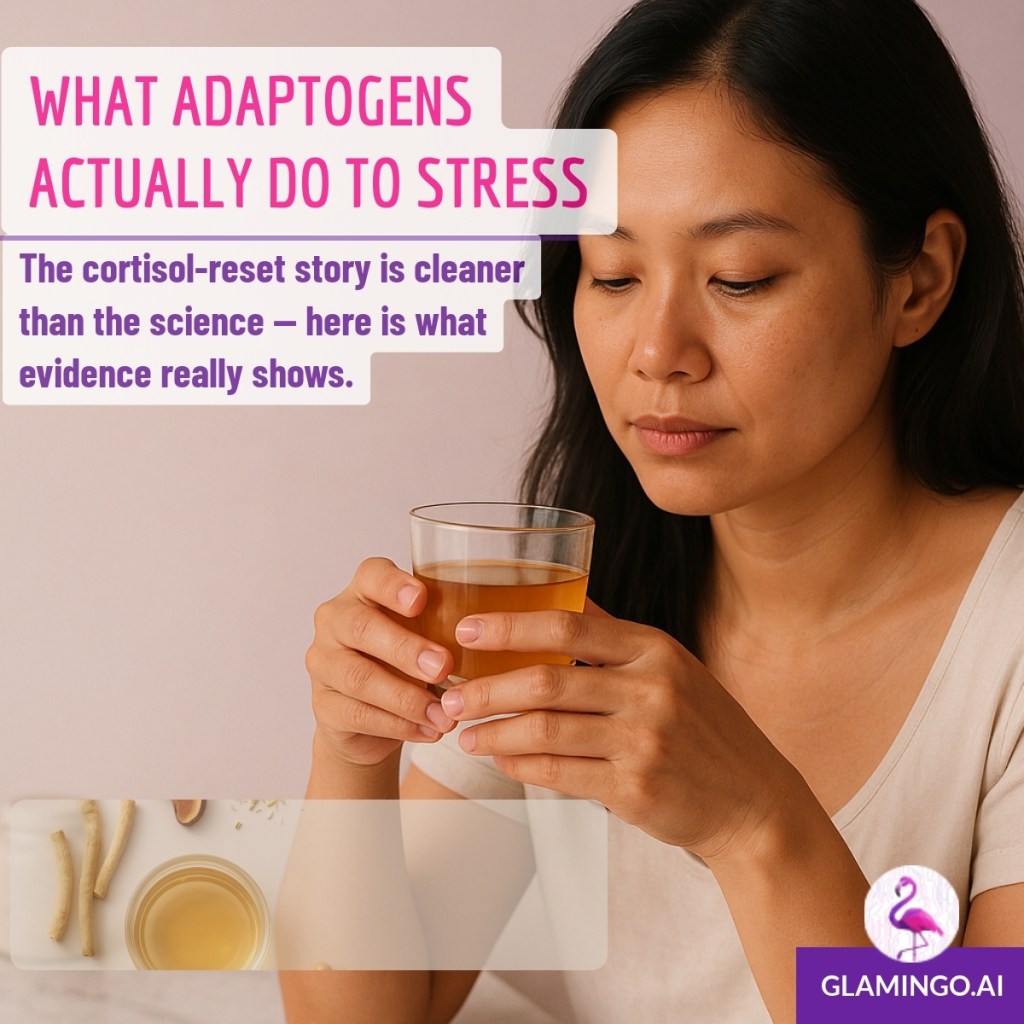
Ashwagandha lattes, reishi capsules, adaptogen-spiked serums — if you’ve been told these will ‘reset your nervous system,’ ‘balance your cortisol,’ and reverse the skin damage that comes with it, you’ve been sold a cleaner story than the science actually tells. The myth isn’t that adaptogens are useless. The myth is what they’re being promised to do.
If you’ve ever noticed your skin breaking out during a brutal work sprint, or watched your complexion go dull during a season of bad sleep and relentless deadlines, you already understand that stress shows up on your face. That connection is real, and it’s one of the reasons the adaptogen market has exploded. When something genuinely affects how you look, you want something that genuinely fixes it. The wellness industry saw that need and handed you a supplement label with a lot of confident language. What it didn’t hand you was the full picture of what the research actually shows — and where it quietly runs out.
The myth on the label: ‘adaptogens balance your cortisol and fix stress-related skin damage’
What that claim implies — and why it’s overbuilt
The phrase ‘balances cortisol’ appears on enough supplement packaging that it’s started to sound like an established fact. It isn’t. Cortisol — your body’s primary stress hormone — operates in a tightly regulated feedback loop. The idea that an ingestible plant extract can ‘balance’ it implies a level of hormonal precision that, frankly, most pharmaceutical interventions can’t achieve, let alone a capsule of ashwagandha you picked up at Guardian.
The broader claim — that you can take an adaptogen, reduce your cortisol load, and therefore repair the skin damage that chronic stress causes — is a chain of logic where each link sounds plausible but the chain as a whole is significantly longer than the marketing implies. Yes, chronic stress elevates cortisol. Yes, sustained high cortisol contributes to inflammation, accelerated skin ageing, barrier disruption, and increased sensitivity. And yes, some adaptogenic compounds have shown biological activity in stress-response pathways. But connecting those dots into ‘this serum reverses your stress skin damage’ requires evidence that simply does not exist yet at scale.
What an adaptogen actually is (and why the definition is fuzzier than the marketing suggests)
The official criteria — and how easy they are to meet
The term ‘adaptogen’ was coined in the 1940s by Soviet pharmacologist Nikolai Lazarev and later refined into a working definition by researcher Israel Brekhman. For a plant to qualify, it needs to meet a relatively small number of criteria: it should enhance the body’s resistance to stress non-specifically, and it should not have a negative impact on the body — meaning the definition includes a safety standard but not, crucially, a therapeutic efficacy standard. A substance that is harmless and shows any activity in a stress-adjacent pathway can technically earn the label.
Why ‘adaptogen’ is a functional category, not a regulated clinical classification
‘Adaptogen’ is not a regulated term in Singapore, the EU, the US, or most other markets. There is no clinical or regulatory body that certifies a product as genuinely adaptogenic before it reaches the shelf. This matters because it means any brand can attach the word to almost any stress-adjacent herb — holy basil, schisandra, eleuthero — without having to meet a clinical threshold. The category is real in a botanical and functional sense. It is not real in the way that, say, a registered pharmaceutical claim is real. The definition itself does not guarantee clinical effect. That gap between ‘this is a recognised plant category’ and ‘this does what the label says’ is where a lot of consumer money quietly disappears.
What the research actually shows they do
The stress-mimetic mechanism — priming resilience, not blocking cortisol
Here is where it gets interesting — and honestly more sophisticated than the marketing gives it credit for. Modern studies suggest adaptogens may act as stress mimetics — meaning they gently stimulate the body’s own stress-response pathways at a low level, essentially giving your system a mild rehearsal. The proposed result is that when real stress hits, your physiological response is better calibrated. This is the opposite of the ‘switch off cortisol’ story. Rather than suppressing the stress response, they may be quietly training it.
Think of adaptogens less like a stress switch you can flip off and more like a shock absorber on a bumpy road. They don’t smooth out the road — the stress is still there. What they may do is reduce how hard the jolt hits your system and how long it takes to settle. That’s a real function. It’s just not the ‘cortisol reset’ the wellness industry is selling.
The flatten-the-curve effect — softening the spike, not eliminating it
Adaptogens do not reduce or block stress — they are proposed to increase someone’s resistance to it, whether physical or psychological. One researcher describes the functional outcome as helping to ‘flatten the curve’ of acute stress response — producing a more mellowed upward movement and therefore avoiding the sharp crash that typically follows a cortisol spike. If that mechanism holds under further study, it’s actually a meaningful and useful thing. It’s just a narrower, more honest version of what brands are selling. ‘May soften your body’s stress response over time with consistent use’ doesn’t move product the way ‘balance your cortisol’ does — but it’s the version that doesn’t mislead you.
The evidence problem: what the studies actually look like
Small samples, short durations, unstandardised doses
Reviews of the evidence on adaptogens consistently conclude that at best they may help with stress and fatigue, and that more studies are needed. What those reviews don’t always spell out is what the existing studies actually look like: small participant groups, short intervention windows of a few weeks, doses that vary significantly between studies, and frequent industry funding. A preliminary review found that adaptogens can non-specifically enhance the body’s resistance under a wide range of external stressors — but ‘non-specifically’ is doing a lot of work in that sentence. It signals that the mechanism is not yet precisely validated. These aren’t reasons to dismiss adaptogens entirely. They are reasons to be deeply sceptical of confident product claims.
Why ‘more studies needed’ is a warning, not a placeholder
In wellness content, ‘more research is needed’ often reads like a polite formality before the real recommendation begins. In scientific literature, it means the current evidence base is insufficient to draw clinical conclusions. When that phrase appears repeatedly across multiple independent reviews of the same ingredient category, it signals a pattern — not a gap that’s about to be filled next quarter. For adaptogens, we are still in a period where the mechanistic understanding is genuinely interesting and the large-scale, standardised human trial data is genuinely thin. Both things are true simultaneously. A product that doesn’t acknowledge the second while selling you the first is not being straight with you.
The beauty industry’s specific claims — and where they fall apart
Ingestible adaptogens and skin: the stress-skin connection is real, but the chain of evidence is long
Ask almost anyone who has gone through a brutal period — a difficult year at work, a relationship ending, the particular exhaustion of perimenopausal hormonal shifts — and they will tell you their skin told the story before they did. Dullness, breakouts along the jaw, skin that suddenly felt reactive and unhappy. The stress-skin connection is real and well-established. Chronic elevation of stress hormones contributes to increased skin inflammation, a disrupted outer protective layer (what dermatologists call the skin barrier), and accelerated breakdown of the proteins — collagen and elastin — that keep skin firm and resilient.
The question is whether taking an adaptogen supplement creates a chain of effects strong enough to meaningfully interrupt that process. Even if adaptogens do modestly soften the physiological stress response in some individuals, the downstream effect on skin specifically — via reduced cortisol, reduced inflammation, improved barrier integrity — requires a chain of evidence that has not yet been assembled. Experts consistently frame adaptogens as supportive tools in the context of a broader lifestyle and medical care — not as standalone interventions for stress-related skin outcomes.
Topical adaptogens: the mechanism gap between oral evidence and skincare formulas
The topical adaptogen trend — serums, moisturisers, and masks that promise to ‘protect skin from stress’ by containing reishi extract or ashwagandha — sits on even shakier ground. In skincare, adaptogens are proposed to protect skin from stress by enhancing resistance to physical, chemical, or biological stressors — but the evidence for topical application is separate from and significantly weaker than the oral supplementation evidence base, which is already limited. The biology does not straightforwardly translate. An extract that may influence stress-response pathways when absorbed through the digestive system and distributed systemically is not necessarily doing the same thing when applied to the surface of the skin. The mechanism gap here is substantial, and the clinical evidence for topical adaptogen efficacy is, at this point, very thin.
The verdict: what adaptogens can and cannot do for stress-related appearance changes
Who might get modest, real benefit
If you are dealing with chronic low-grade stress — the kind that doesn’t feel dramatic but has become a persistent background hum of your life — and you’re looking for supportive measures that might take the edge off your physiological response while you work on the root causes, some adaptogens have enough mechanistic plausibility and moderate evidence to be worth considering. Most are considered safe in modest amounts, and if the flatten-the-curve effect is real for you, it has downstream implications for inflammation, sleep quality, and — indirectly — how your skin behaves over time. Ashwagandha has the most human trial data of the commonly available options, though even here the studies are small and doses are inconsistent. The realistic outcome is modest. For some women, modest is still worth something.
What they will not do — and what the marketing is quietly implying
They will not reset your nervous system. They will not balance your cortisol in any precise clinical sense. They will not reverse the fine lines, hyperpigmentation, or barrier damage that a difficult two years has deposited on your face. The marketing isn’t always lying outright — it’s suggesting. It uses the language of mechanism (‘supports cortisol balance’) in a way that implies an outcome (‘your skin looks less stressed’) without technically promising it. That’s a well-practised move, and knowing it for what it is saves you money and recalibrates your expectations usefully.
The one honest use case — and what else actually addresses the root problem
The most consistent finding in real-world experience isn’t about which supplement transformed someone’s skin. It’s that when people genuinely address the systemic factors — sleep quality, sustained stress reduction, anti-inflammatory eating, consistent movement — their skin responds in ways that no product alone has managed to replicate. That’s not a wellness platitude; it’s what people report when they’re being honest about what actually moved the needle.
Adaptogens, used accurately, fit into that picture as one small supportive element — not the lever. If an ashwagandha supplement helps you feel marginally less wired at 11pm and you sleep better as a result, and better sleep reduces your inflammatory load, and lower inflammation improves your skin barrier function over weeks — that’s a real chain of benefit. It’s just three steps removed from ‘fixes stress skin,’ and none of those steps are guaranteed. That’s the honest use case. It’s worth knowing.
Before buying another adaptogen supplement or adaptogen-infused serum, read the actual claim on the label and ask one question: is this product saying it ‘helps your body resist stress’ (a modest, possibly supportable claim) or that it ‘balances cortisol,’ ‘resets your nervous system,’ or ‘reverses stress-related skin damage’ (claims the current evidence does not support)? That single distinction tells you whether you’re looking at a product making an honest, limited claim or one that has dressed up weak evidence in wellness language. Spend accordingly.
If the stress-skin connection is something you want to address more seriously — whether through professional skin treatments, stress-informed facial therapies, or a consultation with a practitioner who takes a whole-body approach — Glamingo has verified wellness and skin treatment providers near you who work with exactly this overlap. Find a provider near you →
 Glamingo Blog
Drop in your comments..