
You book your first laser session, follow all the prep instructions, and still walk away with patchy results or unexpected irritation — and no one at the clinic explained why. The frustration is real: laser hair removal isn’t a single event, it’s a biological chain reaction, and if any link in that chain is mismatched to your hair or skin, the outcome changes completely. Understanding the cascade — from how the laser pulse hits the follicle, to why some hairs survive, to what your skin does in the days after — is the only way to make a genuinely informed decision before you spend several hundred dollars across six or more sessions.
This gap between expectation and reality is one of the most common experiences among women who’ve gone through treatment. You hear “long-lasting hair removal” and picture smooth skin after a few sessions. What actually happens is more layered than that — and honestly, more interesting. The technology works, but it works through a cascade of biological events that each depend on the one before. When people come away feeling like it “didn’t work” or “worked on my friend but not me,” it’s almost always because one link in that chain was mismatched from the start.
The chain starts here: how laser pulses target melanin in the hair follicle
What selective photothermolysis actually means in plain English
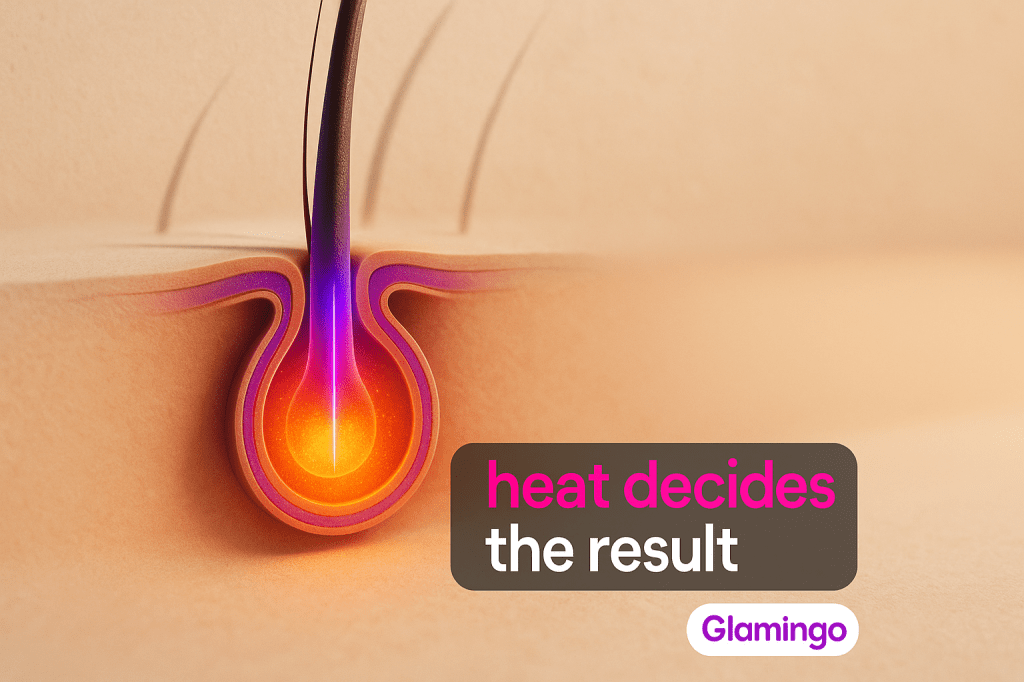
The principle behind laser hair removal is built on something called targeted heat delivery to specific tissue (the formal term for this is selective photothermolysis). In plain terms: the laser is designed to heat one particular target — melanin in the hair shaft and follicle — without cooking everything around it. Laser hair removal works by using pulses of light that target this melanin to achieve long-lasting reduction of unwanted hair. The key word is “target.” The laser isn’t just heat applied to skin — it’s heat aimed at a specific pigment within a specific structure.
Think of your hair follicle as a furnace, and the laser pulse as a precisely aimed heat source. The laser is tuned to recognise the dark fuel — melanin in the hair shaft — and ignite it, generating enough heat to damage the furnace itself without burning the walls around it. The mechanism is elegant when it works. The heat builds in the melanin-rich hair shaft, travels down into the follicle, and damages the structure responsible for producing new hair. The skin surface, if the settings are correct, stays largely uninvolved.
Why hair colour and skin tone sit at the top of the cascade — and why this matters more than the laser brand
The furnace only works if it contains enough dark fuel. Fine, blonde, red, or grey hairs have very little melanin — there isn’t enough pigment to absorb the laser energy and generate the heat needed to damage the follicle. This isn’t a limitation of the technology or the clinic; it’s physics. The cascade literally cannot start without sufficient melanin to absorb the pulse.
Skin tone complicates this further. The contrast between your hair colour and your skin colour determines how precisely the laser can target the follicle without heating surface melanin instead. When that contrast is high — dark hair against light skin — the laser has a clear target. When the contrast is lower, which is common across Singapore’s predominantly Fitzpatrick III–V population, the settings need to be carefully calibrated. Get the fuel-to-wall ratio wrong and the surrounding skin absorbs heat it was never meant to receive. That’s when burns, scarring, or lasting changes in skin tone become a real risk — not a disclaimer to ignore. This is why the laser brand is almost irrelevant compared to the question of who is operating it and how well they understand your skin.
First downstream effect: follicle damage and what ‘long-lasting reduction’ actually looks like
The difference between a damaged follicle and a destroyed one — and why it explains patchy results
When the cascade works as intended, the heat generated in the melanin travels to the follicle’s growth cells and disrupts them — either partially or completely. A fully destroyed follicle produces no more hair. A damaged but partially intact follicle may produce finer, lighter, slower-growing hair, or may eventually recover and produce hair again. This is the real explanation behind patchy results: the treatment didn’t fail uniformly, it succeeded to different degrees across different follicles depending on the energy delivered, the hair’s thickness, and crucially, which phase of the hair growth cycle that follicle was in at the time of treatment.
It’s also why the word “permanent” is technically misleading. The FDA-recognised term is “permanent reduction,” not elimination — a distinction that matters enormously for setting realistic expectations. What you’re working towards is a significant, long-lasting reduction in hair density and regrowth speed. That is genuinely useful and genuinely achievable. It’s just not the same as never having to think about it again.
Why multiple sessions are not a sales tactic but a biological requirement (hair cycles, not clinic schedules)
At any given moment, your hair follicles are in one of three phases: active growth (anagen), a transitional phase (catagen), or resting (telogen). The laser is only effective on follicles in the active growth phase — that’s when the hair shaft is physically connected to the follicle and melanin is most concentrated at the root. A follicle in the resting phase simply isn’t a viable target, no matter how perfectly the settings are calibrated.
This is why multiple sessions are a biological requirement, not a commercial one. Each session catches a different cohort of follicles mid-cycle. Six to eight sessions spaced four to six weeks apart isn’t an arbitrary schedule — it’s designed to intercept as many follicles as possible during their growth phase over time. Anyone who’s gone through several sessions and noticed that “a couple of sessions thinned the hair out and reduced ingrowns but didn’t clear everything” isn’t experiencing a treatment failure. They’re experiencing the biology accurately. Full clearance, if achievable at all, is a longer and less predictable commitment than most clinics communicate upfront.
Second downstream effect: the inflammatory response in your skin
What normal post-treatment redness and swelling actually indicates
After the laser pulse delivers heat to the follicle, the surrounding tissue responds the way skin always responds to controlled damage: with inflammation. You’ll typically see redness and mild swelling around each treated follicle — this is called perifollicular oedema, and it looks like small raised bumps or a generalised flush. In Singapore’s heat and humidity, this can feel more intense than it would in a cooler climate, which is worth knowing if you’ve scheduled a session before an event. It usually settles within 24 to 48 hours.
This response is actually a sign the cascade is working. The inflammation is the body’s repair mechanism engaging with the heat-damaged follicle tissue. Normal, expected, manageable with a cold compress and sun avoidance. The issue is when the inflammatory response doesn’t stop at “normal.”
When the inflammatory response goes further — and who is at higher risk
For most people, that redness resolves without incident. But for some, the inflammatory cascade is more pronounced. Research into conditions like hidradenitis suppurativa — a chronic skin condition causing painful, recurring lesions in hair-bearing areas — has found that laser-induced trauma can trigger a hyperinflammatory response in susceptible individuals. This isn’t a reason to avoid treatment; interestingly, laser hair removal is actually an established adjuvant therapy for hidradenitis suppurativa because it reduces the number of hair follicles and the bacteria present in affected areas. But it does mean that if you have any history of inflammatory skin conditions, your post-treatment response needs closer monitoring and your treatment plan may need to differ from the standard approach.
More broadly, anyone prone to post-inflammatory hyperpigmentation — darker patches that appear after any form of skin irritation — should factor this into their post-care protocol. Keep the treated area cool, avoid anything that generates additional heat or friction for at least 48 hours, and treat SPF as non-negotiable, not optional.
Third downstream effect: pigmentation risk and why darker skin tones need a different conversation
How incorrect settings cause the laser to heat surface melanin instead of follicle melanin
This is the part of the cascade that causes the most serious outcomes — and the part that’s most commonly under-discussed at initial consultations. When laser settings aren’t appropriately adjusted for your skin tone, the melanin at the skin surface becomes an unintended target. Instead of heat concentrating in the hair follicle, it disperses into the surrounding skin, causing burns, post-inflammatory hyperpigmentation, or in more serious cases, permanent changes in skin colour. The American Academy of Dermatology flags that laser hair removal can cause burns, scarring, or permanent changes in skin colour when performed incorrectly.
For women with Fitzpatrick III–V skin tones — which describes the majority of women in Singapore — this is not a rare edge case. It’s a well-documented risk that’s entirely preventable with the right wavelength selection and fluence (the technical term for the energy dose delivered per pulse). Longer wavelengths, such as those used in Nd:YAG lasers, penetrate deeper into the skin, bypassing the surface melanin to target the follicle more precisely. This is why technology choice and settings matter enormously for your specific skin tone.
What to ask your clinic about wavelength and settings before committing
A reputable clinic should be able to tell you exactly which technology they’re using and why it’s appropriate for your Fitzpatrick type, without hesitation. They should also be conducting a patch test before a full session — not offering one as an optional extra, but doing it as standard. If the consultation focuses entirely on session packages and pricing without a substantive conversation about your skin tone, hair colour, and technology suitability, that’s a meaningful gap. The cascade starts at the settings. Everything that follows depends on getting them right.
The hormonal loop that can restart the cascade: PCOS, androgens, and why your results differ from your friend’s
Why laser works differently when androgen-driven hair growth is in the picture
You followed the same protocol as your friend. You went to the same clinic. Your results look completely different after the same number of sessions. One very common explanation is hormonal — specifically, whether excess androgens are driving continued follicle activation beneath the surface. Laser hair removal is a documented treatment option for women with polycystic ovary syndrome experiencing excess hair growth (hirsutism) driven by elevated androgens — but the hormonal environment also means the treatment works against a moving target.
When androgens remain elevated, previously dormant follicles that weren’t active during any of your treatment sessions can be recruited into the growth cycle and start producing new hairs. The treated follicles may be perfectly well-damaged. The issue is that the hormonal signal is activating follicles that were never treated. This isn’t a laser failure — it’s a secondary cascade running in parallel.
What this means practically for treatment planning
If you have PCOS or suspect androgen-driven hair growth — often indicated by hair in androgen-sensitive areas like the chin, upper lip, or lower abdomen — it’s worth having this conversation with your doctor before or alongside starting laser treatment. Managing the hormonal driver doesn’t mean laser won’t work; it means the number of sessions you need may be higher, maintenance sessions are more likely to be part of your long-term plan, and realistic expectations need to be set accordingly. Laser is still a meaningful tool. It’s just one part of a broader picture.
What the cascade looks like when everything goes right — and when it doesn’t
Signs the chain is working as intended
In the days following a successful session, you’ll notice perifollicular redness that resolves within 48 hours, followed by what looks like the hair “shedding” over the next one to three weeks. This shedding — technically the damaged hair shaft being pushed out of the follicle — is confirmation that heat reached its target. Over subsequent sessions, you’ll see regrowth become progressively finer and less dense. The texture changes before the volume does. That gradual lightening and thinning is the cascade doing exactly what it’s supposed to.
Red flags that suggest a link in the chain has been mishandled
Blistering, crusting, or immediate darkening of the skin after treatment are not normal responses — they indicate the surface skin absorbed heat it wasn’t meant to. Patchy results where entire areas show no reduction after four or more sessions may suggest the energy settings are insufficient to reach the follicle depth needed for your hair type. Increasing redness or swelling that worsens rather than resolves over 48 hours warrants a follow-up conversation with the clinic, not just another layer of aloe vera. And if you’re seeing new growth in patterns that don’t match your pre-treatment hair distribution, the hormonal question is worth raising with a doctor rather than simply booking more sessions.
The one question to ask before your next session
Before your next session — or before you book your first — ask the clinic one specific question: what wavelength or technology are they using, and how have they adjusted settings for your Fitzpatrick skin type? If they cannot give you a clear answer, that tells you everything you need to know about whether the cascade will end where you want it to.
If this article has you thinking about finding a clinic that can actually answer that question with confidence, Glamingo lists verified laser hair removal providers across Singapore with real reviews from women with similar skin tones and concerns. Search laser hair removal providers near you →
 Glamingo Blog
Drop in your comments..