
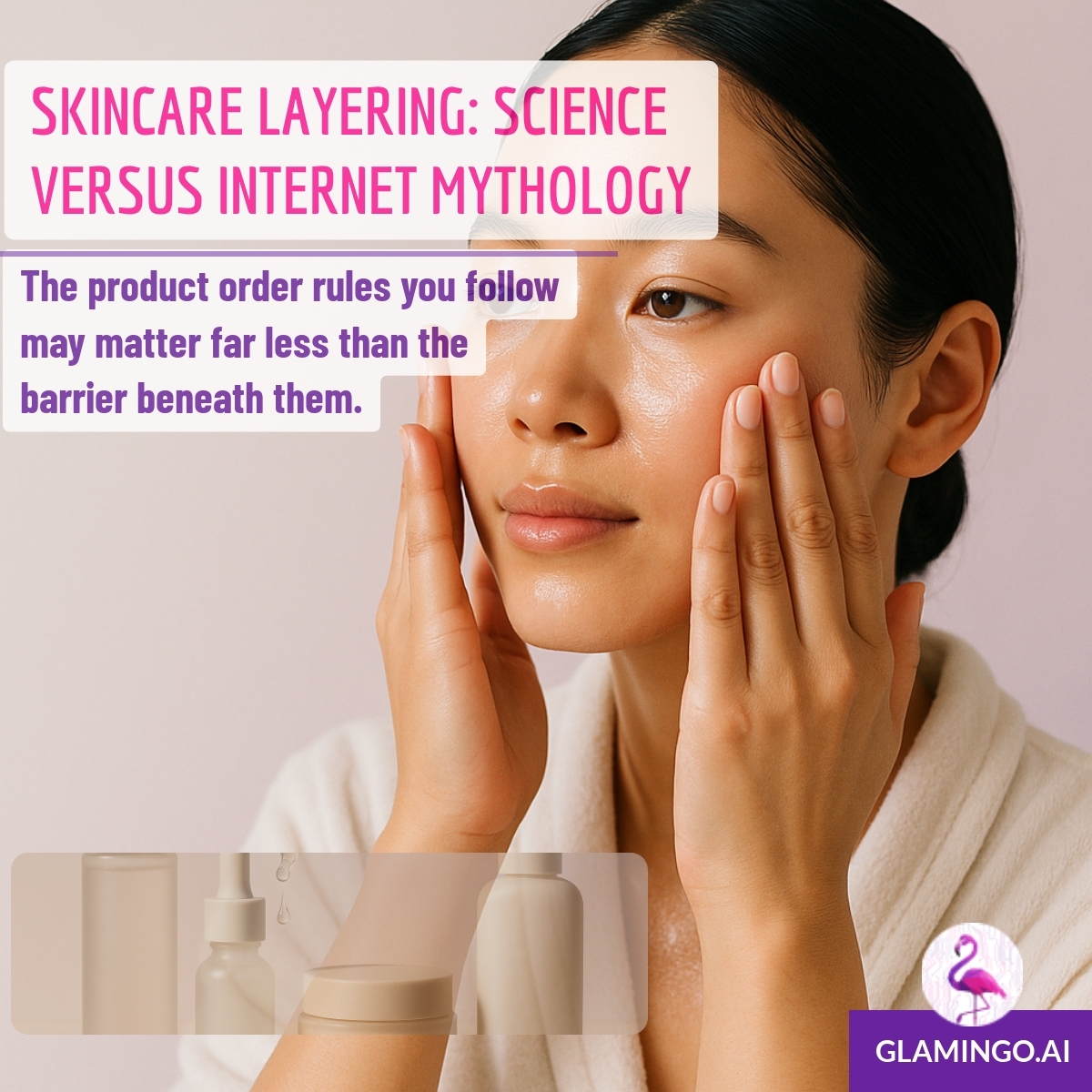
You have seven products lined up on your bathroom shelf and a vague anxiety that you’re applying them in the wrong order. Somewhere between “lighter textures first” and “wait 20 minutes between actives”, the rules multiplied faster than the products themselves. Some of that layering logic is grounded in real skin biology. A surprising amount of it is not — and telling the difference changes how you build a routine that actually delivers.
If you’ve ever had the unsettling feeling that your products are all working fine, but maybe the order is quietly costing you results — that tension is real, and it’s exactly what the internet’s layering rules feed on. The rules feel authoritative because they’re repeated so confidently. But when you trace most of them back to their source, you often find a brand, a content creator, or a forum thread, not a clinical trial. This article is about pulling apart what’s actually supported, what’s extrapolated beyond the evidence, and what was invented wholesale by an industry that benefits from selling you more steps.
The biological question underneath every layering debate
How the skin barrier actually controls what gets in — and what stays out
Think of your skin surface as a bouncer at a door. The barrier decides who gets through, not the order people arrive in. You can line up your products in the “right” sequence all you like, but if the formulation isn’t designed to penetrate — or if the door is already damaged or sealed shut by a previous product — the queue is irrelevant. Layering logic only works when it respects what the barrier is actually doing, not just the texture of what’s in the bottle.
The epidermal barrier is an active, selective structure — not a passive membrane. It controls topical ingredient penetration through both physical and chemical mechanisms. What this means in practice is that your skin is not simply sitting there waiting to absorb whatever you apply in whatever order. It is actively regulating traffic. The stratum corneum — the outermost layer of skin — selectively allows some molecules through while blocking others based on size, charge, and lipid solubility. A molecule’s ability to penetrate depends far more on its chemistry than on whether it was applied first or third.
This is also why barrier integrity matters so much. Optimal management of common skin conditions including eczema, acne, and rosacea depends on maintaining barrier integrity — and inappropriate product use can compromise it. A damaged barrier doesn’t just absorb things differently; it absorbs them less predictably, which is why sensitive and reactive skin types often respond badly to routines that work perfectly well for others. The biology here is not nuanced. It is well-established.
Why the vehicle your product is formulated in matters more than when you apply it
The vehicle — the base in which an active ingredient is suspended, whether that’s a water-based serum, a gel, a cream, or an oil — is a primary driver of how deeply that ingredient penetrates your skin. Permeation enhancers, meaning ingredients or formulation components that increase how deeply a compound travels through the skin, are a recognised category in topical skincare science, and they operate independently of when you apply the product.
What this means practically: a well-formulated vitamin C serum in the right vehicle, applied third in your routine, may penetrate far more effectively than a poorly formulated one applied first. The delivery system is doing more work than the order. This doesn’t mean application order is irrelevant — we’ll get to where it genuinely matters — but it does mean that obsessing over the precise sequence of your routine while ignoring formulation quality is optimising the wrong variable.
What “thinnest to thickest” actually means — and where it breaks down
The occlusion principle: the one part of the rule that has real mechanistic support
The “thinnest to thickest” rule isn’t entirely invented. There is a specific biological mechanism that supports one part of it: occlusion. Occlusive ingredients genuinely do reduce subsequent absorption by creating a physical seal on the skin surface. Heavy balms, petrolatum-based products, and certain face oils form a layer that slows moisture from escaping through the skin surface — what dermatologists call transepidermal water loss — but also physically impedes what can get in after them.
This is real and mechanistically supported. If you apply a rich occlusive cream and then follow it with a niacinamide serum, you are likely reducing how much of that serum reaches where it needs to go. The bouncer metaphor applies directly here: you’ve sealed the door before the last guest arrived. The practical implication is straightforward — actives go before occlusives, not after. This is the one layering principle that has genuine mechanistic ground beneath it.
Where the rule gets misapplied and why it doesn’t always hold for water vs. oil products
Where the rule starts to fall apart is when it gets applied indiscriminately to water-based versus oil-based products as if the underlying mechanism is the same. It isn’t. Not all oils are occlusive in the way petrolatum or thick balms are. Lighter facial oils — rosehip, squalane, marula — have different molecular structures and behave differently on the skin surface. Applying the same “water before oil” logic to these as you would to a heavy balm is extrapolating beyond what the barrier occlusion mechanism actually tells us.
The research supporting occlusion effects is moderate — the mechanism itself is well-understood, but the specific product-order claims that get extrapolated from it often aren’t directly tested. When someone on the internet tells you that you must apply your water-based serum before your oil or the oil “blocks” the serum, they may be drawing on a legitimate mechanism — but applying it more broadly than the evidence warrants.
The active ingredient layering arguments — separated from the myths
Acids and retinoids: what the barrier evidence says about sequencing and spacing
The advice to “wait 20 minutes between acids and retinoids” has been repeated so many times it feels like established science. It isn’t, at least not in the form most people believe it. The concern about layering a chemical exfoliant — an AHA or BHA that lowers your skin’s surface pH — directly before a retinoid is that the lowered pH environment might affect how the retinoid performs. There is some mechanistic logic here, particularly around retinoid conversion in the skin.
But the 20-minute wait time specifically? That specific number comes from guidelines about retinoid application in clinical contexts, not from controlled trials comparing layering sequences in people doing their bathroom routines. Products applied during active barrier disruption behave differently than when applied to an intact barrier, which is the real argument for not piling acids and retinoids on top of each other — not because of a pH window, but because both are barrier-active ingredients and using them simultaneously without adequate support increases your risk of disrupting more than you’re treating.
The niacinamide-vitamin C separation rule: what actually happens at cosmetic concentrations
The claim that you must never mix niacinamide and vitamin C is one of the most persistent pieces of layering mythology. The concern originates from a genuine chemical reaction — niacinamide and ascorbic acid (vitamin C) can theoretically form a compound called nicotinic acid, which can cause flushing. That reaction is real. What the internet consistently leaves out is that it requires high concentrations, prolonged exposure, and elevated temperatures that simply do not occur during skincare application.
Niacinamide operates through multiple distinct cellular mechanisms including DNA damage repair, antioxidant activity, and anti-inflammatory signalling — it is not a delicate ingredient that falls apart in the presence of other actives at cosmetic concentrations. The niacinamide-vitamin C interaction concern is largely debunked at the percentages found in skincare products. You do not need to separate them with a waiting period. Using both in the same routine, even applied close together, is not going to cause a problematic reaction on your skin. The evidence grade here is moderate — the niacinamide mechanism is well-documented, head-to-head layering trials are absent, but the theoretical basis for the separation rule has been repeatedly questioned by independent cosmetic chemists.
Antioxidants, peptides, and growth factors — do they survive layering at all?
Here is where the honest answer gets a little uncomfortable: some of these ingredients face real stability and absorption challenges that have nothing to do with the order you apply them. Vitamin C in its ascorbic acid form is notoriously unstable and degrades quickly with light and air exposure. Peptides face enzymatic breakdown on the skin surface. Growth factors are large molecules with limited penetration regardless of when they arrive.
For these ingredients, the layering order question is almost secondary to the formulation question. Whether a peptide is doing meaningful work in your routine depends primarily on whether it was formulated to penetrate, what concentration it’s at, and how stable the product is — not whether it went on before or after your toner. The formulation vehicle is a primary driver of skin penetration, independent of application order. Understanding this should recalibrate where you spend your scepticism when evaluating these products.
When layering goes wrong: barrier damage, microbiome disruption, and the over-routine problem
How stacking actives without barrier support creates the skin sensitivity spiral
If you’ve ever introduced a new active serum and woken up the next morning with skin that felt tight, reactive, and angrier than before — that’s not bad luck. That’s often what happens when you stack multiple barrier-active ingredients without giving your skin adequate support between them. Retinoids, acids, and strong antioxidants all interact with the skin surface in ways that can temporarily compromise its function, even when used correctly at appropriate frequencies. Layer them without ceramides, humectants, or barrier-supporting ingredients in the routine, and you are asking your skin to absorb impact without a cushion.
The sensitivity spiral is self-reinforcing. Disrupted barrier means more water loss, more reactivity, and greater penetration of things that shouldn’t be penetrating deeply — including potential irritants. People then add more products to address the redness and tightness, some of which add further disruption. Harsh skincare products are explicitly identified in the research as disruptors of skin microbial balance, which can lead to compromised skin health. Your skin microbiome — the community of bacteria that supports barrier function and immune response — is not immune to the products sitting on top of it.
Signs your layering routine is disrupting more than it’s treating
Persistent redness that wasn’t there six months ago. A “tight” sensation after cleansing that you’ve started to think of as normal. Actives that used to work causing noticeable stinging now. Breakouts in unusual locations after introducing a new serum. These are not signs that your skin is “purging” or “adjusting.” They are signs that your barrier is under more stress than it can comfortably manage. The answer is almost never to add another product. It is usually to strip back, support the barrier with simple hydration and ceramide-based moisturisers, and reintroduce actives one at a time once the skin has stabilised.
Layering in Singapore’s climate — why the standard advice needs adjusting
Occlusives and humidity: what changes when your environment is already moisture-rich
Most layering advice is written for temperate climates where the skin barrier is doing active work to retain moisture against dry air. In Singapore, with year-round humidity sitting around 80%, that calculation shifts. Your skin is not losing moisture to the environment the way it does in air-conditioned offices in London or Seoul winters — or actually, wait, you probably are spending a lot of time in aggressively air-conditioned offices and shopping malls, which do strip moisture despite the outdoor humidity.
The practical implication is that heavy occlusive layers — think thick balms or very rich creams as the final step — that make sense in a dry climate may feel suffocating and contribute to congestion in Singapore’s heat. Clinical dermatologist guidance in Singapore specifically acknowledges that layering advice needs to account for local climate conditions, even if that guidance is framework-based rather than derived from climate-specific trials. Lighter humectants like glycerin and hyaluronic acid — which attract and retain water rather than seal the surface — often do more useful work here than heavy occlusives worn during the day.
SPF last — the one rule that genuinely doesn’t bend, and why
There is one layering rule that has no asterisks, no “it depends”, and no exceptions: SPF goes last in your morning routine, applied directly before you leave the house. This is not about texture or absorption sequencing. It is about how sunscreen works. Sunscreen filters — both chemical (which absorb UV) and physical (which reflect it) — need to form a continuous film on the skin surface to provide the protection stated on the label. Anything applied on top of SPF after you leave the house dilutes or disrupts that film. In Singapore’s UV Index of 10 to 12 year-round, this is not a minor consideration. It is the highest-stakes item in your entire routine, and the one place where the order is non-negotiable.
The honest verdict on multi-step routines: what the evidence supports vs. what the industry invented
How many steps does the evidence actually justify?
The skincare industry’s trend toward minimalism in 2025 reflects a market-level acknowledgement that consumers are increasingly sceptical of complex multi-step routines — and this is trend observation, not clinical evidence. But the direction is right. There are no controlled trials comparing five-step to ten-step routines and finding that more steps produce meaningfully better outcomes. What the evidence does support is that cleansing, moisturising, and protecting with SPF form the irreducible core of an effective routine, and that active ingredients add benefit when targeted to a specific, identified concern — not as a default layer for everyone.
The K-beauty influence on Southeast Asian skincare culture has given us beautiful rituals and genuinely effective formulations. It has also given us the cultural permission to treat skincare as an accumulation exercise, where more steps signals more care. Skin ageing is a multifactorial process driven by both intrinsic mechanisms and extrinsic factors, and the environment in which you use your products matters as much as which products you choose. Stacking six actives in humid heat is not more effective than using two well-chosen ones in a barrier-supportive framework.
What a stripped-back, evidence-led layering framework looks like for most skin types
For most people, most of the time, the framework is simpler than the internet makes it look. Cleanser. A targeted treatment serum with your active of choice — one, or at most two that you know to be compatible. A moisturiser that supports your barrier with humectants and ceramides. SPF in the morning. An occlusive only if your skin genuinely needs it, applied last, after the actives. That structure is not exciting. It is, however, what the biology supports. Everything beyond it should have a specific, identified reason for being there.
A practical layering framework grounded in the biology, not the marketing
The framework that emerges from the evidence is not a precise sequence of seven steps with strict waiting times between them. It is a set of structural principles. Actives before occlusives — always, because the seal comes last. Stable, well-formulated products before unstable ones where you have a choice. Barrier-supportive ingredients in every routine that contains actives, not as a luxury step but as functional support. SPF last, every morning, without exception.
The niacinamide-vitamin C anxiety? You can let that go. The 20-minute wait between acids and retinoids? Focus instead on not using both on the same night until your skin has demonstrated it can handle each one individually. The idea that layering more products in the right order compounds their benefits? That is the claim that has the least support and the most marketing behind it.
The skincare rules that actually matter are few, they’re grounded in barrier biology, and they don’t require a spreadsheet. The ones that require elaborate sequencing rituals are usually doing more work for the brand than for your skin.
This week, look at your current routine and identify whether you have an occlusive — a balm, a heavy cream, or a face oil — sitting before any water-based active serum. If you do, swap the order: actives before the seal, not after. That single structural change reflects the one layering principle that has genuine mechanistic support. Everything else is secondary.
If this has you thinking about getting a professional eye on your current routine — whether your products are genuinely suited to your skin type, Singapore’s climate, and each other — Glamingo can help you find facial and skin consultation providers near you with verified reviews. Search skin consultations on Glamingo →
Leave a Reply