
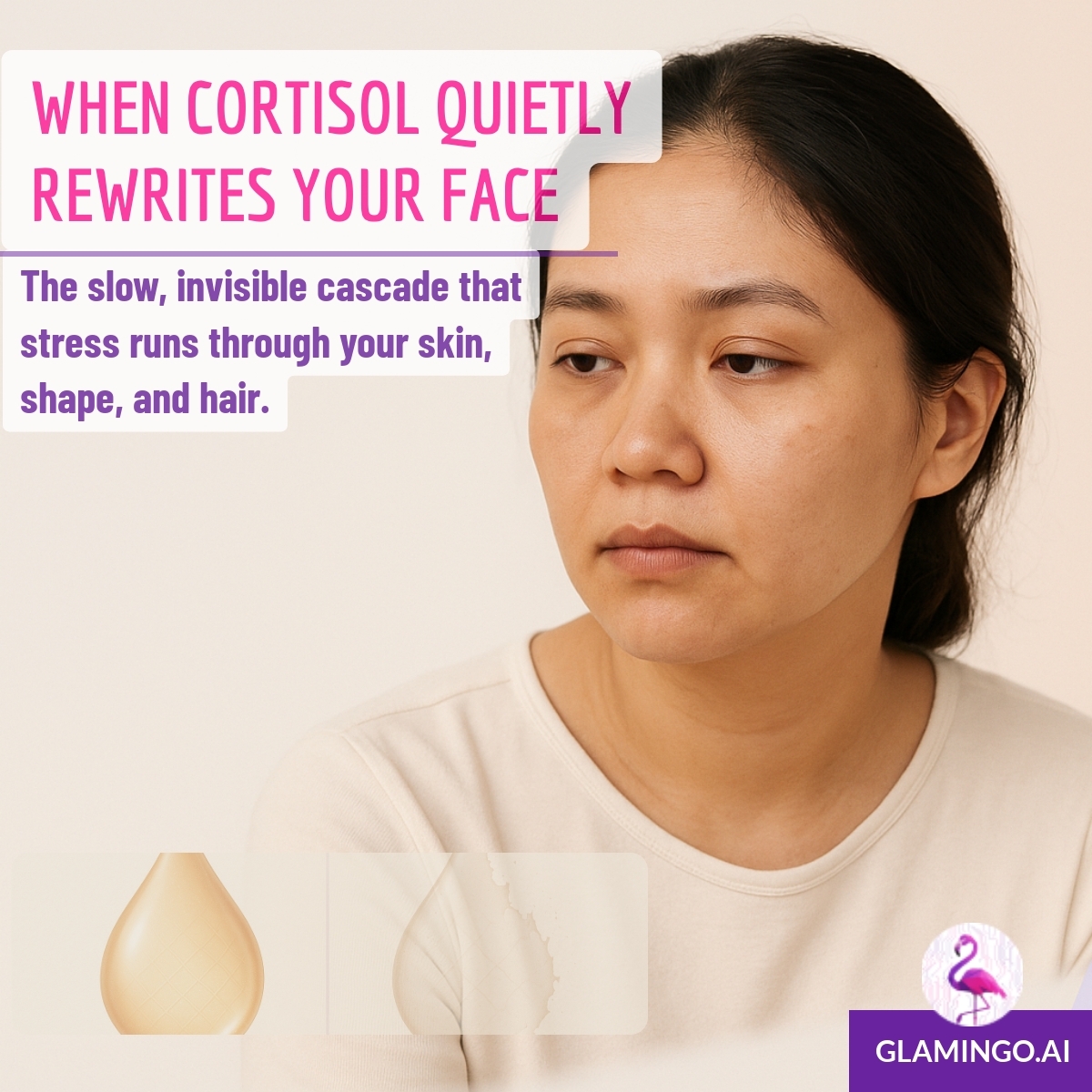
Your skincare routine has not changed, but your skin has — and it happened the same year work got harder, sleep got shorter, and you stopped feeling like yourself. One woman described it with uncomfortable precision: work stress had completely destroyed her skin barrier, leaving her skin so sensitive and reactive that she felt like she was ageing faster. That is not a coincidence. Cortisol, your body’s primary stress hormone, runs a slow and largely invisible cascade through your skin biology — and by the time you see the results on your face, the damage has been building for months.
The frustrating part is that this kind of skin decline does not respond to product swaps. You try a gentler cleanser, a richer moisturiser, a new spot treatment — and nothing quite lands the way it used to. That is because the problem is not on your skin. It is upstream from it, running through a hormonal system that your serums cannot reach. Understanding what cortisol is actually doing — mechanistically, specifically — is the only way to make sense of changes that your routine cannot explain.
The starting point — what chronic cortisol elevation actually means
The difference between a short cortisol spike and sustained elevation
Cortisol is not the villain it is sometimes made out to be. A cortisol spike before a presentation, during a near-miss on the expressway, or in the middle of a difficult conversation is exactly what your body is designed to produce. It sharpens focus, mobilises energy, and helps you respond. The problem is not cortisol existing — it is cortisol that never switches off.
When the stressor is a discrete event, cortisol rises and then drops back down once the threat has passed. Your biology recovers. But when the stressor is chronic — a relentless work environment, financial pressure, a difficult relationship, cumulative sleep debt — the system stays activated. Cortisol does not return to baseline. And a hormonal system that was designed for short-term emergencies starts causing structural damage when it runs at elevated levels for weeks or months on end.
How the HPA axis works as a hormonal chain reaction, in plain terms
The mechanism begins in the brain. When your nervous system registers sustained stress, a region called the hypothalamus sends a chemical signal downward, triggering the pituitary gland, which in turn tells your adrenal glands — two small glands sitting above your kidneys — to release cortisol into the bloodstream. This three-part chain is called the hypothalamic-pituitary-adrenal axis, or the HPA axis, and cortisol is released at the culmination of that cascade. It is elegant as a short-term survival system. It becomes self-reinforcing and damaging when the chain never stops firing.
Stress conditions exert their effects on skin primarily through the HPA axis — cortisol released by this chain reaches skin tissue directly, which is why the effects are systemic rather than localised. This is not a metaphor for “stress is bad for you.” It is a specific biological pathway with documented downstream consequences, and those consequences show up on your face.
Think of cortisol as a building manager who, during a crisis, diverts all repair and maintenance budgets to emergency operations. The pipes get fixed, the alarms get answered — but the roof starts leaking, the walls start cracking, and the cleaning crew stops showing up. When the crisis is short, the building recovers. When the crisis runs for months, the structural damage quietly compounds until one day the whole facade looks different. Your skin is the building. Cortisol is the manager. And the repair budget is collagen production, barrier maintenance, and immune regulation.
First downstream effect — your skin barrier starts to fail
How cortisol suppresses ceramide and fatty acid production
The outermost layer of your skin is not simply dead cells — it is a carefully structured wall built from skin cells held together by fatty molecules that act like mortar between bricks. Those molecules are called ceramides and fatty acids, and they are what keep moisture in and irritants out. Cortisol disrupts the production of both ceramides and fatty acids that form this protective barrier, which means the mortar between your skin cells starts to thin. When the wall is compromised, moisture escapes through the skin surface more readily — a process called transepidermal water loss — and the skin becomes significantly more vulnerable to anything it encounters.
What a compromised barrier looks like in practice: sensitivity, dryness, reactive flares
A failing barrier does not always look dry in the classic sense. Sometimes it looks red. Sometimes it looks irritated by products you have used for years without any issue. Sometimes it presents as a tight, uncomfortable sensation after cleansing that no moisturiser quite resolves. If your skin has started reacting to things it previously tolerated — a fragrance, an active ingredient, even a change in weather — that is not your skin becoming fussier. That is a compromised barrier doing exactly what a compromised barrier does.
In Singapore’s climate, this becomes particularly compounding. The year-round humidity means your skin is constantly negotiating between a warm, humid outdoor environment and aggressively air-conditioned indoor spaces. A healthy barrier manages that transition. A cortisol-compromised one does not — and the reactive flares that follow are often blamed on the wrong culprit entirely.
Why your existing routine may stop working under chronic stress
Here is where the frustration usually peaks: you reach for the products that have always worked, and they stop working. Or worse, they start stinging. This makes sense when you understand the mechanism. A product that your barrier previously filtered appropriately now penetrates differently through a compromised wall. Active ingredients that your skin tolerated are now hitting deeper layers without the buffer they previously had. The routine has not changed. The structure receiving it has. This is why troubleshooting your products during a period of chronic stress is often an exercise in chasing the wrong variable.
Second downstream effect — collagen and elastin breakdown accelerates
The mechanism: cortisol as a collagen disruptor
Below the surface, cortisol is doing something more structural. Your skin’s firmness and elasticity depend on a scaffold of proteins — collagen (which provides structure and volume) and elastin (which allows the skin to spring back). Androgens together with cortisol decrease collagen and elastin production, reduce skin turgor, and impair wound healing. In plain terms: chronic stress actively degrades the scaffolding that keeps your face looking like itself.
Collagen production is already a slow-declining process from your mid-twenties. Cortisol does not pause that decline — it accelerates it. And unlike barrier damage, which can show up relatively quickly as reactive skin, collagen loss is gradual and cumulative. You do not notice it happening. You notice it has happened.
Oxidative stress compounds the structural damage
The cortisol surge also triggers a parallel problem: oxidative stress, which is essentially cellular damage caused by an imbalance between unstable molecules (free radicals) and your body’s ability to neutralise them. Repeated psychological stress accelerates skin ageing by increasing oxidative stress and disrupting the collagen and elastin scaffold. The two mechanisms run simultaneously, which is part of why the visible ageing effect of chronic stress can feel disproportionate to how much time has actually passed.
What this looks like on the face over months, not days
Chronic stress triggers cortisol release that breaks down elastin and collagen, and inadequate sleep — which typically accompanies chronic stress — additionally impairs the skin’s ability to repair these structures overnight. The combination is jialat: your skin loses structural integrity during the day and loses its primary repair window at night. Over months, this shows up as a loss of definition around the jawline, hollowing or sagging in the mid-face, and lines that appear to have deepened faster than your age would suggest. This is not vanity — this is a documented physiological process wearing itself visibly on your face.
Third downstream effect — hormonal acne, puffiness, and visible face shape changes
Cortisol, androgens, and the oil-acne-inflammation loop
Cortisol triggers increased androgen production — androgens being the hormones that drive oil production in your skin. More oil means a more hospitable environment for the bacteria involved in acne. Combined with the systemic inflammation that chronic cortisol elevation produces, this creates the conditions for painful, cystic-style breakouts that tend to cluster around the jaw and chin. Women in their late thirties and forties often find this particularly confusing — breakouts at this stage of life do not fit the narrative they were given about acne being a teenage issue. The mechanism is hormonal, and cortisol is a significant driver.
Why stress-related breakouts are slower to heal and more likely to leave marks — especially on deeper skin tones
Cortisol possesses immune-modulating properties and may directly cause increased inflammation, which has a practical consequence for healing: stress-related breakouts take longer to resolve because the environment they are sitting in — chronically inflamed, barrier-compromised skin — is not optimised for repair. For women with medium to deeper skin tones (Fitzpatrick skin types III to V, which describes most of Singapore’s population), this extended healing time significantly increases the likelihood of post-inflammatory hyperpigmentation — the dark marks that linger long after the breakout itself has cleared. Treating the spot is addressing one tile. The cortisol is pulling up the whole floor.
The fat redistribution and fluid retention behind ‘cortisol face’ — what’s real and what’s trend noise
You may have seen the term “cortisol face” circulating — and dismissed it as another social media wellness trend waiting to be debunked. The terminology is new. The biology is not. Elevated cortisol levels are associated with increased fat deposits in the cheeks and disrupted fluid regulation, which can change the visible shape of the face — though it is worth noting that this evidence is grounded in moderate-strength research, and the dramatic before-and-after framing online often outpaces what the science actually claims. One woman noticed her face had gotten puffier and bigger compared to the previous year, correlating it directly with a period of sustained stress — and feeling genuinely confused about why her face shape had shifted when her weight had not changed significantly. That confusion is understandable. The mechanism is real, the trend language around it is overstated, and the distinction matters if you are trying to make sense of your own face.
Why topical skincare can only do so much when cortisol is the root cause
The brain-skin axis goes both ways — the skin is not just a passive surface
Here is something that skincare marketing rarely acknowledges: the brain-skin connection is bidirectional — the skin is not just a passive victim of cortisol but actively participates in stress hormone signalling. The skin has its own stress-response system. It produces and responds to many of the same signalling molecules as the brain. This means the cascade is not simply “stress happens, cortisol rises, skin suffers” — the skin is part of the conversation, which is part of why the effects are so persistent and why they do not resolve the moment the stressor technically ends.
What this means for how you troubleshoot a routine that has suddenly stopped working
If your routine has stopped working and your stress load has been high for several months, the most sophisticated product reformulation in your bathroom is not the variable you need to change first. Cortisol dysregulation appears to be self-reinforcing once the system is chronically activated — meaning the HPA axis, under sustained stress, does not simply reset on its own. Topical support remains relevant — a compromised barrier still benefits from ceramide replenishment, and antioxidants can help buffer oxidative stress — but these are managing the downstream effects, not addressing the cascade that is generating them. That distinction changes how you prioritise your energy, your spending, and your expectations.
The one upstream signal worth tracking this week
This week, notice whether your most persistent skin complaint — reactive flares, breakouts that will not heal, or that vague puffiness in the morning — follows a pattern tied to your stress load rather than your product routine. Track it for five days: rate your stress level each evening on a scale of one to ten alongside one skin observation. If the correlation is there, you now have a specific reason to address the upstream cause rather than adding another topical layer to a cascade that starts well above the skin surface.
If you want support addressing the downstream effects while you work on the upstream cause, Glamingo has facial and skin treatment providers who specialise in barrier repair and stress-related skin concerns, with verified reviews from women navigating exactly this. Find a provider near you →
Leave a Reply