
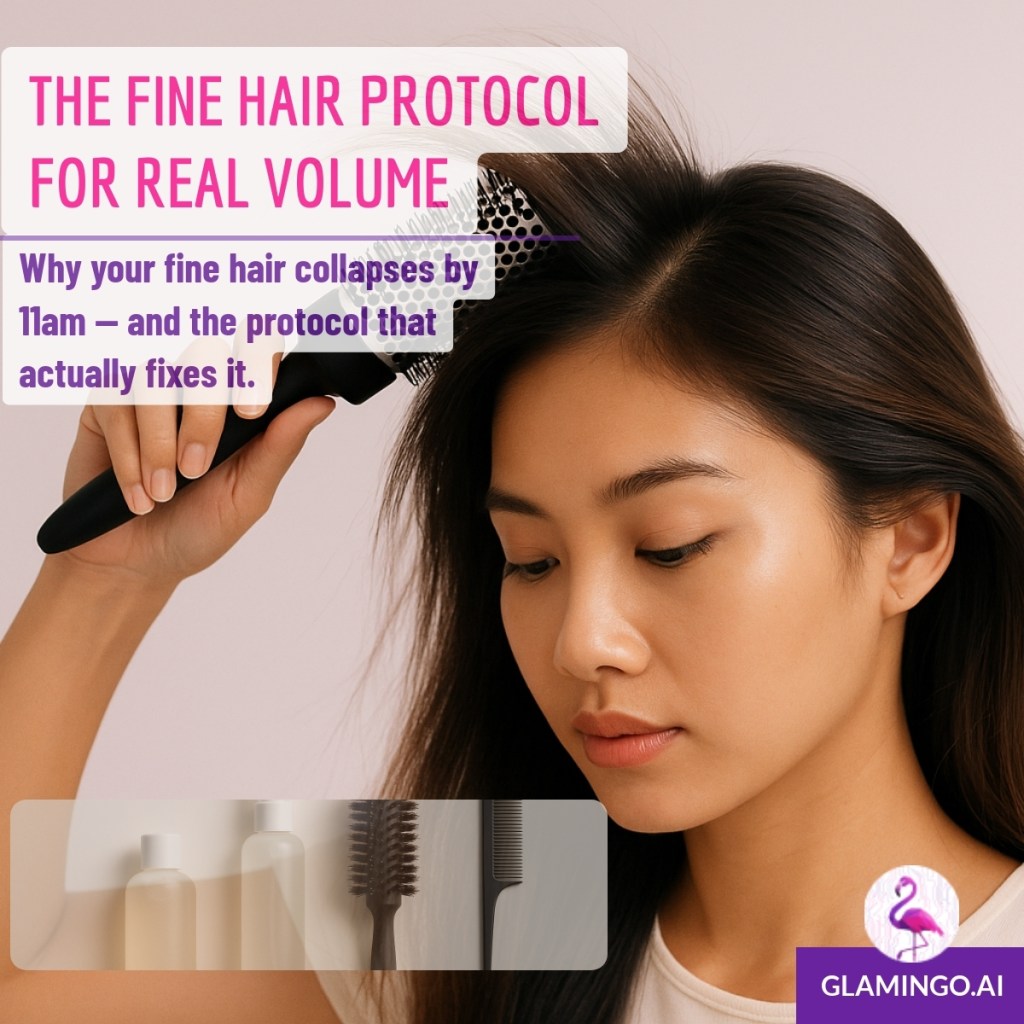
You’ve tried the volumising shampoo, the root spray, the blow-dry technique from the video — and by 11am your hair is flat again. Fine hair doesn’t misbehave because you’re doing everything wrong. It misbehaves because most advice ignores the one thing that undermines it fastest: product weight accumulation. This protocol fixes that from the ground up.
If this sounds familiar, you’re not alone — and you’re not missing some secret product. The women who’ve cycled through every “volume” launch on the market and still end up with flat roots by lunchtime are usually doing everything right except one structural thing: they’re layering lift-focused products onto a base of accumulated residue that cancels out any possible result before their hair even dries. The problem isn’t effort. It’s build-up.
Why fine hair protocols fail (and what this one does differently)
The weight accumulation problem — why your root spray isn’t working
Think of fine hair like a freshly made bed with a very thin mattress. Stack enough blankets on it and the whole thing sags flat — no amount of fluffing helps once the weight is there. The protocol isn’t about adding more “lift” products on top. It’s about stripping the accumulated weight first, then applying only what has a structural reason to be there.
This is where most fine-hair advice falls apart. It treats each product in isolation — a better dry shampoo here, a root-lifting spray there — without addressing what’s underneath. Styling products, conditioner residue, hard water minerals, and scalp sebum layer onto each strand over time. Fine hair has less mass to absorb that load, so the effects show faster and more dramatically. The blanket analogy isn’t decorative — it’s the actual mechanism.
What ‘fine hair’ actually means structurally, and why it changes everything downstream
Hair fineness refers to the diameter of the individual strand — not density (how many strands you have), not thickness (volume overall). A fine-haired person can have a lot of strands; each one is simply narrower in cross-section. That narrower diameter means less cortex mass, a thinner cuticle layer, and — critically — a lower weight-to-surface-area ratio. Every product you apply has proportionally more impact per strand than it would on coarser hair. This is why formulations designed for average or thick hair consistently over-deliver on fine hair in the wrong direction: they coat, flatten, and weigh down rather than condition and hold.
Step 1 — Reset: clarifying wash every 1–2 weeks
What clarifying actually removes (and why your regular shampoo can’t do it)
A clarifying shampoo is not a stronger regular shampoo. It’s a different formulation class — typically higher in chelating agents (ingredients that bind to mineral ions) and stronger anionic surfactants (the cleansing molecules that lift oil and residue) that are specifically designed to break apart the kind of bonded deposits that a mild daily shampoo is not formulated to remove. Clinical guidance on hair cosmetic use recommends clarifying every 15 days for anyone using styling products regularly — not because it’s a nice extra step, but because residue accumulation is an ongoing and compounding problem.
What it removes: silicone coating from conditioners and styling products, cationic (positively charged) conditioning agents that bond to the hair shaft, hard water mineral deposits, oxidised sebum, and the sticky residue from film-forming hold products. Your regular shampoo can lift fresh sebum and surface dirt. It is not designed to break down the rest.
Hard water in Singapore and why mineral buildup is a specific local concern
Singapore’s tap water hardness varies across the island but is classified as moderately hard in many areas — meaning dissolved calcium and magnesium ions are present in the water that flows through your shower every day. These ions react with shampoo and conditioner formulas to form a residue on the hair shaft that isn’t fully rinsed away. Research on hair cleansing specifically flags hard water as a contributor to soap-scum-like deposits that are difficult to remove with regular washing — and the same principle applies to liquid shampoo formulas that aren’t designed to chelate these minerals. For fine hair in Singapore, this isn’t a theoretical concern. It’s a weekly reality.
How to clarify without stripping: frequency, product type, and what to avoid
Every 1–2 weeks is the right rhythm for most people using styling products regularly. If you use heavy silicone-based products daily, lean toward weekly. If your routine is already minimal, every two weeks is fine. When you clarify, follow immediately with conditioner on the mid-lengths and ends — clarifying opens the cuticle and removes protective coating, so a targeted conditioner application after is not optional. Avoid sulphate-free clarifying shampoos that market themselves on gentleness: the point of a clarifying wash is effective removal, and most sulphate-free formulas are not strong enough to do the job. Use it for reset purposes only — not as a daily driver.
Step 2 — Cleanse: frequency and shampoo formulation for fine hair
The wash frequency question — what the evidence actually says
You’ve probably been told to wash less often to preserve your natural oils and protect volume. It’s reasonable advice on its face — but the evidence doesn’t fully support it for fine hair specifically. A peer-reviewed study on wash frequency found that overall satisfaction with hair and scalp condition was highest when hair was washed 5–6 times per week — which challenges the widespread “wash less” approach that gets repeated without qualification. In Singapore’s humidity, where scalp sweat is real and daily, and where fine hair shows oil build-up faster than coarser textures, washing more frequently is often the correct call. Fine hair goes flat faster when it’s carrying oil — which means washing less often can be actively counterproductive.
Surfactant types that work for fine hair vs. those that coat and flatten
A clinical review of shampoo formulation science confirms that surfactant type, pH, and film-forming agent concentration directly affect how hair looks and behaves after washing — which means shampoo choice is not arbitrary. For fine hair, the goal is a surfactant that cleans effectively without leaving a coating residue. Ammonium lauryl sulphate and sodium laureth sulphate are standard anionic surfactants that clean well. The problem arises when a shampoo also contains heavy conditioning agents — cationic polymers, silicones, fatty alcohols — in the same formula. “2-in-1” shampoos are almost always a mistake for fine hair because the conditioning deposit sits at the root where you need lift. Look for a dedicated cleansing shampoo with minimal added conditioners in the formula.
Where to apply, how long to leave it, and why pH matters
Apply shampoo to the scalp and roots only — the lengths will be cleaned as the product rinses through. Two minutes of contact time is sufficient for cleansing; there’s no benefit to leaving shampoo on longer. On pH: healthy hair sits in the slightly acidic range (around 4.5–5.5), and shampoos formulated in this range help keep the cuticle flat and reduce friction. Alkaline shampoos swell the cuticle, which sounds like volume but actually means rougher texture, more frizz, and faster moisture loss — none of which is useful in Singapore’s humidity.
Step 3 — Condition: the mid-length-to-ends rule (and why the scalp is off-limits)
How conditioner physically coats the hair shaft and why that kills root volume
Hair conditioning is a physicochemical process — the cationic (positively charged) conditioning agents in your conditioner are attracted to the negatively charged surface of freshly washed hair, and they deposit a coating layer that smooths the cuticle and reduces static. This is the mechanism that makes hair feel soft. It’s also the mechanism that adds weight. Applied to the roots, this coating sits right at the point where you’re trying to create lift — which is why scalp-applied conditioner is one of the most common and least-discussed volume killers for fine hair.
Lightweight vs. standard conditioner — how to read the formulation signals on the label
Hair cosmetic formulations have defined modes of action — a conditioner is primarily a coating product, and what varies between formulas is the weight and persistence of that coat. Look at the first five ingredients after water: if you see multiple fatty alcohols (cetyl alcohol, stearyl alcohol, cetearyl alcohol) and silicones (dimethicone, cyclopentasiloxane) before anything else, that’s a heavier coating formula. Lightweight conditioners typically lead with humectants (glycerin, panthenol) and smaller amounts of conditioning agents. For fine hair, shorter ingredient lists with fewer heavy emollients generally mean less deposit. This won’t tell you everything, but it’s a more reliable signal than the word “lightweight” on the front of the bottle.
Leave-in conditioner: when it helps and when it makes things worse
Leave-in conditioner can work for fine hair if it’s genuinely lightweight — think water-based sprays rather than creams — and applied only from mid-shaft to ends on hair that genuinely needs detangling help. If your hair is fine but relatively healthy, you may find that a rinse-out conditioner applied correctly does everything you need, and the leave-in simply adds another layer of residue that shortens the time before your next clarifying wash. Start without it and add it back only if your ends are suffering.
Step 4 — Prep: product application before heat styling
Film-formers vs. emollients — what each does to fine hair and how to choose
Before heat styling, the product choice matters more than the technique. Styling products fall into distinct functional categories — film-formers create a flexible coating that adds structure and hold without significant weight (think PVP, VP/VA copolymer, acrylates). Emollients soften and smooth but add weight and slip, which is the opposite of what you want at the root. For fine hair, you want film-formers: a lightweight mousse or a volumising spray that contains hold polymers, not a cream or serum with emollient as the primary function. The label will rarely say “film-former” — but if the first active ingredients are polymers rather than oils or butters, you’re in the right territory.
The application sequence that prevents product layering from adding weight
Apply one product to damp (not soaking wet) hair. One product. The impulse to layer — heat protectant, then volumising mousse, then root spray — is where weight starts building even before you’ve touched a tool. If you need heat protection and hold, look for a product that genuinely delivers both in a single lightweight formula. Apply to the mid-lengths first, work through to the ends, then apply just a small amount to the roots using your fingers rather than raking it through. Let it distribute naturally during blow-drying rather than trying to coat every strand manually.
What NOT to use on fine hair (and why popular ‘nourishing’ oils are often the problem)
Hair oils — including the widely beloved argan, coconut, and marula oils — are emollients. They coat the hair shaft and add slip and shine by filling in the cuticle surface. This is genuinely useful for coarse or chemically damaged hair that needs smoothing. For fine hair, an oil applied to roots or mid-lengths adds weight without structural benefit. If your ends are dry and you want to use an oil, apply a single drop to dry ends only, after styling is complete. That’s the boundary. The “nourishing” positioning of these products is not wrong — it’s just irrelevant, and often counterproductive, for your specific hair structure.
Step 5 — Style: heat tool selection and technique for fine hair
Damage load by tool type — why fine hair has less margin for error
Fine hair has a thinner cortex — the structural core of the strand — which means it reaches its damage threshold faster than coarser hair when exposed to the same level of heat stress. The tools that deliver the most concentrated heat over the smallest surface area (flat irons, curling wands used on small sections) present the highest risk. A diffuser-equipped blow-dryer distributes heat more evenly and over a larger area, making it the lower-damage option for routine styling of fine hair. This doesn’t mean you can never use a curling iron — it means that every time you do, the margin for error is smaller than it would be on thicker hair, and recovery time is longer.
Temperature settings and hold time: the trade-off between lift and damage
For blow-drying fine hair, 150–175°C is a reasonable working range — enough to set the style, low enough to stay beneath the temperature at which keratin (the protein that makes up the hair shaft) begins to degrade rapidly. The time the tool spends on each section matters as much as the temperature: a fast pass at 180°C does less cumulative damage than a slow pass at 160°C. Move through sections deliberately but without lingering. For tools used on already-dry hair — curling irons, wands — lower temperatures with a slightly longer hold time generally produce better results for fine hair than high heat for a short burst, because the style sets more evenly without the stress spike.
Blow-dry direction, tension, and timing — the mechanics of creating root lift that lasts
Root lift is built during the first 60–70% of the drying process, when the hair shaft is still malleable from moisture. If you wait until hair is nearly dry to apply tension at the root, you’re setting a shape that’s already close to fixed. Use a round brush or your fingers to lift sections away from the scalp and direct airflow from roots to ends while hair is still damp. The direction matters: blow-drying in the direction of hair growth (down the shaft) smooths the cuticle; blow-drying upward or sideways from the root with the root section held taut creates lift. Finish each section with a brief cool air shot to set the shape before releasing — this closes the cuticle and helps the volume hold longer against humidity.
Step 6 — Maintain: protecting volume through the day in humidity
Why Singapore’s humidity collapses fine hair faster and what the science says about it
Singapore’s ambient humidity sits around 80% year-round. When the air has that much moisture in it, hair — particularly fine hair with its higher surface-area-to-mass ratio — absorbs atmospheric moisture continuously. This causes the hydrogen bonds within the hair shaft (the same bonds that styling manipulates to create shape) to weaken and reform in whatever direction the moisture pushes them, which is usually downward and inward. The result is the flat, slightly damp-feeling hair that sets in well before noon if you’re commuting, or stepping between air-conditioning and outdoor heat repeatedly, which is basically every working day in Singapore.
Touch-up tools and products that do not add cumulative weight
The goal for midday maintenance is to restore lift without adding more product to already-styled hair. A small volume-powder (typically silica or starch-based) applied at the root can absorb moisture and restore texture without depositing a coating layer — these work differently from hairsprays or root sprays in that they don’t add a film, they absorb. A dry shampoo can do the same job if it’s a genuine starch-based formula rather than a fragrance-heavy aerosol with conditioning agents in it. The test: if using it daily means your clarifying wash feels more urgent, the product is adding more than it’s absorbing. Limit touch-up product use to roots only, and treat it as a temporary fix rather than a substitute for the reset cycle.
The weekly reset schedule — putting the protocol into a realistic routine
This is what the protocol looks like across a week, built for a realistic Singapore schedule — not a beauty editor with a dedicated morning hour.
Once every one to two weeks, do your clarifying wash before bed — not the morning you plan to style, because hair benefits from a brief recovery period after clarifying. On wash days (aim for five to six times a week if your scalp and routine allow it), use your cleansing shampoo on the scalp only, condition mid-lengths to ends only, rinse thoroughly, and apply one lightweight film-forming product to damp hair before blow-drying with lift technique at the roots. On non-wash days, spot-correct with a starch-based powder at the root if needed. That’s the full structure.
The clarifying wash anchors everything else. Without it running in the background on schedule, the rest of the protocol is optimising on top of a bad base. The shampoo choice, the conditioning placement, the blow-dry technique — all of these deliver noticeably better results when the slate is periodically clean. Which is why the reset isn’t a bonus step. It’s step one for a reason.
This week, check when you last did a clarifying wash — if you can’t remember, or if it’s been more than two weeks, do one before your next styling session. Everything else in this protocol works better on a clean base. Use it as a reset, not a reaction.
If you’d rather hand this off to someone who can assess your hair type in person and recommend the right clarifying and styling treatment for your specific situation, Glamingo has hair care salons and treatment providers near you with verified reviews. Search hair treatments near you →
 Glamingo Blog
Drop in your comments..