
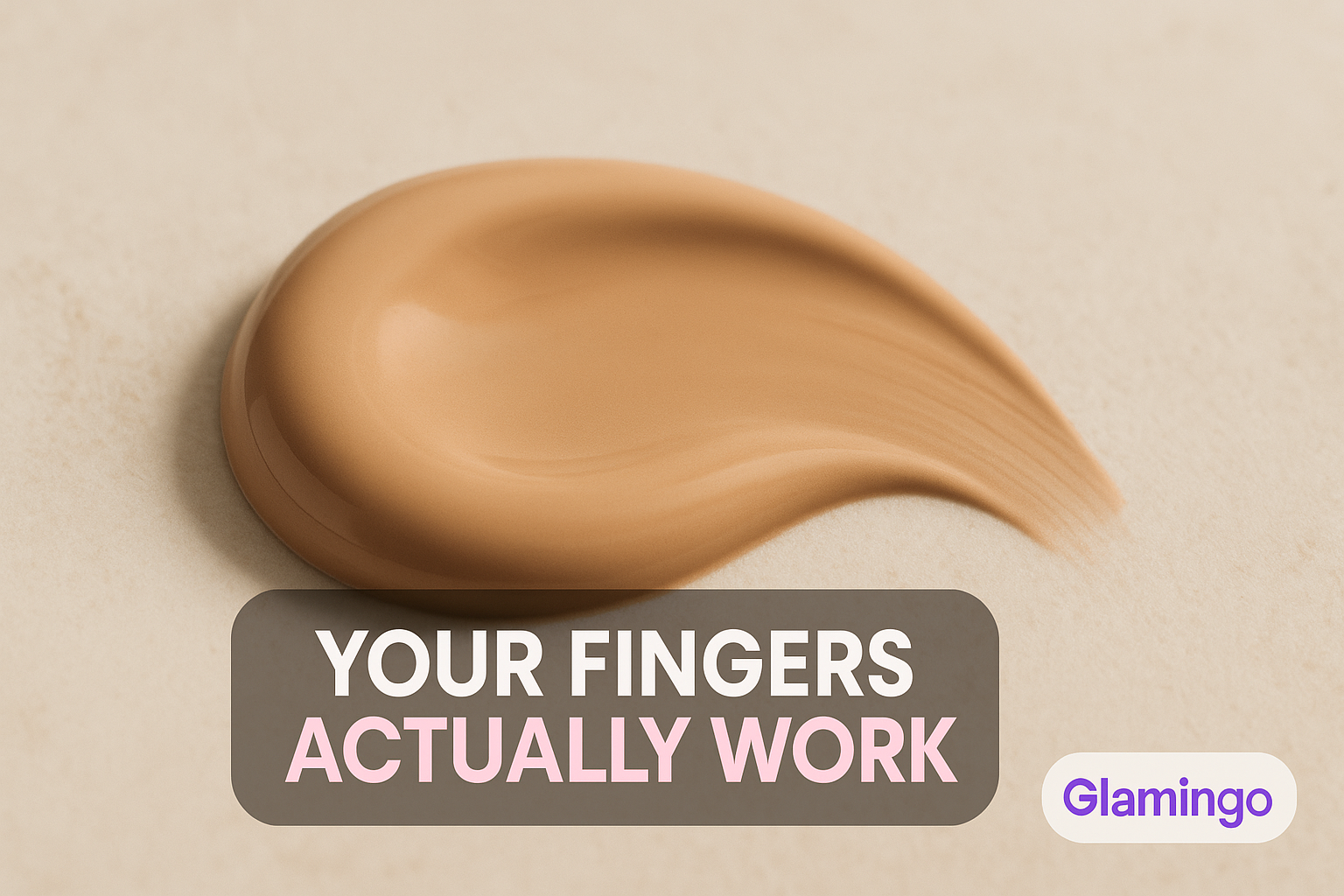
You’ve been told that applying foundation with your fingers is lazy, unhygienic, or the reason your base never looks right. So you bought the beauty blender, then the kabuki brush, then the flat foundation brush — and somehow the finish still isn’t what you want. One woman put it plainly: she’d just started using liquid foundation, was applying it with her fingers, it didn’t look bad, but she was convinced there must be a more effective method. The question itself is telling. The result was fine. The doubt was the product — not of the technique, but of years of being told that fingers simply aren’t a legitimate tool. The honest answer? The tool matters far less than the technique and the formula — and the “fingers are wrong” rule is mostly a marketing story, not a skin science one.
If you’ve spent any real money on your makeup bag, you’ve almost certainly also spent money on the accessories that are supposed to make it work. Foundation brushes in three different shapes. A sponge you replace every few months because you read somewhere that you should. A damp-versus-dry debate you’ve had with yourself more than once. None of this is entirely without value — but very little of it is grounded in actual evidence. Most of it is grounded in what sells.
The Myth — You Need a Brush or Sponge to Apply Makeup Correctly
Where this rule came from (and who benefits from you believing it)
The idea that professional tools produce professional results is as old as the beauty industry itself. It’s a logical extension of a broader belief — that expertise requires equipment. And it’s a belief that happens to be enormously profitable for brands that sell brushes, sponges, and applicator sets at margins that would make a restaurant owner blush.
What’s less often acknowledged is that there is no peer-reviewed evidence establishing that brushes or sponges produce measurably better foundation results than fingers. The “tools only” convention is exactly that — a convention, passed down through professional makeup artistry, amplified by decades of beauty advertising, and turbocharged by social media. Research confirms that social media’s emphasis on visual aesthetics drives cosmetic product decisions and fosters appearance anxiety — which means the environment you’re consuming beauty content in is specifically structured to make complex rituals and product purchases feel necessary. The influencer who swears by her $60 brush set has every incentive to make the brush feel essential. She does not have a control group.
Choosing a makeup application tool is like choosing between a spoon, a fork, and your hands to eat rice — all three can get the food to your mouth effectively. The outcome depends far more on the rice (the formula) and whether you’ve washed your hands (hygiene) than on the utensil. The beauty industry has simply convinced you that one utensil is more sophisticated than the others, because utensils are something they can sell you.
The Verdict — Fingers, Brushes, and Sponges All Work. Here’s What Actually Differs.
What fingertip application actually does to formula and finish
Your fingertips warm product as you apply it. For many liquid and cream formulas — particularly skin-finish foundations and tinted moisturisers — this is genuinely useful. Warmth reduces viscosity slightly, helping the product spread more evenly and melt into the skin rather than sit on top of it. For a dewy, skin-like finish in Singapore’s humidity, this is not a flaw. It’s a feature.
The “fingers are wrong” claim has no scientific basis. It is built on industry convention and influencer guidance, not clinical evidence. What fingers do require is clean hands — more on that shortly — and a light enough touch that you’re pressing and warming the product rather than dragging it across the skin. That technique distinction matters. The finger itself does not.
What brushes genuinely do better — and what they don’t change
Brushes do offer real advantages in specific contexts. A densely packed flat brush can build coverage more efficiently in targeted areas. A fluffy buffing brush blends powder products in a way that’s genuinely difficult to replicate with fingers. If you’re applying a matte, full-coverage formula that requires layering, a brush gives you more control over each layer without disturbing what’s underneath.
What brushes do not do is transform a formula that isn’t working for your skin, fix a shade that’s slightly off, or produce a result that fingers categorically cannot. The finish difference between a well-applied finger technique and a well-applied brush technique, for most liquid foundations, is far smaller than the content you’ve watched about it would suggest. Consumer perceptions of cosmetic product effectiveness are significantly shaped by marketing framing rather than objective performance — meaning what you believe about your brush is often a reflection of how it was sold to you, not how it actually performs.
What sponges genuinely do better — and when they’re oversold
The damp sponge method does have a genuine use case. A damp beauty sponge sheers out product as it applies — which is useful if you want lighter coverage or if you’re working with a formula that tends to look heavy. The stippling motion also reduces drag, which matters if your skin is textured or sensitised. These are real, legitimate advantages for the right formula and the right finish goal.
They are not universal advantages. A damp sponge absorbs product — you are literally pressing some of your foundation into the sponge rather than onto your skin, which is why you go through product faster with this method. If you prefer medium-to-full coverage, a sponge is actively working against you. And if that sponge isn’t being cleaned regularly, it is a problem you have created in the name of “better application.”
The ‘Tapping Only’ Rule — Another Technique Myth That Doesn’t Hold Up
Why the tap-don’t-swipe instruction exists and when it’s relevant
The instruction to tap rather than swipe with a sponge or brush exists for a real reason — swiping can move product that has already set, create streaks in certain formulas, and lift coverage rather than build it. For a sponge being used with a medium-coverage liquid on dry or textured skin, stippling does reduce the risk of patchiness. That’s a legitimate technique note for a specific scenario.
Where it goes wrong is when this context-specific advice becomes a universal rule applied to every tool, every formula, and every skin type. There is no controlled evidence that tapping universally outperforms other motions across all application contexts. The rule has been repeated so many times that it has taken on the weight of fact — which is, again, not the same thing as being one.
When swiping or pressing is equally or more effective
For a fluffy brush applying a lightweight serum foundation on normal or oily skin, a circular buffing motion distributes product faster and more evenly than tapping alone. For fingers working with a balm or skin-tint formula, a pressing-and-warming motion outperforms either stippling or swiping. The right motion is the one that works with the specific formula you’re using on the specific skin you have that day. Technique is not one-size-fits-all, and anyone telling you otherwise is simplifying for content, not for accuracy.
The One Application Rule That Is Evidence-Based: Hygiene
Bacteria transfer from unwashed tools — fingers, brushes, and sponges equally
Here is the one place where the science is genuinely on the side of caution. Research has linked contaminated cosmetic products and application tools to skin irritation and adverse health outcomes — making cleanliness in whatever you’re using a real skin health consideration, not a beauty influencer talking point.
The important nuance: this applies equally to fingers, brushes, and sponges. The argument that fingers are “unhygienic” while a brush is not ignores the fact that a foundation brush used daily and cleaned monthly is carrying a significant bacterial load. A damp beauty sponge left in a closed makeup bag between uses is a warm, moist, product-saturated environment — not a sterile applicator. If hygiene is your concern, the answer is cleaning your tools consistently, regardless of which tool you choose.
How often you actually need to clean each tool type
For daily-use sponges, washing every two to three days is genuinely warranted given the moisture retention issue. For brushes used with liquid or cream products, weekly cleaning is a reasonable standard. For brushes used only with powder, every two weeks is manageable. And for fingers — which can actually be the cleanest option when you wash your hands immediately before application — the barrier to hygiene is the lowest of all three. The irony of the “fingers are dirty” argument is that your fingers are the one tool you can clean in thirty seconds before every single use.
Mascara Wand Myths — Does the Applicator Shape Change Anything?
The lash damage claim — what’s actually causing breakage (it’s not the wand)
The mascara conversation follows exactly the same pattern as the foundation tool debate. There is a persistent belief that mascara damages lashes — and that the applicator wand, its shape, or its bristle type is somehow responsible. The evidence does not support this. Mascara itself does not cause eyelash breakage — the damage is mechanistically consistent with friction during removal, not with the product or wand.
If your lashes feel brittle or you’re noticing breakage, the question to ask is how you’re taking your mascara off, not which wand you’re using to put it on. Rubbing at your eyes with a dry cotton pad, using a harsh makeup remover, or simply going at it too aggressively — that’s the damage mechanism. A curved wand versus a straight one, a fat brush versus a thin one — these create minor cosmetic differences in how lashes separate and coat. They do not create or prevent lash damage.
The Clear Verdict — What to Actually Base Your Tool Choice On
Formula type
Start here, not with the tool. A thick, full-coverage foundation behaves differently in your hands than a sheer skin-tint does. Powder formulas need brushes — that’s not a preference, it’s a physical reality. Cream and balm formulas often work best with fingers or a sponge. Liquid formulas work with all three. Match the tool to what you’re actually applying.
Coverage preference
If you want buildable, sheer-to-medium coverage, a damp sponge or fingers give you that naturally. If you want layered, full coverage, a brush gives you more control between layers. This is a genuine functional difference worth knowing — but it is a preference guide, not a rule about what is correct.
Time and convenience
Fingers are faster. If you’re doing your makeup in the fifteen minutes before leaving the office for a dinner and your foundation looks fine applied with your hands, the tool is not your problem. Brushes take longer to blend and longer to clean. Sponges need to be damp and then need to be dried properly afterwards. The time cost of each tool is real and belongs in your calculation.
The one thing that is not on the list: what an influencer told you to buy
Tool and application myths are among the most commercially motivated categories of misinformation in the beauty industry — and the influencer economy is built on the assumption that your current method is wrong and a new purchase will fix it. It usually won’t. The formula match, the shade match, and the consistency of your hygiene practice will do more for your base than any applicator upgrade. What you believe about a product’s effectiveness is shaped more by how it was marketed to you than by how it actually performs — which means the most useful thing you can do is notice when you’re about to spend money on a tool to solve a problem that the tool probably didn’t cause.
This week, apply your foundation with whichever tool you reach for first — then ask yourself one question: is the result actually worse, or have you just been told it should be? If your finish is acceptable, the tool is not your problem. Direct your troubleshooting to formula match and hygiene (when did you last clean that sponge?) instead of buying another applicator.
If reading this has you thinking it might be time to let a professional assess your base — formula, coverage level, and technique together — Glamingo has makeup and beauty consultation services near you with verified reviews. Find a makeup artist or beauty consultant near you →
Leave a Reply