
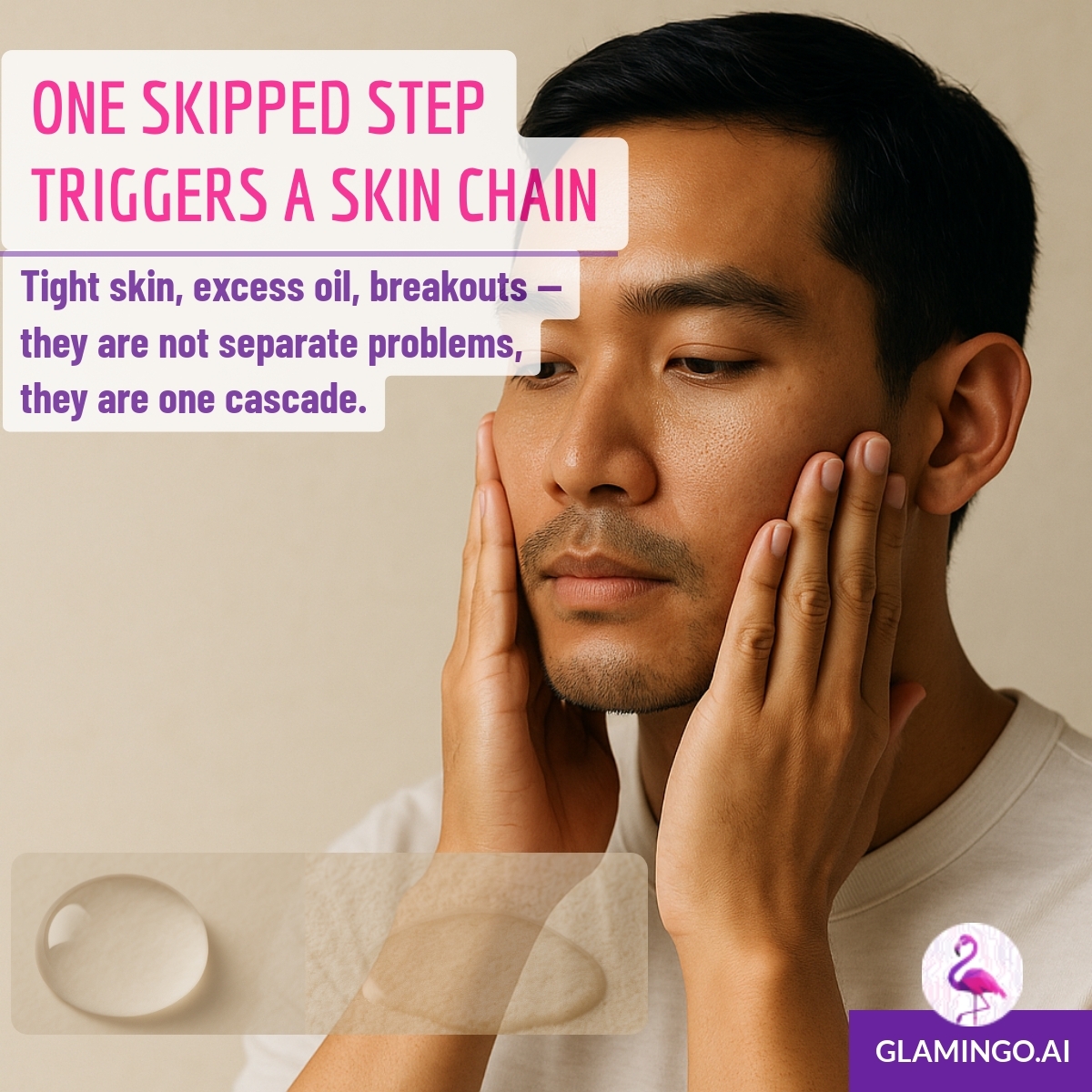
You wash your face, your skin feels tight for an hour, you ignore it, and eventually your face is either constantly oily, randomly breaking out, or ageing faster than it should. These feel like separate problems. They’re not — they’re one chain, starting from a damaged skin barrier, and it runs deeper than most men realise.
Here’s the thing no one explains: most men who avoid skincare aren’t indifferent. They just haven’t been given a reason that makes the effort feel proportionate. “Moisturise so your skin looks nice” doesn’t land the same way as understanding that skipping it is quietly triggering inflammation, breakouts, and accelerated ageing — simultaneously, through the same biological pathway. Once you see the chain, it’s hard to unsee it.
The starting point: what a damaged skin barrier actually is
Your skin barrier isn’t just the surface you can see. It’s a physical, chemical, and biological system — a layered structure of skin cells, fatty molecules called ceramides that act like mortar between those cells, and a thin acidic film on the surface that keeps moisture in and pathogens out. When this system is functioning, it regulates moisture, controls inflammation, and keeps microbial balance in check. When it’s compromised, all three go sideways at once.
Think of your skin barrier like the waterproofing on a good jacket. When it’s intact, rain beads off and nothing gets in. When the coating wears away — from harsh detergents, sun, or just not maintaining it — water seeps in, the lining gets damaged, and eventually the whole jacket degrades faster than it should. The jacket didn’t fail because of rain. It failed because the protective layer was never maintained. Your skin works exactly the same way, and the downstream damage follows the same logic.
Why men’s skin is not naturally tougher — it just fails differently
There’s a widely held assumption that men’s skin is inherently more resilient. It’s thicker, yes — higher androgen activity (the hormonal driver behind testosterone) does produce denser, oilier skin. But that thickness doesn’t protect against barrier disruption; it just changes how that disruption shows up. Men tend to experience more persistent breakouts, blocked pores, and excess oil production as their specific failure modes — rather than the dryness and sensitivity that women more commonly notice. The damage is the same. The symptoms just look different enough that most men don’t connect them back to a single cause.
The common behaviours that quietly break down your barrier every day
Hot showers are probably the biggest one. High water temperature strips away the lipids (the fatty molecules that maintain your skin’s protective film) faster than you’d expect. Harsh cleansers — anything that leaves your face squeaky clean and tight — do the same job. Shaving adds mechanical disruption on top of that, particularly if you’re using a foam or gel with a high fragrance or alcohol content. And UV exposure in Singapore’s intense sun, a UV Index that regularly sits between 10 and 12, degrades the barrier cumulatively every time you step outside without SPF. Any one of these is manageable. Done together, every single day, they add up to chronic barrier disruption — and that’s where the chain begins.
Stage one of the chain: barrier damage triggers inflammation
How moisture escaping through the skin surface sets off an inflammatory signal
When your barrier is compromised, moisture escapes through the skin surface — what dermatologists call transepidermal water loss, or TEWL. That’s not just a dryness problem. The loss of moisture and the disruption of your skin’s surface acidity (its natural pH balance) directly activates inflammatory signalling molecules called interleukins, and triggers a molecular pathway known as nuclear factor kappa B. This pathway operates at a cellular level, meaning barrier disruption activates inflammation not just at the surface but deep within the skin tissue. The tight feeling after washing isn’t just discomfort. It’s your barrier telling you the system is under stress.
Why this inflammation is the same pathway that causes acne — not a coincidence
This is the part most people miss. Acne pathophysiology involves both topical and systemic inflammatory cascades — the exact same molecular pathways that are triggered when your barrier is disrupted. Which means an over-cleansed, under-moisturised face isn’t just dry. It’s a face where the inflammatory machinery is already running. Add the bacteria and sebum changes that come with a compromised barrier, and breakouts aren’t a random coincidence. They’re a predictable downstream consequence of the same upstream disruption.
Stage two: inflammation drives breakouts and reactive skin
The oil-barrier paradox — why stripping skin makes it oilier and more breakout-prone
This is counterintuitive enough that it’s worth sitting with for a moment. When your barrier is stripped — by a harsh cleanser, by hot water, by skipping moisturiser — your skin registers the moisture loss and ramps up oil production to compensate. More oil on already-inflamed skin means more blocked pores, more bacterial activity in those pores, and more breakouts. So the instinct many men have — to wash more aggressively when they’re breaking out — actually feeds the cycle rather than breaking it. The oiliness is a symptom of disruption, not the cause of it. Treating it as the cause is exactly how you end up washing your face twice a day with a foam cleanser and still breaking out every week.
Singapore humidity does not protect your barrier — here is why it can make things worse
Living in Singapore’s year-round humidity of around 80% might seem like it would help your skin stay hydrated. It doesn’t work that way. High ambient humidity can actually interfere with your skin’s natural moisture-regulating signals, making it harder for the barrier to function optimally. And the sweating that comes with that humidity — combined with the instinct to wash your face more frequently — can strip away the acidic surface film your barrier depends on. Add the constant air-conditioning exposure (moving between humid outdoor air and aggressively cooled offices and MRT carriages repeatedly through the day), and your barrier is dealing with rapid humidity swings throughout the day. That fluctuation is its own form of stress on the barrier system.
Stage three: sustained inflammation accelerates visible ageing
How collagen and elastin break down when inflammation runs unchecked
If you’re in your late twenties or thirties and thinking this doesn’t apply to you yet — the molecular ageing cascade doesn’t start at 40. The continuous accumulation of DNA-damaged cells triggers a process called cellular senescence, which leads to chronic inflammation, loss of function, and tissue atrophy — and this process is influenced by daily inputs, including how well or poorly your barrier is maintained. In practical terms: chronic low-grade inflammation accelerates the breakdown of collagen and elastin through enzymes called matrix metalloproteinases (MMPs) — the structural proteins that keep skin firm and elastic. When those degrade prematurely, the result is deeper lines, looser skin, and the kind of tired-looking face that no amount of sleep seems to fix. The connection between a skipped moisturiser today and visibly older-looking skin in five years is not marketing copy. It’s a well-documented biological pathway.
The stress loop — how pressure at work feeds back into your skin’s inflammatory state
There’s one more layer to this, and it’s relevant for anyone navigating a demanding job in a high-pressure city. Psychological stress has been clinically linked to the onset and aggravation of multiple skin conditions, with the brain-skin connection operating through inflammatory signalling pathways that directly affect barrier integrity. Stress elevates cortisol, which increases oil production and amplifies the same inflammatory signals your disrupted barrier is already triggering. The result is a feedback loop: a compromised barrier makes your skin more reactive, stress makes the barrier worse, and the skin issues that follow create more stress. This isn’t a case for meditating your way to clear skin — but it is worth knowing that the cascade isn’t only driven by what you put on your face.
Where to interrupt the chain
The minimum effective barrier routine — what actually needs to be in it
The good news is that the chain is interruptible, and you don’t need ten products to do it. Topical application of barrier-supporting ingredients has demonstrated measurable anti-inflammatory and barrier repair effects — meaning a moisturiser isn’t just passive hydration, it’s an active intervention in the inflammatory pathway. The minimum effective routine is genuinely minimal: a gentle, non-foaming or low-lather cleanser (one that doesn’t leave your face feeling tight after use), a fragrance-free moisturiser with ceramides or fatty acids applied immediately after washing while the skin is still slightly damp, and SPF in the morning. That’s it to start. The clinical evidence supports incorporating these basics into daily practice as meaningful for long-term skin health — not as a beauty routine, but as maintenance of a biological system you’re already relying on.
What to stop doing before you add anything new
Before you buy anything, remove what’s breaking things down. If your current cleanser leaves your skin feeling tight or squeaky, it’s damaging your barrier — switch it out first. Turn the shower temperature down, or at least rinse your face with cooler water. Stop using products that contain high concentrations of alcohol or fragrance (these appear near the top of an ingredient list when present in significant amounts). If you shave daily, follow it with something that doesn’t sting — stinging usually means alcohol content, and alcohol on a freshly shaved face is barrier disruption in real time. The interconnected biological loops that drive skin ageing and barrier breakdown reinforce one another once initiated — which means stopping the inputs that keep triggering them is at least as important as adding something new.
The one upstream fix that changes everything downstream
Every stage of this chain — the inflammation, the breakouts, the accelerated ageing, the stress loop — traces back to one point of origin. Not your genetics, not your skin type, not the humidity. The barrier. Specifically, whether it’s being actively maintained or quietly degraded day by day. The cascade framing matters because it makes the effort proportionate: you’re not moisturising so your face looks nice. You’re interrupting a molecular chain before it compounds into something that takes significantly more effort to address later.
This week, after your morning face wash, notice whether your skin feels tight, looks shinier than usual an hour later, or breaks out in the same spots repeatedly. If yes to any of these, you are seeing barrier disruption at stage one of the chain — before the inflammation and accelerated ageing downstream. That tightness after washing is your barrier signalling for help. Pick one gentle, fragrance-free moisturiser and use it every morning for two weeks — not to hydrate, but to interrupt the chain at its starting point.
If you’d rather get a proper baseline assessment of your skin before building a routine, Glamingo connects you with men’s skincare and facial treatment providers across Singapore who can identify where your barrier is compromised and what’s actually worth addressing. Find a provider near you →
Leave a Reply