
You’ve tried the bond-building treatments, the keratin masks, the protein sachets — and your hair still snaps, frizzes, or turns into straw after a blow-dry. The issue probably isn’t which product you’re using. It’s that most hair care routines are built around marketing categories, not the actual structure of the hair strand itself. Once you understand what each layer of your hair fibre does and how it breaks down, the order and logic of your routine stops being guesswork.
This frustration is more common than you’d think. Plenty of experienced product users — people who know their ingredients, who have tried everything the beauty counters and online forums suggest — still can’t tell whether what they’re doing is working at the fibre level or just making their hair temporarily feel better. That gap between “feels smooth today” and “is structurally sound” is exactly what this protocol addresses. Not by adding more products. By understanding what each step is actually doing — and to which layer of your hair it’s doing it.
Why your hair care routine needs a structural foundation, not just a product stack
The three layers of a hair fibre and what each one does
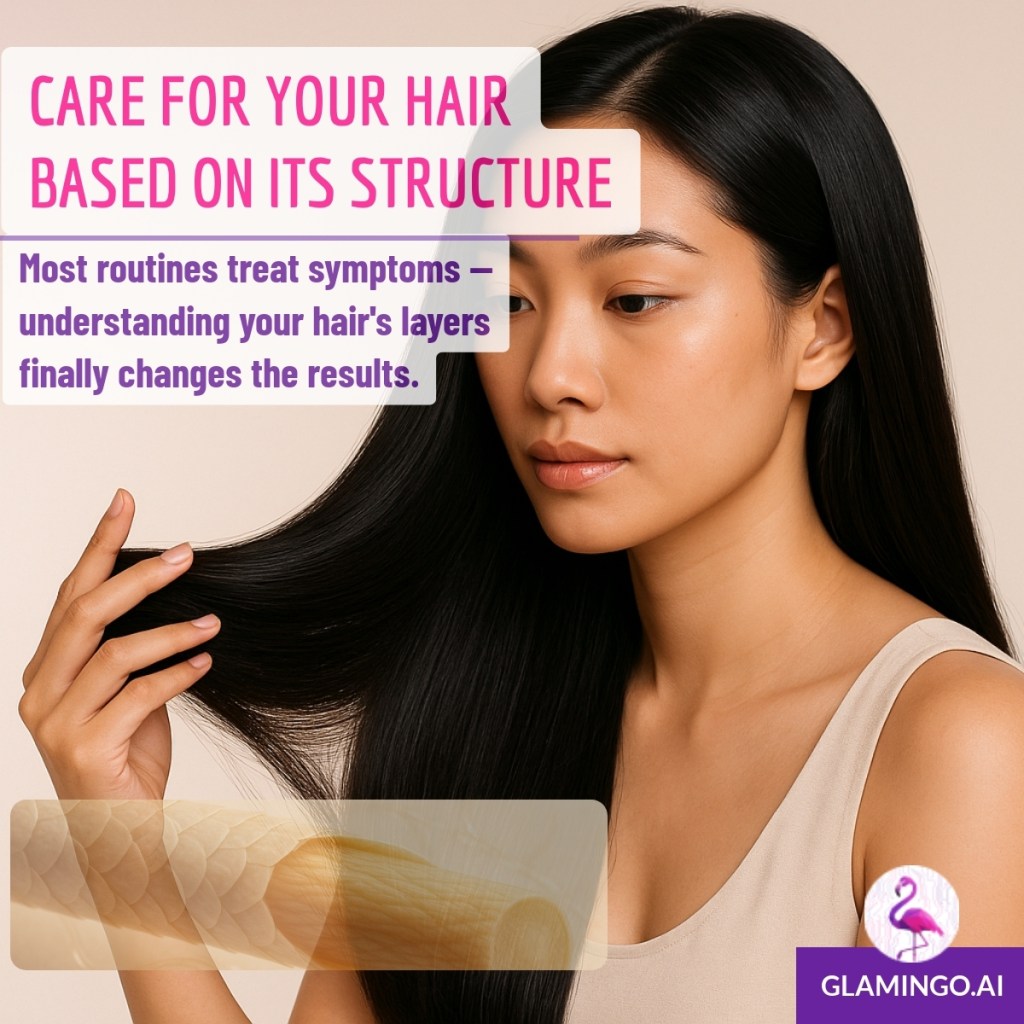
The hair fibre has three distinct structural layers, and knowing which one you’re working with changes everything about how you select and sequence products. The outermost layer is the cuticle — a series of overlapping, scale-like cells that wrap around the fibre like shingles. Its job is protection: it shields the interior from UV, heat, friction, and chemical intrusion. Beneath it sits the cortex — the dense, protein-packed core that gives the strand its tensile strength, elasticity, and the ability to bend without snapping. This is where the structural integrity of your hair actually lives. At the very centre, when present, is the medulla — a hollow channel whose function in cosmetic hair science is less well understood and largely irrelevant to your routine choices. The cuticle and cortex are where your decisions matter.
The core analogy: your hair strand as a tiled roof over a rope bridge
Think of your hair strand as a tiled roof built over a rope bridge. The tiles are the cuticle — overlapping scales that protect the structure underneath from rain, heat, and friction. The rope is the cortex — the keratin protein bundles that give the strand its tensile strength and elasticity. When the tiles crack or lift, the rope underneath gets wet, stressed, and eventually frays. Most hair products work on the tiles. A few genuinely reach the rope. Your protocol needs to address both layers in the right order — because sealing tiles over an already-damaged rope just hides the problem until the next wash.
This is the central flaw in most routines. A silicone-heavy conditioner that makes your hair feel glassy? Tiles. A protein treatment that temporarily fills gaps in the cuticle? Tiles, mostly. The rope — your cortex — requires a different class of intervention, applied with specific timing and in specific conditions. The rest of this protocol is built around that distinction.
Step 1 — Assess your hair’s current structural state before you touch a product
How to read your hair’s porosity (the float test and the feel test)
Hair porosity — how readily the cuticle layer opens to allow water and ingredients into the cortex — is the single most useful piece of structural information you can have before building a routine. Research confirms that porosity is directly modified by chemical and physical damage: the more damage your hair has sustained, the higher its porosity tends to be, and the more dramatically its response to products changes.
Two quick tests give you a working read. The float test: take a few clean, dry strands and drop them into a glass of room-temperature water. Watch for two to three minutes. If they float near the surface and resist sinking, your cuticle is relatively closed — that’s low porosity. If they sink quickly, the cuticle is lifting and allowing water in easily — high porosity. The feel test is simpler: run a finger from the tip toward the root along a single dry strand. If it feels rough and catches slightly, the cuticle scales are raised. If it glides smoothly, they’re lying flat. Neither test is laboratory-precise, but together they give you enough directional information to make better product decisions than “moisturising” versus “volumising” ever would.
Virgin, colour-treated, chemically processed, or heat-damaged — why your history changes the protocol
Your hair’s processing history is structural biography. Research shows that shampoos, hair dyes, and straightening treatments all cause measurable structural damage to the fibre — stripping lipids from the cuticle surface, leaching protein from the cortex, and altering the hair’s mechanical behaviour. This is not marketing language. It is documented, measurable degradation. Which means a routine designed for chemically untreated hair will not adequately address hair that has been coloured, bleached, relaxed, or permed — and using the same approach for both wastes both money and opportunity.
Before you move to any product step, be honest with yourself about your hair’s history. Highlighted twice a year is different from full bleach every eight weeks. Occasional blow-drying is different from daily flat-ironing on fine, colour-treated strands. The protocol branches from here — but only if you know which branch you’re on.
Step 2 — Cleanse without stripping the lipid layer
What surfactants actually do to the cuticle’s lipid coating
Your hair’s surface is coated in a layer of lipids — including a specific fatty acid called 18-MEA (octadecyl methyl ether acrylamide, if you want the technical term, though it’s rarely labelled). This lipid layer plays a direct structural role in water resistance, how the hair feels to the touch, and how well conditioning agents are able to adhere to the fibre. When surfactants — the cleansing agents in shampoo — do their job of removing oil and debris, they also disturb this lipid coating. The stronger the surfactant, the more disruption. This is why the conditioning step is not just a finishing touch. It’s a partial restoration of what cleansing removes.
How to choose a shampoo based on your damage level, not your hair ‘type’ label
The “for damaged hair” or “for fine hair” labels on shampoo bottles correspond to marketing segments, not fibre architecture. More useful is understanding the surfactant profile. Shampoos built around sodium lauryl sulphate (SLS) are aggressive — effective at removing sebum and product, but correspondingly harsh on the lipid layer. Gentler alternatives use amino acid-based surfactants (like sodium cocoyl glutamate or sodium lauroyl methyl isethionate), which clean adequately while preserving more of the cuticle’s surface lipids. If your hair is colour-treated, bleached, or high-porosity, a sulphate-free or low-sulphate formulation is not a trend choice. It’s a structural one.
Frequency: why washing less is not always the answer in Singapore’s humidity and UV environment
There’s a widespread idea that washing your hair less frequently is inherently better for it. In many climates, this has merit. In Singapore, with year-round humidity around 80% and a UV index routinely hitting 10 to 12, the calculation is different. Sweat, sebum, and UV-generated oxidative damage accumulate faster on the scalp and fibre surface here than in cooler, drier environments. Leaving that accumulation in place isn’t protecting your hair — it’s marinating it. The right frequency depends on your scalp type, your physical activity, and your damage level. For most women in Singapore washing every one to two days with a gentle, low-surfactant formula is both practical and structurally appropriate. The goal is clean without stripped.
Step 3 — Condition based on porosity, not hair ‘feel’
Low-porosity hair: why your conditioner is sitting on top, not penetrating
If your hair is low porosity — cuticle tightly closed, water beading off — the challenge isn’t damage. It’s access. Standard conditioners applied to dry or slightly damp low-porosity hair tend to sit on the cuticle surface rather than penetrating to the cortex where moisture and protein are actually needed. The practical fix is heat. Applying conditioner under a plastic cap for five to ten minutes, or using the warmth of your shower steam, helps the cuticle scales lift slightly and allows conditioning agents to work their way in. Another common mistake with low-porosity hair is over-relying on heavy protein treatments — the cuticle’s resistance to penetration means most of the protein sits on the surface anyway, leading to buildup and stiffness rather than strength.
High-porosity hair: why you absorb product fast but lose it just as fast
High-porosity hair — lifted or damaged cuticle, water absorbed immediately — has the opposite problem. Ingredients go in easily, but they also come out easily. Moisture escapes through the same lifted cuticle that let it in. This is why high-porosity hair often feels dry again within hours of conditioning. The approach here is two-part: use protein treatments to temporarily fill and reinforce the gaps in the cuticle structure, then follow with a moisture-based conditioner to hydrate, and seal with an oil or leave-in to slow water loss. The sequence matters. Protein first, moisture second, seal third.
Protein vs. moisture: how to sequence these without causing brittleness
Protein and moisture are not interchangeable, and using too much of either creates its own problem. Research into how conditioning formulations interact with the hair fibre distinguishes between cosmetic surface smoothing and treatments with genuine structural benefit — and most over-the-counter protein treatments sit closer to the cosmetic end, forming a temporary film rather than integrating with the cortex. That said, even film-forming protein has value for high-porosity hair if used with the right frequency. The brittleness that some people experience after protein treatments usually isn’t from the protein itself — it’s from using a heavy protein treatment on hair that was already protein-saturated, without following with adequate moisture. Every protein step needs a moisture step after it.
Step 4 — Apply heat protectant as a structural intervention, not a finishing step
What heat actually does to the cuticle and cortex at different temperatures
Heat causes structural damage to both the cuticle and the cortex, and this damage compounds significantly in hair that has already been chemically treated. At temperatures above 180°C — standard on many flat irons — cuticle scales begin to deform and lift. The cortex proteins start to undergo irreversible structural changes, a process called denaturation (the permanent unravelling of protein structure due to heat), reducing elasticity and increasing brittleness. For colour-treated or relaxed hair, where the fibre is already structurally compromised, the same temperature causes disproportionately more damage. This is not a reason to avoid heat entirely. It is a reason to treat heat protectant as mandatory, not optional.
When to apply, how much, and what the evidence says about efficacy
Studies conducted both in laboratory conditions on shed hair fibres and on scalp hair in real-world conditions confirm a measurable protective effect from heat protectant products when applied correctly before heat exposure. The operative phrase is “before heat exposure” — applied to dry or near-dry hair, not damp, because applying a heat protectant to wet hair and then immediately using a flat iron means you’re essentially steaming the strand from the inside. Apply to sections that are around 80 to 90% dry. Use enough to coat the fibre — underapplication is where the evidence-backed benefit disappears. And check the temperature threshold listed on the product; most are formulated for a specific range.
Step 5 — Seal and protect between washes
The role of oils and leave-ins at the cuticle surface lipid level
Between washes, your hair’s job is to hold onto what the conditioning step restored. Oils and leave-in conditioners contribute here at the level of the cuticle surface lipid layer — supplementing or mimicking the 18-MEA fatty acid coating that surfactants deplete. Lighter oils like argan and camellia work well for low-porosity hair where heavy coating creates buildup. Denser options like castor or shea work better for high-porosity hair where the cuticle needs more sealing. The point is not to coat the hair in oil for shine. The point is to slow moisture loss through the cuticle surface and reduce the mechanical friction that lifts and damages scales during the day.
What ‘bond-building’ treatments actually do — and what they don’t
Bond-building treatments — the Oplex category, the various salon treatments marketed as structural repair — have become genuinely mainstream, and for good reason. They address the disulphide bonds within the cortex (the chemical links between keratin chains that give hair its strength and shape) that are broken during chemical processes like bleaching and colouring. The mechanism is real. At the cortex level, reforming or temporarily reinforcing these bonds can produce measurable improvements in tensile strength and elasticity for chemically treated hair.
Evidence grade check: cosmetic smoothing vs. structural cortex repair
Here’s where honesty matters. Research distinguishes meaningfully between surface film-forming effects and genuine cortex-level structural changes, and not every product marketed as “bond-building” delivers the latter. Professional-grade treatments applied in-salon under controlled conditions — with the right pH, the right concentration, and the right application time — have stronger evidence for structural benefit. At-home bond-building products in the same category tend to be more dilute and have more variable evidence. The cosmetic smoothing effect is real and worth something. Whether it equals structural cortex repair depends on the formulation and the evidence behind it — not the marketing language on the bottle. Read sceptically, and weight your investment accordingly.
What NOT to do — the protocol errors that accelerate fibre breakdown
Layering protein on already protein-overloaded hair
Protein overload is a real phenomenon, and it usually happens to people who are trying hardest to fix their hair. The signs are hair that has become rigid, straw-like, and prone to snapping rather than stretching before it breaks. If your hair has lost its elasticity — if a wet strand snaps immediately rather than stretching slightly — stop all protein treatments and focus on moisture and gentle cleansing for at least two to three weeks before reintroducing any protein step. The cuticle accumulation needs to clear before protein can do anything useful again.
Applying heat to chemically treated hair without adequate lipid protection
Chemical treatments already strip lipids from the cuticle surface and leach protein from the cortex. Applying heat on top of that stripped, higher-porosity structure without adequate lipid protection — a leave-in, an oil, and a heat protectant in sequence — is where cumulative damage compounds fastest. This is the combination most likely to result in the kind of breakage and texture loss that no product can correct post-hoc. The intervention has to happen before the heat tool, not after.
Using high-surfactant shampoos daily on damaged, high-porosity hair
Daily use of a high-SLS shampoo on high-porosity hair is structurally counterproductive. The cuticle is already lifted and permeable — stripping its lipid layer every day removes the one surface defence mechanism that remains functional. If your routine demands daily cleansing (and in Singapore, for many people it does), a co-wash or a very mild amino acid-based shampoo used on alternating days is the structural compromise. Full sulphate shampoo can rotate in once or twice a week for thorough cleanse. Daily is too much for damaged fibre.
The one thing to do this week
This week, do the porosity test on your hair before you next condition it — wet a few clean strands and watch whether water beads off (low porosity, cuticle is dense and closed) or absorbs immediately (high porosity, cuticle is lifted or damaged). Then check whether your current conditioner is formulated for your actual porosity state, not the general ‘hair type’ on the label. This one structural check changes whether your conditioning step is actually reaching the cortex or just sitting on top of the cuticle and washing off.
If this article has you thinking about going beyond your at-home routine — whether for a professional bond-building treatment, a porosity-targeted conditioning treatment, or a scalp assessment — Glamingo has verified hair treatment providers across Singapore with reviews from women who’ve actually been through the chair. Find a hair treatment near you →
 Glamingo Blog
Drop in your comments..