
You’ve probably seen HIFU marketed for the face — lifting, tightening, the works. But the same technology is now being aimed at your abdomen, arms, and thighs with promises of fat reduction and skin firming in one go. Before you book a session based on a clinic’s before-and-after grid, it’s worth understanding exactly what the ultrasound is doing beneath your skin — because the mechanism explains both why it can work and why the results are slower and less dramatic than the marketing suggests.
The gap between what clinics promise and what clients actually experience tends to come down to one thing: nobody explained the process clearly before the treatment began. Some people walk out worried that nothing happened. Others feel immediate tightening and spend three months anxious about how much further it might go. Both reactions make complete sense when you don’t know what the technology is actually doing — or when it’s supposed to do it. That’s what this article is for.
What HIFU actually does beneath the skin surface
From sound wave to heat — the conversion mechanism
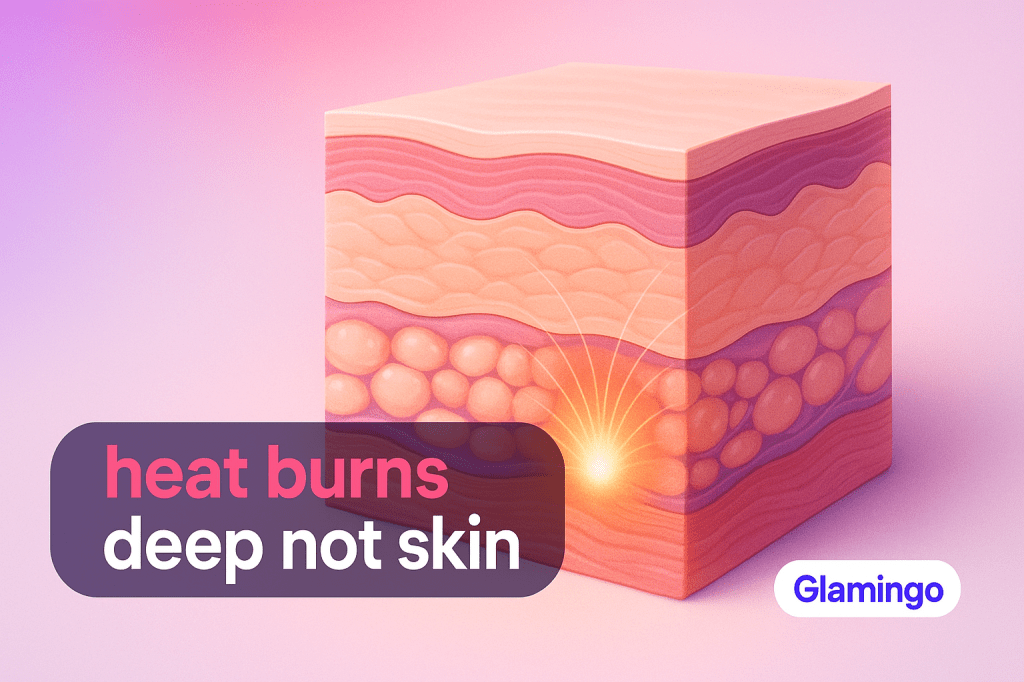
HIFU stands for High-Intensity Focused Ultrasound. The “ultrasound” part is familiar — it’s the same basic technology used in medical imaging. The “focused” and “high-intensity” parts are what make it a treatment rather than a diagnostic tool. When the ultrasound beam is concentrated tightly enough, the mechanical energy of the sound wave converts to thermal energy at the point of focus — generating enough heat to cause what researchers describe as irreversible thermal coagulation of targeted cells, a mechanism that is distinct from radiofrequency, which heats tissue more diffusely. In plain terms: the tissue at the focal point is heated precisely enough to destroy it, while everything between the surface and that point is left untouched.
The temperatures involved are not subtle. The targeted zone is raised to between 56–70°C — hot enough to cause permanent cell death in fat cells without burning the skin above. That temperature range is what determines whether the treatment is doing anything meaningful. Too low and the cells survive. Too high and you risk damaging surrounding tissue. The device is calibrated to hit that window.
Why ‘focused’ is the operative word: how thermal energy is confined to one precise depth
Think of body HIFU like using a magnifying glass to focus sunlight onto a single point on a piece of paper — the glass itself stays cool, the surface between the glass and the paper stays cool, but at the exact focal point the energy concentrates and burns. Body HIFU works the same way: the ultrasound beam passes harmlessly through the skin surface and the tissue above the target, then converges at a preset depth where the energy converts to heat and destroys fat cells — without touching anything between the skin and that point.
This is not just a clever metaphor. It’s the actual reason the technology is categorised as non-invasive. The surface of your skin doesn’t need to be broken, heated, or disrupted. All the thermal activity happens at a specific depth underground, so to to speak. The depth is determined by the transducer head being used, with different cartridge configurations focusing energy at specific tissue depths — which is why the operator’s choice of cartridge matters enormously. More on that later.
Body HIFU vs facial HIFU — why they are not the same treatment
The depth difference: subcutaneous fat vs skin tightening planes
Facial HIFU targets relatively shallow depths — typically the layer just beneath the dermis and the fibromuscular network that holds facial structures in place (the superficial musculoaponeurotic system, or SMAS). The goal is collagen stimulation and structural lifting, not fat destruction. The fat deposits on your face, where they exist, are thin. The energy levels required are correspondingly lower.
Body applications are a different category entirely. Subcutaneous fat on the abdomen, flanks, and thighs sits significantly deeper — and breaking it down requires higher energy levels and deeper focal points than any facial protocol. Devices like the Scizer are designed specifically for body areas where fat reduction is the primary goal, targeting thicker subcutaneous fat deposits on the abdomen and flanks. Using a facial HIFU device on your stomach is not just ineffective — it’s the wrong tool entirely. If a clinic is treating your abdomen with the same handpiece they use for facial lifting, that’s worth questioning.
Which body areas are typically treated and why
Body HIFU is most commonly applied to the abdomen, flanks (the sides of the waist), inner and outer thighs, upper arms, and the bra-line area. These are areas where subcutaneous fat sits in a consistent, accessible layer — deep enough to be targeted by the ultrasound beam, but not so deep that the energy dissipates before reaching it. Areas with very thin fat deposits are less suitable, and areas over bony structures or major nerves require care in protocol design. The practitioner should be assessing your specific tissue composition, not applying a one-size approach across all body zones.
The two things body HIFU is actually doing (and how they differ)
Fat cell destruction: what happens to the cells and where they go
When the focal heat reaches fat cells (adipocytes), it causes them to undergo a process called apoptosis — essentially programmed cell death triggered by the thermal injury. The cells don’t vaporise or disappear on the spot. What happens is more gradual: the cell walls are compromised by the heat, the cells break down over time, and the resulting cellular debris is cleared by the body’s lymphatic system. This is the part most people aren’t told, and it’s why you don’t see results the day after your session. The fat doesn’t go anywhere immediately — it has to be processed and eliminated through normal metabolic pathways. Clinical evidence confirms this clearance process takes weeks to months, with visible fat reduction typically appearing at the 8–12 week mark post-treatment.
Collagen stimulation: why the skin-tightening effect takes longer to appear
The second mechanism operates at a shallower tissue depth. When lower-intensity focused energy is delivered to the dermis and the layer just beneath it, it creates a controlled thermal injury that triggers the skin’s repair response — specifically, the production of new collagen and elastin fibres. This is the same principle behind many professional skin-tightening treatments. The skin responds to the perceived damage by rebuilding its structural scaffolding. This dual-mechanism approach means body HIFU can theoretically address both subcutaneous fat and skin laxity in a single session, with the fat reduction and skin-firming effects operating at different depths simultaneously. The skin-tightening response takes even longer than the fat clearance to become visible — collagen remodelling is a slow biological process, and improvements in skin quality can continue developing for up to six months after treatment. These dual-mechanism claims are plausible from a mechanistic standpoint, though robust comparative human trial evidence remains limited.
What the timeline actually looks like
Why results are slow — the lymphatic clearance explanation
Your lymphatic system is essentially your body’s waste clearance network — it processes and removes cellular debris, excess fluid, and metabolic byproducts. After a HIFU session, the thermally damaged fat cells need to be broken down and transported through this system before they leave your body. This is not a fast process. It’s the same reason staying well-hydrated after treatment is frequently recommended — the lymphatic system’s efficiency affects how quickly the debris from treated cells is cleared, and that clearance directly determines when you’ll start to see a visible reduction.
What to expect in weeks 1, 4, and 12 post-treatment
In the first week, most people notice soreness in the treated area — a deep, bruised feeling rather than surface pain. Some swelling and temporary numbness are also common. This is not a sign something went wrong. It’s evidence the tissue actually responded to the energy. By week four, the soreness is gone and you may start to notice subtle changes in the contour of the treated area — though many people notice nothing at this stage and worry the treatment didn’t work. Week twelve is typically the point at which meaningful fat reduction becomes visible. Collagen improvements to skin texture and firmness continue developing beyond this — up to the six-month mark in many cases. Results at week two are not a fair measure of this treatment. Judging HIFU at the six-week mark is like leaving bread in the oven for twelve minutes and declaring it doesn’t work.
Side effects, safety, and what the clinical record shows
Documented adverse events (and absence of serious ones)
A review of HIFU for body sculpting found no serious adverse events reported across clinical applications, supporting its classification as a non-invasive procedure with an acceptable safety profile. That is genuinely reassuring — and meaningfully different from the safety record of surgical body contouring options. The absence of serious adverse events in the reviewed literature is consistent, and it’s one area where the clinical evidence is reasonably straightforward. The peer-reviewed evidence base for body-specific HIFU is thinner than for facial lifting, and most trials are smaller and shorter-term than ideal, but the safety signal is consistent.
The difference between expected soreness and a red flag
Expected aftereffects include tenderness in the treated area (sometimes described as the sensation of a muscle worked hard at the gym), mild swelling, and occasional temporary numbness or tingling. These typically resolve within a few days to two weeks. What warrants follow-up with your practitioner: burns or blistering on the skin surface, persistent numbness beyond three weeks, or pain that is worsening rather than gradually improving. The first category is your tissue responding normally. The second category suggests something went wrong with energy delivery — usually an operator error rather than a device failure.
What body HIFU cannot do — honest limits of the technology
It is not a substitute for fat loss — who gets meaningful results and who doesn’t
Body HIFU targets a specific, defined layer of subcutaneous fat. It has no effect on visceral fat — the fat stored deeper in the abdominal cavity around your organs, which is what contributes most to overall health risk and a large portion of abdominal volume. If the majority of your abdominal volume is visceral rather than subcutaneous, the treatment will produce limited visible change regardless of how many sessions you have. HIFU works best on people who are broadly within a healthy weight range but have localised subcutaneous fat deposits that have proven resistant to change. It is a refinement tool, not a transformation tool — and any clinic that frames it otherwise is overpromising.
Why operator skill and cartridge selection matter as much as the device brand
The device brand is not the most important variable in your results. The practitioner operating it is. The depth of energy delivery is entirely determined by the transducer cartridge selected — different cartridges focus at different tissue depths, and choosing the wrong one means the energy is delivered to the wrong layer entirely. A practitioner targeting your fat layer with a cartridge calibrated for facial skin tightening depths is not treating your fat at all. This is not a theoretical risk. It’s a real one in a market where devices are sold widely and operator training varies significantly. The premium clinic with the well-known device brand is not automatically safer than a mid-range clinic with a thorough, experienced practitioner.
Questions to ask before you book
Ask what device and cartridge depths they plan to use — and why those depths are appropriate for your specific concern. A practitioner who can answer this clearly, and who tailors the protocol to your tissue composition rather than applying the same settings to every client, is demonstrating the kind of clinical judgement worth paying for. Ask what results are realistic for your body type, and in what timeframe. Ask what the expected aftereffects are and how they distinguish normal recovery from a response that would require follow-up. Ask whether they would recommend one session or a course — and why. If the answer to that last question comes without any assessment of your specific tissue and goals, treat it as a yellow flag. A good practitioner should be able to tell you who this treatment genuinely suits and who it doesn’t — including the possibility that it’s not the right option for you.
Before you book a body HIFU session, ask the clinic one specific question: which cartridge depth they plan to use, and why that depth is appropriate for your target area. A practitioner who can explain the tissue depth being targeted — fat layer versus skin tightening plane — and match it to your concern is demonstrating the clinical judgement that separates a considered treatment from a default protocol applied to every client.
If you’re ready to compare clinics offering body HIFU in Singapore, Glamingo lets you browse verified providers with real client reviews — so you can find a practitioner who will actually answer your questions, not just show you a before-and-after grid. Search body HIFU treatments near you →
 Glamingo Blog
Drop in your comments..