
First, what is fascia — and why does it keep showing up in beauty content
You’ve seen the before-and-after facial massage videos. You’ve maybe tried gua sha, cupping, or a fascial manipulation session and noticed something shift — puffiness down, jawline more defined, eyes slightly less hooded. But then someone posts that the same techniques destroyed their skin. Both experiences are real. The question is what fascia actually is, what it does to your face and body as you age, and which part of the wellness industry’s fascia story holds up when you look at the evidence.
Here is the thing about fascia: it has been inside your body your entire life doing something genuinely important, and it took the beauty industry approximately five minutes to turn it into a sales mechanism. That does not mean the underlying biology is fake. It means the claims have run ahead of the science — which, for a reader who has already been burned by overhyped serums and underdelivering treatments, should sound very familiar.
The continuous body-suit analogy: why fascia is not a muscle and cannot be ‘stretched’ the way Instagram suggests
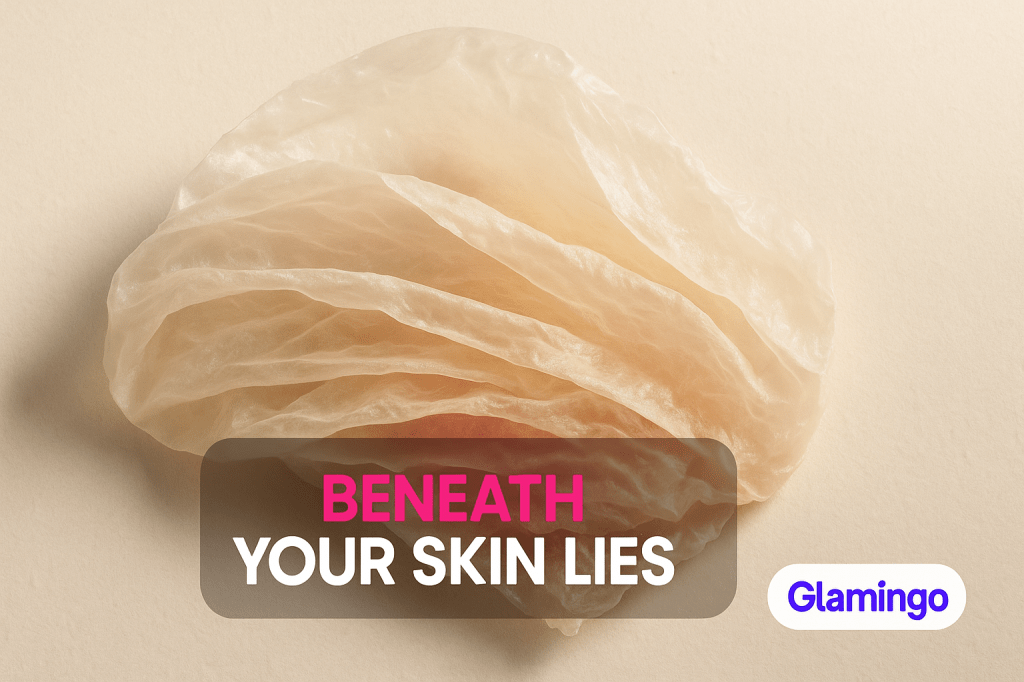
Think of fascia — the continuous web of connective tissue that surrounds and connects every muscle, bone, nerve, and organ in your body — as the cling wrap inside your body. It wraps around every structure, connects everything to everything else, and when it is well-hydrated and mobile it slides smoothly. When it dries out, gets compressed, or is left in the same position for too long, it starts to stick to itself, like sheets of cling wrap that have been left crumpled in a drawer.
This is the mechanism that matters. Stretching and movement are not primarily about lengthening a muscle. They are about keeping the wrap from fusing. And this is also where the Instagram version of fascia falls apart: because fascia is not a discrete structure you can isolate and target with a specific tool, it is a system. You cannot release one section of cling wrap by poking it in one spot. The whole sheet is connected. The mechanistic understanding of fascia as a continuous interconnected web is reasonably well established, but what brands rarely tell you is that the ability to meaningfully alter it through a five-minute tool-based ritual is a different question entirely — and a much less settled one.
Where facial fascia sits and why it is relevant to skin texture, puffiness, and contour
Your face has its own fascial layers. The superficial musculoaponeurotic system (SMAS) — the sheet of tissue that connects your facial muscles to your skin — is what plastic surgeons tighten during a facelift. Below your skin, above your muscles, fascia is helping hold your facial architecture in place. As this tissue loses hydration and elasticity over time, you get what people describe as a loss of definition: features that feel less supported, contours that look less crisp. In Singapore’s climate — high humidity, high UV — the skin itself is under constant oxidative pressure, which compounds the underlying tissue story.
Puffiness is a separate but related issue. Fluid retention in facial tissue, which is partly regulated by the lymphatic system running through and alongside fascial structures, can make features look less defined. This is the biological rationale behind drainage-focused facial massage — and it is actually the most plausible mechanism for why some of these techniques visibly work, at least in the short term.
What the science actually says — and where the gaps are
The rehabilitation literature’s honest admission: evidence is lacking even in sports medicine
If you want to know how well-evidenced fascial work really is, start not with beauty brands but with sports medicine — the field that has been using manual therapy and fascial intervention on athletes for decades. What you find there is bracing. Published rehabilitation literature explicitly acknowledges that research evidence is lacking regarding the full role of manual therapy and fascial intervention, even in clinical settings where practitioners have been applying these techniques for years. If sports medicine — with its rigorous outcome-tracking and financial incentive to justify what it does to elite athletes — is still working with significant evidence gaps, the beauty industry’s confident claims should be read with considerable scepticism.
That is not the same as saying fascial work does nothing. It is saying that what it does, and how, and under what conditions — these questions are still being worked out by people with much better tools than a gua sha stone and a ring light.
What self-myofascial release (foam rolling, gua sha, massage) demonstrably does — blood flow and short-term mobility — versus long-term structural claims
Self-myofascial release — the category of technique that covers foam rolling, facial massage, gua sha, and similar practices — has some evidence behind it, but it is specific evidence. Practitioner literature describes these techniques as increasing local blood flow and providing a gentle stretch to fascia, contributing to a subjective sense of openness and reduced tension. The blood flow effect is real and meaningful. Increased circulation means more oxygen and nutrients delivered to tissue, and more metabolic waste cleared away. For your face, that translates to the flush and glow you notice immediately after a good facial massage. It is genuine. It is also temporary.
What these techniques have not demonstrated in rigorous human trials — at least not at the level of evidence that would satisfy a clinical review — is long-term structural facial remodelling. The idea that you can systematically reorganise your facial connective tissue through daily gua sha in a way that produces lasting anatomical change is, right now, a marketing claim, not a proven outcome. The mechanism is plausible on paper. The clinical evidence for the specific aesthetic outcome is not there yet. These are two different things, and the distinction is worth holding onto.
The fascia-lymph connection: the most biologically plausible mechanism for facial massage benefits
The mechanism that actually has the most going for it is the lymphatic one. Practitioners describe the lymphatic system and fascia as deeply intertwined, with restrictions in connective tissue mechanically able to impede lymphatic flow — which is why gentle drainage-focused massage may reduce facial puffiness. Your lymphatic system has no pump of its own. It relies on movement, muscle contractions, and pressure differentials to move fluid. Manual techniques that create those pressure changes can, plausibly, help shift retained fluid that contributes to puffiness and reduced definition.
This is limited evidence — practitioner-cited mechanism rather than peer-reviewed trial outcome — but it is the most biologically coherent explanation for why facial massage appears to produce genuine short-term visible results for some people. If you are going to invest in any part of the fascia-beauty story, this is the part that has the most structural logic beneath it.
The stress and sleep dimension: how systemic factors affect your connective tissue
Chronic stress, inflammation, and tissue hydration — the pathway that links how you feel to how your face looks
Fascia is not separate from your stress response. Chronic stress elevates cortisol and systemic inflammation, and both affect tissue quality at the cellular level. Inflamed, dehydrated tissue loses its glide. The cling wrap metaphor holds here too: fascia that is chronically bathed in inflammatory signalling molecules does not maintain its hydration or mobility the way well-regulated tissue does. For the reader juggling a demanding job, disrupted sleep, and the low-grade physiological stress that comes with hormonal shifts in your late thirties or forties — the fascial consequences are real, even if they are not the ones the wellness industry usually describes.
This is the body-systems connection that tends to get lost in facial massage content: your face is downstream of your biology. What you are seeing in the mirror is often a reflection of what is happening systemically, not something that can be corrected by a tool working on the surface.
Why immobility and poor sleep may contribute to fascial cross-linking — and what movement does to counteract it
There is a concept in anatomy education sometimes called the fascial fuzz phenomenon — the idea that connective tissue lays down fibrous cross-links during periods of rest or immobility, which is why sustained stretching and movement matter for tissue quality and mobility. This is mechanistic and anatomy-based — robust clinical trial evidence in humans is still limited — but the underlying logic is observed in wound healing, post-surgical recovery, and the well-documented stiffness that follows prolonged immobility. Poor sleep does not just leave you puffy. If it is part of a pattern of reduced movement and high inflammation, it may contribute to the gradual process by which fascial tissue becomes less mobile and more adherent.
Movement is the counterforce. Not as a wellness platitude — as a mechanical reality. The body’s connective and neural systems are complex and difficult to distinguish from the surface; what feels like tight fascia is sometimes nerve tension, sometimes muscle restriction, sometimes both. But consistent, varied movement — the kind that takes your body through a full range of positions — is the best-supported intervention for fascial health across the literature.
The wellness industry’s fascia problem: confident claims, thin evidence
What brands and practitioners are selling versus what the research can actually support
The fascia category in wellness and beauty has expanded rapidly because it offers something commercially valuable: a mechanism that sounds scientific, involves a physical structure real anatomists acknowledge, and connects to visible outcomes that clients report in real time. The problem is the gap between mechanistic plausibility and demonstrated clinical outcome — and the industry consistently presents the former as if it were the latter.
When a brand tells you their tool will “release facial fascia” and “restore youthful contour,” they are taking a biologically real structure and attaching outcome claims that the evidence has not actually established. The rehabilitation literature — working with musculoskeletal fascial conditions in clinical settings — cannot fully justify these claims for the body. Applying them to the face, with far less tissue mass and far more delicate skin, requires an additional leap that no peer-reviewed trial has yet supported. The brand-funded enthusiasm is understandable. Independent science has not caught up.
The real risk: when facial fascial massage goes wrong — pressure, direction, and skin type considerations
The risk is not theoretical. There is a documented pattern — and if you have spent time in skincare communities online, you have encountered it — of people experiencing capillary damage, worsened skin laxity, and increased texture after aggressive facial massage or fascial manipulation. The same category of technique that one person credits with lifting their hooded eyes has left another person with broken capillaries and skin that now holds less tension than before.
Both outcomes are real, and the variable between them is almost always technique, pressure, and individual skin characteristics. Skin that is already thin, compromised in barrier function, or prone to sensitivity responds very differently to mechanical force than skin that is robust and resilient. In Asian skin types — Fitzpatrick III to V, which describes most of Singapore’s population — the risk of post-inflammatory response and capillary vulnerability varies significantly between individuals. Pressure matters. Direction of movement matters. The idea that more is more, applied to facial tissue, is not supported by the evidence and is contradicted by the documented harms.
What is actually worth doing — a grounded, evidence-proportionate view
Movement and whole-body stretching: the strongest supported intervention
The most evidence-supported thing you can do for your fascial system — including the fascia that affects your face — is move your whole body consistently and through varied ranges of motion. This is not a consolation prize for people who cannot afford a professional treatment. It is the most powerful lever available, and it works through mechanisms the research actually supports: preventing fibrous cross-linking, maintaining tissue hydration, supporting lymphatic circulation, and reducing the systemic inflammation that degrades connective tissue quality over time. Yoga, Pilates, swimming, a regular morning stretch — not because any of them will give you cheekbones, but because they address the underlying tissue environment in a way that no surface tool can replicate.
Facial massage done correctly: what ‘correctly’ means and who should be cautious
Gentle facial massage — done with light pressure, in the direction of lymphatic drainage (typically outward and downward toward the neck, not vigorously inward), with a suitable medium to reduce friction — can genuinely deliver the blood flow and short-term drainage effects the evidence supports. “Correctly” means light enough that you are guiding tissue rather than compressing it. It means slow enough to allow fluid to follow the pressure gradient. And it means brief enough that you are not repeatedly stressing the same area.
If you have thin skin, visible capillaries, active skin conditions, or are on medications that affect tissue fragility — retinoids included — proceed with more caution than the average tutorial will suggest. The tutorial is not tailored to your skin. You are.
The honest verdict on professional fascial treatments in Singapore
Professional fascial treatments — whether buccal massage, lymphatic facial drainage, or the increasingly available myofascial facial sessions offered by aesthetic clinics and wellness studios in Singapore — sit in the same evidence zone as the home tools: plausible mechanism, genuine short-term visible effects, limited long-term clinical evidence. What a skilled professional adds is training in appropriate pressure and technique, which reduces the risk of the harms documented with aggressive self-application. If you are curious about these treatments, they are likely worth a single session to assess your own response — but approach any provider claiming dramatic structural or anti-ageing outcomes with the same scepticism you would bring to an overhyped ingredient. Ask what they expect you to notice, and over what timeframe. Vague answers tell you something.
The bottom line: what fascia can and cannot do for your skin
Fascia is real. The connection between connective tissue health, lymphatic flow, and how your face looks is biologically plausible. The short-term effects of gentle massage on puffiness and blood flow have enough mechanistic support to justify a low-pressure, low-frequency practice if you enjoy it. What the evidence does not support is the confident claim that you can structurally remodel facial fascia through daily tool use, reverse the effects of ageing on connective tissue from the outside in, or achieve lasting anatomical change through techniques that the clinical literature in sports medicine — working with far more tissue and far more research — still cannot fully justify.
The wellness industry found a real structure, wrapped compelling language around it, and outran the science by several years. That is a familiar story. The honest version of the fascia narrative is smaller and more useful: systemic health — movement, sleep, managed stress — shapes your connective tissue over time. Gentle, technique-conscious facial massage offers real but temporary benefits through circulation and drainage. And anything promising more than that is, right now, selling you a mechanism, not a proven outcome.
Before adding any new facial massage or fascial tool to your routine, check the pressure you are using: if you are pressing hard enough to feel resistance or pain, you are likely working against the tissue rather than with it. This week, try any facial massage technique you already do at half the pressure for half the time, and observe whether the short-term result — reduced puffiness, defined jawline — is the same or better. Because the evidence for lymphatic and blood flow effects does not require aggressive force, and the documented risk of skin damage does.
If you want to explore professional lymphatic facial massage or myofascial treatments with practitioners who can adjust technique to your specific skin type, Glamingo has verified wellness and facial treatment providers across Singapore with real client reviews to help you find someone worth trusting. Browse facial treatment providers near you →
 Glamingo Blog
Drop in your comments..