
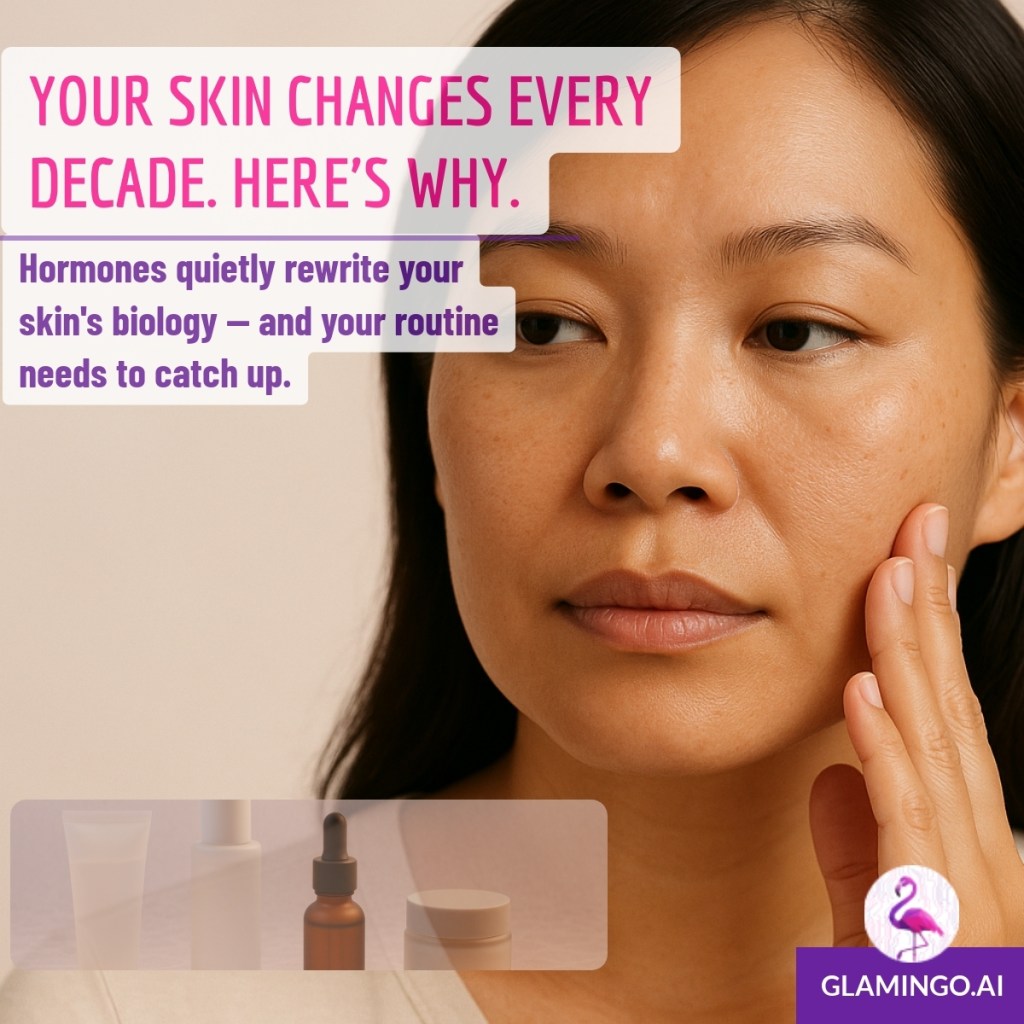
You have been using essentially the same routine since your mid-twenties, but your skin keeps changing anyway. That is not a product problem. Your hormones have been quietly rewriting the biological rules your skin operates under — and what worked at 27 is working against a different set of conditions at 37 or 45. Understanding the mechanism is what makes the difference between chasing symptoms and actually adapting.
The frustrating part is that the changes are gradual enough to miss until they are not. You add a new serum, your skin feels fine, you carry on. Then somewhere in your mid-thirties you notice that the breakout on your chin showed up at the same time as a line you cannot quite explain, and no amount of product-switching seems to resolve either. That is not a coincidence. That is your hormonal profile doing something new — and your routine, which was designed for a different biological moment, simply has not caught up.
The question this article is actually answering: why does skin change on a schedule?
Intrinsic ageing vs. extrinsic ageing — two separate clocks running at once
Skin ageing is driven by a combination of endogenous or intrinsic factors — genetics, cellular metabolism, hormones, and metabolic processes — and exogenous or extrinsic factors including UV exposure, pollution, and lifestyle. These are not the same clock. Intrinsic ageing runs on a biological schedule largely set by your hormones, your genetics, and how efficiently your cells repair themselves. Extrinsic ageing runs on an environmental schedule — cumulative UV exposure in Singapore’s UV Index 10–12 conditions, oxidative damage from pollution, dietary patterns. Both matter. But they interact differently at each decade of your life, which is why the intervention that was relevant at 28 may not be the most relevant at 42.
The practical implication: skin ageing involves both intrinsic mechanisms — including the gradual shortening of protective chromosome caps (telomere shortening), oxidative stress, hormonal decline, and impaired cellular repair — and extrinsic mechanisms including UV-driven damage, and these two systems compound each other over time. Understanding which track is currently dominant for your skin changes which interventions are actually worth your attention and your money.
Where hormones fit into that system
Hormones are not peripheral to skin ageing — they are central to it. At the molecular level, hormonal decline drives the breakdown of collagen and elastin, activates enzymes that degrade the collagen and elastin scaffold under your skin (the technical term for these is matrix metalloproteinases, or MMPs), and contributes to accumulated oxidative damage. These are measurable, structural changes — not marketing language. The reason your skin behaves differently in your late 30s compared to your late 20s is not that you are “ageing” in some vague, inevitable way. It is that specific biological systems are changing in sequence, and that sequence has a mechanism you can actually work with.
Your skin in your late 20s — the shift you probably haven’t noticed yet
What is biologically changing: early collagen slowdown, oxidative stress accumulating, cell turnover beginning to lengthen
Think of your skin’s structural foundation like a mattress. In your 20s it is still fairly new — the springs (collagen fibres) are dense and responsive. The mattress does most of the work itself. You can be inconsistent, skip SPF occasionally, sleep badly for a week, and your skin recovers. That recovery capacity is not discipline or good genetics alone — it is biology running in your favour.
But the shift begins earlier than most routines account for. Collagen production starts to slow in the mid-to-late twenties. The rate at which your skin cells complete their natural shedding cycle (desquamation) — which most of us unknowingly disrupt with over-exfoliation — begins to lengthen. Oxidative stress from free radicals that damage skin cells accumulates silently, particularly in Southeast Asian climates where year-round UV exposure adds up in a way that northern-hemisphere-designed skincare timelines don’t fully reflect. These structural and physiological changes are well-characterised at a biological level, even if they are not yet visible in the mirror at 27.
What this means for your routine: this is a prevention decade, not a correction decade
The late 20s are genuinely the best decade to establish the habits that slow extrinsic ageing — not because things are falling apart, but because the biological systems that will later need active support are still largely intact. Broad-spectrum sun protection is the single most evidence-supported intervention here. Antioxidant serums that neutralise free radical damage before it accumulates make mechanical sense. A gentle retinoid introduced early, before structural loss has begun, works with a system that is still responsive. The mistake most routines make in this decade is product volume over targeted mechanism. More steps is not better biology.
Your skin in your 30s — when hormonal fluctuation becomes visible
The mechanism: oestrogen fluctuation, MMP activation, and the beginning of structural collagen loss
The 30s are where the intrinsic clock becomes harder to ignore. Oestrogen levels, which had previously been relatively stable, begin to fluctuate — not the dramatic decline of perimenopause, but enough to make a structural difference. Hormonal changes activate the MMPs — those collagen-degrading enzymes — meaning the scaffold under your skin is now being broken down at a rate that begins to outpace repair. The mattress springs are not disappearing dramatically, but they are becoming less dense. And the remaining ones are starting to show their age.
Oestrogen also plays a role in regulating moisture retention and skin barrier integrity. When it fluctuates, the skin barrier — the outer layer of fatty molecules and skin cells that keeps moisture in and irritants out — becomes less predictable. You may notice that products your skin previously tolerated without issue suddenly cause redness. That is a barrier sensitivity signal, not a product quality problem.
Why hormonal acne and early fine lines can appear simultaneously — and what that tells you
Here is the biological contradiction that catches a lot of women off guard: breakouts along the jawline and chin showing up at the same time as the first visible fine lines around the eyes or mouth. If you have experienced this, you are not imagining a strange combination — you are experiencing exactly what the hormonal fluctuation of the early 30s looks like. The jaw-and-chin breakout pattern reflects androgen sensitivity driven by hormonal shifts, not the teenage-style congestion that comes from excess sebum production across the whole face. Meanwhile, those same hormonal fluctuations are contributing to the early collagen and elastin changes that show up as fine lines. Your skin is not behaving like it did at 22, and it is also not doing what you imagined “ageing skin” would look like. It is doing something more complicated than either.
What your routine needs to do differently: address both barrier support and early structural change
The 30s require a routine that holds two things at once. On one side: barrier support, because hormonal fluctuation compromises it. This means fatty molecules that act like mortar between skin cells (ceramides), gentle formulations, and resisting the urge to treat adult acne the same way you treated teenage acne — which typically means using actives that are far too stripping for a barrier that is already under hormonal stress. On the other side: early structural support, because the collagen loss is real and measurable. Retinoids — vitamin A derivatives that speed up skin cell turnover — have strong clinical evidence showing both structural and visible improvement in skin ageing, and this is the decade where introducing one with consistency starts to matter in ways that are later measurable rather than just theoretical.
Your skin in your 40s — when glycation and declining oestrogen compound each other
What glycation actually is and why it accelerates now
Glycation is one of those mechanisms that most skincare marketing either oversimplifies or ignores entirely. Here is what it actually is: when excess sugar molecules bond permanently to collagen fibres, they make those fibres stiff and cross-linked — the technical term for these damaged proteins is advanced glycation end-products (AGEs). Glycation is a documented mechanism by which skin ages, operating alongside free radical damage and cellular deterioration. It accumulates progressively across decades and accelerates in the late 30s and 40s. Critically, it is independent of UV exposure — meaning your SPF habit, excellent as it is, does not address this particular pathway. The dullness and stiffness you may be noticing in your 40s that doesn’t respond to hydration is often partly this. Not dehydration. Not a weaker moisturiser. A different mechanism entirely.
Perimenopause and oestrogen decline: what this does to skin thickness, moisture retention, and wound healing
The 40s, particularly the mid-to-late 40s, often overlap with perimenopause — the transition period before menopause, which in Singapore and Southeast Asia typically begins between 45 and 55. Oestrogen decline during this phase has direct, documented effects on the skin. Skin thickness decreases as collagen production continues to slow. Moisture retention becomes less efficient because oestrogen plays a role in regulating hyaluronic acid production — the water-binding molecule that keeps skin plump. And wound healing, including the skin’s ability to recover from any kind of treatment or minor irritation, takes longer. The mattress analogy is useful here: by the 40s, the springs are meaningfully fewer, the remaining ones have stiffened from both glycation and structural collagen loss, and the maintenance required is now genuinely different from what it was at 30. Not more aggressive — more targeted.
Why a single-active approach stops being sufficient — and what multi-mechanism support looks like
Skin ageing is a multifactorial process — hormonal decline, oxidative stress from free radicals, and impaired cellular repair all converge, which is precisely why a single active ingredient approach becomes less adequate as the decades advance. A retinoid addresses cell turnover and collagen stimulation. It does not address glycation. An antioxidant addresses oxidative stress. It does not rebuild structural collagen. A ceramide-rich moisturiser supports the barrier. It does not slow MMP activation. By the 40s, the question is not “which one active should I add?” but rather “which biological mechanisms are currently most active in my skin, and am I addressing more than one of them?” The multi-hallmark framework — looking at skin ageing as several converging biological processes rather than a single cause — is where serious skin science has been moving, and it is a more useful lens than “anti-ageing ingredient of the year.”
Your skin in your late 40s and 50s — the post-menopause shift
What the biological evidence shows about skin in the post-oestrogen environment
Post-menopause represents a distinct biological environment for skin. Oestrogen levels have now stabilised at a significantly lower baseline, rather than fluctuating. The hormonal instability of perimenopause — which drove some of the unpredictability and sensitivity of the 40s — often resolves. What remains is a skin that is operating with fundamentally different levels of hormonal support: lower collagen density, reduced moisture retention capacity, thinner skin overall, and a slower cellular repair cycle. The good news, if there is a practical reframe available: the biology is now more consistent, which means interventions can be more targeted and predictable in their outcomes than during the perimenopause fluctuation years.
Where retinoids fit — and what the evidence grade for other interventions actually is
Retinoids remain the most clinically supported topical intervention for hormonally and photo-driven skin ageing, with multiple clinical studies demonstrating both structural and visible improvement. That evidence base holds across decades, though the formulation and concentration that makes sense at 50 may differ from what was appropriate at 35. Beyond retinoids, the picture is more complicated. Longevity cosmeceuticals — compounds targeting the underlying molecular hallmarks of skin ageing rather than surface symptoms — are an emerging category, with research reviewing geroprotective compounds showing potential, though the evidence grades for most novel actives remain limited to moderate. Worth watching as the science develops. Not worth significant financial investment yet if your decision-making is based on independent evidence rather than brand-funded studies.
The honest summary: what changes each decade and the one principle that runs through all of it
What the science supports vs. what is still marketing
Here is what the evidence actually supports across every decade: broad-spectrum UV protection is the single most documented intervention for slowing extrinsic ageing, full stop. Retinoids have strong, independent clinical evidence for structural improvement and are underused by most women who would benefit from them. Barrier support — ceramides, gentle formulations, not over-stripping — matters more as hormonal fluctuation makes the barrier less stable. Everything else exists on a spectrum from “mechanistically plausible with moderate evidence” to “compelling brand story with very limited independent research.” The difference matters when you are deciding whether to spend on a longevity serum or allocate that budget to a professional treatment with a stronger evidence base.
How to apply this mechanism insight to decisions you are already making
The principle that runs through every decade is this: your routine needs to address the mechanism that is currently dominant in your skin, not the mechanism that was dominant five years ago. In the late 20s, that is oxidative stress accumulation and early prevention. In the 30s, it is barrier instability from hormonal fluctuation alongside early structural support. In the 40s, it is multiple converging mechanisms — glycation, MMP activity, declining oestrogen — that a single active cannot address alone. In the 50s, it is working with a post-oestrogen baseline that is stable but requires consistent, multi-mechanism support rather than reactive product-chasing. The structural and physiological changes across decades are well-characterised at a biological level — meaning you do not have to guess. You just have to look at the mechanism, not the marketing.
This week, identify which decade-driven mechanism is most relevant to where you are right now — not based on your age in isolation, but based on what your skin is actually doing. If you are seeing simultaneous breakouts and loss of firmness, that is a hormonal fluctuation signal, not a basic routine gap. If you are seeing dullness and stiffness rather than dehydration, glycation and collagen cross-linking may be the more relevant target than adding another humectant layer. Use the mechanism framework from this article to audit one product in your current routine and ask: is this ingredient addressing the biology of my skin right now, or is it addressing the biology of skin I had five years ago?
If this article has you thinking about getting a professional skin assessment rather than navigating the mechanism questions alone, Glamingo has verified facial and skin consultation providers near you — including options that address hormonal skin concerns, barrier repair, and collagen support at a clinical level. Find a skin specialist near you →
 Glamingo Blog
Drop in your comments..