
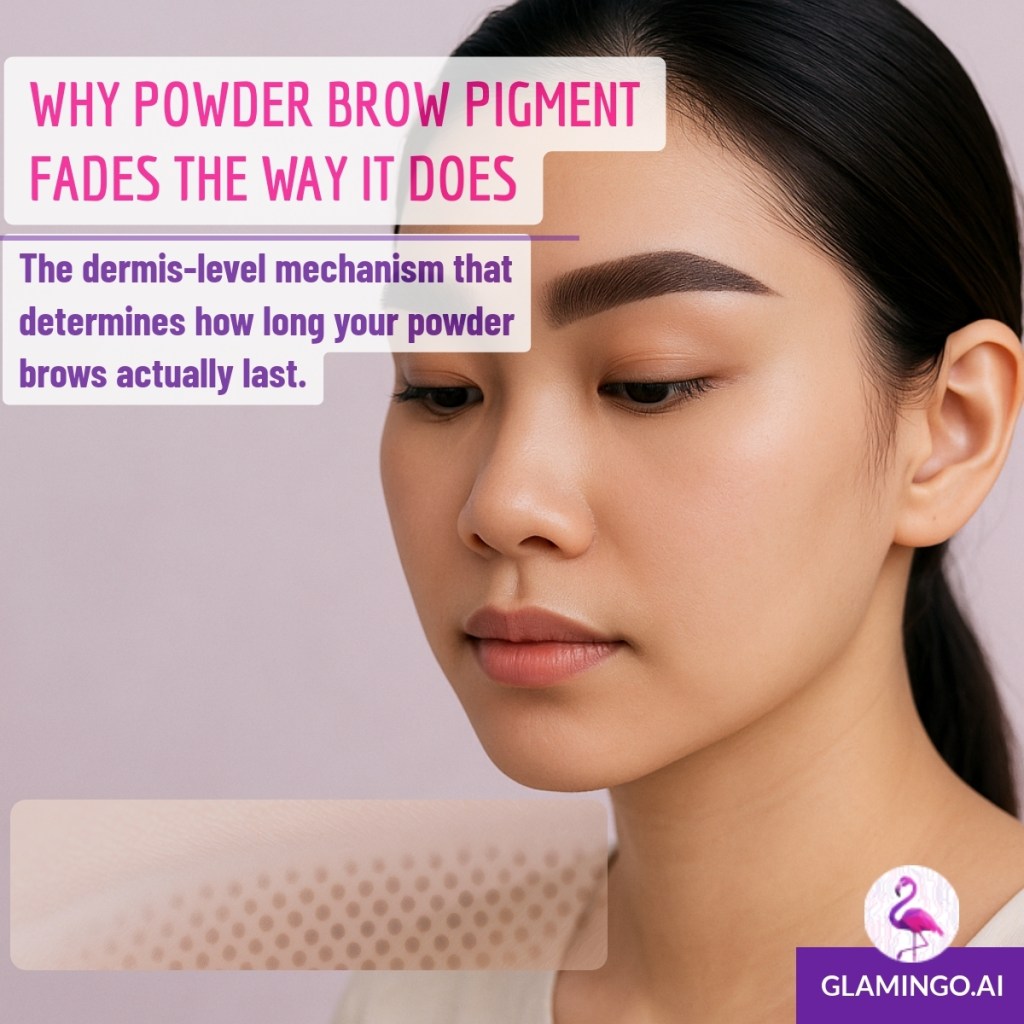
You’ve watched the before-and-afters, read the salon descriptions, and seen “semi-permanent” thrown around like it explains everything. But what’s actually happening when a technician deposits pigment into your brow area — and why does the result look completely different from microblading, even though both are described as “semi-permanent makeup”? The mechanism is the part no one explains, and it’s the part that tells you whether the result will suit your skin, how long it will actually last, and what happens when it starts to fade.
If you’ve ever sat in a consultation chair nodding along while a technician talks about “superficial pigment implantation” without really explaining what that means, you’re not alone. Most powder brow content stops at the aesthetic — the soft, airbrushed finish, the no-makeup makeup effect. What it skips is the biology. And understanding the biology is exactly what helps you set realistic expectations, choose the right technique for your skin, and avoid the very common spiral of post-procedure panic that hits around day one, when your new brows look nothing like what you signed up for.
What powder brows actually are — and what they are not
Powder brows are positioned as “a more natural-looking alternative to microblading that semipermanently enhances the shape and color of your eyebrows” — which is technically accurate but tells you almost nothing useful. Here’s what the description leaves out: powder brows are a form of superficial micropigmentation, meaning pigment is deliberately deposited just beneath the skin’s surface using a device — either a manual tool or a machine — in a way that the body will eventually break down and remove. They are not a tattoo in the traditional sense. They are not permanent. And they are not the same as drawing on your brows with a product, even though the finished result can look remarkably similar to a well-applied brow powder.
Semi-permanent makeup vs. tattooing: why the depth distinction matters
The difference between a tattoo you’d get at a studio and a powder brow procedure comes down almost entirely to depth. Traditional tattoo ink is deposited deep into the dermis, where it remains essentially permanent because the body’s immune response cannot fully remove it from that depth. Powder brow pigment, by contrast, is placed much closer to the surface — in the uppermost layer of the true skin, called the papillary dermis. This placement is intentional. It’s what makes the treatment semi-permanent rather than permanent, and it’s also what produces the softer, more diffused colour appearance at the surface.
This is also why the word “semi-permanent” deserves a raised eyebrow (pun intended). It’s not a marketing hedge. It’s a direct consequence of where the pigment actually lives in your skin. Depth equals longevity. Shallower depth equals a result your body can gradually process and remove — which is the whole point.
How the stippling technique creates the powder finish
The visual result of powder brows — that soft, filled-in, almost airbrushed look — is a direct product of technique, not just pigment colour. A machine deposits thousands of tiny pigment dots into the skin in a stippling pattern, building up density in the same way that ink dot density creates shading in print. Unlike microblading, which uses a blade to cut hair-stroke shapes into the skin, powder brows use this dot-by-dot approach to produce a gradient rather than defined lines. The result reads as a soft powder or pomade finish — brows that look filled-in rather than drawn on with individual hairs.
This distinction matters practically, not just aesthetically. The stippling approach creates no deliberate cuts in the skin. The trauma to the tissue is more distributed and generally less intense than microblading’s blade technique, which is part of why powder brows tend to heal more predictably and retain more evenly across different skin types.
The mechanism: how pigment gets into your skin and stays there
Think of powder brows like a pointillist painting applied just beneath a very thin layer of frosted glass. The pigment dots sit in the upper dermis — close enough to the surface that light passes through and you see colour, but beneath a translucent skin layer that softens and diffuses the dots into a smooth, blended effect. That frosted glass effect is exactly why the result looks softer than it technically “should” — you’re seeing the pigment through a skin layer, not directly.
Where exactly pigment is deposited — the papillary dermis explained in plain terms
Your skin has two main structural layers beneath the outer surface cells you can see: the epidermis on top, and the dermis beneath it. The papillary dermis is the uppermost portion of the dermis — sitting just below the epidermis — and it’s precisely here that powder brow pigment is deposited. Why does this matter? Because the epidermis itself is constantly shedding and renewing. If pigment were only in the epidermis, it would shed away within weeks. The papillary dermis sits below that active turnover zone, which is what gives the pigment staying power. But it’s also shallow enough that the body’s immune system can reach it — which is what makes the treatment semi-permanent rather than permanent.
Why your immune system is what eventually removes it
Once pigment is deposited in the papillary dermis, the body’s immune cells — specifically macrophages — treat those pigment particles as foreign bodies and work to break them down and carry them away. This process is slow and gradual, which is why powder brows don’t just disappear one day. The “painting” fades over months and years as those immune cells remove dots one by one — restoring density with a top-up is effective precisely because the underlying pattern is still partially there, not because you’re starting from scratch each time. The rate of this immune clearance isn’t the same for everyone. It varies with skin biology, how actively your immune system responds, and external factors like UV exposure — more on that shortly.
Why powder brows fade — and what accelerates that process
Fading is not a flaw in the treatment. It’s the expected biological outcome of placing pigment at a depth where the body can eventually metabolise it. The more useful question is what makes some results last closer to two years and others feel noticeably light at twelve months.
Skin cell turnover, UV exposure, and the Singapore climate factor
Three factors accelerate pigment clearance more than any others. The first is skin cell turnover rate — the speed at which your skin renews itself. Faster turnover (which increases naturally with age, certain skincare ingredients like retinol, and some skin conditions) means more activity near the papillary dermis, which can disturb pigment retention over time. The second factor is UV exposure. UV radiation drives a process of oxidative pigment breakdown — essentially, sunlight degrades the pigment particles in a way that accelerates fading. The third is sweat-driven surface exfoliation, where ongoing moisture at the skin surface speeds up the natural shedding of surface cells.
All three of these factors are amplified in Singapore. The UV Index here sits at 10–12 year-round — classified as “extreme” — and ambient humidity runs at approximately 80%. If you’re spending time outdoors without SPF on your brows, you’re actively working against your result. This is mechanistically plausible even if large-scale clinical studies specific to Singapore’s climate haven’t been published. The physics of UV-driven pigment oxidation doesn’t change with geography.
The honest version of the “2–3 year” longevity claim
The “2–3 years” figure you’ll see in most salon marketing is a best-case ceiling, not a guarantee. Longevity claims from industry sources are based on average outcomes under moderate conditions — and they don’t usually account for oily skin, high UV environments, active skincare routines, or individual immune response variation. In practice, many clients in Singapore find that brows begin to look noticeably lighter at the twelve to eighteen month mark, particularly those with oilier skin or who spend significant time outdoors. A top-up at that point isn’t a sign that something went wrong. It’s just how the biology works in a high-UV, high-humidity environment.
The healing sequence, week by week
The most important thing to understand about powder brow healing is that what you see in the first week is not your result. Not even close. The skin at the papillary dermis level undergoes a wound-healing response after pigment is deposited — and that healing process follows a predictable biological sequence over approximately four to six weeks.
Why your brows will look too dark, then too light, before they look right
In the first two to three days, brows look significantly darker and more saturated than the intended result — this is the pigment before any healing has occurred, sitting in freshly worked skin that is slightly swollen and reactive. Then, as the skin begins to repair itself, a thin surface layer forms and starts to flake away. This takes the top layer of pigment with it, and the brows can suddenly appear dramatically lighter — the “ghost phase” that catches almost every first-time client off guard. One day-one experience that gets shared widely captures this exactly: the shock of looking in the mirror at dark, defined, slightly sharp brows and thinking something has gone wrong. Almost universally, it hasn’t. By weeks four to six, the remaining pigment in the papillary dermis settles, the skin normalises, and the true result — softer, lighter, and more diffused than week one — finally shows up.
What interferes with pigment retention during healing
Picking at flaking skin during healing is the single fastest way to create uneven pigment retention — you’re physically pulling out pigment that hasn’t fully anchored yet. Beyond that, anything that increases blood flow or lymphatic activity near the treated area in the first week (intense exercise, saunas, swimming) can push pigment out before it settles. Sun exposure during healing accelerates oxidation at exactly the moment when pigment is most vulnerable. And keeping the area dry — following your technician’s specific aftercare protocol — is not overcautious advice. It’s directly tied to how much pigment your skin retains long-term.
Powder brows vs. microblading vs. ombré — the technique differences that produce different results
Microblading creates hair-like strokes for a natural, feathered finish, while powder brows produce a soft, filled-in gradient — these are distinct techniques with genuinely different visual outcomes, not interchangeable terms for the same thing. Ombré powder brows are a variation within the powder brow family: the same stippling technique is used, but pigment density is intentionally graduated — lighter at the inner corner of the brow, denser toward the tail — to mimic the natural gradient of a filled brow. The tool and pigment are the same; the mapping of density across the brow zone is what differs. Hybrid brows, meanwhile, combine hair strokes with shading to produce a blended result that sits somewhere between the two approaches visually.
Who each technique is actually suited for, based on skin type and desired finish
Skin type is genuinely the most important variable here, not aesthetic preference alone. Powder brows are widely considered the better choice for oily skin — and this is an industry-wide position rather than a peer-reviewed finding, but the logic holds. Microblading creates defined hair strokes by cutting the skin; on oilier skin types, sebum production causes those strokes to blur and heal less crisply, resulting in a healed result that looks smudged rather than defined. The stippling technique of powder brows doesn’t rely on crisp lines, so it heals more consistently across a wider range of skin types including oily, combination, and mature skin with larger pores. Microblading remains a good option for drier skin types who genuinely want the most natural, hair-like result. If you’re unsure which category you fall into, your technician should be assessing this during consultation — not defaulting to whichever technique they happen to specialise in.
What to ask before you book — and what the technician’s answer tells you
A technician’s communication before the procedure is one of the most reliable indicators of the quality of work after it. Any professional worth booking will ask about your skin type, your skincare routine (retinol use matters, because it affects skin cell turnover and pigment retention), any history of skin conditions in the brow area, and your lifestyle — how much time you spend outdoors, whether you swim regularly. If a consultation focuses only on the shape and colour you want without addressing any of these factors, that’s information.
It’s also worth asking directly about the pigment being used. Not all brow pigments are the same — some are more prone to colour shifting as they fade (a warm pigment fading to orange, a cool pigment shifting grey or blue-green). A knowledgeable technician will be able to explain what pigment family they’re using and how it fades on your likely skin undertone. If they can’t, that’s also information.
Finally: brow lamination is a completely separate treatment that sometimes gets mentioned alongside powder brows in salon menus. Brow lamination uses thioglycolate compounds to restructure the brow hairs themselves — it’s a chemical reshaping treatment, not a pigment implantation procedure, and the two are not alternatives to each other. They can be complementary, but they are not interchangeable.
Before you book a powder brow consultation, ask the technician one specific question: “Can you show me healed results — photos taken at least six weeks after the procedure — not just immediate after photos?” Immediate results show the darkest, most saturated version of the pigment, before healing softens and settles the colour. Healed photos are what you’re actually buying. If a studio can’t produce them readily, that tells you something important about how they manage client expectations.
If you’re ready to find a powder brow technician in Singapore with verified client reviews and healed result portfolios, Glamingo makes it straightforward to compare providers near you. Search powder brow treatments on Glamingo →
 Glamingo Blog
Drop in your comments..