
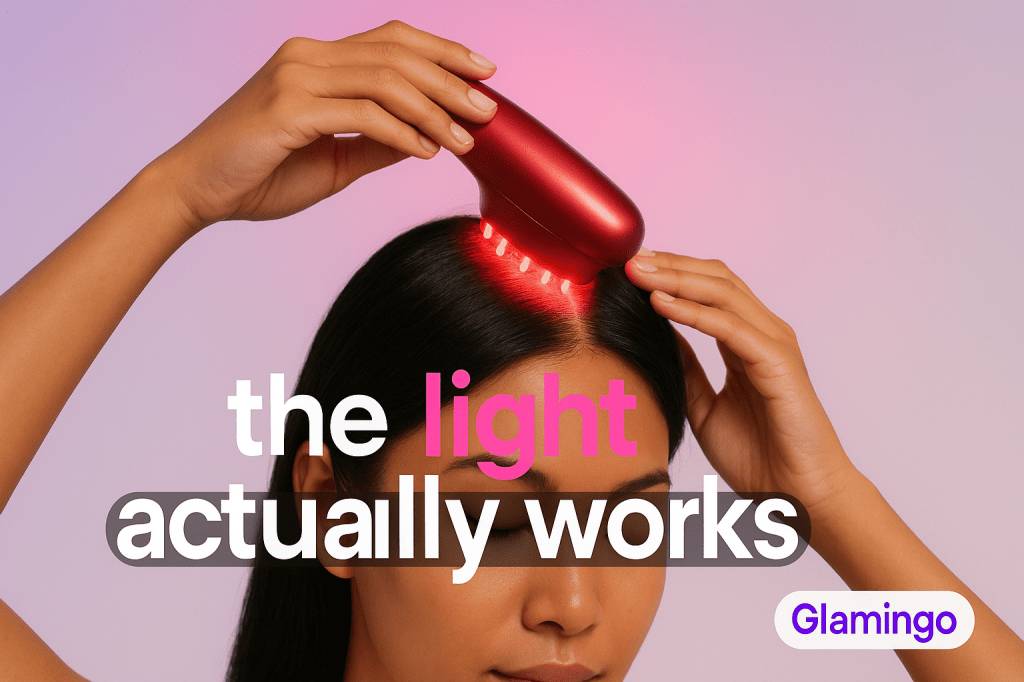
If you have written off red light therapy as another overpriced gadget for people who buy into wellness trends, you are not alone. The before-and-after videos feel staged, the helmet devices look absurd, and the brand claims are loud enough to make any informed buyer suspicious. But dismissing it entirely might be the wrong call — because unlike most hair growth marketing, this one has peer-reviewed human trials behind it.
Hair loss is a particular minefield for misinformation, and for good reason. It is slow, emotional, and deeply personal. The treatments that do exist — minoxidil, finasteride, hair transplants — carry their own complications, costs, and side effects. Into this gap, wellness brands have flooded with devices that look more like props from a sci-fi film than serious medical equipment. The scepticism is warranted. But it has also meant that a treatment with a genuine biological rationale and a growing clinical record is getting lumped in with collagen-boosting crystals and scalp detox shampoos. That is worth untangling.
The Myth — Red Light Therapy for Hair Is a Wellness Trend With No Real Science
Why this belief is understandable — and what the marketing has done to muddy the water
The marketing around red light therapy is, frankly, a mess. Brands make sweeping claims, cherry-pick studies, and lean hard on the FDA-clearance badge — which sounds authoritative until you understand what it actually means (more on that later). Consumer devices are sold with before-and-after photographs that are almost impossible to verify. Influencers wear glowing helmets and report miraculous results after six weeks. None of this helps you figure out what is real.
Add to this the fact that the treatment goes by multiple names — low-level light therapy (LLLT), photobiomodulation (PBM), red light therapy, laser hair therapy — and it starts to feel deliberately obfuscated. The terminology alone is enough to make a sharp buyer walk away. That reaction is logical. It is also, in this case, costing some people access to a tool that the evidence suggests could genuinely help them — if they have the right type of hair loss and the right device.
The Verdict — It Has Genuine Mechanistic and Clinical Support, With Important Caveats
What the randomised controlled trials actually showed
Studies including the largest randomised controlled trials have demonstrated statistically significant hair growth stimulation using LLLT in both men and women with androgenetic alopecia — the clinical term for genetic hair thinning, which is the slow, pattern-based loss at the crown or temples that tends to progress quietly over years. These are not brand-funded blog posts. They are peer-reviewed trials with control groups, measurable outcomes, and published methodology.
That said, the evidence is graded as moderate, not strong — and the distinction matters. The trials vary in size, duration, and some have industry-adjacent funding. They are not uniformly large-scale. The honest reading is: the clinical signal is real and consistent enough to take seriously, but this is not the same level of evidence as, say, a drug that has been through phase three trials with thousands of participants. What it is not is nothing — and that is the point the marketing-averse response has been getting wrong.
The biological mechanism in plain English: ATP, nitric oxide, and follicle activation
Think of a hair follicle that has gone quiet — not dead, but operating on low power, like a phone in battery-saving mode. Red light therapy works like plugging it in: the specific wavelengths of light are absorbed by the mitochondria inside the follicle cells, boosting their energy output — adenosine triphosphate (ATP), the molecule that powers almost every cellular function — the way a charger restores battery function. That increased cellular energy can shift follicles from a dormant, miniaturised state back toward active growth.
Low-level light therapies using visible to infrared light activate cellular functions including ATP production and nitric oxide release — and that second part matters. Nitric oxide is a signalling molecule that dilates blood vessels, improving circulation to the scalp and delivering more of what follicle cells need to function. This is not a vague wellness claim about “energising” the scalp. It is a specific, understood biological pathway. The catch — and it is a significant one — is that this mechanism only works if the follicle still has enough life in it. If it has completely shut down and the follicle has been replaced by scar tissue, no amount of light will restart it. Earlier intervention produces better results. That is not a caveat brands like to lead with.
What It Actually Treats — and What It Does Not
Androgenetic alopecia (genetic thinning): where the evidence is strongest
Androgenetic alopecia — genetic thinning driven by sensitivity to a hormone called DHT — is the specific condition where the clinical evidence for LLLT is concentrated. It is the slow, diffuse thinning at the crown, the widening part, the temples that start to feel less full over years rather than weeks. This is the pattern where follicles are miniaturising gradually, not dying suddenly. That distinction matters because miniaturising follicles are exactly what red light therapy’s mechanism of action is designed to address — restoring energy and reducing the inflammation that is accelerating that shrinkage. If this is your pattern, the evidence is meaningful enough to consider.
Nutrient deficiency, stress shedding, hormonal loss: not the right tool
Here is where expectations go badly wrong, and where a lot of money gets wasted. Not all hair loss is the same. Over-supplementation of certain nutrients including selenium, Vitamin A, and Vitamin E has been directly linked to hair loss — which is a useful reminder that nutritional hair loss is its own distinct category with its own causes and solutions. Red light therapy targets follicle energy production and local inflammation. It does nothing to correct a selenium excess, a thyroid imbalance, an iron deficiency, or the telogen effluvium (the medical term for stress-triggered mass shedding) that many women experience after illness, significant weight loss, or a prolonged difficult period. If you noticed dramatic hair fall in the months after a stressful event — and Singapore’s pandemic years sent many women through exactly this — PBM is not your answer. That type of shedding typically resolves on its own once the trigger is addressed. Spending on red light treatments during that window is, at best, a coincidence if the hair comes back.
The Device Problem — Why ‘Red Light Therapy’ Is Not One Thing
Lasers vs. LEDs: what photobiomodulation actually requires to work
Photobiomodulation is defined as treatment using irradiation with specific wavelengths of red or near-infrared light — and both lasers and LEDs fall under this category, but they deliver light with meaningfully different characteristics. Lasers produce coherent, focused light that penetrates tissue more precisely. LEDs produce broader, less focused light that disperses. This does not automatically make LEDs ineffective, but it does mean the device design, wavelength, and power density matter enormously — far more than whether the packaging says “red light therapy.”
Wavelength, power density, and why most consumer devices do not publish the numbers that matter
The wavelengths that research supports for follicle stimulation sit in a specific range — generally 630 to 670 nanometres for red light, and 800 to 850 nanometres for near-infrared. Power density (measured in milliwatts per square centimetre) determines whether enough light energy actually reaches the follicle beneath the scalp surface. A device that emits the right colour of light at insufficient intensity is essentially a very expensive lamp. Most consumer devices do not publish their power density figures in any meaningful way. There is also a practical detail that rarely surfaces in marketing: having the light source in direct contact with or very close to the scalp appears to significantly improve efficacy — something that helmet-style devices with gaps between the LEDs and your head may not achieve consistently.
FDA-cleared means safe, not proven effective — the distinction brands skip over
This is the sleight of hand that deserves its own paragraph. Devices like the iRestore system are marketed prominently with FDA-cleared status. FDA clearance for a device confirms it meets safety standards — it does not constitute a finding of clinical efficacy. The FDA clearance pathway for devices is not the same as drug approval. It means the device is unlikely to harm you. It says nothing about whether it will grow your hair. Brands know this distinction and routinely omit it. Now you know it too.
The Scalp Inflammation Connection — A Secondary Mechanism Worth Understanding
How chronic low-grade scalp inflammation contributes to follicle miniaturisation
The conventional explanation for androgenetic alopecia focuses on DHT sensitivity — the hormone that causes follicles to progressively miniaturise in genetically predisposed individuals. But the picture is becoming more complex. Chronic low-grade scalp inflammation is increasingly understood as an accelerating factor in follicle miniaturisation, not just a bystander. This is relevant in Singapore and across Southeast Asia, where year-round heat, humidity, and UV exposure create conditions that can sustain low-level scalp inflammation even in people who do not experience obvious scalp irritation. You might not feel it. Your follicles might still be responding to it.
What the LLLT inflammatory marker data shows
LLLT has demonstrated the ability to downregulate scalp inflammatory markers in human subjects — which gives red light therapy a plausible secondary mechanism beyond just energising follicle cells. If the treatment is also reducing the inflammatory environment that is suppressing follicle activity, that is an additive benefit. The sample sizes in these studies are limited, so this should be read as a credible mechanistic signal rather than a definitive finding. But it adds weight to the biological rationale, particularly for people in climates where scalp inflammation may be a persistent, underacknowledged factor.
Where Red Light Therapy Sits in a Realistic Hair Loss Plan
As a complement to minoxidil or other treatments — not a replacement
A Delphi consensus — where a structured panel of experts reaches formal agreement — found PBM to be a safe treatment in adults that can be effective in inducing hair regrowth, while stopping short of a blanket endorsement. The framing matters: effective when used as part of a broader approach, not as a standalone cure. Minoxidil remains the most evidence-backed topical treatment for androgenetic alopecia. Red light therapy appears to work best alongside it, not instead of it. Thinking of PBM as your primary intervention and waiting to see results before trying anything else is likely to leave you disappointed — and six to twelve months further into the thinning process.
What a realistic timeline looks like based on the evidence
One experience that will resonate with anyone who has been down this road: the changes are slow, subtle, and genuinely hard to evaluate on yourself. A woman noticing baby hairs along her hairline after months of consistent use, but honestly unsure whether her part is actually filling in or whether she is seeing what she wants to see — that uncertainty is not a personal failing. It reflects the reality of a treatment that works incrementally on a biological process that moves slowly. Clinical trials measure outcomes at six months and twelve months, not six weeks. Consumer devices promising transformation in a month are selling you a timeline the evidence does not support. The honest window for any meaningful assessment is four to six months of consistent use, with before photographs taken under identical lighting conditions — not bathroom selfies — so you have something objective to compare.
The Single Honest Takeaway
Before investing in a red light device or booking a clinical PBM session, identify which type of hair loss you are actually dealing with. If your shedding is diffuse and recent — triggered by stress, illness, or a diet change — red light therapy is not the right tool and the evidence does not support it for your situation. If your loss is a slow, gradual thinning at the crown or temples that has been progressing over years, that pattern is consistent with androgenetic alopecia, where the clinical evidence for LLLT is strongest. Get that distinction clear first, ideally confirmed by a trichologist or dermatologist, before spending on any device or treatment course.
If you want to explore professional LLLT or PBM scalp treatments rather than navigating the consumer device market alone, Glamingo lists verified scalp and hair loss clinics across Singapore with real reviews from women who have gone through the same research process you are doing right now. Find a provider near you →
 Glamingo Blog
Drop in your comments..