
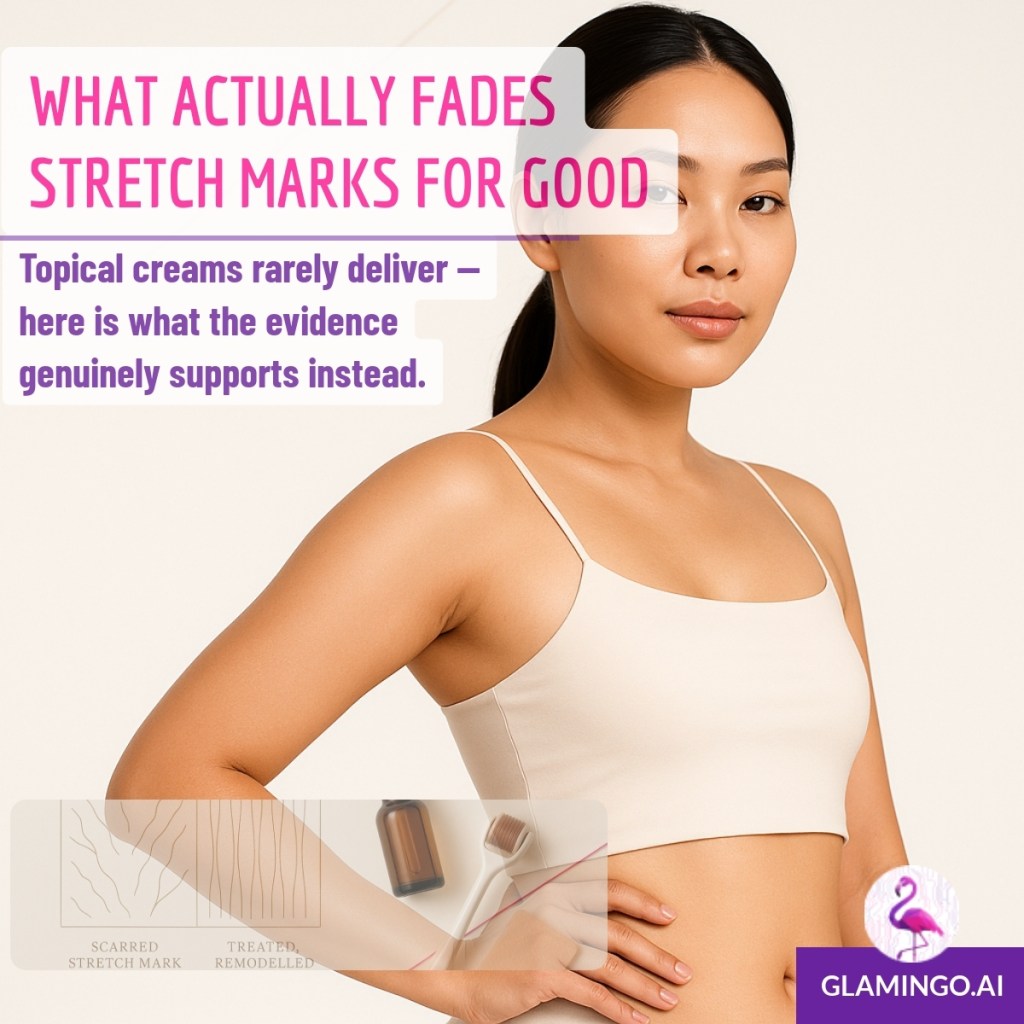
You have probably tried at least one stretch mark cream, oil, or butter that promised visible results in weeks. Maybe cocoa butter, bio-oil, or something marketed specifically at pregnant women or post-weight-loss skin. And you probably noticed very little difference. That is not a failure of consistency — it is a failure of the claim. The evidence on topical stretch mark treatments is far weaker than the price tags suggest, and the treatments that do show real results work in a completely different way.
If that sounds frustrating, it should. Stretch marks are one of the most common skin concerns women deal with — after pregnancy, rapid weight changes, growth spurts, or simply genetics doing what genetics does. And because they are so common, and because the emotional stakes around them are real, the market for products claiming to fix them is enormous. Enormous, and largely built on very shaky ground. Before you spend another fifty or a hundred dollars on something that sits on the surface while the actual problem is buried underneath, here is what the evidence actually shows.
The Myth — Creams and Oils Can Remove or Prevent Stretch Marks
What the evidence actually says about topical treatments
The most honest summary of the topical stretch mark market is this: there is no high-quality clinical evidence that any of it works in the way it claims to. Not a softened version of that statement — the full, unvarnished one. A systematic review of topical preparations used during pregnancy found no high-quality evidence to support the use of any topical product — including oils, creams, and butters — for preventing stretch marks. This is the population most aggressively targeted by these products, during a window that brands market as the critical prevention period. The evidence still does not support the claims.
It is worth sitting with that for a moment. This is not one study with a small sample. A systematic review pulls together the available evidence base and assesses it collectively. The conclusion was that the evidence was not there — not weak, not promising, not mixed. Not there.
Why pregnancy is the most aggressively marketed window — and why the products still do not work
Pregnancy is the perfect marketing environment for stretch mark products. The skin is visibly and rapidly changing. There is heightened motivation to act, real emotional investment in how the body looks and feels, and a specific, predictable timeline that brands can attach urgency to. “Start from your first trimester” is a more compelling call to action than “try this product and wait.” The products are also generally considered safe during pregnancy, which removes the natural hesitation barrier.
But motivation and market conditions are not the same as mechanism. The reason these products do not work during pregnancy — or after, or ever — is structural. And understanding that structure changes how you think about the entire category.
Why Topicals Cannot Reach the Problem
Stretch marks are structural damage below the skin surface, not a surface discolouration issue
Think of a stretch mark like a tear in the inner lining of a leather bag that has healed over with scar tissue. You can condition and polish the outside of the leather all you like — it will look better and feel softer, but the structural tear underneath is unchanged. The only way to actually address the tear is to work from inside the material itself. That is what clinical treatments like microneedling do: they create controlled micro-damage that prompts the skin to lay down new, better-organised collagen where the original tear occurred.
This analogy is not just illustrative — it is mechanistically accurate. And it explains why an entire shelf of beautifully packaged, convincingly marketed topical products consistently fails to deliver on its promises. The problem is not on the surface. Putting something on the surface cannot fix it.
The plain-English biology: what a stretch mark actually is
Stretch marks form when the skin’s structural scaffolding — the network of collagen and elastin fibres in the deeper layer of the skin (what dermatologists call the dermis) — is stretched faster than it can adapt and tears. The skin heals over, but the new tissue is disorganised and different in texture and appearance from the surrounding skin. This is scar-like tissue at the structural level. The pink or red colour you see in new stretch marks is inflammation and increased blood flow. The silver or white appearance of older marks is the scarred, collagen-depleted tissue that remains once inflammation has resolved.
An ingredient in a cream, no matter how premium or how thoughtfully formulated, cannot penetrate through the outer skin layer (the epidermis) in concentrations sufficient to remodel that deeper structural damage. Moisturising ingredients work on the surface and just beneath it. The dermis, where stretch marks actually live, is not accessible to them. That is not a formulation problem that a more expensive product solves — it is a physical limitation of the delivery method.
The Verdict on Store-Bought Products
Cost versus evidence — what you are actually paying for
The American Academy of Dermatology notes directly that stretch mark treatments available over the counter can be expensive — which is a notably measured way of flagging that you are routinely overpaying for products with no robust clinical backing. In Singapore, a reasonably mid-range stretch mark product easily runs $40–$80. More premium options hit $100 and above. None of them have a published clinical trial demonstrating they reduce the appearance of stretch marks in a way that is meaningfully different from a basic moisturiser.
What you are paying for, mostly, is packaging, fragrance, marketing, and the psychological comfort of doing something. That last one is not entirely worthless — there is real value in a ritual that makes you feel cared for. But that is a different claim than “visibly reduces stretch marks in four weeks.”
What topicals can realistically do (hint: it is not removal)
Here is the honest version of what a good body oil or cream can do for stretch-marked skin: it can keep the skin hydrated, which makes it look and feel better. It can temporarily plump the surface, which can make marks appear slightly less visible in certain lighting. It may reduce the itching that sometimes accompanies new stretch marks forming. These are real, if modest, benefits. They are just not the benefits being sold.
If you enjoy using a body butter and it makes your skin feel good, there is nothing wrong with that. Just go in with accurate expectations. You are moisturising, not remodelling.
What the Evidence Does Support
How microneedling works on stretch marks — and why the mechanism is different
Microneedling works by creating controlled micro-injuries in the skin, triggering a wound-healing response that stimulates new collagen production. In the context of stretch marks, this matters because it addresses the structural problem rather than sitting on top of it. The needles penetrate into the dermis — the exact layer where the disorganised scar tissue is — and the healing process that follows lays down new, better-organised collagen in that space. Over a series of sessions, this can genuinely change the texture, depth, and appearance of a stretch mark in ways that no topical can.
The evidence for microneedling on stretch marks is moderate rather than conclusive — individual studies tend to be small and methods vary — but the mechanism is well understood and the results reported are consistently more meaningful than anything in the topical category. This is a category shift, not just a more expensive version of the same approach.
PRP as a combination approach — what the evidence says and what it does not
You may have seen PRP — platelet-rich plasma, where a small amount of your own blood is processed to concentrate growth factors and then applied or injected into the skin — marketed for stretch marks, often as an add-on to microneedling. PRP has approximately four decades of clinical history and has gained significant traction in skin remodelling applications. The growth factors it delivers are thought to amplify the collagen-stimulating response that microneedling triggers.
Where honesty is required: the general skin remodelling evidence for PRP is more robust than the stretch mark-specific evidence. The mechanism makes sense and clinical practitioners report good outcomes in combination protocols, but you should approach stretch-mark-specific PRP claims with the same scepticism you bring to topicals — ask for the evidence, not just the before-and-after photos. The combination approach is promising and worth exploring if you are already considering professional treatment. It is not yet proven in the way that some clinics present it.
New versus old stretch marks: why timing changes what is possible
One thing the evidence is fairly clear on is that newer stretch marks — the red or pink ones (known in clinical language as striae rubrae) — respond better to treatment than older, white or silver ones (striae albae). When a stretch mark is still in its inflammatory phase, there is active tissue remodelling happening, and clinical treatments can work with that process. Once the mark has fully matured and settled into that flattened, silvery appearance, the tissue is more stable and more difficult to change. This does not mean older marks cannot be improved — they can — but the degree of improvement is generally more modest and may require more sessions.
What ‘Improvement’ Actually Looks Like — Setting Honest Expectations
Fading and texture smoothing vs. complete removal: the honest distinction
Somewhere between the marketing claim (“visibly reduces stretch marks in four weeks”) and the dismissive opposite (“nothing works, learn to love them”) is the actual truth, which is more nuanced and more useful than either. Clinical treatments can produce real, visible improvement. The texture of a stretch mark can become smoother and closer to surrounding skin. The colour contrast can fade significantly. The depth of the indentation — that slightly sunken, grooved texture — can reduce. These are meaningful changes that women who have done a full course of treatment often describe as genuinely confidence-shifting.
Complete removal is not on the table. The tissue in that area has changed structurally, and no current treatment reverses that entirely. What is realistic is improvement — sometimes quite significant improvement — and for many women, that is enough to be worth pursuing. The problem is when clinics or social content imply the former when they can only deliver the latter.
How many sessions, at what cost, and what the realistic outcome range is
A typical microneedling course for stretch marks involves multiple sessions — commonly four to six, spaced several weeks apart to allow the skin’s collagen response to develop between treatments. In Singapore, a single microneedling session from a reputable clinic can range from roughly $150 to $400 or more depending on the area treated and whether combination treatments like PRP are included. A full course is therefore a meaningful financial commitment, which makes it all the more important to go in with accurate expectations rather than marketing-driven ones.
The realistic outcome range is wide — some women see substantial fading and textural improvement after a full course; others see moderate change; a smaller number see limited results, particularly with older or more extensive marks. Variables include skin type, the age and depth of the marks, how consistently the aftercare protocol is followed, and frankly, individual biology. Fitzpatrick III–V skin types, which are common across Singapore and Southeast Asia, may also have a higher tendency toward post-inflammatory responses, so choosing a practitioner with specific experience treating darker skin tones is worth prioritising.
The Single Thing Worth Doing
If you are going to spend money on this, here is where the evidence points
Before you spend another dollar on a stretch mark cream or serum, look up whether the product has any published clinical trial data specifically for stretch marks — not general skin moisturisation or elasticity claims, and not testimonials. If the brand cannot point to one, you have your answer. If you are ready to explore professional treatment, ask any clinic you consult to explain specifically how their method addresses the structural layer of the skin, not just the surface — the answer will immediately tell you whether they understand what stretch marks actually are.
If you are ready to explore microneedling or combination treatments for stretch marks and want to compare clinics in Singapore with verified reviews, Glamingo has you covered. Browse stretch mark treatment providers near you →
 Glamingo Blog
Drop in your comments..