
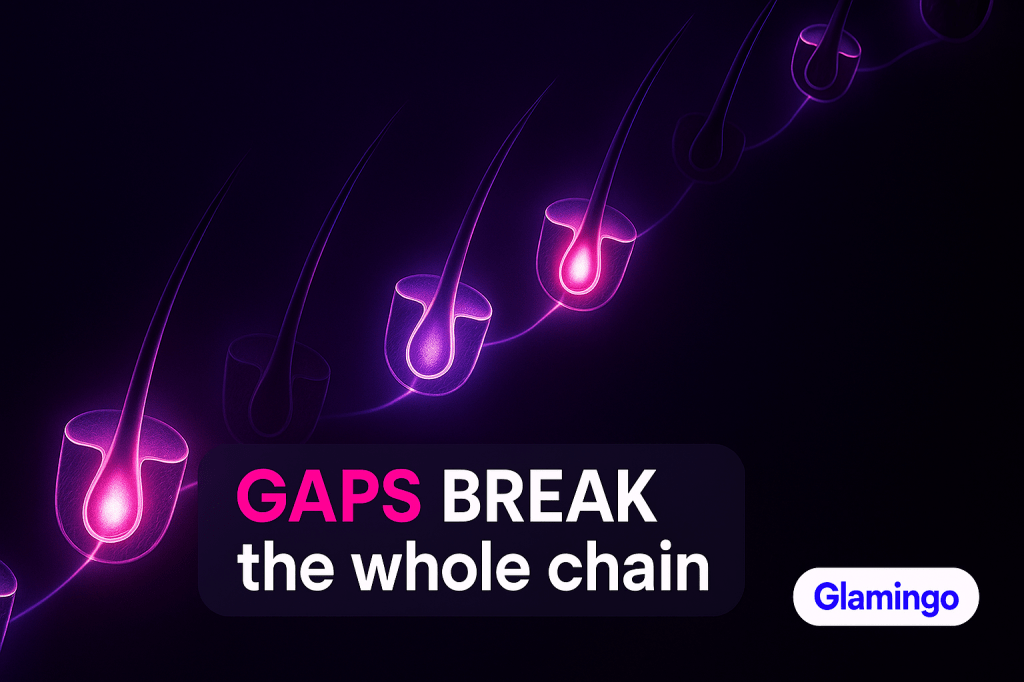
You bought the device, used it religiously for a few weeks, started seeing results, then life got in the way. A few missed sessions later, the hair is back — and somehow thicker-looking than before. This is not a coincidence or a product failure. It is a cascade built into how your hair follicles communicate with each other, and understanding it changes how you use any at-home IPL or laser device going forward.
This pattern is more common than most device brands would like you to know. Women who have put real money into at-home IPL — and these devices are not cheap — describe exactly the same cycle: early wins, a disrupted schedule, and then a frustrating return of hair that feels coordinated, almost deliberate. That is because it is. Your follicles are not passive targets sitting there waiting to be zapped. They are a networked system with its own communication logic, and when you treat that system inconsistently, it responds accordingly.
The chain starts here — why your hair follicles are not operating independently
How follicles ‘talk’ to each other through quorum sensing
Think of your hair follicles like a neighbourhood of houses that share the same water main. If you shut off water to one house — the IPL target — the houses next door detect the pressure drop and compensate by drawing more water themselves. That is the quorum-sensing response. The only way to shut down the whole street is to work systematically, house by house, at the right time — when each house is actively using water. Miss a section, treat at the wrong time, or disturb the pipes without fully cutting the supply, and the network rebalances around your gaps.
This is not a metaphor invented to make biology friendlier. Research shows that removing hair at certain densities can activate up to five times more neighbouring, unplucked resting follicles to re-enter the growth phase simultaneously — a collective signalling behaviour that researchers describe as organ-level quorum sensing. Your follicles are reading each other’s states and adjusting. When you treat some and not others, or treat inconsistently, the untreated follicles do not stay quietly dormant. They recruit.
The three-phase hair cycle and why timing is not optional
Every hair follicle cycles through three phases continuously. The active growth phase (called anagen) is when the follicle is producing a pigmented hair shaft. The regression phase (catagen) is a brief transitional window. The resting phase (telogen) is when the follicle is quiet and the hair is no longer growing. At-home light-based devices target the melanin in the hair shaft and can only effectively disable follicles during the anagen phase — when the follicle is actively producing pigment and the light energy has something to travel down toward the root.
Treating during catagen or telogen means the light passes through without reaching a viable target. The follicle survives. It will cycle back into anagen. And when it does, it will have company — the neighbouring follicles you inadvertently recruited with your inconsistent approach. Timing is not a scheduling preference. It is the biological mechanism that makes the treatment work at all.
Link one — skipping or spacing sessions incorrectly re-activates resting follicles
What happens at the molecular level when a session is missed mid-course
When an IPL session disrupts an active follicle without fully disabling it — because the timing was slightly off, or the fluence (the amount of light energy delivered per session) was insufficient, or you simply missed the window — the follicle does not stay disrupted. The molecular signalling pathways that govern whether a follicle enters or exits active growth continue to function. The WNT and BMP signalling pathways play central roles in determining whether a follicle enters or exits the anagen phase, and partial disruption without full follicle disablement allows the regeneration signal to persist rather than arrest.
In plain terms: you annoyed the follicle without stopping it. The machinery that tells it to keep growing is still running. And now it has had time to reset while you were between sessions.
The regrowth wave: why hair can appear to return in patches or thicker clusters
The visual result of this is what many people describe as patchy regrowth — or worse, regrowth that looks denser than it did before treatment started. Both experiences have the same underlying explanation. The quorum-sensing mechanism means that follicles do not re-enter the growth phase individually at random intervals. They synchronise. When your inconsistent treatment sends the signal that some follicles have been disrupted, the surrounding resting follicles activate together in response. You then have a coordinated cohort of follicles in the same growth phase at the same time — which looks, on the surface, like a thick cluster of regrowth arriving simultaneously. It is not new hair. It is recruited hair, all moving together.
Link two — using the wrong intensity setting creates inflammation instead of follicle disruption
The JAK/STAT3 inflammation pathway and how it dysregulates the follicle
The assumption with at-home IPL is often that more intensity equals faster results. This is wrong in a specific, structural way. Activation of the JAK/STAT3 inflammatory signalling pathway causes hair follicle dystrophy — structural disruption of the follicle — rather than the clean disablement you are trying to achieve. When the heat generated by an IPL flash is excessive relative to your skin’s melanin concentration, it does not simply overshoot the target. It triggers an inflammatory cascade that alters the follicle’s physical structure in ways that produce unpredictable regrowth patterns.
This is a meaningful distinction. Follicle dystrophy from inflammation is not the same as follicle disablement from correctly timed light energy. One produces unreliable outcomes. The other, when done correctly, produces gradual and cumulative reduction. The device instructions that tell you to start at a lower setting are not excessive caution — they reflect this underlying biology.
Why this risk is amplified for deeper skin tones (Fitzpatrick III–V) common in Singapore
For anyone with medium to deeper skin tones — the Fitzpatrick III–V range that describes the majority of skin types in Singapore and across Southeast Asia — the risk of crossing from effective treatment into inflammation is significantly higher. The reason is melanin competition. IPL targets melanin. Deeper skin tones contain more melanin not just in the hair shaft but in the surrounding skin. When the intensity setting is too high, the light energy is absorbed by the skin surface as well as the follicle, generating excess heat and triggering the JAK/STAT3 inflammatory response more readily.
This does not mean at-home IPL cannot work for darker skin tones. It means the intensity calibration is doing more critical work than the device marketing typically communicates. Using the highest setting your device deems “safe” for your skin tone is not the same as using the most effective setting. Those are different things — and the gap between them is where inflammation lives.
Link three — cumulative oxidative stress degrades the follicle environment over time
Free radicals generated by repeated IPL exposure without barrier support
Every IPL flash generates localised heat and, as a byproduct, reactive oxygen species — the free radicals that damage skin cells at a cellular level. Oxidative stress directly affects hair follicle development and the hair growth cycle through multiple signalling pathways, and the cumulative load from repeated IPL sessions without adequate post-treatment care creates a progressively less stable follicle microenvironment.
Think of it like this: each session generates a small amount of oxidative debris. If that debris is not managed — if the skin barrier around the treated follicles is not supported — it accumulates. The follicle environment becomes less hospitable. Not in a way that produces immediate visible problems, but in a way that quietly reduces how effectively subsequent sessions perform.
What this means for post-treatment skincare and why it is not just a comfort issue
Post-treatment skincare for IPL is often framed as a comfort measure — apply something soothing, avoid irritants, stay out of the sun. That framing undersells what is actually happening. Supporting the skin barrier after each session is directly relevant to treatment outcome, not just skin comfort. Antioxidant-containing products applied post-session help neutralise the reactive oxygen species generated by the treatment. Barrier-repairing ingredients — the lipid molecules that act like mortar between skin cells (ceramides) — reduce the oxidative load that the follicle environment is carrying into your next session.
If you have been skipping post-treatment care because you thought it was optional, this is the link in the chain worth revisiting. It is not optional. It is part of the mechanism.
What the cascade looks like in practice — the full chain from one missed session to compromised results
Session consistency → follicle phase synchronisation → effective disruption
When the process works, it follows a logical chain. Regular sessions at the correct intervals — typically every two weeks in the first phase for most devices — catch successive cohorts of follicles as they cycle into anagen. Because not all follicles are in the same phase at the same time, the treatment needs to run long enough to reach each follicle during its active window. Consistent timing means the treated area’s follicle phases begin to fall out of sync with each other. Gradually, fewer and fewer follicles are active simultaneously, and the visible hair density reduces. This is the intended mechanism. It requires patience, but it is biologically sound.
Inconsistency → quorum-sensing re-activation → coordinated regrowth → frustration
When the process breaks down, it also follows a chain — just in the opposite direction. A missed session allows partially disrupted follicles to resume their cycle. The quorum-sensing mechanism recruits resting neighbours. A coordinated cohort re-enters anagen together. The regrowth looks worse than the baseline because it is more synchronised than it was before treatment started. Partial-area or inconsistent treatments can inadvertently recruit dormant follicles back into the active growth phase — which is precisely the opposite of what you were trying to achieve. This is the frustrating experience that so many people describe after an interrupted course: the hair came back, it seems worse, and they are not sure whether to start over or continue.
How to use this understanding to get better results from the device you already own
Matching your treatment schedule to the actual anagen phase window
The session intervals on your device manual exist for a specific biological reason, not as arbitrary guidance. Most at-home IPL devices recommend treating every two weeks during the initial course — typically six to eight sessions — because the anagen phase for body hair lasts several weeks and the two-week interval is designed to catch successive follicle cohorts as they cycle into active growth. Deviating from this spacing in either direction — too frequent or too far apart — misses the window. Treating too frequently may mean you are hitting the same follicles twice in catagen. Leaving gaps means anagen-phase follicles are missed entirely and allowed to complete their cycle undisturbed.
Intensity calibration for your skin tone — not just the highest safe setting
Start one level below the maximum recommended setting for your skin tone on the first two sessions, particularly if you have a Fitzpatrick III–V skin tone. Assess the skin response in the 24 hours after each session. Mild warmth and very slight redness that resolves quickly is an acceptable response. Prolonged redness, itching, or any change in pigmentation is the JAK/STAT3 inflammatory pathway telling you the intensity needs to come down. The structural niche formed by the arrector pili muscle and its associated sympathetic neurons directly regulates follicle stem cell activity — physical over-treatment of this structure can stimulate rather than suppress stem cell activation. Pressing too hard with the device head, or treating the same area multiple times in a single session, falls into this category.
Post-treatment skin care that reduces oxidative stress and supports the follicle environment
For the 24 hours following each session, use a fragrance-free moisturiser that contains antioxidant ingredients — niacinamide, vitamin E, or a centella asiatica extract — alongside a ceramide-containing barrier repair product. Avoid exfoliating acids, retinoids, and anything that adds additional oxidative load to already-stressed skin. SPF is non-negotiable on treated areas, particularly in Singapore’s UV Index 10–12 environment. Post-inflammatory hyperpigmentation risk is elevated on freshly treated skin at any skin tone, and significantly more so for Fitzpatrick III–V. These steps are not a luxury add-on to your IPL course. They are part of the mechanism by which each session’s results are preserved and built upon.
This week, look up the recommended session intervals for your specific device and map them against your actual calendar for the next eight weeks. If you cannot commit to the full spacing — every two weeks for the first phase on most devices — delay starting or restarting your course until you can. The follicle quorum-sensing research makes one thing clear: partial, inconsistent treatment does not produce partial results. It produces a coordinated regrowth response from follicles you thought you had already addressed.
If you are weighing whether professional IPL or laser hair removal might deliver more consistent results than the at-home route, Glamingo has verified providers across Singapore with real reviews from women who have compared both options. Browse hair removal treatments near you →
 Glamingo Blog
Drop in your comments..