
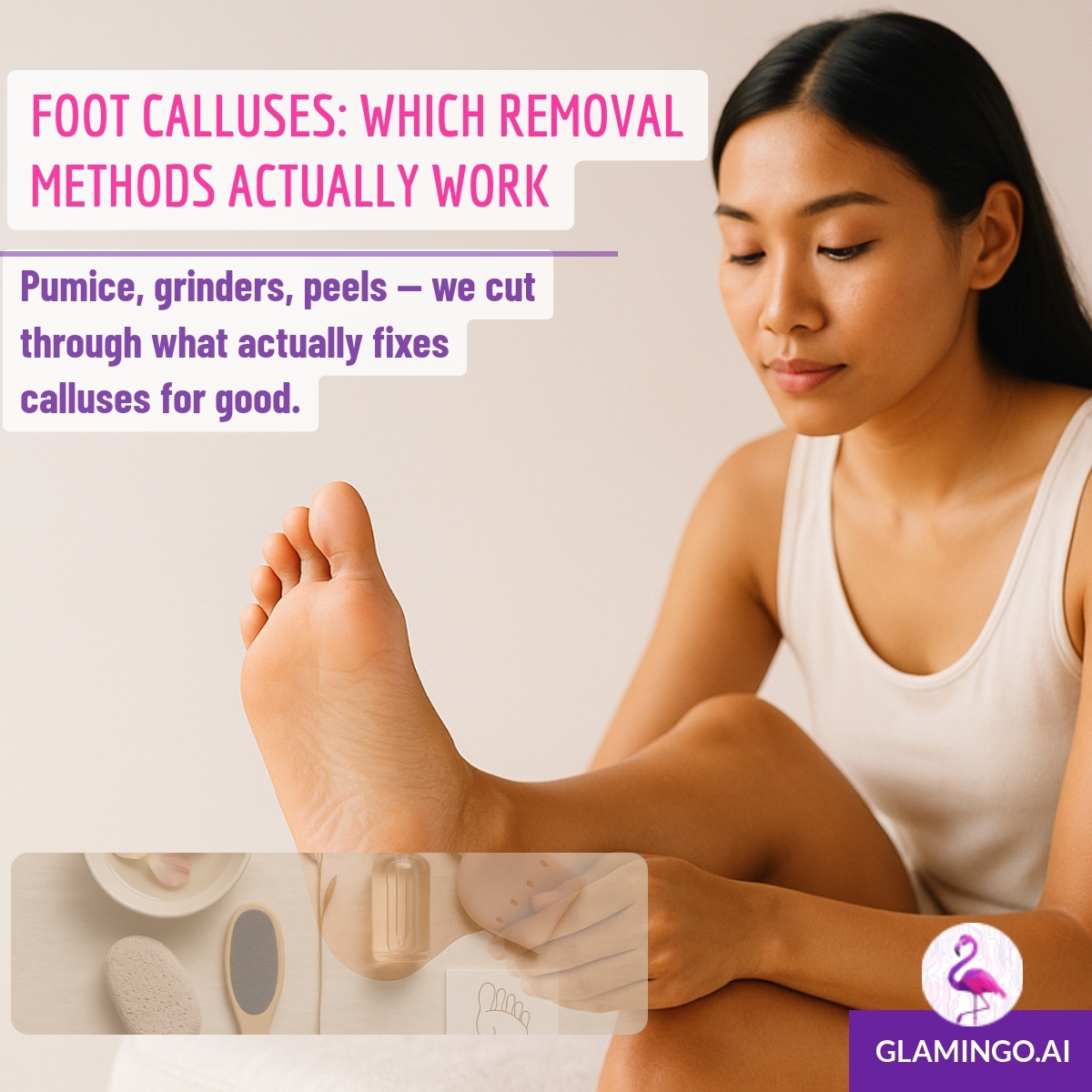
You’ve tried the pumice stone, the foot file, maybe even one of those electric grinder devices — and six weeks later the hard skin is back, thicker than before. Someone put it plainly once: I tried using a pumice stone but they’re pretty thick, didn’t accomplish much. If that sounds familiar, the problem probably isn’t the tool you’re using. It’s that you’re treating the symptom while ignoring what’s actually driving the build-up.
This is the thing about calluses that beauty content almost never addresses directly: they are not a hygiene problem, and they are not a moisturiser deficiency. They are your skin doing its job — laying down extra protection in response to repeated friction and pressure. Which means that attacking the hard skin without asking why it keeps forming in that exact spot is a loop you can stay in indefinitely. The tools keep multiplying, the results keep disappointing, and the callus keeps coming back. Let’s actually break that cycle.
The Verdict Upfront
Worth it for aesthetics — with realistic expectations and the right method
If you have healthy feet and you want smoother skin for sandal season or before a pedicure, callus removal is absolutely a reasonable thing to do. Chemical exfoliants — particularly urea and salicylic acid — have the strongest case for at-home use, and professional podiatric debridement is your most effective short-term option. Just go in knowing that without addressing what’s causing the build-up, you are managing the situation rather than resolving it. That’s still a valid choice. Manage it with the right tools, not the most aggressive ones.
Worth escalating — if calluses are thick, painful, or keep returning despite treatment
If you’ve been consistently treating a callus for months and it keeps rebuilding, or if it’s causing you pain when you walk, that’s your foot flagging a biomechanical issue — footwear, gait, or load distribution — that no amount of filing will fix. A podiatrist visit here is a better investment than another beauty gadget. Recurring, painful calluses are a signal worth reading, not just sanding down.
Skip it (or get medical clearance first) — if you have diabetes, neuropathy, or poor circulation
This is non-negotiable. In a study of 4,014 individuals with type 2 diabetes, 39.5% reported pre-ulcerative foot lesions, with calluses among the most commonly reported — making them a clinically meaningful risk marker, not a cosmetic nuisance. If you have diabetes, peripheral neuropathy, or circulation issues, DIY callus removal carries genuine infection risk. You need professional foot care, full stop.
What a Callus Actually Is — and Why That Changes Everything
Thickened skin as a protective response to friction and pressure
A callus is what happens when your skin detects repeated mechanical stress and responds by producing extra layers of hardened cells (the technical process here is hyperkeratosis — an overproduction of keratin, the structural protein that makes up the outer skin layer). It is not a sign that your feet are dirty or neglected. It is your skin being genuinely useful. The friction triggers a cascade that tells your skin cells to stick around longer than usual rather than shedding normally, and the result is that dense, yellowish pad of hard skin that no amount of lotion seems to fully shift.
Why the location of your callus tells you more than the callus itself
Think of a callus like a car’s brake pads wearing down in one spot — it tells you something about how the load is distributed, not just that the pad needs replacing. You can sand it back, but if the pressure imbalance stays the same, the wear pattern will re-establish itself in the same place. The useful question isn’t “how do I remove this?” — it’s “why is my skin building up protection here specifically?”
Research confirms that callus formation and the specific locations where calluses develop are associated with individual biomechanical factors — meaning where your callus forms is not random. A callus under the ball of your foot points to how your weight distributes when you walk. One along the outer edge of your heel suggests a pronation issue or a specific shoe silhouette. One at the base of your big toe is often a narrow toe box story. Reading the location is genuinely useful information.
The shear stress factor most removal routines completely miss
Here’s something almost no beauty content mentions: direct pressure is only part of what drives callus formation. The other factor is shear stress — the horizontal sliding force that happens when your foot moves slightly within your shoe with each step. Research shows that interventions targeting calluses that have limited consideration of shear stress demonstrate a gap in effectiveness, suggesting that pressure alone doesn’t fully explain why calluses form or why they keep coming back. This is why even well-cushioned shoes can still produce calluses if there’s movement inside them — and why insoles that reduce friction, not just pressure, can make a meaningful difference.
Method-by-Method Evidence Review
Pumice stone and manual foot files — low risk, modest results, requires consistency
The pumice stone is probably the most ancient callus removal tool in existence, and it works — just not dramatically or permanently. Used on damp skin after soaking, it manually abrades the outermost hardened layers (the dead keratinocytes sitting on the surface). The evidence base for this in healthy cosmetic use is, honestly, limited — most formal callus removal research focuses on clinical populations with diabetes or foot conditions rather than someone who just wants smoother heels. What we do know is that used correctly, it’s low risk, inexpensive, and produces incremental improvement. Used on dry skin, or used too aggressively, it can cause micro-tears and actually worsen the situation. Wet feet, gentle circular pressure, and regular use beats occasional aggressive scrubbing every time.
Electric callus removers — same mechanism as manual, faster; evidence grade the same
Electric foot files are essentially powered pumice stones — the mechanism is identical, the speed is faster. They’re convenient, and for thick calluses they require less effort than manual filing. The risk profile is also similar, with one caveat: it’s easier to overdo it with an electric device because you can remove more tissue before your hand gets tired enough to stop. The evidence grade here mirrors manual filing — extrapolated from clinical data, not directly tested on healthy cosmetic cases. Useful. Not transformative.
Chemical exfoliants (urea, salicylic acid) — the strongest case for at-home use
This is where the evidence starts to get genuinely more interesting. Urea is a substance your skin produces naturally as part of its own moisturisation system — at low concentrations (around 10%) it’s a humectant that draws water into the skin; at higher concentrations (25–40%) it actively breaks down the bonds holding hardened keratin cells together. This is called keratolysis — essentially, chemically dissolving the glue that keeps thick skin stuck. Salicylic acid works similarly, softening keratin and loosening hardened surface cells. Both have a meaningful track record in clinical foot care, and for cosmetic use in healthy adults they represent the most evidence-adjacent at-home option. A foot cream with 25–40% urea used consistently over weeks is doing more targeted work than a pumice stone alone. Used together — chemical softening followed by gentle mechanical removal — you get the most out of both.
Professional podiatric debridement — most effective short-term; evidence-based for clinical populations
Professional debridement — where a podiatrist uses a scalpel or specialist tool to precisely remove thickened tissue — is the most clinically supported method for callus removal, and the most effective single-session intervention available. Evidence-based, standardised methods for treating foot calluses are associated with reduced risk of skin damage and infection compared to non-standardised approaches. In a clinical setting with trained hands and sterile tools, debridement can safely remove significant callus build-up quickly. The caveat: it’s treating the symptom. Without addressing the mechanical cause, regrowth follows the same timeline as always. Worth doing. Not worth doing repeatedly instead of addressing footwear.
Foot peel masks — what the evidence actually shows versus what the packaging promises
Foot peel masks — those gel sock treatments that promise to shed your entire foot’s worth of dead skin over a week — are hugely satisfying if you enjoy that sort of thing (and a lot of people genuinely do). The active ingredients are typically a combination of AHAs and BHAs, usually lactic acid, glycolic acid, and salicylic acid, which chemically loosen the bonds between surface skin cells. The peeling is real. What the packaging implies — that you’re permanently addressing your calluses — is much less supported. The dramatic shedding is largely surface exfoliation; deeper, established calluses that are mechanically driven will regenerate at the same rate as before. The independent evidence for foot peels specifically is thin. They’re not harmful for healthy feet (though not suitable for sensitive or compromised skin), but treating them as a callus solution rather than a once-in-a-while skin refresh sets you up for disappointment.
The Recurrence Problem — Why Results Don’t Last
Removing the callus without fixing the cause
The question that rarely gets a straight answer in beauty content is: how long does it actually take for a callus to come back? The honest answer is — it depends entirely on whether the mechanical trigger is still present. If you’ve removed a callus but are still wearing the same shoes, walking the same way, and distributing load through the same pressure points, the build-up will begin again almost immediately. Your skin has a memory for this. It’s been told repeatedly that this area needs protection, and it will keep providing it until the signal changes.
Footwear, gait, and load distribution: the unsexy answer
This is the part of the conversation that doesn’t sell foot files or peel masks, which is probably why it gets skipped so often. The most durable callus improvement comes from changing the mechanical environment — specifically the footwear. Shoes with a narrow toe box compress the forefoot and create predictable pressure hotspots. Completely flat soles (including the ultra-flat slides that are standard Singapore weekend footwear) distribute load differently than a shoe with mild arch support, often concentrating pressure on the heel and ball of the foot. Worn-out insoles lose their cushioning and introduce friction. None of these problems are solved by filing.
When orthotics are worth considering
If you have consistently recurring calluses in the same location despite changing footwear and using appropriate removal methods, it may reflect a structural issue with how your foot loads — something like overpronation, supination, or uneven weight distribution across the metatarsals. Custom or over-the-counter orthotics redistribute load and reduce shear force at specific pressure points. This is not a first step, but for genuinely persistent cases, it’s worth a conversation with a podiatrist before continuing to escalate home treatments.
Salon Safety: What to Look For and What to Walk Away From
Sterilisation standards for tools used on debrided skin
When callus removal goes beyond the surface — which it does with any mechanical filing that generates heat or removes multiple layers — the skin underneath is more exposed and more vulnerable to bacteria and fungi. Clinical evidence supports standardised, evidence-based methods to reduce infection risk from callus treatment, and that principle applies in salon settings just as much as clinical ones. Tools that contact debrided foot skin need to be either single-use or properly sterilised between clients — not just rinsed or wiped down. Autoclaving (the high-heat sterilisation method used in medical settings) is the gold standard for metal tools. If you can’t verify that’s happening, you’re taking on risk you shouldn’t have to.
Red flags to watch for in nail salon foot treatment settings
A few practical things worth checking before you settle into that massage chair: metal files and rasps that aren’t autoclaved between clients, foot baths that aren’t properly drained and disinfected between uses (fungal and bacterial contamination here is a real and documented risk), and staff using callus shavers (blade-based tools) without any form of sterilisation protocol. In clinical settings, calluses are assessed alongside broader foot health markers — not treated in isolation — and a good salon professional should be pausing if they see cracked, bleeding, or infected skin rather than continuing to work on it. If they don’t, walk away.
The Final Ruling — Who Should Do What
Healthy adults wanting cosmetic improvement
Use a urea-based foot cream at 25–40% concentration consistently — this is your most evidence-adjacent at-home option. Add a pumice stone or manual file on damp skin weekly for mechanical removal. Keep the expectation realistic: you’re managing a recurring mechanical issue, not resolving it permanently. A professional debridement session once or twice a year gets you back to a smooth baseline efficiently. The evidence base for cosmetic callus removal in healthy adults remains genuinely limited — most formal research focuses on clinical populations — so approach with calibrated expectations, not marketing-level optimism.
People with recurring or painful calluses
Stop escalating home tools and book a podiatrist appointment. A podiatrist can identify the mechanical driver — whether it’s a gait issue, structural foot shape, or a footwear problem — and give you targeted advice rather than generic guidance. Calluses are the most commonly self-reported foot condition, which means a lot of people are managing them independently for longer than they should before getting proper advice. Pain is the signal to stop self-treating.
Anyone with diabetes, neuropathy, or circulation issues
DIY callus removal is not for you. Foot calluses are identified alongside peripheral neuropathy as a factor associated with increased risk of diabetic foot ulcers — meaning in this context, a callus is a clinical finding that warrants medical attention, not a cosmetic problem to manage at home. See a podiatrist. This is one of those cases where the stakes are genuinely high and the beauty aisle is the wrong place to solve the problem.
Before buying another callus removal tool, look at where on your foot the callus is forming and match it to your most-worn shoes. If the location lines up with a pressure point in a specific pair — narrow toe box, flat sole, worn-out insole — address the footwear first. Removing the callus without removing the cause is a temporary fix at best. If the callus is painful, cracked, or has been building for months despite regular attention, book a podiatrist appointment rather than escalating to more aggressive home tools.
If you’d rather have a professional take care of the removal properly while you figure out the footwear situation, Glamingo has foot care and pedicure treatment providers near you with verified reviews — so you can find someone whose hygiene standards you can actually check before you book. Search foot care treatments near you →
Leave a Reply