
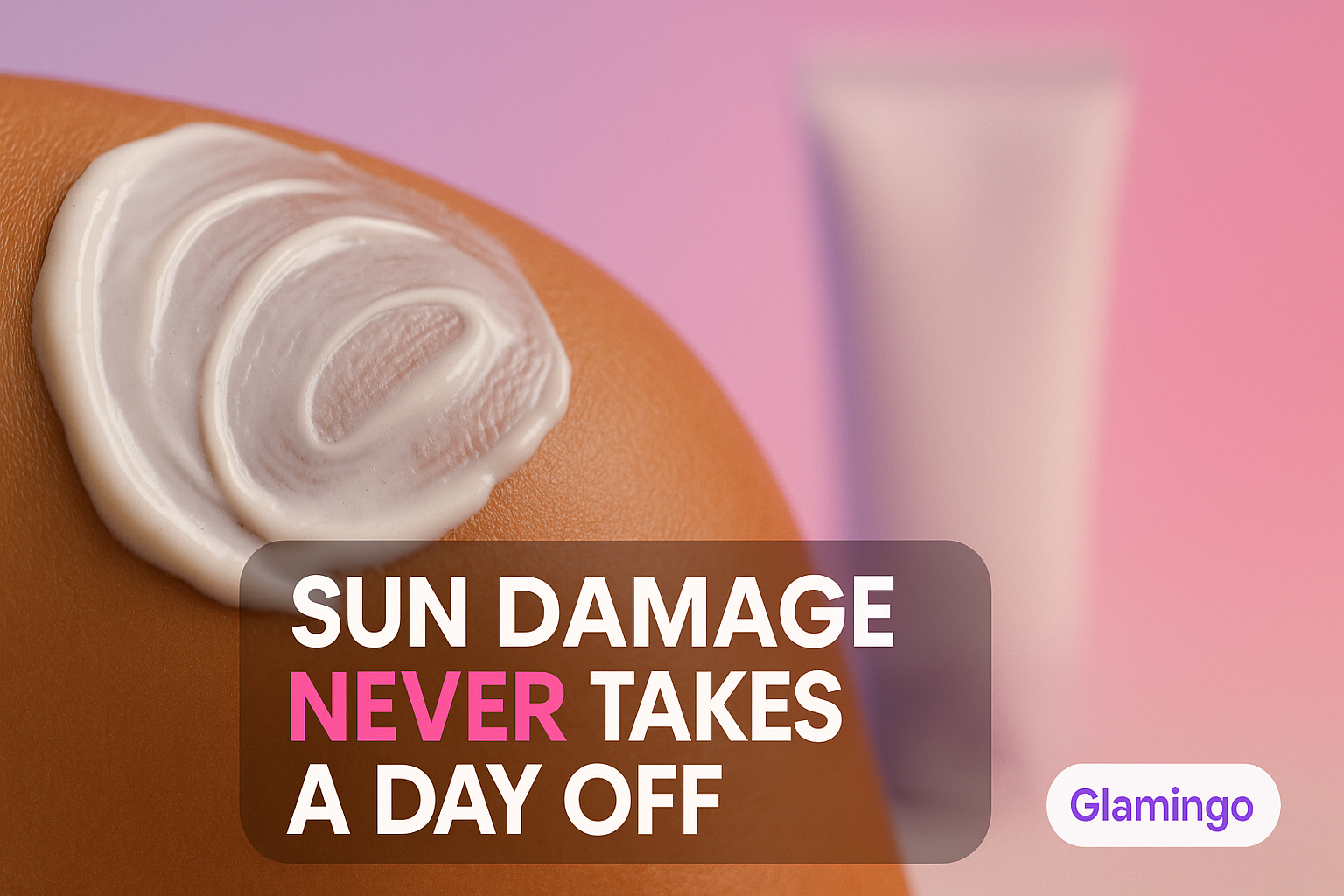
Most women who have a considered face SPF routine will walk out the door every morning with their neck, chest, arms, and hands completely unprotected. The logic feels reasonable: you’re just commuting, running errands, maybe sitting near a window. But UV exposure doesn’t require a beach towel and a holiday playlist to cause real, cumulative skin damage — and the evidence on what that daily unprotected exposure actually costs your skin over time is harder to ignore than most people realise.
Here’s the thing: this isn’t a niche concern for people who sunbathe. It’s for anyone who sits by a window at their desk, drives to work, eats lunch outdoors, or wears short sleeves in Singapore — which is to say, essentially everyone. The body SPF gap is one of the most consistent blind spots in otherwise careful skincare routines, and it’s built on a set of beliefs that feel intuitive but simply don’t hold up.
The myth: body skin doesn’t need daily sun protection unless you’re spending time outdoors
Why this belief feels logical — and where it breaks down
The reasoning goes something like this: sunscreen is for sun exposure, and “real” sun exposure means being outside intentionally — at the beach, the pool, a weekend hike. A fifteen-minute walk to the MRT, or sitting by the window in a meeting room, doesn’t count. You’re not tanning. You’re not burning. Therefore, you’re fine.
The problem is that UV radiation doesn’t operate on your schedule or your intentions. UVA radiation — the wavelength responsible for deep skin ageing and DNA damage — penetrates glass. It doesn’t stop at your office window. It’s present year-round in Singapore regardless of cloud cover, and it doesn’t produce the visible redness that signals “too much sun” in the way UVB does. You can accumulate significant UVA exposure without ever feeling it happening. That’s precisely what makes it dangerous: there’s no real-time feedback.
The belief also rests on a mental model of damage as event-based — the bad sunburn, the beach holiday where you forgot to reapply. But that’s not how photo-ageing or UV-related skin cancer risk actually works.
What ‘incidental exposure’ actually adds up to over a year in Singapore
Think of UV radiation the way you think of noise damage to hearing. You don’t go deaf from one loud concert — you lose hearing gradually from years of cumulative exposure that each felt fine in the moment. Body skin photo-ageing and UV-related skin cancer risk work the same way: it’s not the beach holiday that does the damage alone, it’s the ten thousand unprotected school runs, commutes, and window-seat lunches that quietly stack up.
Singapore’s UV Index sits between 10 and 12 for most of the year. That’s classified as “extreme” on the World Health Organisation scale — the kind of UV intensity that can cause skin damage in under fifteen minutes of unprotected exposure at midday. Now multiply fifteen minutes by every day you commute, every lunch you eat near a window, every errand you run between 10am and 3pm. The forearms that rest on your car door. The chest exposed by your work outfit. The hands that sit on your keyboard beside a sun-facing window. None of it feels like “sun exposure.” All of it is.
The verdict: UV doesn’t distinguish between a beach day and a commute
80–90% of skin cancers are linked to cumulative UV — not single high-dose events
Research establishes that 80–90% of all skin cancers are linked to solar UV radiation exposure — making it the single most important preventable environmental risk factor for skin cancer. That figure isn’t describing people who sunbathe obsessively. It’s describing the cumulative effect of UV on skin over time, across any chronically exposed surface: forearms, hands, décolletage, the back of the neck.
And critically, the highest-quality systematic review-level evidence confirms that sunscreens do prevent skin cancer — the American Academy of Dermatology recommends sunscreen for all skin-exposed individuals, not just people deemed high-risk. This is not a marketing claim. It’s the conclusion of rigorous, independent research.
Photo-ageing on the body is the same biological process as on your face — just less noticed
If you’re already using an antioxidant serum, a retinol, and a broad-spectrum SPF 50 on your face every morning, you’ve already accepted the premise that UV causes visible skin ageing and that it’s worth preventing. Excessive sun exposure is directly associated with accelerated skin ageing and promotion of skin cancers including basal cell carcinoma — and that applies to every UV-exposed skin surface, not just the one you’re staring at in the mirror.
The reason you notice facial ageing before body ageing isn’t because the body is more resilient. It’s because you look at your face every day and your forearms far less often. The biological process is identical: UV generates free radicals that damage skin cells, breaks down collagen, and causes the kind of deep structural change that no topical treatment can fully reverse after the fact. The crepey texture on the upper arms, the uneven tone on the chest, the spotted, thinning skin on the backs of hands — these are the long-term receipts of years of incidental exposure that didn’t feel like sun damage at the time.
The dark skin myth within the myth: ‘I have enough melanin, I don’t need SPF on my body’
What melanin actually does (and doesn’t) protect against
This particular belief is worth addressing directly, because in a multicultural city like Singapore — where a significant proportion of the population has Fitzpatrick III–V skin tones — it circulates constantly and causes real harm.
Melanin does provide some natural UV protection. This is true. Darker skin has a naturally higher SPF equivalent — estimates typically range from SPF 2 to SPF 4 for deeply melanated skin. That sounds meaningful until you compare it to Singapore’s daily UV Index of 10–12 and realise that SPF 4 is not even in the same conversation as adequate protection. Melanin delays the visible surface damage; it does not prevent the deeper cellular and DNA damage that UV causes over time.
Why post-inflammatory hyperpigmentation risk and skin cancer risk both remain real across Fitzpatrick III–V skin tones
Clinical evidence directly contradicts the myth that sunscreen is only necessary for fair-skinned individuals — UV exposure is identified as a leading modifiable risk factor for skin cancer and photo-ageing across all skin tones. What does differ is the pattern of damage. Darker skin tones are more prone to post-inflammatory hyperpigmentation — the dark marks left behind after skin trauma or irritation — and UV exposure makes this significantly worse by stimulating additional melanin production in already-affected areas. If you’re dealing with uneven body skin tone, dark patches on your chest or inner arms, or pigmentation that never quite fades after a blemish, unprotected UV exposure is actively working against you every single day.
The idea that darker skin is self-protecting enough to skip SPF is not a scientific position. It’s a gap in awareness that the beauty industry has historically done a poor job of addressing — partly because sun protection marketing has been so visually coded to fair-skinned consumers that many women with deeper skin tones never saw themselves in the conversation. That framing is a marketing failure, not a medical fact.
The SPF compensation trap: why applying sunscreen and then staying out longer cancels the benefit
The psychology of false protection and what it means for reapplication habits
Here’s a subtler problem that affects people who do apply body sunscreen. Research shows that people prolong their sun exposure after applying higher SPF sunscreen, incorrectly believing they are sufficiently protected — a behavioural compensation effect that reduces real-world protection in practice.
The logic, unconsciously, goes: I’ve applied SPF 50, therefore I’m protected, therefore I can stay out longer without worrying. But sunscreen degrades with UV exposure, sweat, and physical contact. Reapplication every two hours is the clinical recommendation for a reason — and most people apply once and consider the job done. The SPF number on the bottle describes protection under controlled laboratory conditions with precise application amounts. It does not describe the protection you actually get when you applied a thin layer, sweated through your commute, and never reapplied. Higher SPF numbers can paradoxically create more risk if they generate enough confidence to change behaviour.
The vitamin D defence: does skipping body sunscreen actually help your levels?
What the evidence actually shows — and why it doesn’t justify unprotected daily exposure
This is probably the most persistent justification for skipping body SPF, and it deserves a straight answer: the science here is genuinely more complicated than either camp admits.
Yes, UVB radiation triggers vitamin D synthesis in the skin. Yes, vitamin D deficiency is a real health concern. And yes, in theory, applying sunscreen reduces the skin’s UVB-driven vitamin D production. These things are all true. But the evidence on sun-derived vitamin D involves genuine benefits and risks that require objective investigation, and does not support unprotected chronic sun exposure as a reliable or necessary strategy for maintaining adequate vitamin D levels.
A few things worth knowing: vitamin D synthesis reaches a saturation point relatively quickly with sun exposure and doesn’t increase proportionally with more time outdoors. Dietary sources and supplementation are effective alternatives that don’t come with cumulative UV damage. And in Singapore, where people are outdoors regularly — even briefly — the incidental UVB exposure that gets through routine activity is likely more than many people realise. The vitamin D argument is real in some contexts. As a justification for leaving your arms and chest unprotected during daily life in a country with extreme year-round UV, it doesn’t hold up.
What about UV filter safety concerns — do they change the calculus?
Organic vs physical UV filters for body use: what to know without overcorrecting
The concern about sunscreen ingredients — particularly the class known as organic UV filters (sometimes called chemical filters, which absorb UV radiation and convert it to heat) versus physical UV filters like zinc oxide and titanium dioxide (which reflect and scatter UV) — is legitimate enough to address honestly.
Recent studies report concerns about organic UV filters, including allergic reactions and potential endocrine disruption. This is real. Some organic filters have been detected in bloodstream and breast milk samples after topical application. The endocrine disruption research is worth watching. But — and this is important — the human clinical evidence on actual harm from topical UV filter use remains inconclusive. The studies raise questions that deserve further research. They do not establish that using a sunscreen with avobenzone or octocrylene is causing you measurable hormonal harm right now.
The appropriate response to this uncertainty is not to skip body sun protection. It’s to make an informed filter choice. Physical UV filters — zinc oxide and titanium dioxide — do not have the same systemic absorption concerns and are a sound alternative if you want to sidestep the organic filter debate entirely. For body use specifically, newer formulations of physical filters have come a long way from the thick, white-cast textures that made them impractical on larger body areas. If the ingredient concern feels real to you, look for a physical filter body SPF and the calculus changes without the trade-off.
The real barrier to body sun protection — and what actually works
Texture, format, and coverage: why body SPF compliance fails and how to fix it
Most people who intellectually accept that they should be applying body SPF still don’t do it consistently. And the reason is almost never lack of information — it’s the actual experience of applying sunscreen to a larger surface area before getting dressed in the morning. It’s sticky. It takes time to absorb. It pills under clothing. It smells like a hotel pool. It leaves white cast on darker skin. These are not vanity complaints. They are legitimate friction points that have been largely ignored by a sun care industry that has historically focused on beach and holiday formats rather than daily urban use.
A few things genuinely help. Spray and mist formats reduce the tactile barrier significantly and cover larger areas faster. Fluid or water-based body SPF formulas absorb quickly in humid climates and don’t create the suffocating feel of traditional sunscreen textures. UV-protective clothing — the Uniqlo UV-cut options that many people already gravitate toward — provides genuine protection for covered areas and is a practical complement to topical SPF, not a replacement for exposed skin. Building application into a specific existing habit (directly after body moisturiser, before getting dressed) rather than treating it as an add-on step also makes a measurable difference to consistency. The goal is not perfection. It’s closing the most significant exposure gaps with the least friction.
The verdict, plainly stated
The belief that body skin doesn’t need daily sun protection unless you’re at the beach is not a cautious, sensible position. It’s a gap — in awareness, in habit, and in how the beauty industry has historically marketed sun protection — that has real, cumulative consequences for skin health and skin quality. UV is responsible for 80–90% of skin cancers. It accelerates ageing in every skin surface it reaches. It doesn’t take a beach day to accumulate damage — it takes years of ordinary life in a country with extreme UV exposure and no off-season. The face-only SPF routine, for all its good intentions, is half a strategy.
This week, identify the one body area that gets consistent incidental UV exposure in your daily life — forearms during your commute, chest in your work outfit, hands at your desk near a window — and start applying your existing facial SPF there for five days. You are not building a new routine from scratch; you are closing one specific gap with a product you already own and trust.
If you’re ready to go further and explore professional body skin treatments that address existing UV-related pigmentation or texture concerns, Glamingo has a range of verified body treatment providers across Singapore with honest reviews from people who’ve actually been. Browse body skin treatments near you →
Leave a Reply