
You’ve seen it everywhere — salons in Singapore promising ‘sculpted results’ from a handheld device that just rolls over your skin. And you’re wondering whether there’s any real science behind it, or whether you’re paying for glorified heat. The scepticism is fair. The specific concern that comes up most often isn’t whether RF does anything — it’s whether the claim that ‘a massage mixed with an RF machine will eliminate fat cells’ is real mechanism or sales pitch. Here’s what the science actually tells you.
If you’ve been comparing treatment menus across a few clinics and finding that every single one promises dramatic contouring with zero downtime, you already know something doesn’t quite add up. The marketing is consistent. The explanations are not. What’s worth understanding before you commit to a course of sessions — or decide it isn’t worth it — is the mechanism itself. Because once you understand what RF energy is physically doing to tissue, you can read any clinic claim and tell immediately whether it makes sense.
What RF energy actually is — and why ‘radio’ doesn’t mean it’s broadcasting anything
The physics of controlled heat: how electromagnetic waves warm tissue from the inside out
Radiofrequency energy sits on the electromagnetic spectrum — the same spectrum as the radio waves in your car, the microwaves in your kitchen, and the visible light from your phone screen. What makes RF energy useful for body contouring isn’t the ‘radio’ part. It’s the frequency range, which is tuned to interact specifically with water molecules in tissue. When RF waves penetrate the skin layers, they cause water molecules within the dermis and subcutaneous tissue to vibrate, and that vibration generates heat in the target layer. The surface doesn’t burn. The heat builds where it’s needed.
Think of it like a microwave set to low power, aimed precisely at a layer beneath the surface. The outer surface — your skin — stays comfortable because the energy passes through it and converts to heat only at the deeper target layer. Just as a microwave heats food from the inside without burning the container, RF energy warms fat cells and the collagen scaffold under your skin without damaging the surface. The crucial difference from a microwave: the temperature is controlled carefully enough to trigger your body’s own repair response — collagen tightening and gradual fat cell clearance — rather than simply cooking the tissue.
Why the skin surface stays intact while deeper layers heat up
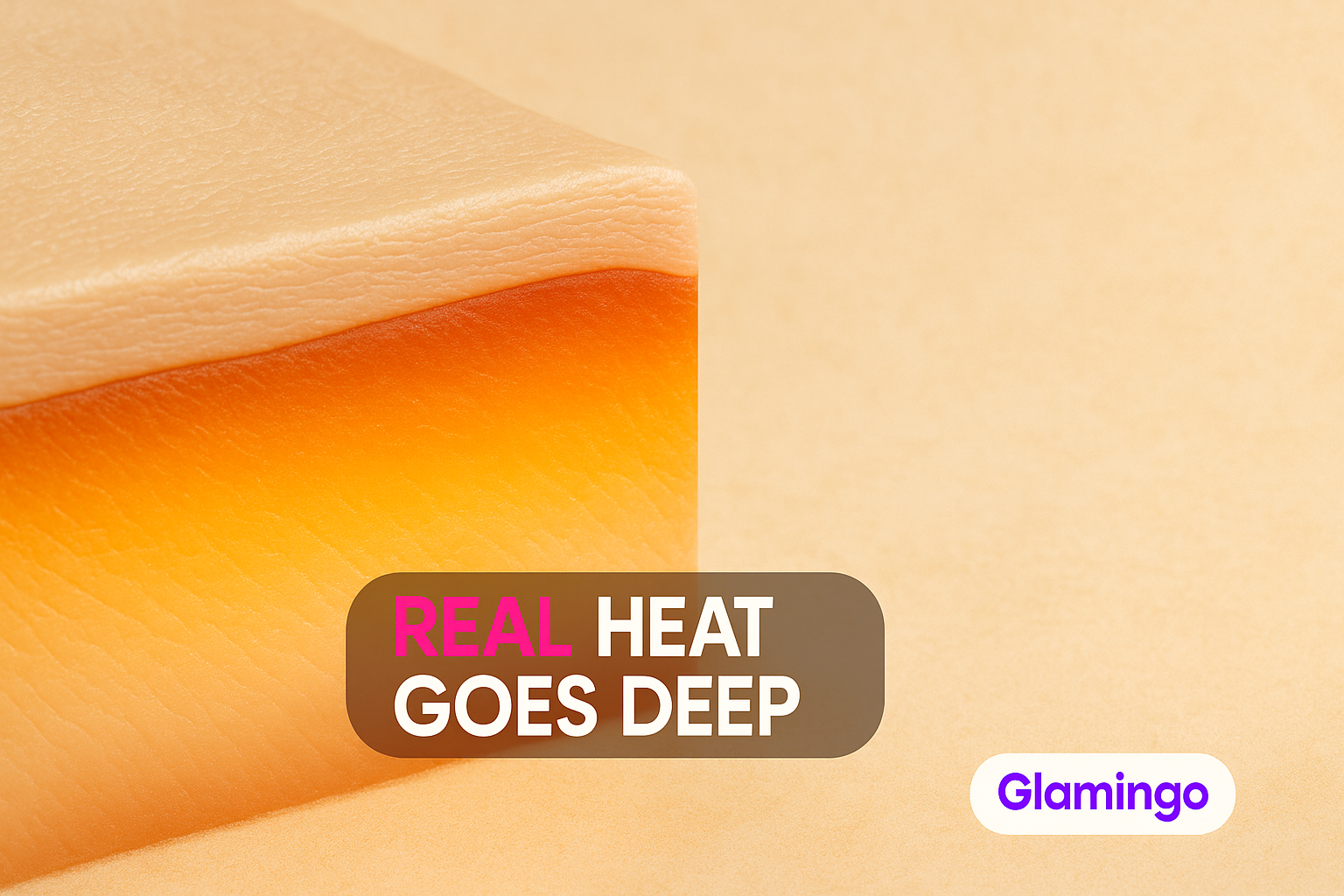
This is the part that makes RF genuinely different from, say, a heat lamp. The electromagnetic waves are calibrated to pass through the epidermis (the outermost skin layer) with minimal energy conversion, then deposit their energy as heat once they reach the dermis and the subcutaneous fat layer beneath it. The result is a non-invasive treatment that targets the deepest layers of the skin using controlled RF energy to generate heat — without incisions or downtime. The skin surface acts more like a conductor than a target. What you feel during treatment is warmth, not burning, because the surface tissue itself isn’t where the energy is landing.
The two mechanisms at work: fat reduction and skin tightening
How fat cells respond to heat — and why the body clears them over days, not during the session
Fat cells — the technical term is adipocytes — are vulnerable to heat in a way that your skin cells and surrounding tissue are not. When the RF energy raises the temperature of the subcutaneous fat layer to a sufficient threshold, the fat cells are damaged. They don’t vaporise on the table. The proposed pathway is that damaged fat cells are then cleared by the body’s lymphatic system gradually — over days and weeks following treatment. This is meaningfully different from what fat freezing (cryolipolysis) does, which triggers fat cell death through cold rather than heat. The endpoint is similar in concept — damaged cells, lymphatic clearance — but the mechanism and the sensation are different.
This is also why the claim that a device ‘eliminates fat cells during your session’ is worth scrutinising. The session creates the thermal damage. The clearance happens after you leave. You won’t walk out looking measurably different. That’s not a sign the treatment didn’t work — it’s how the biology works.
How heat triggers collagen contraction immediately, then new collagen over weeks
The skin-tightening effect operates through a different pathway, though it starts with the same mechanism: heat. When RF energy warms the dermis, it does two things in sequence. First, existing collagen fibres — which have a spring-like structure — contract immediately in response to heat. This is what gives you that subtle tightened sensation right after a session. Second, the heat triggers longer-term new collagen and elastin production, which is the mechanism behind why skin-tightening results continue to develop after the session ends. Your body interprets the controlled thermal injury as a signal to repair and remodel — and that remodelling takes weeks, not hours.
Elastin, the protein that gives skin its bounce-back quality, is part of this remodelling response too. Lose elastin — through sun damage, ageing, or significant weight fluctuation — and skin stops snapping back. RF-stimulated collagen and elastin synthesis is how the treatment addresses that. It’s not magic. It’s wound-healing biology, triggered on purpose.
Why results keep developing after your last session ends
Collagen remodelling — the technical term for the process of breaking down old collagen and replacing it with new, better-organised fibres — takes roughly six to twelve weeks for meaningful changes to be visible. This means the most significant results from an RF course often appear a month or two after your final session, not the week after. If a clinic tells you you’ll see dramatic results immediately, that’s either describing the temporary flushing and firmness from heat (real, but minor) or it’s overselling the timeline. Results that develop over time aren’t a weakness of the treatment. They’re evidence that the biology is actually doing something.
Device types and why depth of penetration changes everything
Monopolar vs bipolar vs multipolar RF — what the difference means for how deep the energy travels
RF energy must reach the subcutaneous fat layer — the layer of fat sitting just beneath the dermis — to have any fat-reduction effect. Surface-level heating addresses skin tightening, not fat. This is why the device type matters enormously, and why ‘RF machine’ as a category tells you almost nothing useful about what a treatment will actually do.
Monopolar RF uses a single electrode on the handpiece with a grounding pad placed elsewhere on the body. This configuration drives the current deeper, making monopolar devices better suited for fat layer targeting. Bipolar RF runs current between two electrodes on the same handpiece, which means the energy travels a shallower path — typically through the dermis only. That makes bipolar more appropriate for skin tightening and surface-level collagen work, but less effective for subcutaneous fat. Multipolar devices use multiple electrodes and can be tuned to hit various depths, offering more versatility. None of these is universally better — they’re suited for different goals. The question is whether the device your clinic is using matches the outcome you’re expecting.
Microneedling RF: bypassing the skin surface entirely to remodel deeper tissue
Microneedling RF combines RF energy delivery through microneedles, allowing the energy to bypass the epidermis entirely and remodel deeper tissue layers in areas like the abdomen and thighs. Instead of energy having to travel through the skin surface, the needles create direct channels into the dermis, depositing RF heat precisely at the depth where the needles sit. The result is more targeted dermal remodelling — and because the epidermis is largely bypassed, there’s less thermal load on the surface. This is a more intensive treatment with slightly more downtime than surface RF, but the depth of remodelling is genuinely different. If a clinic offers this as a separate option and can explain why it suits your concern, that’s a good sign they understand what they’re doing.
What RF body contouring is genuinely suited for — and what it isn’t
Cellulite appearance, loose skin, and stubborn fat pockets — where the evidence is strongest
RF body contouring is clinically positioned for improving the appearance of cellulite and tightening loose skin — it is described as a non-surgical cosmetic procedure, not a weight-loss intervention. The evidence base for cellulite appearance improvement is more consistent than for volumetric fat loss — partly because cellulite involves the dermal structure and fibrous bands as much as fat cells, and RF’s collagen-remodelling effect directly addresses that. For loose skin following weight loss or pregnancy, the collagen stimulation pathway gives it a credible mechanism. For stubborn subcutaneous fat — the layer of fat sitting just beneath the skin that resists diet and exercise — there’s moderate evidence for gradual reduction, though the effect size is smaller than surgical options.
Why this is not a weight-loss treatment and who gets the most visible results
RF body contouring does not burn significant calories. It does not address visceral fat — the metabolically active fat stored deep around your organs. What it targets is the subcutaneous layer, which is why results are most visible on people who are already close to their goal body composition and dealing with specific textural concerns or localised pockets that haven’t responded to lifestyle changes. If you’re hoping to use RF treatment as a substitute for addressing diet and activity, the results will be underwhelming. If you’re using it to refine and tighten after doing the lifestyle work, the mechanism is actually well-matched to that goal.
What to expect: sessions, timeline, and how to read clinic claims honestly
Why a single session is unlikely to show much — and how many sessions the evidence points to
Collagen remodelling is a cumulative process. One session creates one wave of thermal stimulus. The response builds with repeated sessions, which is why most protocols recommend a course — typically six to eight sessions, often spaced one to two weeks apart — before assessing results. You should expect to see meaningful changes around four to six weeks after completing a course, not after session one. Some clinics offer single-session ‘trials’ at a lower price point. These are fine for understanding the sensation and whether you tolerate the treatment well. They are not a reliable indicator of what a full course would do.
Industry-sourced claims that ‘over 90% of people are happy with their results’ come from device manufacturer-aligned sources, not independent peer-reviewed trials — and that funding conflict is worth noting when you’re evaluating how to weight that number. Independent studies on RF body contouring do show real effects, particularly for skin tightening and cellulite improvement. The effect sizes are more modest than manufacturer claims tend to suggest.
Red flags in clinic marketing: what to question before you book
A clinic that tells you RF will ‘melt fat’ during the session is describing the mechanism imprecisely at best. A clinic that promises dramatic inch loss after a single session is either overstating results or banking on the fact you won’t come back for a comparison measurement. Claims about ‘eliminating’ fat cells should prompt you to ask: via what pathway, and over what timeline? A clinic that can answer — lymphatic clearance, over days to weeks, not instant — understands what the device is doing. One that can’t is relying on your willingness not to ask.
In Singapore’s aesthetics market, where there’s no shortage of options and clinics range from medical-grade to mall-level, the device question is genuinely useful as a filter. Not every salon will have a medically-trained operator. But any clinic offering RF body contouring should be able to name the device, explain the technology, and give you a realistic session and timeline expectation.
Before booking your next RF body contouring session, ask the clinic one specific question: which device are they using, and what depth does it penetrate to? A clinic that can answer clearly — monopolar for deeper fat targeting, bipolar or multipolar for skin tightening, microneedling RF for deeper dermal remodelling — is demonstrating they understand the mechanism. One that just tells you it ‘melts fat’ without specifying the device type or depth is a signal to look elsewhere.
If you want to compare RF body contouring providers in Singapore with verified treatment details and real client reviews, Glamingo lists clinics by treatment type so you can see exactly what device and protocol each one offers before you commit. Browse RF body contouring providers near you →
Leave a Reply