
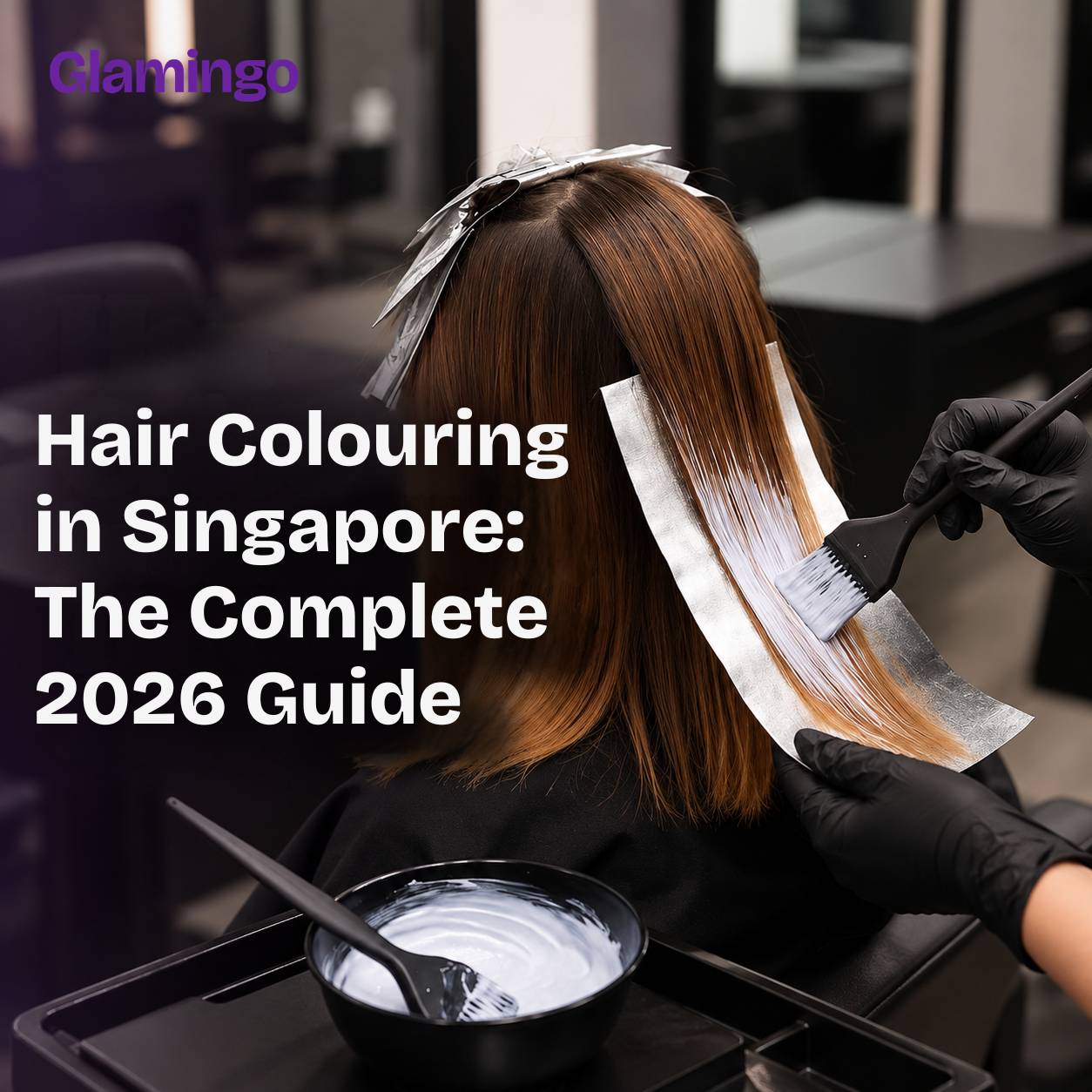
A full-head hair colour in Singapore typically starts around $120 at a salon, takes about two hours, and lasts until your roots grow out, usually four to eight weeks before regrowth shows. Nearly half of salons start at $100 to $150 for short hair, with more for long hair, bleach or fashion shades.
This guide is for anyone staring at a salon menu wondering what “single process”, “ammonia-free”, “toner” and “gloss” actually mean, and which one they need.
We cover the types of hair colour, what happens in the chair, how long each type lasts, what it costs based on real Singapore salon menus, the allergy check nobody should skip, aftercare for our humid climate, and whether a salon is worth it over a box dye.
What Hair Colouring Actually Is
“Hair colour” covers any service that changes the shade of your whole head in one go. Stylists call a single-shade, all-over colour a single process or global colour. It’s the base that most other colour services build on.
Most salon colour is permanent (oxidative) colour. The colourant is mixed with a developer, which opens the hair’s outer layer so the dye molecules can get inside and set. Because the colour sits inside the strand, it doesn’t wash out. It grows out.
There are gentler, shorter-lived options too:
- Semi-permanent colour coats the outside of the hair and fades wash by wash. No developer, so no lightening.
- Demi-permanent colour, glosses and glazes use a low-strength developer. They deepen, tone or add shine, and fade gradually over several weeks.
The Types of Hair Colour (and What They’re For)
Single-tone colour.

One shade, root to tip. This is what most people mean by “colouring my hair”: going a few shades warmer, richer or darker, or covering greys evenly. It’s the most affordable colour service on most menus.
Ammonia-free and “organic” colour.
Ammonia is what gives classic dye its strong smell. Ammonia-free ranges swap it for a milder alkaliser, so they tend to feel and smell gentler on the scalp. Two honest caveats: they usually cost a little more, and “ammonia-free” or “organic” does not mean allergen-free. Many of these ranges still contain the same family of dye ingredients that cause most hair dye allergies (more on that below).
Fashion colours.

Pinks, blues, lilacs, silver, copper and anything else that isn’t a natural shade. On dark hair, bright fashion shades almost always need the hair lightened first, and pastels fade fastest of all.
Bleach (lightening).

Bleach removes pigment rather than adding it. On naturally dark hair, going more than a couple of shades lighter usually means bleach. Expect warm, orange or brassy tones as the hair lifts. That’s normal chemistry, not a mistake, and it’s why bleach is almost always followed by toner.
Toner, gloss and glaze.

A toner corrects the tone after lightening (cancelling brass, cooling to ash, warming to honey). A gloss adds shine and refreshes faded colour. Both are quick and fade over a few weeks, which makes them a handy top-up between bigger appointments.
Highlights and lowlights.

Lightened (or darkened) strands woven through your base colour for dimension, usually with foils. It’s a big enough topic that it has its own guide: read our complete guide to hair highlights in Singapore for babylights, face-framing pieces and upkeep.
Balayage.

Hand-painted lightening that blends softly from the mid-lengths down, so it grows out gently. If that’s the look you’re after, start with your first balayage: what to expect and what to ask for. Torn between the two techniques? Our balayage vs highlights comparison settles it.
Who Hair Colouring Suits (and When to Wait)
Go for it if:
- You want a richer, warmer or darker shade, or even coverage for greys
- Your hair is in reasonable condition and you’re happy to rebook every few months
- You want a noticeable change without the upkeep of bleached, high-contrast looks
Wait, or talk it through first, if:
- You’ve had a reaction to hair dye (or a black henna tattoo) before. See the allergy section below, and speak to a doctor before any further dye.
- You’ve just rebonded or permed. Stacking chemical services on the same hair compounds damage. Most stylists suggest waiting about two weeks after rebonding. Our guide on colouring your hair after rebonding explains the timing and what to tell your colourist.
- Your hair is already fragile or heavily bleached. Ask about bond repair first (see aftercare).
- Your scalp is irritated, broken or sunburnt. Colour on a sore scalp stings and raises the risk of a reaction.
What Happens in the Chair (Step by Step)
For a single-tone colour, block out about two hours. Bleach plus toner, or a full fashion colour, can take three to five hours.
1. Consultation (10 to 15 min). Your colourist looks at your current colour, any old dye or chemical history, and the shade you want. Bring photos. This is where they should tell you honestly if your goal needs bleach or more than one session.
2. Mixing and application (20 to 40 min). The colour is mixed with developer and applied section by section, usually roots first if you have regrowth.
3. Processing (30 to 45 min). The colour develops. Heat may be used to speed it up.
4. Rinse, shampoo and treatment (15 min). An acidic conditioner or treatment helps close the hair’s outer layer and lock in shine.
5. Toner or gloss, if needed (15 to 25 min). Standard after lightening.
6. Blow-dry and styling (20 to 30 min).
How Long Does Hair Colour Last?
Permanent colour stays in the hair until it’s cut off, but your roots keep growing at roughly 1 cm a month. On dark hair, regrowth from a colour close to your natural shade can go unnoticed for two months or more. A bigger contrast, or grey regrowth, shows within four to six weeks.
Semi-permanent colours, glosses and toners fade gradually, typically over a few weeks depending on how often you wash. Bright fashion shades and pastels fade fastest.
Most people alternate between a full colour and a cheaper root touch-up, which recolours only the regrowth. For timing, costs and whether a retouch is enough, read our root touch-up guide. If you colour mainly to cover greys, our grey coverage guide by budget compares the options.
How Much Does Hair Colouring Cost in Singapore?
Across 31 Singapore salon menus in our marketplace research, the typical starting price for a full-head, single-tone colour is about $120, and the biggest group, nearly half, start between $100 and $150 for short hair. About one in three salons start at $50 to $90, and about one in six start at $160 or more. Long hair usually adds $20 to $40 per length step, and ammonia-free colour usually adds $20 to $30. A root touch-up comes in lower, at around $100 typical.
For the full breakdown by salon tier, hair length and add-on, read our hair colour price guide for Singapore.
These are menu starting prices, not quotes, so always confirm the price for your hair length before the colour goes on.
The Patch Test: One Step Not to Skip
Most permanent and many “natural” hair dyes contain para-phenylenediamine (PPD) or related ingredients. It’s what makes dark, long-lasting colour possible, and it’s also the most common cause of hair dye allergy.
Allergy can build up over time, so having coloured your hair safely before doesn’t guarantee you won’t react in future. Dye manufacturers generally advise a skin test about 48 hours before every colour, and many salons offer one if you ask. It’s especially worth it if:
- It’s your first colour, or your first at a new salon or with a new brand
- You’ve had a black henna tattoo (these can contain PPD and sensitise your skin)
- You’ve noticed itching, redness or swelling after a previous colour
If you have ever had swelling, blistering or a strong reaction to hair dye, don’t colour again until you’ve seen a doctor, and seek medical help straight away for swelling around the face or difficulty breathing. A salon patch test is a useful check, but it isn’t a medical diagnosis.
Hair dyes are regulated as cosmetic products in Singapore by the Health Sciences Authority, which covers ingredient and labelling rules for products sold here.
Hair Colour Aftercare in a Humid City
- Wait 48 to 72 hours before your first wash if you can, to give the colour time to settle.
- Switch to a sulphate-free, colour-safe shampoo and wash with cool or lukewarm water.
- Wash less often. Singapore’s heat makes daily washing tempting, but every wash fades colour a little. A dry shampoo helps on in-between days.
- Use heat protection before blow-drying or ironing.
- Protect it from sun and chlorine. A hat outdoors and a rinse after swimming help colour last.
- Tackle brass on lightened hair with a purple or blue shampoo once a week.
- Consider bond repair if you bleach. Olaplex and K18 type treatments rebuild the internal bonds that lightening breaks. Our bond repair guide covers when it’s worth it and what it costs.
Salon vs Box Dye: Is a Salon Worth It?
Box dye can be fine if you’re keeping a shade close to your natural colour, or darkening, and you’re comfortable doing a patch test at home first.
A salon is worth it when you want to go lighter, cover stubborn greys evenly, fix a colour that went wrong, or try anything with bleach or fashion shades. A colourist mixes the formula for your hair, adjusts developer strength, and can see the back of your head. Box dye is a one-size formula, and lightening dark hair at home is the most common route to patchy, brassy results that then cost more to correct.
A common middle path: a salon colour to set the shade, then root touch-ups in between.
Frequently Asked Questions
How much does it cost to colour your hair in Singapore?
Across 31 Singapore salon menus we reviewed, a full-head single-tone colour typically starts at about $120, and nearly half of salons start between $100 and $150 for short hair. About one in three start at $50 to $90. Long hair usually adds $20 to $40 per length step, and ammonia-free colour adds $20 to $30.
How long does hair colour last?
Permanent hair colour stays in the hair until it is cut off, but roots grow about 1 cm a month. Regrowth close to your natural shade can go unnoticed for two months or more, while grey or high-contrast regrowth shows within four to six weeks. Glosses, toners and semi-permanent colours fade gradually over a few weeks.
Is ammonia-free hair colour safer?
Ammonia-free colour tends to feel and smell gentler on the scalp, but it is not allergen-free. Many ammonia-free and organic ranges still contain PPD or related dye ingredients, the most common cause of hair dye allergy. Do a patch test about 48 hours before, and see a doctor if you have reacted before.
Do I need a patch test before colouring my hair?
Yes, it is worth doing one about 48 hours before every colour, as dye manufacturers generally advise. Allergy to PPD can build up over time, so past safe colours are no guarantee. It matters most for a first colour, a new brand, or if you have had a black henna tattoo.
Can I colour my hair after rebonding?
Yes, but most stylists suggest waiting about two weeks after rebonding, and you should tell your colourist that your hair is rebonded. Stacking chemical services on the same hair compounds damage, so bleaching freshly rebonded hair is the riskiest combination. Ask about bond repair if your hair already feels fragile.
Where to Book Hair Colouring in Singapore
The best colour starts with a colourist who asks about your hair history, is honest about what your hair can take, and shows you work they’ve done on hair like yours. Browse salons offering hair colouring on Glamingo by area and price, compare their menus, and request a booking in a few taps.
Want a shortlist near you? Start with our picks for the best hair colour salons at Far East Plaza, and if you’re after grey coverage, see our best grey coverage salons by budget.
Leave a Reply