
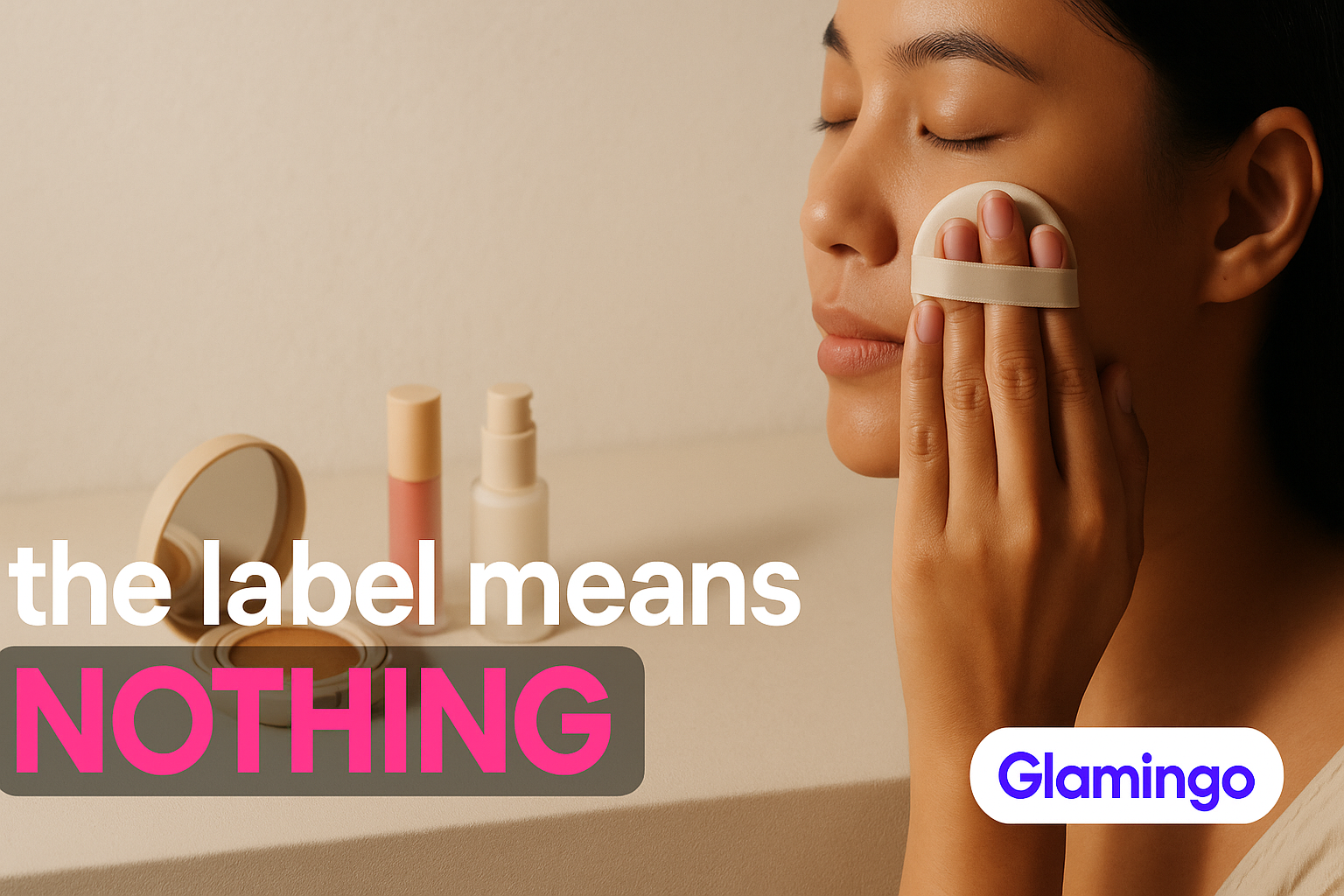
You’ve bought the cushion foundation, the gradient lip, the glass-skin base primer — all marketed as made for skin like yours, optimised by Korean beauty labs, dermatologist-tested. But if you’ve ever broken out from a K-beauty makeup product, watched your dewy base turn patchy by noon in Singapore’s humidity, or quietly noticed the shade range stopping three steps before your actual skin tone, you already know the myth doesn’t hold. K-beauty makeup is not a monolith, and ‘Korean-formulated’ is not a skin-type guarantee.
And yet the halo persists. There’s something deeply compelling about the K-beauty narrative — the 10-step routines, the glass-skin ideals, the sense that Korean beauty labs have cracked some code that Western brands missed. It’s a narrative that sells exceptionally well in Singapore, where K-drama culture runs deep and Sephora shelves dedicate entire bays to the category. The problem isn’t that K-beauty is bad. The problem is that the story being sold about it has quietly outgrown what the products can actually deliver — and for women with deeper skin tones, acne-prone complexions, or skin that simply doesn’t perform like the models in the campaigns, the gap between promise and reality can be quietly frustrating.
The Myth: K-Beauty Makeup Is Made for Skin Like Yours
What ‘Korean-Formulated’ Actually Means — and What It Doesn’t
Think of ‘K-beauty makeup’ like ‘French cuisine’ — a legitimate tradition with real techniques and genuine innovations, but not every dish from Paris suits every palate, and a label saying ‘French-inspired’ on a supermarket ready meal tells you nothing about what’s actually inside. The origin story is real. The halo effect it creates on every product wearing that label is not.
‘Korean-formulated’ is a geographic descriptor, not a clinical one. It tells you where the product was developed and manufactured. It does not tell you whether the formula was tested on diverse skin tones, whether the shade range extends past a certain depth, or whether the texture was designed with tropical humidity in mind. The core principles of K-beauty — layering, hydration focus, a skin-first approach — work across diverse skin profiles and are not exclusive to any one skin type. But ‘the philosophy works broadly’ is a very different claim from ‘every product in this category is right for you.’ One is a legitimate observation about an approach to skincare. The other is marketing doing most of the heavy lifting.
The Shade Range Problem Southeast Asian Buyers Know But Don’t Talk About
Here’s the thing that gets quietly glossed over in K-beauty content aimed at Southeast Asian audiences: the shade ranges were not built with Singapore in mind. K-beauty’s foundational aesthetic was developed around Korean skin ideals — which skew lighter on the Fitzpatrick scale and lean toward a cooler, porcelain finish. For women with Fitzpatrick III skin, this occasionally works. For deeper Malay and Indian complexions that are common in Singapore — Fitzpatrick IV and V — the options frequently run out two or three shades too early, with undertones that pull ashy or pink rather than warm and golden.
This isn’t a conspiracy. It’s a market development pattern. Korean beauty brands built their formulas and shade ranges for their primary domestic market first, then expanded globally without always reformulating. The result is a category that genuinely works beautifully for a specific skin profile and leaves a significant portion of its Southeast Asian buyers quietly making do with a shade that’s close but not quite right. If you’ve ever bought a K-beauty cushion and found it oxidising orange or pulling grey on your skin by midday, this is likely part of what’s happening — and no amount of setting spray will fully fix a shade that wasn’t designed for your undertone in the first place.
The Label Lies: What ‘Dermatologist-Tested’ and ‘Natural’ Actually Mean on a K-Beauty Product
No Regulatory Standard, No Guarantee
‘Dermatologist-tested.’ It sounds authoritative. It sounds like someone in a lab coat reviewed the formula and signed off on it. In reality, these phrases carry no standardised regulatory meaning and do not confirm safety, efficacy, or suitability for sensitive or acne-prone skin. There is no global standard — and no Singapore-specific standard — that defines what ‘dermatologist-tested’ requires. It can mean a single dermatologist applied the product to their own forearm and noted no immediate reaction. It can mean a patch test was conducted on twenty people over 48 hours. It can mean something broader, or it can mean almost nothing at all. The phrase is marketing language dressed in clinical clothing.
The same applies to ‘hypoallergenic’, ‘non-comedogenic’, and ‘gentle formula’ — all of which appear with similar frequency on K-beauty packaging and carry similarly limited regulatory weight. None of these terms are independently verified before a product reaches shelves. You’re trusting the brand’s own testing, which was conducted with the brand’s own interests in mind.
Why ‘Natural Ingredients’ Does Not Mean Gentle or Non-Irritating
K-beauty leans heavily into botanicals — centella asiatica, green tea extract, mugwort, fermented ingredients, rice water. And many of these do have real, well-documented benefits for the skin. But the assumption that natural ingredients are automatically gentle or non-irritating is one of the most persistent myths in beauty, and it does not hold up to scrutiny. The natural-versus-synthetic distinction does not reliably predict product performance or skin compatibility. Poison ivy is natural. Fragrant botanical extracts — lavender, citrus, rose — are among the most common skin sensitisers in cosmetics. Some fermented ingredients can trigger reactions in people with certain sensitivities.
The mechanism that matters is not where an ingredient came from. It’s how your specific skin responds to its molecular structure, concentration, and interaction with everything else in the formula. A product full of botanical extracts can absolutely cause a reaction. A well-formulated synthetic base might be exactly what acne-prone or sensitised skin needs. The natural halo on K-beauty products doesn’t change this.
K-Beauty Makeup Can Break You Out — Here’s the Actual Mechanism
The Real Culprit Is Not the Korean Origin, It’s the Formula and the Removal
If you’ve started using a highly-rated K-beauty foundation or cushion and found yourself waking up with raised bumps or clogged pores a week later, you’re not imagining it — and you’re not alone. What’s worth understanding is that the breakouts are not about Korean cosmetics specifically. Makeup itself does not cause acne — the real contributing factors are improper removal, using pore-clogging ingredients, or not cleansing skin thoroughly after wear. The K-beauty origin is irrelevant. The formula and your removal routine are everything.
The ingredients to watch for are pore-clogging agents — specifically heavy silicones like dimethicone at high concentrations, thick occlusive oils, and certain waxes that sit on the skin surface and trap debris in your pores over time. Glass-skin bases and cushion foundations often use exactly these ingredients to achieve their signature smooth, blurred, luminous finish. That finish is real. The congestion risk it creates for certain skin types is also real, and the two facts coexist.
Cushion Foundations and Glass-Skin Bases in Singapore Humidity: What Happens When You Don’t Double-Cleanse
Singapore’s year-round humidity sits around 80%, and the UV index regularly hits 10 to 12. In that environment, any occlusive makeup formula sits on skin that is already producing more sebum than it would in a temperate climate, mixing with sweat and sunscreen throughout the day. By the time you get home, the product has been on your face for 10 to 12 hours in conditions that accelerate oxidation and encourage congestion.
A single-step micellar wipe will not remove a cushion foundation formulated with silicones and SPF. You need a proper first cleanse with an oil-based or balm cleanser to break down the formula, followed by a water-based cleanser to remove residue — what the K-beauty world itself calls double cleansing. The irony is that K-beauty popularised this method, and then its own makeup products became the category most likely to cause problems when users skipped it. The technique is genuinely good advice. Not everyone marketing K-beauty products leads with it.
The Viral Product Gap: When the Aesthetic Is Better Than the Formula
What Repeat Disappointment with K-Beauty Makeup Actually Signals
There is a particular kind of beauty disappointment that K-beauty generates at scale: the product that looks extraordinary in every review video, arrives in packaging that feels genuinely premium, and then performs mediocrely on your actual face. In 2025, experienced K-beauty consumers have documented significant disappointment with viral products that underdelivered relative to their marketing claims — and the pattern isn’t random. K-beauty marketing operates at a very high aesthetic level. The campaigns are beautiful, the influencer content is compelling, and the packaging is often genuinely lovely to hold. None of that tells you whether the pigment payoff is good, whether the formula lasts past 2pm in Singapore’s heat, or whether the skin-care-makeup hybrid claims actually do anything once it’s on your face.
How to Read a K-Beauty Product Launch Versus How It Performs
A useful habit: notice whether a K-beauty product is being sold on its formula or its concept. ‘Glass skin in a compact’ is a concept. The actual ingredients — their concentrations, the results of third-party testing — are the formula. The concept can be real and the formula can still be ordinary. K-beauty genuinely advocates gradual results over time — which means any K-beauty makeup or hybrid skincare-makeup product promising immediate skin transformation is waving a red flag for misleading marketing rather than a credible product claim. If the launch copy sounds more like a miracle than a cosmetic, trust that instinct.
The Counterfeit Problem No One Talks About When Buying K-Beauty in Singapore
How Fakes Enter the Market and What to Look For
This is the conversation that gets skipped in most K-beauty content, because it’s uncomfortable and nobody selling you product wants to raise it. Counterfeit Korean cosmetics are a genuine and documented problem, circulating particularly through online marketplaces — and Singapore’s enthusiastic appetite for K-beauty, combined with cross-border purchasing via Shopee, Lazada, and various Carousell listings, creates real exposure. Fake Korean cosmetics with misleading packaging and ingredient red flags circulate widely, and spotting them requires checking packaging details and ingredient lists rather than relying on branding alone.
The tell-tale signs are worth knowing. Misspelled Korean text on the packaging. Ingredient lists that don’t match what’s listed on the brand’s official website. Unusually low prices from sellers without verified track records. Missing or poorly printed batch codes. If a cushion refill from a premium Korean brand is selling for $8 on an unofficial listing, the maths don’t work — and putting an unverified formula on your face daily is a meaningful risk, not just a financial one. Buying from authorised stockists — Sephora, Watsons, official brand stores, or the brand’s own direct website — removes this risk almost entirely and is worth the slight price difference.
The Verdict — What K-Beauty Makeup Genuinely Does Well, and Where the Myth Ends
Real Strengths: Texture Innovation, Hybrid Skincare-Makeup Formats, Broad Accessibility
None of this is an argument against K-beauty makeup. It’s an argument against the myth that surrounds it. The category has made genuinely meaningful contributions: cushion foundation technology changed how portable SPF makeup could be; the hybrid skincare-makeup format — products that deliver real skincare actives alongside cosmetic coverage — is a legitimate innovation that several K-beauty brands execute well. The texture research that goes into K-beauty bases is often excellent, and at accessible price points, it’s hard to match. The philosophy of treating makeup as an extension of skincare, not a mask over it, is worth keeping.
What to Stop Assuming Just Because the Packaging Says ‘Korean’
Stop assuming it was formulated for your skin tone. Stop assuming ‘dermatologist-tested’ means anything specific. Stop assuming natural ingredients make it gentle. Stop assuming a product that went viral in Seoul will survive Singapore’s humidity without a proper removal routine. And stop assuming that because K-beauty is associated with good skin outcomes overall, every product in the category will deliver them. The principles underlying K-beauty work across diverse skin profiles — but the individual products vary wildly in quality, formulation, and suitability. The category’s overall reputation does not travel to every item on the shelf.
K-beauty at its best is thoughtful, innovative, and genuinely skin-forward. At its worst, it’s a geographic label on a mediocre formula with a beautiful campaign behind it. The difference is in the ingredient list, not the origin story.
Next time you reach for a K-beauty makeup product — especially a cushion, BB cream, or hybrid skincare-makeup formula — flip it over and read the ingredient list before you buy, not after you break out. If it contains pore-clogging silicones or heavy occlusive oils and you’re acne-prone, the ‘Korean-formulated’ label won’t save your skin. Check the formula first, the origin story second.
If you’d like help navigating which treatments and services actually work for your skin in Singapore’s climate — from professional facial consultations to finding a salon that understands your skin tone and concerns — Glamingo has verified providers across the island with real reviews from women who look like you. Find a facial or skin consultation near you →
Leave a Reply